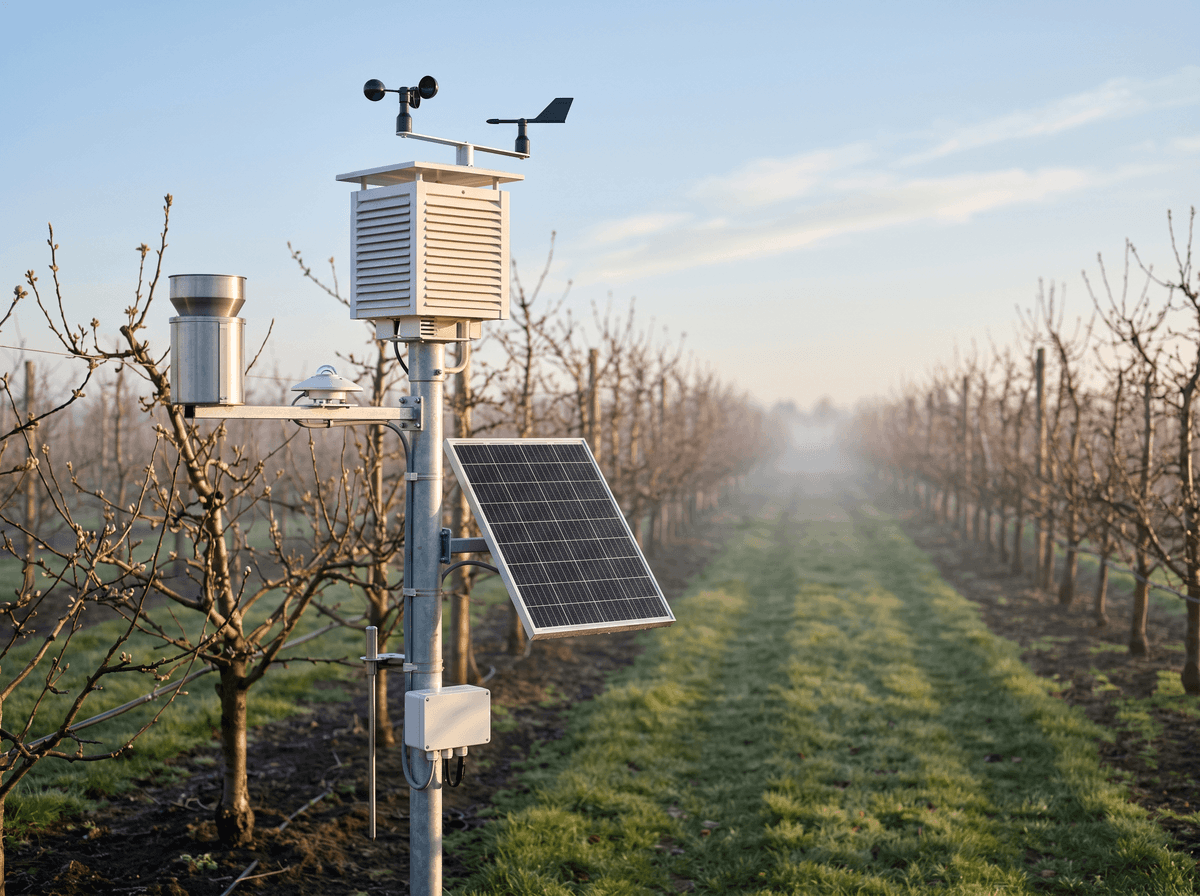
Orchard Frost Early Warning 40ha - LoRaWAN Frost Protection System
Key Features
- Covers up to 40 hectares with 1 LoRaWAN gateway and 10 distributed sensing points
- Provides 10-minute default data reporting, configurable from 1 to 60 minutes
- Includes 1 professional weather station measuring 8 key atmospheric parameters
- Supports staged frost alerts with SMS, email, and app push across 3 notification channels
- Enables wind machine control logic that can reduce unnecessary runtime by 10% to 25%
Orchard Frost Early Warning 40ha is a professional smart agriculture IoT monitoring system for up to 40 hectares, combining 1 professional weather station, 10 soil moisture-temperature sensing points, LoRaWAN communication, solar-powered field nodes, frost alerts, and wind machine control. The system delivers 10-minute data, SMS/email/app alarms, REST API integration, and professional cloud analytics for apple and citrus orchards requiring earlier frost response and lower crop-loss risk.
Description
The Orchard Frost Early Warning 40ha system is a professional-grade smart agriculture IoT platform designed for 40 hectares of orchard coverage with 10 field sensing points, LoRaWAN communication, solar-powered outdoor nodes, and professional cloud monitoring. It combines weather monitoring and soil moisture-temperature monitoring to support apple and citrus frost protection, with 10-minute default data intervals, SMS + Email + App Push alerts, and integrated wind machine control for active frost mitigation.
For orchard operators managing 1 large 40 ha block or 2 to 4 adjacent orchard zones, the system provides earlier frost detection than manual scouting by continuously measuring air temperature, humidity, wind, rainfall, solar radiation, atmospheric pressure, evapotranspiration, and root-zone conditions. In line with WMO weather observation guidance, ISO 11783 agricultural data interoperability, and common IP67/IP68 outdoor protection practice, the architecture is intended for year-round field deployment with low-maintenance solar power and long-range wireless communication. Buyers can also View all Smart Agriculture IoT Monitoring System products or Configure your system online for different hectare ranges and crop profiles.
Why orchard frost monitoring matters
Radiation frost and advective frost events can damage blossoms, shoots, and young fruit within 1 to 3 hours when canopy temperature falls below crop-specific thresholds, and losses in sensitive bloom stages can exceed 20% to 90% in severe events. Apple and citrus orchards often require action when near-surface temperatures approach approximately 0°C to -2.5°C, but the exact response threshold depends on cultivar, phenological stage, humidity, and wind conditions. According to research and technical references from NREL, IEA, and IRENA, digital monitoring and automation improve operational response by converting environmental data into threshold-based actions instead of relying on periodic human checks every 30 to 60 minutes.
Conventional frost management typically depends on 1 handheld thermometer, 1 operator vehicle patrol, and visual checks across 20 to 40 hectares, which can miss microclimate differences of 1°C to 3°C between low spots and elevated rows. By contrast, this system collects synchronized weather and soil data every 10 minutes, and intervals can be configured from 1 to 60 minutes. Compared with manual monitoring, operators generally gain 20 to 40 minutes of additional reaction time, which is often enough to start wind machines, irrigation, or other frost-control measures before critical tissue damage occurs.
System architecture
The standard configuration for this variant includes 1 professional weather station, 10 soil moisture-temperature sensor nodes, 1 LoRaWAN gateway, 1 small solar power subsystem, and 1 professional cloud account. The weather station measures up to 8 core atmospheric parameters: air temperature, relative humidity, wind speed, wind direction, rainfall, solar radiation, atmospheric pressure, and estimated evapotranspiration. The soil nodes monitor 2 parameters at the root zone—volumetric moisture and temperature—with deployment options that can be aligned to 10 cm, 20 cm, 40 cm, and 60 cm depth strategies depending on orchard rooting profile.
LoRaWAN is selected because a single gateway can support 500+ sensors and practical field transmission distances of 10 km or more under favorable line-of-sight conditions. For a 40 ha orchard, that coverage is typically sufficient with 1 gateway, while still leaving capacity for future expansion such as valve controllers, additional frost points, or disease sensors. Data are buffered locally and retransmitted after network recovery, reducing data loss during temporary backhaul interruptions of 5 to 30 minutes.

Core frost-protection functions
The frost warning engine uses a combination of air temperature, dew point trend, wind speed, relative humidity, soil temperature, and time-based temperature decline rate to trigger actionable alarms. Instead of waiting for a single threshold crossing at 0°C, professional users can define multi-stage alerts such as a pre-alert at 2.0°C, a warning at 1.0°C, and an action alert at 0°C or lower. This staged logic helps crews prepare labor, fuel, and equipment 30 to 90 minutes ahead of critical conditions.
Wind machine control is included in this variant for orchards that rely on active inversion-layer mixing. When configured, the platform can issue remote start/stop commands based on threshold logic, operating windows, and manual override rules. For example, a site can be programmed to start wind machines when canopy-adjacent air temperature drops below 1.2°C and wind speed remains under 3 m/s, then stop when temperature recovers above 2.5°C for 15 continuous minutes. This reduces unnecessary runtime, fuel use, and mechanical wear compared with fixed overnight operation.
Weather and soil sensing performance
The professional weather station is intended for decision-grade orchard management rather than hobby-level observation. Continuous readings of wind speed and direction are important because wind machine effectiveness often declines when ambient wind exceeds approximately 4 to 5 m/s, while rainfall and solar radiation support broader orchard management and evapotranspiration tracking. WMO-aligned station design principles emphasize proper siting, shielding, and calibration because even 0.5°C measurement error can alter frost decisions in high-value fruit blocks.
Soil monitoring adds a second layer of frost intelligence because soil moisture and temperature directly influence heat storage and night-time radiative cooling behavior. A wetter root zone can store and release more heat than a dry profile, while dry topsoil may cool faster after sunset. The system’s 10 soil nodes allow managers to compare low-lying rows, mid-slope sections, and exposed boundaries across the 40 ha plot. In many orchards, this reveals microclimate and moisture differences of 5% to 15% volumetric water content and 1°C to 2°C soil temperature variation that are not visible from a single manual reading point.
Cloud monitoring and analytics
The professional cloud tier provides real-time dashboards, historical trend analysis, alarm logs, user permissions, and exportable datasets for agronomy and operations teams. Data are visualized in 10-minute intervals by default, with configurable windows from 1 minute to 60 minutes, and historical analysis can be used to compare multiple frost nights over 30-day, 90-day, or 365-day periods. For engineering teams integrating the system into broader farm software, REST API access is included as standard.
Alert delivery supports 3 channels—SMS, email, and app push—so farm managers, supervisors, and equipment operators can receive the same event within seconds to minutes depending on local telecom conditions. The cloud layer also supports user-defined escalation, such as notifying 1 operator at pre-alert level and 3 recipients at action level. For buyers evaluating digital agriculture platforms, Learn about topic resources can help compare monitoring architectures, communication topologies, and field deployment practices.

Application scenario
A 38-hectare mixed apple and citrus orchard in a semi-arid region deployed a similar architecture with 1 professional weather station, 8 soil probes, 1 LoRaWAN gateway, and automated wind machine signaling before the spring bloom period. During 4 frost-risk nights over 21 days, the operator received pre-alerts 35 to 50 minutes before the historical manual-response point, started wind machines only when inversion conditions were favorable, and reduced unnecessary machine runtime by approximately 18%. The grower also identified 2 colder low-elevation blocks where night temperatures averaged 1.4°C lower than the orchard midpoint, enabling more targeted frost response and improved labor allocation.
Comparison with conventional alternatives
Compared with a conventional setup based on manual thermometers, vehicle patrols, and fixed-time wind machine operation, the Orchard Frost Early Warning 40ha system improves both response speed and operating efficiency. Manual methods often require 2 to 4 labor-hours per frost night and still provide only spot readings, while an IoT system logs data continuously across 10 sensing points. In practice, this can reduce monitoring labor by 60% to 80%, cut unnecessary wind machine runtime by 10% to 25%, and lower the probability of delayed frost response in marginal temperature events.
Compared with short-range Wi-Fi field devices, LoRaWAN generally offers wider area coverage and lower power demand for orchards above 10 hectares. Wi-Fi repeaters may need multiple powered nodes every 100 to 300 meters, while a LoRaWAN gateway can often cover the entire 40 ha orchard from 1 central mast. This reduces trenching, AC power dependency, and maintenance visits, especially in remote blocks where utility access is limited.
Standards, reliability, and data quality
This product line is aligned with practical industry references including ISO 11783 for agricultural information exchange, WMO guidance for meteorological station practice, and IP67/IP68 ingress protection expectations for outdoor sensors. While frost monitoring is highly site-specific, adherence to recognized measurement and communication practices improves data consistency over 12 months of seasonal operation. For buyers with compliance-driven procurement, these references are important because weather and soil data become operational inputs for irrigation control, crop protection, and traceable farm records.
For communication resilience, LoRaWAN supports low-power operation with batteries commonly rated for 5 to 10 years depending on reporting interval and local temperatures. The solar subsystem in this variant is sized for small autonomous loads using an LFP-backed field power kit, supporting maintenance-free operation through variable weather cycles. In normal use, the system tolerates temporary backhaul outages and resumes cloud synchronization automatically, preserving event continuity across frost nights where every 10-minute record matters.
Integration with irrigation and farm systems
Although this variant is optimized for frost warning, it also supports broader orchard management because the same field network can be extended to irrigation valve control, agronomic dashboards, and third-party farm software. The included REST API enables integration with SCADA, FMIS, and custom analytics platforms, while the cloud can export historical records for 12 months or longer depending on subscription policy. If your team is planning expansion beyond frost warning, Learn about topic pages explain sensor layering, ET-based irrigation logic, and gateway planning for larger estates.
For procurement teams standardizing across multiple sites, the 40 ha variant is often used as a modular building block. Two systems can cover approximately 80 hectares, while 3 to 5 systems can be distributed across separate orchard blocks with independent frost baselines. This modularity supports phased CAPEX deployment instead of one large upfront investment, and buyers can Request a custom quotation for multi-site engineering, OEM branding, or alternate alert logic.
Technical specifications
The Orchard Frost Early Warning 40ha configuration is summarized below for engineering review, bidding, and procurement comparison. Standard data interval is 10 minutes, but projects requiring faster frost response can request 1-minute to 5-minute reporting for critical nodes. Hardware warranty is 2 years, and cloud service warranty is 1 year under the standard commercial package.
| Parameter | Value |
|---|---|
| Coverage Area | 40 hectares |
| Monitoring Types | Weather + Soil |
| Weather Level | Professional |
| Soil Type | Moisture + Temperature |
| Total Sensors | 10 sensors |
| Communication | LoRaWAN |
| Power Supply | Small solar power kit with LFP battery |
| Data Interval | 10 min, configurable 1-60 min |
| Cloud Platform | Professional |
| Alert Channels | SMS + Email + App Push |
| API Access | REST API included |
| Frost Alert | Yes |
| Wind Machine Control | Yes |
| Crop Focus | Apple + Citrus |
| Warranty | 2 years hardware, 1 year cloud |
EPC Investment Analysis and Pricing Structure
For B2B buyers, EPC means more than equipment delivery. A turnkey scope typically includes 5 elements: engineering, procurement, construction/installation, commissioning, and warranty support. Engineering covers site layout, mast placement, sensor zoning, and communications planning; procurement covers hardware sourcing and QA; construction covers mounting, wiring, solar power setup, and field installation; commissioning includes calibration, cloud onboarding, and alert testing; and warranty covers 1 year of support under the EPC package. For quotations and project discussion, contact [email protected].
Pricing tiers
| Tier | Scope | Price Range (USD) |
|---|---|---|
| FOB Supply | Equipment only, ex-works China | $1,488 - $2,108 |
| CIF Delivered | Equipment + ocean freight + insurance | $1,552 - $2,199 |
| EPC Turnkey | Installed, commissioned, 1-year warranty | $2,400 - $3,100 |
Volume discounts
| Order Volume | Discount |
|---|---|
| 50+ systems | 5% |
| 100+ systems | 10% |
| 250+ systems | 15% |
From an ROI perspective, frost monitoring economics are usually favorable because a single avoided frost-loss event can protect fruit value far above the system CAPEX. For example, if a 40 ha orchard avoids just 1% yield loss on a crop value of $8,000 per hectare, preserved revenue equals $3,200, already above the lower end of the turnkey EPC range. Additional annual savings can include $300 to $900 in reduced night patrol labor and $200 to $700 in optimized wind machine runtime. Depending on crop value, frost frequency, and labor cost, simple payback is often 1 to 2 seasons, and in high-value orchards it can be less than 12 months.
Compared with conventional alternatives, the cost of manual monitoring may appear lower at first because a handheld thermometer costs under $100, but total seasonal cost rises when labor, missed events, and inefficient machine operation are included. Over 3 years, an IoT system can be economically superior if it prevents even 1 moderate frost incident or reduces frost-night labor by 50+ hours. Payment terms are 30% T/T + 70% against B/L, or 100% L/C at sight; financing is available for projects above $1,000K.
Procurement guidance
This configuration is suitable for orchard owners, EPC contractors, agricultural cooperatives, irrigation integrators, and government modernization programs requiring digital risk reduction over 40 hectares. It is especially relevant where frost events occur 2 to 10 nights per season, where labor availability is limited, or where orchard blocks have measurable topographic variation. Before ordering, buyers should confirm 1 gateway mounting location, 10 sensor positions, local mobile backhaul availability, and the number of wind machines or controlled outputs required.
For technical comparison, buyers should evaluate sensor density, weather station class, cloud retention period, API availability, and support scope rather than comparing only entry price. A low-cost station with 4 parameters may be adequate for basic weather logging, but frost decision support across 40 hectares benefits from professional sensing and multi-point soil context. To match your orchard layout, Configure your system online or Request a custom quotation with block maps, crop type, and frost-control equipment details.
Technical Specifications
| Coverage Area | 40ha |
| Monitoring Types | Weather + Soil |
| Weather Level | Professional |
| Soil Monitoring | Moisture + Temperature |
| Total Sensors | 10pcs |
| Communication | LoRaWAN |
| Power Supply | Small solar power kit with LFP battery |
| Data Interval | 10min |
| Configurable Interval | 1-60min |
| Cloud Platform | Professional |
| Alert Channels | SMS + Email + App Push |
| API Access | REST API included |
| Frost Alert | Yes |
| Wind Machine Control | Yes |
| Warranty | 2 years hardware, 1 year cloud |
Price Breakdown
| Item | Quantity | Unit Price | Subtotal |
|---|---|---|---|
| Professional Weather Station | 1 pcs | $1,200 | $1,200 |
| Soil Moisture & Temperature Sensor Node | 10 pcs | $55 | $550 |
| LoRaWAN Gateway | 1 pcs | $225 | $225 |
| Solar Power Kit (micro 10W) | 1 pcs | $55 | $55 |
| Professional Cloud Platform License | 1 pcs | $48 | $48 |
| Installation & Commissioning | 1 pcs | $500 | $500 |
| Engineering & QC | 1 pcs | $180 | $180 |
| 1-Year Warranty & Support | 1 pcs | $120 | $120 |
| Total Price Range | $2,400 - $3,100 | ||
Frequently Asked Questions
How many hectares and sensor points does this system support?
What frost actions can the system trigger or support?
Is LoRaWAN reliable enough for orchard use?
What is included in the EPC turnkey price and warranty?
What payback period should orchard operators expect?
Certifications & Standards


Data Sources & References
- •NREL digital agriculture and environmental monitoring references
- •IEA technology and energy efficiency outlook references
- •IRENA renewable-powered remote monitoring references
- •WMO Guide to Instruments and Methods of Observation
- •ISO 11783 agricultural electronics communication framework
- •LoRaWAN field deployment benchmarks and vendor technical documentation
Interested in this solution?
Contact us for a customized quote based on your specific requirements.
Contact Us