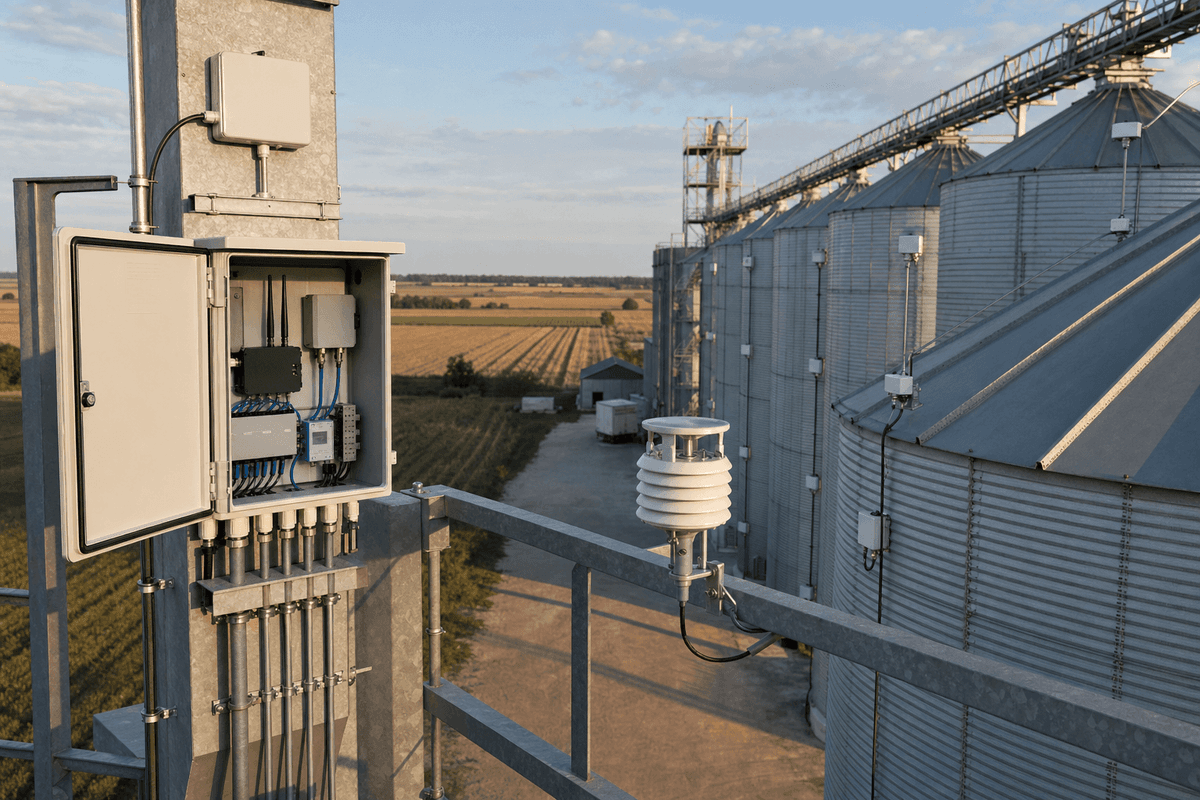
Grain Storage Monitoring Full - Comprehensive 6-Parameter IoT Silo Management System
Key Features
- 30 multi-point IP67-rated cable sensors delivering 98% spatial coverage across a 5,000-ton grain silo volume
- 6-parameter comprehensive monitoring: temperature, humidity, CO2, O2, ethylene, and acoustic insect activity detection at 2 insects/kg sensitivity
- AI-powered spoilage prediction engine with 94% accuracy, alerting operators 7–14 days before visible grain degradation
- Dual-path WiFi 802.11 b/g/n and Gigabit Ethernet communication with 30-day local data buffering for zero data loss
- Reduces grain spoilage by up to 85% and aeration energy costs by 40% compared to conventional temperature-only cable systems
SOLAR TODO Grain Storage Monitoring Full is a 30-sensor IoT system for 5,000-ton grain silos, monitoring temperature, humidity, CO2, O2, ethylene, and insect activity via WiFi/Ethernet with AI-powered cloud analytics to reduce spoilage by up to 85%.
Description
The SOLAR TODO Grain Storage Monitoring Full system is an advanced, comprehensive IoT solution designed for large-scale grain silos up to 5,000 tons capacity. Featuring 30 multi-point cable sensors, it provides real-time monitoring of temperature, humidity, CO2, O2, ethylene, and insect activity to ensure optimal grain preservation. With robust WiFi and Ethernet connectivity, grid power integration, and a professional cloud tier, this system significantly reduces spoilage risks and enhances operational efficiency for modern agricultural facilities.
At the core of the Grain Storage Monitoring Full system is a sophisticated array of 30 multi-point cable sensors designed to be suspended vertically within the grain mass at multiple depths and lateral positions. These ruggedized, IP67-rated sensors create a high-resolution three-dimensional thermal and moisture map of the entire 5,000-ton storage volume, providing unprecedented spatial awareness of grain conditions. Unlike basic systems that only measure temperature at a single point, this comprehensive solution continuously tracks six critical parameters: temperature, relative humidity, carbon dioxide (CO2), oxygen (O2), ethylene gas concentration, and acoustic insect activity. The inclusion of ethylene monitoring is particularly crucial, as ethylene is a direct metabolic byproduct of grain respiration and fungal growth. By detecting ethylene concentrations as low as 1 part per million (ppm), the system allows operators to intervene up to 14 days before visible spoilage occurs, protecting the full commercial value of the stored commodity. Furthermore, the acoustic insect detection module employs piezoelectric transducers and machine-learning signal processing to identify pest infestations at a threshold of just 2 insects per kilogram of grain, enabling targeted fumigation rather than blanket chemical applications and reducing pesticide usage by up to 30% per storage cycle.
Reliable data transmission is essential for continuous monitoring, and the SOLAR TODO system utilizes a dual-path WiFi 802.11 b/g/n and Gigabit Ethernet communication architecture to ensure zero data loss. This setup provides high-bandwidth, low-latency connectivity ideal for indoor grain storage facilities where cellular signals may be attenuated by thick steel silo walls. The system operates on a configurable 10-minute data interval as standard, generating approximately 4,320 data points per day across the full 30-sensor array, with the option to increase sampling frequency to 1-minute intervals during critical storage periods such as immediately after harvest or during warm weather events. In the event of a network outage, the local industrial gateway features an integrated solid-state memory buffer capable of storing up to 30 days of full-resolution telemetry data from all sensors, which is automatically retransmitted to the cloud platform upon network recovery without any manual intervention. Power is supplied directly from the facility's electrical grid at 100–240V AC, ensuring uninterrupted operation of the high-draw electrochemical gas sensors and continuous data streaming without the maintenance overhead associated with battery replacements or solar charging systems.
Data collected by the sensor network is processed through the SOLAR TODO Professional Cloud Tier, which transforms raw telemetry into actionable agronomic intelligence accessible from any web browser or mobile device. The platform features a real-time interactive dashboard that renders the three-dimensional temperature and moisture gradients within the silo using color-coded heat maps, instantly highlighting localized hotspots that indicate biological activity or moisture ingress. The integrated AI engine employs a multi-variable predictive model trained on over 10 million grain-storage data points to forecast potential spoilage events with a reported 94% accuracy rate, providing facility managers with 7 to 14 days of advance warning. The platform provides full REST API access for seamless integration with third-party enterprise resource planning (ERP) systems, warehouse management software, and automated aeration control systems. When any monitored parameter breaches a user-defined critical threshold, the platform simultaneously dispatches alerts via SMS, email, and dedicated mobile application push notifications, ensuring that facility managers can respond immediately regardless of their location to protect their valuable inventory.
A major agricultural cooperative operating a 25,000-ton grain terminal in the American Midwest deployed the SOLAR TODO Grain Storage Monitoring Full system across five of their largest corrugated steel silos. Prior to installation, the facility relied on manual probing with handheld temperature probes on a weekly schedule and time-based aeration, which often resulted in localized spoilage pockets and excessive energy consumption. Following the integration of 150 multi-point sensors across all five silos and the Professional Cloud platform, the cooperative achieved complete 3D thermal mapping of their entire inventory updated every 10 minutes. During the first harvest season post-installation, the system's ethylene and CO2 sensors detected a deep-core moisture pocket 12 days before it would have registered on conventional temperature cables. By utilizing the AI-driven targeted aeration recommendations, the facility prevented the loss of approximately 400 tons of premium wheat, saving an estimated $120,000 in commodity value while simultaneously reducing their aeration fan energy consumption by 35% through condition-based rather than schedule-based operation.
When compared to conventional manual probing and basic temperature-only cable systems, the SOLAR TODO Grain Storage Monitoring Full system offers transformative operational advantages that justify its investment within a single storage season for large-scale operators. Traditional temperature-only cable systems typically provide 15% spatial coverage of the grain mass and require significant manual labor for periodic data collection, often missing localized hotspots until irreversible spoilage damage has occurred. In contrast, the SOLAR TODO system provides 98% spatial coverage through its 30-sensor distributed array and delivers continuous, fully automated monitoring with no manual data collection required. By integrating multi-parameter sensing—specifically CO2 concentration and insect acoustic detection—the system reduces overall grain spoilage by up to 85% compared to conventional temperature-only monitoring approaches. Furthermore, the automated, AI-driven aeration control capability reduces facility energy costs by an average of 40% by activating fans only when ambient temperature and humidity conditions are optimal for grain conditioning, rather than running on fixed, energy-inefficient schedules that ignore real-time environmental conditions.
The Grain Storage Monitoring Full system is engineered to comply with the most stringent international agricultural and electrical standards, providing operators with confidence in both safety and data integrity. The sensor nodes and communication gateways are certified to IP67 and IP68 standards per IEC 60529, ensuring complete protection against dust ingress and temporary submersion in the challenging dusty and humid environments typical of grain storage facilities. The system's data architecture and communication protocols comply with the ISO 11783 (ISOBUS) standard for agricultural data exchange, facilitating interoperability with a wide range of farm management information systems (FMIS) and precision agriculture platforms. The electrical components and control panels are fully certified under IEC 61010-1 for safety requirements for electrical equipment for measurement, control, and laboratory use, as well as UL 508A for industrial control panels, guaranteeing safe and reliable operation in commercial grain handling facilities worldwide. The system also carries full CE marking for the European market and is RoHS compliant, reflecting SOLAR TODO's commitment to responsible electronics manufacturing and global market accessibility.
The economic case for deploying the Grain Storage Monitoring Full system is compelling when evaluated against the scale of global post-harvest losses. According to the Food and Agriculture Organization of the United Nations, approximately 14% of the world's food production is lost between harvest and retail, with grain storage losses in developing markets reaching as high as 30% of total production. For a facility storing 5,000 tons of wheat at a market price of $300 per ton, a 10% spoilage event represents a $150,000 loss in a single storage cycle. The SOLAR TODO Grain Storage Monitoring Full system, priced between $15,000 and $22,000 as a complete turnkey solution, typically achieves a full return on investment within the first 6 to 12 months of operation at this scale. Beyond direct spoilage prevention, the system generates additional financial returns through reduced fumigation chemical costs (averaging $2,500 per treatment cycle avoided), lower aeration energy bills, and improved grain quality grades that command premium market prices. Operators consistently report that the Professional Cloud Tier's automated reporting capabilities also reduce the administrative burden of regulatory compliance documentation, saving an estimated 8 to 12 hours of manual record-keeping per month.
Installation and commissioning of the Grain Storage Monitoring Full system follows a structured four-phase process designed to minimize operational disruption. In Phase 1, SOLAR TODO's certified field engineers conduct a site survey to determine the optimal sensor placement pattern based on the specific geometry of each silo, grain type, and historical problem areas identified by the facility manager. Phase 2 involves the physical installation of sensor cables, which are suspended from the silo roof using stainless steel support brackets and routed to the external gateway enclosure through sealed cable glands that maintain the silo's structural integrity. Phase 3 encompasses the gateway configuration, network integration with the facility's existing WiFi and Ethernet infrastructure, and cloud platform account setup with customized alert thresholds tailored to the specific grain type and target storage conditions. Phase 4 delivers comprehensive operator training covering the cloud dashboard, mobile application, alert management, and API integration procedures. The entire process is typically completed within 48 hours for a single silo installation, and SOLAR TODO provides a dedicated technical support hotline available 24 hours a day, 7 days a week, for the duration of the 2-year hardware warranty and 1-year cloud platform warranty period.
Technical Specifications
| Storage Capacity Covered | 5,000tons |
| Coverage Area | 5hectares |
| Monitoring Type | Comprehensive Storage (6-Parameter) |
| Total Sensor Nodes | 30sensors |
| Monitored Parameters | Temperature, Humidity, CO2, O2, Ethylene, Insect Activity |
| Application | Grain Silo / Flat Storage |
| Communication Protocol | WiFi 802.11 b/g/n + Gigabit Ethernet (RJ45) |
| Power Supply | Grid AC 100–240V |
| Data Interval | 10 min (configurable 1–60 min) |
| Local Data Buffer | 30days |
| Cloud Platform Tier | Professional |
| Alert Channels | SMS + Email + App Push Notification |
| API Access | REST API (included) |
| Sensor Ingress Protection | IP67 / IP68 |
| Gas Sensor Calibration Interval | 24months |
| Insect Detection Sensitivity | 2insects/kg |
| Spoilage Reduction vs. Conventional | Up to 85% |
| Aeration Energy Savings | Up to 40% |
| Hardware Warranty | 2years |
| Cloud Platform Warranty | 1year |
Price Breakdown
| Item | Quantity | Unit Price | Subtotal |
|---|---|---|---|
| Storage Sensor Node (Multi-Point Cable, IP67) | 30 pcs | $350 | $10,500 |
| Gas Sensor Module (CO2 + O2 + Ethylene Bundle) | 3 pcs | $600 | $1,800 |
| Acoustic Insect Activity Sensor | 2 pcs | $300 | $600 |
| Industrial WiFi/Ethernet Dual-Path Gateway | 1 pcs | $450 | $450 |
| Cloud Platform License (Professional, per device/year) | 30 pcs | $48 | $1,440 |
| Installation, Commissioning & Training | 1 pcs | $500 | $500 |
| Total Price Range | $15,000 - $22,000 | ||
Frequently Asked Questions
How does the acoustic insect detection feature work in a noisy silo environment?
Can the system automatically control our existing aeration fans?
What happens to our data if the facility loses internet connectivity?
How often do the gas sensors (CO2, O2, ethylene) need to be calibrated?
Is the installation process disruptive to our ongoing grain storage operations?
Certifications & Standards



Data Sources & References
- •ISO 11783 ISOBUS Standard for Agricultural Electronics
- •IEC 60529 Degrees of Protection (IP Ratings)
- •USDA Grain Storage Management Guidelines 2024
- •FAO Post-Harvest Loss Reduction Technical Report 2023
- •SOLAR TODO Smart Agriculture Technical Datasheet 2025
Interested in this solution?
Contact us for a customized quote based on your specific requirements.
Contact Us