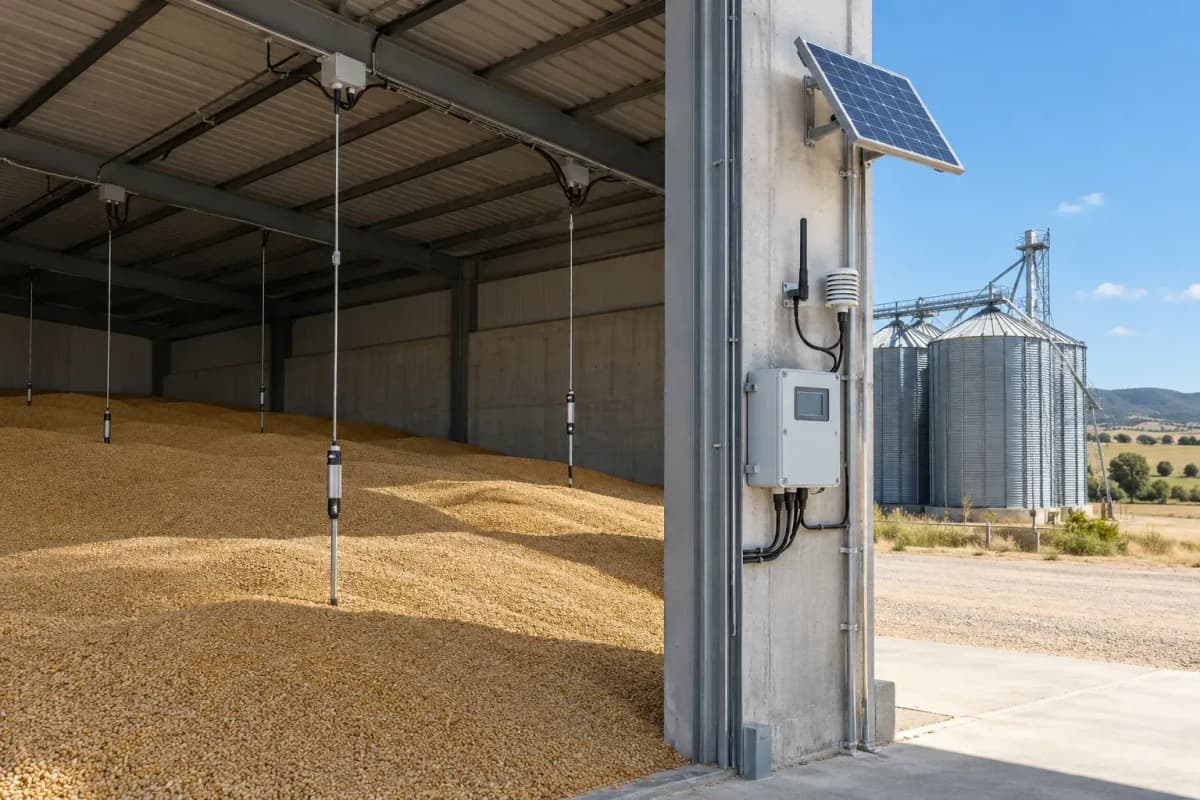
Grain Storage Monitoring 6ha - 12-Sensor 4G Solar Silo IoT System
Key Features
- 6 ha storage-monitoring package for up to 5,000 tons of grain inventory
- 12 sensor points monitor temperature, humidity, CO2, O2, ethylene, and insect activity
- 10-minute default interval produces 1,728 system records per day
- 4G LTE communication with solar medium 80 W class power and LFP battery
- USD 2,052-2,592 EPC turnkey price with commissioning and 1-year warranty
Grain Storage Monitoring 6ha is a 12-sensor, solar-powered 4G monitoring package for up to 5,000 tons of grain silo or warehouse storage, tracking temperature, humidity, CO2, O2, ethylene, and insect activity at 10-minute intervals. The EPC turnkey price range is USD 2,052-2,592 with dashboard, alerts, commissioning, and 1-year cloud warranty included.
Description
Grain Storage Monitoring 6ha is a smart agriculture IoT package for 6 hectares of grain-storage operations or a 5,000-ton silo/warehouse site, using 12 sensor points, 4G communication, medium solar power, and standard cloud monitoring. The system tracks 6 storage-risk parameters: temperature, humidity, CO2, O2, ethylene, and insect activity, with a default 10-minute data interval configurable from 1 to 60 minutes.
SOLARTODO designs this package for B2B operators that need documented grain-condition visibility across 1 storage yard, 1 or more silos, or a warehouse cluster serving a 6 ha farm or aggregation facility. The system is positioned inside the Smart Agriculture IoT Monitoring System product line, and buyers can View all Smart Agriculture IoT Monitoring System products, Configure your system online, or Request a custom quotation for country-specific EPC scope, SIM-card options, and silo cable lengths.
System Architecture
The 6 ha configuration uses 12 measurement points distributed across grain depth, wall-adjacent zones, roof-level headspace, and aeration-risk areas, so the operator can compare at least 4 vertical levels and 3 horizontal positions in a typical silo map. Multi-point monitoring is important because FAO grain-storage guidance notes that cereals have low heat conductivity, meaning localized temperature changes may remain hidden for long periods unless measured at multiple positions; FAO also links higher temperature, moisture, insects, and condensation to quality loss in stored grain FAO storage fundamentals.
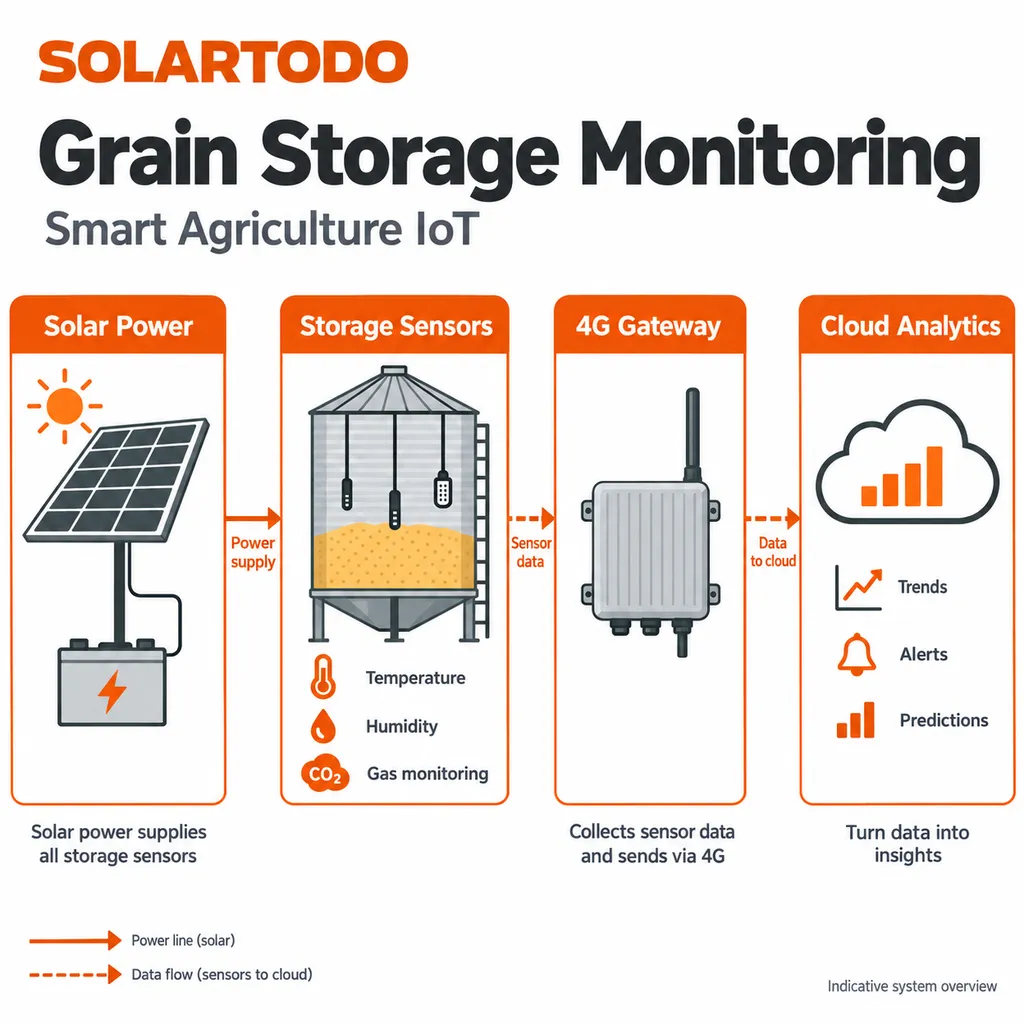
The architecture has 5 functional layers: sensor probes, local acquisition node, 4G gateway, solar-LFP power subsystem, and standard cloud dashboard. The 4G LTE link is selected for higher bandwidth than low-power-only networks, supporting rapid alarm upload, retransmission after network recovery, and optional image or video evidence where a storage site adds camera traps in a later phase.
Each 12-point installation is normally powered by an 80 W class solar kit with an LFP battery sized for maintenance-free outdoor operation under typical agricultural duty cycles. IEA reported that renewable electricity capacity additions reached about 507 GW in 2023 and were almost 50% higher than 2022, while solar PV and wind are expected to dominate new renewable additions; this supports the use of compact solar power for distributed farm IoT loads where grid trenching is uneconomic IEA Renewables 2023.
Technical Specifications
The standard package covers 6 hectares and a nominal 5,000-ton storage capacity, with 12 sensors sampling at 10-minute intervals for 144 readings per sensor per day and 1,728 readings per system per day before event metadata. Data can be configured from 1 to 60 minutes, allowing high-resolution commissioning checks during the first 7 days and lower-bandwidth operation during stable storage periods.
The 6 monitored parameters are selected because stored-grain deterioration normally combines biological activity, moisture migration, oxygen depletion, and localized heating. FAO post-harvest documentation states that fungi and many deterioration agents require moisture, oxygen, and suitable temperature, while insects, mites, and microorganisms can generate heat in stored products; this makes combined temperature, humidity, O2, CO2, and insect-activity monitoring more informative than 1 temperature probe alone FAO post-harvest loss manual.
Environmental enclosures are specified around IP67 or IP68 sensor designs where the final bill of materials requires dust and water protection. IEC 60529 defines the IP Code classification for electrical enclosures up to 72.5 kV, so procurement teams can reference a recognized ingress-protection framework instead of a supplier-only waterproof claim IEC 60529.
The data model is compatible with farm-management integration through REST API fields for timestamp, silo ID, sensor ID, depth, temperature, relative humidity, CO2, O2, ethylene, insect event count, battery voltage, signal strength, and alert state. ISO 11783-1:2017 defines a serial data network for agricultural and forestry machinery communication, and SOLARTODO uses the same principle of structured agricultural data exchange when mapping storage measurements into third-party dashboards or ERP systems ISO 11783-1:2017.
Cloud Monitoring
The standard cloud tier provides a real-time dashboard, trend charts, multi-threshold alarms, sensor-health status, historical export, and SMS, email, and app push alerts. With 12 sensors and 10-minute readings, a procurement manager receives 1,728 daily records, while an engineer can set 3 alarm levels per parameter, such as early warning, maintenance inspection, and urgent aeration or fumigation review.
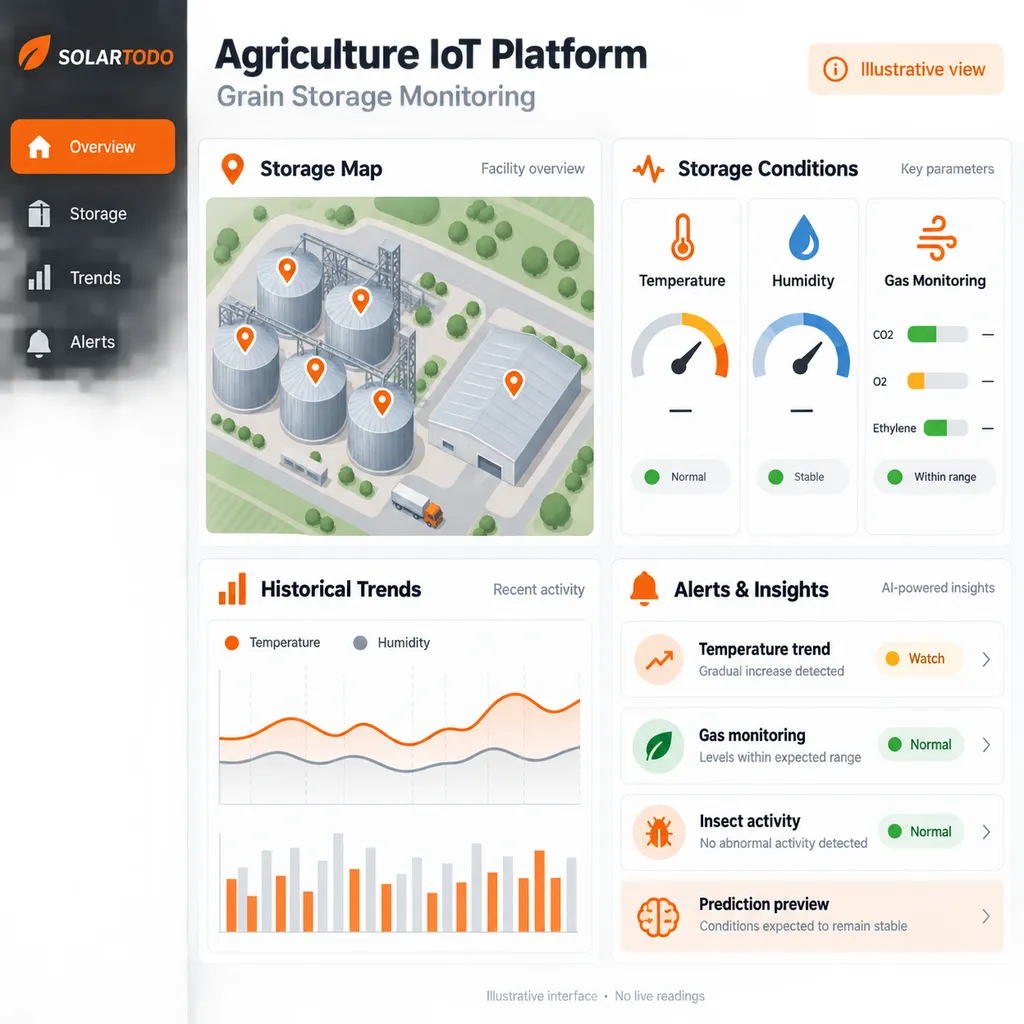
For grain storage, the most useful cloud views are 24-hour change rate, 7-day gradient, 30-day heat-map, and cross-sensor deviation. A 2 °C rise between adjacent depth points, a 5 percentage-point humidity divergence, or a persistent CO2 increase can trigger an inspection before the condition becomes visible at a hatch, reducing reliance on manual sampling rounds that may occur only 1-4 times per week.
WMO guidance is relevant when the project also connects yard weather data, because WMO-No. 8 covers instruments and methods of observation, including automatic weather stations and measurement practice. For storage-only projects, SOLARTODO can still align timestamping, sensor siting notes, and quality-control records with WMO-style observation discipline so the 6 ha storage dataset remains auditable over 12 months WMO Guide No. 8.
Grain Storage Risk Control
A conventional storage inspection program may depend on handheld temperature probes, manual logbooks, and worker judgment, often producing 1 record per inspection point per day or less. This IoT package can produce 1,728 records per day, which is a 100x to 1,000x data-density increase compared with weekly manual logs across 12 positions, depending on the buyer’s previous inspection frequency.
Insects are a primary storage-risk driver, and FAO technical material reports that the optimum temperature for many storage insects is around 30 °C at 75% relative humidity, with development occurring across roughly 17-35 °C. The SOLARTODO platform uses these known biological thresholds to flag 2 combined risks: warm-humid conditions that favor insect growth and localized heat signatures that may indicate insect or microbial activity FAO insect guidance.
Controlled atmosphere and hermetic-storage references also support gas monitoring, because oxygen depletion and CO2 increase can indicate biological activity or intentional atmosphere control. FAO material on controlled atmosphere storage describes O2 levels below 1.2% for complete insect control under defined time and temperature conditions, while other FAO guidance notes that stored insects may be affected as O2 falls toward low single digits; SOLARTODO does not claim fumigation performance, but it gives operators 2 gas channels for decision support FAO fumigation manual.
Ethylene is included as a configurable sensor parameter because some mixed agricultural warehouses handle fruit, seed, or transitional crop materials where ripening gases must be separated from cereal-grain storage decisions. In a pure wheat, maize, or rice silo, ethylene may be disabled or used as a contamination and cross-storage indicator, while CO2, O2, temperature, humidity, and insect activity remain the 5 primary channels.
Representative Scenario
For a representative MENA grain-terminal scenario, assume 5,000 tons of wheat stored across 2 connected silos on a 6 ha logistics yard, with ambient daytime temperatures above 35 °C for 90 summer days and inspection staff visiting each silo 1 time per day. A 12-sensor SOLARTODO system places 8 temperature-humidity cable points inside the grain mass, 2 gas points in headspace/aeration zones, and 2 insect-activity sensors near intake and discharge areas.
In that scenario, the system can compare 10-minute changes against 24-hour and 7-day baselines, so a 2-3 °C localized rise, a 5-10% relative-humidity increase, or abnormal insect counts can generate an SMS and app alert before a weekly quality audit. The result is not a guaranteed loss reduction, because grain type, moisture, fumigation practice, and storage discipline vary, but it gives operators a measurable earlier-warning layer over 12 locations.
Compared with a conventional alternative using 1 handheld probe and paper sheets, the IoT design reduces manual inspection dependence by about 80-90% for routine condition logging while increasing recorded measurement frequency from 7 readings per week to 10,080 readings per week per system. The operator still retains manual sampling for moisture verification, pest identification, and commercial grading, but the automated system prioritizes where those 3 manual checks should occur.
Applications
This 6 ha variant is suitable for grain silos, seed warehouses, feed mills, cooperative collection centers, rural storage parks, and food-security reserve depots with up to 5,000 tons of monitored capacity. It is particularly useful where the asset owner needs 24/7 visibility but does not want to trench grid power or Ethernet to every storage structure.
The same Smart Agriculture IoT platform can expand beyond storage into weather, soil, pest, water-quality, irrigation, and crop-growth monitoring, using the same REST API and cloud account structure. Buyers planning a phased farm digitization roadmap can Learn about topic for background articles and then use Configure your system online to compare storage-only, weather-plus-storage, and full-field packages.
EPC Investment Analysis and Pricing Structure
The EPC turnkey scope includes 5 service blocks: engineering design, procurement, construction and installation, commissioning, and 1-year warranty support. Engineering defines sensor positions and cable routes; procurement supplies probes, gateway, solar power, enclosure, SIM-ready communication hardware, and cloud activation; construction covers mounting, wiring, labeling, and weatherproofing; commissioning validates at least 12 live channels and 3 alert routes.
| Pricing tier | Scope | Price range, USD |
|---|---|---|
| FOB Supply | Equipment only, ex-works China | 1,272-1,763 |
| CIF Delivered | Equipment plus ocean freight and insurance | 1,327-1,839 |
| EPC Turnkey | Installed, commissioned, and 1-year warranty | 2,052-2,592 |
| Volume band | Discount | Typical buyer use case |
|---|---|---|
| 50+ systems | 5% | Regional distributor or cooperative rollout |
| 100+ systems | 10% | National grain-storage modernization program |
| 250+ systems | 15% | Multi-country EPC or government framework |
ROI depends on commodity value, baseline losses, labor cost, and storage discipline, but a simple 5,000-ton example shows the scale. If grain value is USD 220 per ton, the monitored inventory is USD 1.10 million; preventing only 0.25% of quality or quantity loss equals USD 2,750, which is already within the USD 2,052-2,592 EPC investment band before labor savings are counted.
Against manual inspection, assume 1 technician hour per day at USD 8 per hour for 300 storage days, equal to USD 2,400 per year in inspection labor before travel and reporting. If automation reduces routine manual logging by 70%, annual labor savings are USD 1,680; combined with even USD 1,000 of avoided grain downgrade risk, the simple payback can be around 9-12 months for many 5,000-ton commercial storage sites.
Standard payment terms are 30% T/T deposit plus 70% against bill of lading, or 100% irrevocable L/C at sight for approved buyers. Project financing can be discussed for projects above USD 1,000K, and technical-commercial questions can be sent to [email protected] with silo drawings, storage tonnage, country, preferred SIM carrier, and required warranty period.
Standards, Data Governance, and Maintenance
The package is specified with IEC 60529-aligned IP67/IP68 sensor protection, CE/RoHS electrical compliance options, IEC 61215/IEC 61730 references for solar-module procurement where applicable, and ISO 11783-style structured agricultural data mapping. IRENA reports that solar PV module prices have fallen by around 90% since the end of 2009, which is one reason medium 80 W solar kits are now economical for distributed agricultural IoT nodes IRENA power-generation costs.
Data ownership should be defined in the purchase order: the buyer normally owns site data, SOLARTODO hosts the standard cloud workspace for 1 year, and API export allows integration into ERP, warehouse management, insurance reporting, or national food-reserve dashboards. Each record includes a timestamp, channel ID, and alert flag, so a 12-month archive can support trend analysis, inspection scheduling, and after-action review.
Maintenance is normally limited to 4 quarterly tasks: wipe solar modules, inspect cable glands, verify sensor drift against a reference instrument, and test SMS/email/app alarms. For harsh dust, salt, or high-ammonia environments, SOLARTODO recommends a 90-day visual inspection cycle and a 12-month recalibration review for gas sensors, because chemical sensors can age faster than temperature probes.
Procurement Notes
The 6 ha SKU is best purchased with silo dimensions, grain type, maximum fill height, expected storage duration, ventilation equipment details, and target alarm thresholds. These 5 inputs allow SOLARTODO to confirm whether the default 12-sensor package is enough or whether a 16-, 24-, or 32-point map is justified for larger diameter silos or high-value seed lots.
For engineering buyers, the key decision is not whether to collect more data, but where the first 12 sensors produce the highest risk visibility. For procurement buyers, the key decision is whether to buy FOB supply for local installation or EPC turnkey for a single accountability package; SOLARTODO supports both models and can provide datasheets, packing lists, and quotation validity terms through Request a custom quotation.
Technical Specifications
| Coverage Area | 6hectares |
| Monitoring Types | storage |
| Application | grain_silo |
| Storage Capacity | 5000tons |
| Total Sensors | 12sensors |
| Measured Parameters | temperature, humidity, CO2, O2, ethylene, insect activity |
| Communication | 4G LTE |
| Power Supply | solar_medium with LFP battery |
| Solar Power Class | 80W |
| Data Interval | 10 min configurable 1-60 min |
| Cloud Platform | standard |
| Alert Channels | SMS + Email + App Push |
| API Access | REST API included |
| Ingress Protection | IP67/IP68 sensor option |
| Warranty | 2 years hardware, 1 year cloud |
Price Breakdown
| Item | Quantity | Unit Price | Subtotal |
|---|---|---|---|
| Multi-point temperature and humidity cable probes | 8 pcs | $42 | $336 |
| CO2 and O2 gas monitoring modules | 2 pcs | $95 | $190 |
| Ethylene and insect activity monitoring modules | 2 pcs | $85 | $170 |
| 4G gateway with antenna and data logger | 1 pcs | $110 | $110 |
| Solar Power Kit medium 80W with LFP battery | 1 pcs | $225 | $225 |
| Outdoor IP67 enclosure, glands, mounting hardware | 1 pcs | $120 | $120 |
| Standard cloud platform license | 12 pcs | $12 | $144 |
| Signal cabling, labels, and installation accessories | 1 pcs | $155 | $155 |
| Engineering design and QC documentation | 1 pcs | $260 | $260 |
| Installation and commissioning | 1 pcs | $500 | $500 |
| Training, alert setup, and API onboarding | 1 pcs | $185 | $185 |
| 1-Year warranty and support reserve | 1 pcs | $210 | $210 |
| Total Price Range | $2,052 - $2,592 | ||
Frequently Asked Questions
What does the Grain Storage Monitoring 6ha package monitor?
Is the system suitable for remote grain silos without grid power?
What is included in the USD 2,052-2,592 EPC turnkey price?
Can the cloud platform integrate with an existing warehouse or ERP system?
Does this system replace grain sampling and fumigation decisions?
Certifications & Standards



Data Sources & References
- •FAO Manual of the Prevention of Post-Harvest Grain Losses
- •FAO Prevention of Post-Harvest Food Losses manual
- •FAO Mycotoxin Prevention and Control in Foodgrains
- •FAO Manual of Fumigation for Insect Control
- •IEC 60529 IP Code publication
- •ISO 11783-1:2017 agriculture communication standard
- •IEA Renewables 2023
- •IRENA Renewable Power Generation Costs database
- •WMO Guide to Instruments and Methods of Observation No. 8
Interested in this solution?
Contact us for a customized quote based on your specific requirements.
Contact Us