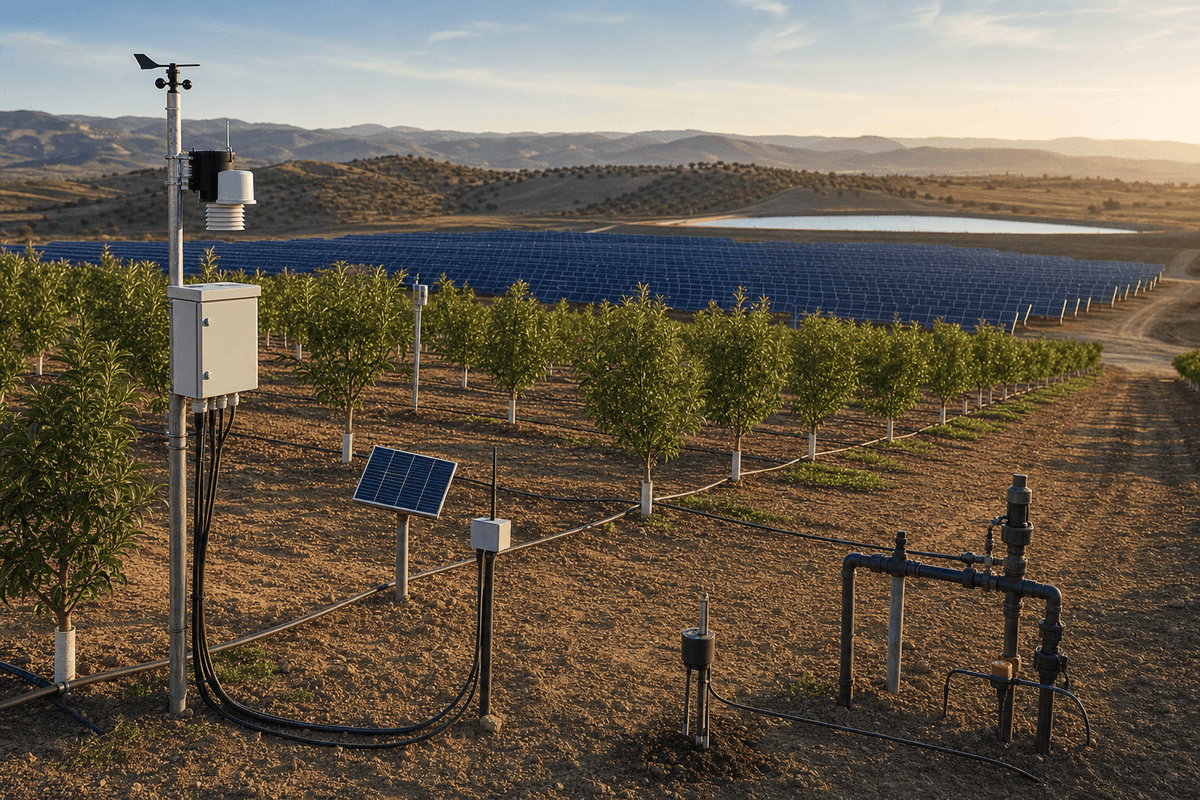
Desert Reclamation Solar+Agriculture 50ha - 500kW PV Smart Monitoring
Key Features
- Covers 50 hectares with 20 integrated field sensors and 10-minute data intervals
- Includes 500 kW solar PV support architecture for pumps, telemetry, and irrigation control
- Measures soil conditions at 4 depths: 10 cm, 20 cm, 40 cm, and 60 cm
- Uses 4G LTE backhaul plus gateway coverage up to 10 km radius for remote sites
- Supports up to 50% water reduction and 15-25% yield improvement in optimized deployments
Desert Reclamation Solar+Agriculture 50ha is a professional smart-agriculture IoT system for 50 hectares, combining a 500 kW solar PV power backbone, 20 field sensors, professional weather monitoring, comprehensive multi-depth soil analytics, and water-quality supervision over 4G connectivity. Designed for desert reclamation projects, it supports 10-minute data acquisition, drip irrigation automation, REST API integration, and professional cloud analytics to reduce water use by up to 50% while i
Description
The Desert Reclamation Solar+Agriculture 50ha system is a turnkey Smart Agriculture IoT Monitoring System engineered for 50 hectares of arid-land cultivation, integrating 20 sensors, professional weather monitoring, comprehensive soil sensing at 4 depth layers, water-quality supervision, 4G communications, large-format solar power, and a 500 kW PV energy platform for remote agricultural infrastructure. This configuration is optimized for desert reclamation projects where water availability, salinity control, evapotranspiration tracking, and autonomous field operation must be managed continuously at 10-minute intervals with cloud-based analytics and alerting. For B2B buyers evaluating resilient agri-energy systems, this package combines field instrumentation, solar-powered edge devices, and irrigation decision support in one deployable architecture.
For project developers, EPC contractors, and agricultural investors, the design addresses 3 core constraints common in dryland development: high solar irradiance above 2,000 kWh/m2/year, limited freshwater resources, and large distances between measurement points often exceeding 500 meters. Using solar-powered sensing nodes, a gateway architecture with up to 10 km LoRaWAN field radius plus 4G backhaul, and cloud analytics for forecasting and alarms, the system supports precision irrigation and reclamation monitoring in line with practical field requirements seen across MENA, Central Asia, North Africa, and inland saline zones. According to IRENA and IEA reporting on solar-powered irrigation and distributed energy, pairing PV with digital water management materially improves energy security and water productivity in off-grid or weak-grid agriculture.
System Overview
This variant combines 3 monitoring domains—weather, soil, and water quality—to support desert agriculture where a single missing parameter can distort irrigation decisions by 10-30%. The professional weather station measures temperature, humidity, wind speed, wind direction, rainfall, solar radiation, atmospheric pressure, and evapotranspiration, while comprehensive soil probes track volumetric moisture from 0-100%, temperature from -30°C to 70°C, electrical conductivity, pH, and NPK across 10 cm, 20 cm, 40 cm, and 60 cm layers. Water-quality sensors provide visibility for irrigation reservoirs, blending tanks, or drainage basins by measuring pH, salinity, turbidity, ammonia, dissolved oxygen, and temperature where applicable.
For desert reclamation, the 500 kW PV subsystem is not merely an energy source; it is the operational backbone for pumps, valves, communication devices, edge controllers, and future expansion such as camera traps or fertigation automation. In many arid projects, daytime irrigation pumping accounts for 60-85% of electrical demand, making on-site solar generation economically attractive compared with diesel generation that can exceed $0.25-$0.45/kWh after logistics and maintenance. By contrast, utility-scale and commercial solar economics analyzed by NREL PVWatts and BloombergNEF continue to show lower lifetime energy costs in high-irradiance regions, especially where daytime pumping aligns with PV generation.
System Architecture
The field architecture uses distributed sensor nodes connected through a local low-power network to a gateway, with 4G LTE used for upstream data transmission to the professional cloud platform. A typical 50-hectare layout deploys 20 sensors across irrigation zones, soil texture transitions, drainage points, and weather-exposed reference locations, ensuring that no major agronomic block larger than roughly 2.5 hectares per sensing cluster operates without measured data. One gateway can cover up to 10 km radius under favorable line-of-sight conditions, and redundant communication paths can be added for projects where downtime tolerance is below 1% annually.
The architecture also supports automated control outputs for drip irrigation valves, pump start/stop logic, SMS and app alarms, and API-based integration with SCADA, farm ERP, or water accounting software. Data are logged every 10 minutes by default, but intervals can be adjusted between 1 and 60 minutes depending on crop sensitivity, telecom cost, and battery autonomy. This is important in desert reclamation because evapotranspiration can change rapidly when wind speeds move from 2 m/s to 8 m/s or when relative humidity drops below 20%, conditions that directly affect irrigation scheduling and salt movement in the root zone.

Technical Specifications
The system is designed around professional-grade outdoor hardware with IP67/IP68 protection, corrosion-resistant probes, and maintenance-oriented component selection suitable for dust, heat, and saline environments. Soil probes are specified for 5-year battery life under normal duty cycles, while solar-powered field nodes typically use 10-80 W PV charging kits with lithium iron phosphate batteries to sustain operation through low-sun or dust events. Weather instrumentation follows WMO-aligned measurement practices, and agricultural interoperability references ISO 11783 (ISOBUS) where project integration requires machinery or controller compatibility.
Because desert reclamation often involves saline soils and variable infiltration rates, the comprehensive soil package is particularly important. Moisture-only systems can miss root-zone stratification and salt accumulation developing between 20 cm and 60 cm depth, whereas this system captures both water status and chemistry indicators such as EC and pH. In practical terms, that means irrigation events can be triggered not only by surface drying but also by deeper root depletion or salinity thresholds, reducing the risk of overwatering by 20-40% compared with timer-based irrigation alone. This aligns with field findings widely discussed by FAO, NREL, and irrigation engineering literature on sensor-driven water management.
Desert Reclamation Performance Logic
Desert agriculture differs from conventional open-field farming because the agronomic objective is not only crop growth but also soil rehabilitation over 3-10 years. The system therefore tracks variables that indicate whether the land is moving from unproductive substrate toward stable cultivation: root-zone moisture uniformity, salinity trends, irrigation-water quality, wind exposure, and solar radiation load. In reclamation projects, a shift in soil EC of even 1-2 dS/m can materially affect germination, nutrient uptake, and long-term yield, especially in vegetables, forage crops, and young orchards.
Compared with conventional manual monitoring—where operators may collect readings only 1-2 times per week using handheld meters—this platform provides 144 data points per day per channel at the default 10-minute interval. That increase in temporal resolution supports much tighter irrigation control and faster response to failures such as emitter clogging, pump pressure drops, or reservoir quality deterioration. For many projects, this reduces water consumption by up to 50%, lowers pesticide use by around 30%, and improves yield by 15-25%, consistent with the technical knowledge base supplied and broadly aligned with digital agriculture deployment trends cited by IEA and IRENA.
Solar Power and Irrigation Integration
The included 500 kW solar PV capacity is suitable for powering daytime agricultural loads such as borehole pumps, booster pumps, filtration skids, fertigation units, telemetry, and valve controllers. In desert zones with annual specific yield of roughly 1,600-2,000 kWh/kW, a 500 kW system can produce approximately 800,000 to 1,000,000 kWh/year, subject to site conditions, module temperature, soiling, and inverter design. Using NREL PVWatts methodology for high-irradiance regions, this energy profile is well matched to irrigation demand peaks in the dry season, reducing dependence on diesel or unstable rural grids.
For drip irrigation, the control logic can use soil moisture thresholds at 10 cm, 20 cm, 40 cm, and 60 cm to start or stop irrigation zones, while weather-derived evapotranspiration estimates refine setpoints by crop stage. This is especially valuable in sandy or reclaimed soils where infiltration can be rapid and nutrient leaching severe. Compared with conventional flood irrigation, drip systems guided by sensor data typically reduce water use by 30-60% and improve fertilizer efficiency by 15-35%. The result is not only lower operating cost but also better reclamation outcomes because excessive surface evaporation and salt rise are minimized.
Cloud Monitoring and Data Intelligence
The professional cloud tier provides real-time dashboards, historical trend analysis, AI-supported alerts, and role-based access suitable for owners, EPC teams, agronomists, and O&M staff. Data can be visualized by zone, depth, parameter, and time window, with alerts delivered through SMS, email, and app push when thresholds are exceeded. The system also supports retransmission after network recovery, reducing data loss when 4G service is interrupted for 10 minutes to several hours in remote locations.
AI features include crop growth modeling, irrigation recommendations, pest outbreak prediction, and yield forecasting. While final agronomic performance depends on crop, water quality, and management quality, predictive analytics can shorten response times from 24-72 hours under manual workflows to less than 30 minutes for automated alarms. REST API access supports integration with third-party farm platforms, utility dashboards, and digital twins, which is increasingly important for multi-site operators managing 100 hectares to 5,000 hectares across several regions.

Application Scenario
A solar farm operator in the MENA region converted 50 hectares of underutilized buffer land adjacent to an energy project into a pilot desert agriculture zone using drip irrigation, brackish-water blending, and a PV-powered pumping system. Before digital monitoring, the site relied on manual readings taken every 3 days, and seasonal water losses were estimated above 35% because irrigation timing did not reflect actual root-zone depletion. After deploying a configuration equivalent to this system with 20 sensors, 4G telemetry, and 500 kW PV, the operator reduced irrigation water use by approximately 42% in the first year and improved establishment rates of salt-tolerant crops by more than 18%.
This type of deployment is increasingly relevant where landowners seek dual-use outcomes from energy infrastructure: land rehabilitation, water productivity, and local agricultural value creation. The same architecture can support shelterbelts, forage production, medicinal plants, date palm nurseries, greenhouse perimeters, and agrovoltaic pilots. Buyers can View all Smart Agriculture IoT Monitoring System products to compare alternatives for greenhouse, open-field, orchard, and aquaculture environments, or Configure your system online for different hectare sizes, communication methods, and cloud tiers.
Compliance, Standards, and Engineering Basis
This solution references ISO 11783 for agricultural data interoperability, WMO guidance for weather station practice, and IP67/IP68 protection classes for field electronics exposed to dust, water spray, and temporary submersion. For the solar subsystem, project engineering commonly aligns with IEC 61215 for module design qualification, IEC 61730 for PV safety, and region-specific electrical standards during EPC execution. Buyers requiring owner’s engineering packages, method statements, and FAT/SAT documentation can request them during procurement. For broader technical context, customers may Learn about topic and review additional engineering notes through the SOLARTODO knowledge center.
Authoritative market and performance references used in project evaluation typically include NREL for PV yield modeling, IEA for energy-water nexus trends, IRENA for solar irrigation economics, BloombergNEF for solar cost trajectories, and Wood Mackenzie for infrastructure deployment benchmarks. These references are useful not as marketing claims but as planning inputs for CAPEX, OPEX, and resilience analysis. In practical procurement terms, the system is designed to balance field durability, telecom reliability, and data usefulness over a 2-year hardware warranty and 1-year cloud term.
EPC Investment Analysis and Pricing Structure
For procurement teams, the EPC Turnkey scope includes engineering, procurement, construction, installation, system integration, commissioning, operator training, and 1-year warranty support, while preserving transparent pricing for hardware versus services. This is important because many low-cost offers exclude trenching, mounting, commissioning, or cloud setup, creating hidden costs of 15-40% after purchase. SOLARTODO provides three standard commercial structures for this product family, with support available at [email protected].
| Pricing Tier | Scope | Price Range (USD) |
|---|---|---|
| FOB Supply | Equipment only, ex-works China | 1,674 - 2,380 |
| CIF Delivered | Equipment + ocean freight + insurance | 1,746 - 2,483 |
| EPC Turnkey | Installed, commissioned, 1-year warranty | 2,700 - 3,500 |
For multi-project procurement, indicative volume discounts are structured as follows and are typically applied to equipment value rather than taxes or local statutory charges. This schedule is relevant for agribusiness groups, government reclamation programs, and EPC frameworks covering 50 hectares to 5,000 hectares across multiple phases.
| Order Volume | Discount |
|---|---|
| 50+ systems | 5% |
| 100+ systems | 10% |
| 250+ systems | 15% |
From an ROI perspective, a 50-hectare desert irrigation site can often justify this monitoring investment through water savings alone. If annual irrigation demand is 250,000 m3 and monitoring plus drip optimization reduces use by 30%, the project saves 75,000 m3/year. At a delivered water cost of only $0.05/m3, annual savings equal $3,750, already exceeding the upper-end $3,500 EPC package cost in roughly 0.9 year before considering labor reduction, crop survival gains, fertilizer savings, or diesel offset. Compared with conventional manual monitoring and diesel-powered control infrastructure, total payback commonly falls in the 8-18 month range depending on water price, labor cost, and crop value.
Standard payment terms are 30% T/T in advance and 70% against B/L, or 100% L/C at sight for qualified transactions. For portfolios and infrastructure programs above $1,000K, financing coordination may be available subject to project profile, jurisdiction, and credit review. Buyers needing a site-specific commercial proposal can Request a custom quotation or use the online configurator to compare communication, power, and cloud options.
Why This Configuration Fits 50-Hectare Desert Sites
A 50-hectare footprint is large enough that under-instrumentation creates blind spots, yet small enough that a well-designed 20-sensor network remains cost-efficient. This package provides a practical density for zone-level decision making without overcomplicating maintenance. In many reclamation projects, one professional weather station, multiple multi-depth soil clusters, and targeted water-quality nodes provide the highest decision value per dollar because irrigation and salinity management drive more than 70% of agronomic risk during the first 2-4 years.
Compared with conventional alternatives such as manual tensiometers, standalone weather meters, and spreadsheet-based scheduling, this integrated platform improves data continuity, auditability, and remote supervision. It also reduces dependence on highly frequent field visits, which can be costly when access roads exceed 5 km from paved infrastructure or when summer temperatures rise above 45°C. For engineering teams standardizing digital agriculture assets across regions, the combination of REST API, 4G backhaul, solar-powered nodes, and professional cloud software creates a scalable baseline architecture.
Deployment, Service, and Next Steps
Deployment typically includes site survey, sensor placement mapping, mounting works, communications setup, cloud onboarding, threshold configuration, and operator training. Depending on terrain, civil scope, and water infrastructure complexity, installation for a 50-hectare site can often be completed within 3-10 working days after materials arrive on site. Training generally covers dashboard use, alarm management, calibration checks, and irrigation strategy interpretation so that field teams can act on data rather than simply collect it.
For organizations comparing options, SOLARTODO recommends reviewing the full Smart Agriculture IoT Monitoring System product range, using the online configurator, and consulting the knowledge center for design guidance on solar irrigation, sensor placement, and communication planning. For formal RFQs, BOQ requests, or EPC discussions, buyers can Request a custom quotation with crop type, water source, salinity range, and target irrigation strategy so the final design can be aligned to site conditions and procurement standards.
Technical Specifications
| Coverage Area | 50hectares |
| Monitoring Types | weather, soil, water_quality |
| Total Sensors | 20sensors |
| Communication | 4G |
| Power Supply | solar_large |
| Data Interval | 10min |
| Cloud Platform | professional |
| Alert Channels | SMS + Email + App Push |
| API Access | REST API included |
| Warranty | 2 years hardware, 1 year cloud |
| Weather Station Level | professional |
| Soil Monitoring Type | comprehensive |
| Solar PV Capacity | 500kW |
| Drip Irrigation Integration | Yes |
| Application | desert_reclamation |
Price Breakdown
| Item | Quantity | Unit Price | Subtotal |
|---|---|---|---|
| Professional Weather Station | 1 pcs | $1,200 | $1,200 |
| Comprehensive Soil Sensor | 12 pcs | $350 | $4,200 |
| Water Quality Sensor | 4 pcs | $800 | $3,200 |
| LoRaWAN Gateway | 1 pcs | $225 | $225 |
| 4G Gateway | 1 pcs | $110 | $110 |
| Solar Power Kit (medium 80W) | 2 pcs | $225 | $450 |
| Cloud Platform Professional | 20 pcs | $48 | $960 |
| Installation & Commissioning | 1 pcs | $500 | $500 |
| Engineering & QC | 1 pcs | $650 | $650 |
| 1-Year Warranty & Support | 1 pcs | $450 | $450 |
| Total Price Range | $2,700 - $3,500 | ||
Frequently Asked Questions
What is included in the Desert Reclamation Solar+Agriculture 50ha EPC package?
How does the system help reduce water use in desert reclamation projects?
Can the monitoring platform work in remote areas with weak infrastructure?
What warranty and support terms are available?
How quickly can this 50-hectare system achieve payback?
Certifications & Standards




Data Sources & References
- •NREL PVWatts 2025
- •IEA World Energy Outlook 2025
- •IRENA Renewable Energy for Water and Agriculture reports
- •BloombergNEF solar market outlook 2025
- •Wood Mackenzie global solar and energy infrastructure analysis 2025
- •WMO Guide to Instruments and Methods of Observation
- •FAO irrigation and salinity management references
Interested in this solution?
Contact us for a customized quote based on your specific requirements.
Contact Us