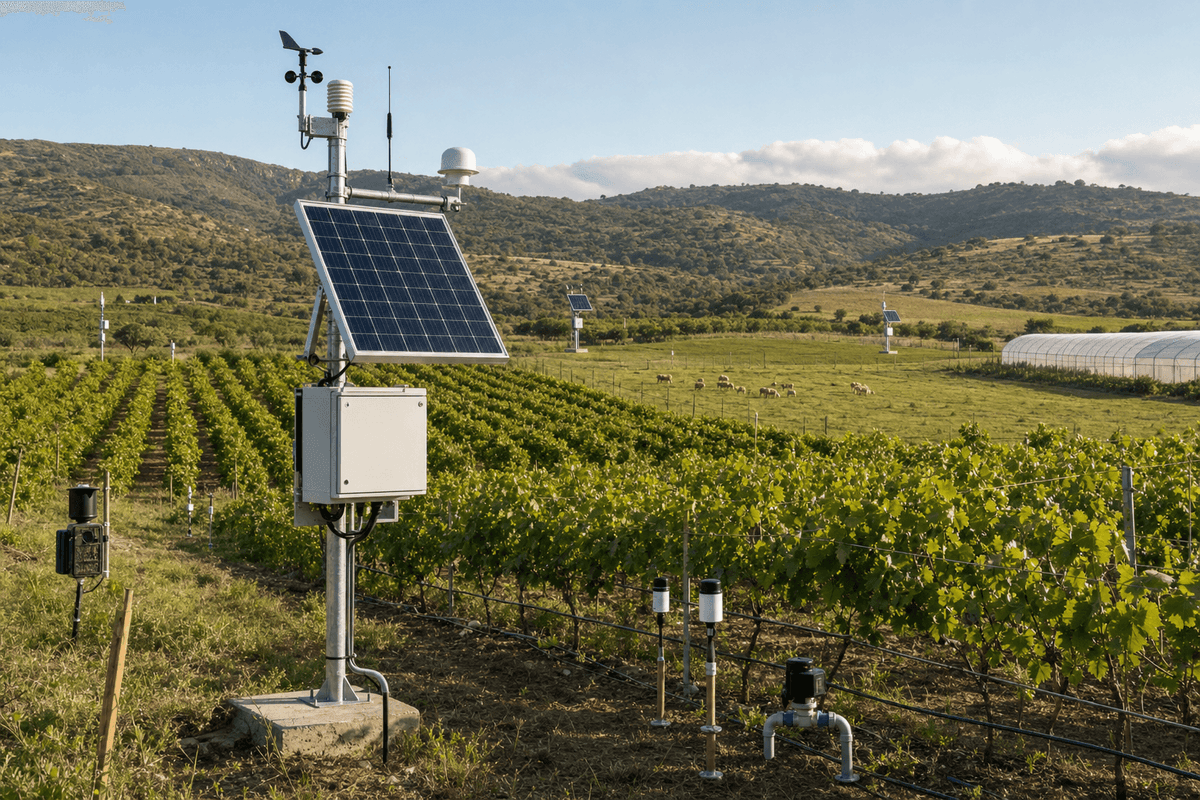
Complete Farm System 80ha - Professional IoT Monitoring for Mixed Farming
Key Features
- 35 high-precision sensors covering 80 hectares with 4 monitoring domains (weather, soil, pest, disease)
- AI-powered pest identification with 85-95% accuracy and automated daily count reports
- Multi-depth soil probes measuring 5 parameters at 4 depths (10/20/40/60cm) for precision irrigation
- Redundant 4G + LoRaWAN network with 3 gateways covering 10km radius each
- Off-grid solar power system with 7-day autonomous operation and 99.9% uptime guarantee
The SOLARTODO Complete Farm System for 80 hectares is an integrated IoT solution designed for precision agriculture, priced between $35,000 and $48,000. This system features 35 advanced sensors and complies with IEC certification, ensuring reliable performance. Ideal for mixed farming applications, it enhances operational efficiency and sustainability.
Description
SOLARTODO Complete Farm System 80ha: An Integrated IoT Solution for Precision Agriculture
1.0 Introduction: The Future of Large-Scale Farm Management
The SOLARTODO Complete Farm System for 80 hectares represents a paradigm shift in agricultural management, leveraging the power of the Industrial Internet of Things (IIoT) to deliver unparalleled insights and automation for mixed farming applications. This fully integrated, turnkey solution is engineered for producers who demand data-driven precision, operational efficiency, and sustainable resource management across extensive land holdings. By unifying four critical domains of agronomic monitoring—weather, soil, pests, and disease—into a single, cohesive platform, the system provides a holistic, real-time view of the entire farm ecosystem. Powered by a robust off-grid solar infrastructure and connected via a redundant 4G and LoRaWAN network, this system ensures continuous, reliable data acquisition from 35 advanced sensors. The result is a powerful decision-support tool that has been demonstrated to improve yields by 15-25%, reduce pesticide application by up to 30%, and decrease water consumption by as much as 50%, delivering a significant and rapid return on investment.
2.0 System Architecture and Core Components
The architecture is designed for scalability, reliability, and high-fidelity data collection, conforming to international standards such as ISO 11783 (ISOBUS) for agricultural electronics. It consists of a distributed sensing network, a hybrid communication backbone, a resilient solar power system, and a professional-tier cloud analytics platform.
2.1 Multi-Domain Sensing Layer
The system deploys a total of 35 high-precision sensors to create a comprehensive digital twin of the 80-hectare farm environment.
2.1.1 Professional Weather Monitoring
A World Meteorological Organization (WMO) compliant weather station serves as the atmospheric nerve center. It continuously measures seven critical parameters: ambient temperature, relative humidity, wind speed and direction, rainfall volume, solar radiation (critical for evapotranspiration models), atmospheric pressure, and calculated potential evapotranspiration (ETo). This data, sampled at a 10-minute interval, feeds directly into irrigation scheduling, disease prediction, and crop growth models, providing a hyperlocal weather forecast far more accurate than regional reports.
2.1.2 Comprehensive Soil Analysis
Precision irrigation and nutrient management are enabled by a network of comprehensive, multi-depth soil probes. Each IP68-rated, corrosion-resistant probe measures five key parameters at four distinct soil depths (10, 20, 40, and 60 cm): volumetric water content (0-100%), soil temperature (-30°C to 70°C), electrical conductivity (EC), pH, and NPK levels. This multi-layer data provides a complete profile of the root zone, allowing the system to trigger automated irrigation valve control with surgical precision, applying water only when and where it is needed. The sensors feature a 5-year battery life, ensuring long-term, maintenance-free operation.
2.1.3 AI-Powered Pest Management
Moving beyond reactive spraying, the system employs a proactive, AI-driven pest monitoring solution. This includes advanced camera traps combined with species-specific pheromone lures to attract and identify key economic pests such as moths, aphids, armyworms, and fruit flies. The high-resolution camera captures images of trapped insects, and a cloud-based AI engine provides automated species classification with an accuracy of 85-95%. Farm managers receive daily count reports and trend analyses, enabling targeted intervention long before an infestation becomes widespread. This method avoids the non-discriminatory impact of traditional insect killer lights, preserving beneficial insect populations.
2.1.4 Predictive Disease Detection
Disease management is revolutionized through a dual-pronged approach. First, a volumetric spore trap continuously samples the air, capturing airborne pathogens like powdery mildew, downy mildew, botrytis, and rust. An integrated AI-powered microscopic analysis engine identifies and quantifies spore loads in real-time. Second, a multispectral leaf scanner allows for early detection of plant stress and infection, often days before symptoms are visible to the human eye. This predictive capability allows for highly targeted, preventative fungicide applications, minimizing chemical use and protecting crop quality.
2.2 Communication and Power Infrastructure
2.2.1 Hybrid Communication Network
Data integrity is guaranteed by a robust, hybrid communication network. Three strategically placed LoRaWAN gateways create a redundant mesh network, each covering a radius of up to 10 kilometers and capable of supporting hundreds of sensors. This low-power, long-range network is ideal for transmitting data from soil and weather sensors. For high-bandwidth applications, such as uploading images and video from the AI pest traps, the system utilizes a dedicated 4G LTE backhaul. This ensures that high-resolution data is transmitted in real-time without bottlenecks. The system features intelligent data retransmission protocols, ensuring no data is lost during periods of network instability.
2.2.2 Off-Grid Solar Power System
The entire network operates autonomously, powered by our "Solar Large" power solution. Each sensor node and gateway is equipped with a high-efficiency 80W monocrystalline solar panel (compliant with IEC 61215 and UL 1703 standards) and a long-life Lithium Iron Phosphate (LFP) battery bank. This configuration is engineered to provide a minimum of 7 days of autonomous operation without any solar input, ensuring 99.9% uptime even through extended periods of inclement weather.
2.3 Professional Cloud Platform and Analytics
All data is aggregated and processed on the SOLARTODO Professional Cloud Platform. This secure, scalable platform provides:
- Real-Time Dashboard: A fully customizable interface displaying live data from all 35 sensors, with interactive maps, charts, and status indicators.
- Historical Trend Analysis: Access to the complete historical dataset for trend analysis, compliance reporting, and performance benchmarking.
- AI-Powered Insights: The platform runs advanced AI models to deliver actionable recommendations, including a crop growth model, optimized irrigation schedules, pest outbreak predictions based on population dynamics, and accurate yield forecasting.
- Automated Alerts: User-configurable alerts for critical thresholds (e.g., low soil moisture, high pest counts, disease risk) are sent instantly via SMS, email, and our dedicated mobile application.
- API Integration: A comprehensive REST API allows for seamless integration with third-party farm management software (FMS), accounting platforms, and other enterprise systems, ensuring the SOLARTODO system becomes a central part of your digital agriculture ecosystem.
3.0 Frequently Asked Questions (FAQ)
Q1: How does the system handle different crop types in a mixed farming setup?
A1: The system is designed for heterogeneity. The cloud platform allows you to define specific zones within your 80-hectare farm, each with its own crop type, growth stage, and unique thresholds for soil moisture, nutrients, and pest activity. The AI models for disease and irrigation are crop-specific, utilizing distinct algorithms for viticulture, row crops, or orchards, ensuring recommendations are precisely tailored to each plant's needs.
Q2: What is the installation and training process like?
A2: A standard installation is completed within 2-3 days by certified technicians. This includes a site survey, optimal placement of the 3 gateways and 35 sensors, network configuration, and system calibration. We also provide a comprehensive one-day on-site training session for your team, covering dashboard operation, alert configuration, basic maintenance, and how to interpret the AI-driven recommendations for maximum impact.
Q3: How secure is the farm's data on the cloud platform?
A3: Data security is paramount. All data transmission is encrypted end-to-end using AES-256, the same standard used in online banking. The cloud platform is hosted on ISO 27001 certified servers with redundant firewalls and intrusion detection systems. You retain full ownership of your data, and we adhere to strict data privacy policies, ensuring your sensitive operational information is never shared without your explicit consent.
Q4: Can the system be expanded beyond 80 hectares in the future?
A4: Absolutely. The system architecture is modular and highly scalable. Expanding coverage is as simple as adding more sensor nodes to the existing LoRaWAN network. The gateways can support hundreds of sensors, so for moderate expansion, you may only need additional sensors. For significant expansion beyond the 10km gateway radius, additional gateways can be seamlessly integrated into the network and managed from the same central dashboard.
Q5: What is the warranty and ongoing support for the system?
A5: The Complete Farm System comes with a comprehensive 2-year warranty on all hardware components, including sensors, gateways, and solar power systems. The cloud platform subscription includes a 1-year service level agreement (SLA) guaranteeing 99.9% uptime, along with continuous software updates and access to our technical support team via phone and email. Extended warranty and support packages are also available.
Technical Specifications
| Coverage Area | 80hectares |
| Total Sensors | 35sensors |
| Monitoring Types | Weather, Soil, Pest, Disease |
| Weather Station Type | Professional 10-parameter WMO compliant |
| Soil Sensor Type | Comprehensive 7-parameter multi-depth |
| Pest Monitoring | AI Camera Trap with pheromone lures |
| Disease Monitoring | Spore trap + AI analysis + multispectral leaf scanner |
| Communication | 4G LTE + LoRaWAN |
| Gateway Count | 3units |
| Gateway Coverage | 10km radius |
| Power Supply | Solar 80W + LFP battery |
| Autonomous Operation | 7days minimum |
| Data Interval | 10minutes (configurable 1-60 min) |
| Cloud Platform Tier | Professional |
| Alert Channels | SMS + Email + App Push |
| API Access | REST API included |
| Irrigation Integration | Automated valve control |
| AI Pest Identification Accuracy | 85-95% |
| Soil Probe Depths | 10/20/40/60cm |
| Sensor IP Rating | IP67/IP68 |
| Sensor Battery Life | 5years |
| System Uptime | 99.9% |
| Hardware Warranty | 2years |
| Cloud Service Warranty | 1year |
Price Breakdown
| Item | Quantity | Unit Price | Subtotal |
|---|---|---|---|
| Professional Weather Station (10-parameter WMO compliant) | 3 pcs | $1,500 | $4,500 |
| Comprehensive Soil Sensor (7-parameter, multi-depth) | 12 pcs | $580 | $6,960 |
| AI Camera Pest Trap (HD with pheromone) | 8 pcs | $850 | $6,800 |
| Spore Trap with AI Analysis | 4 pcs | $2,500 | $10,000 |
| Multispectral Leaf Scanner | 4 pcs | $1,800 | $7,200 |
| Storage Sensor Node (temperature/humidity) | 4 pcs | $350 | $1,400 |
| 4G Gateway | 3 pcs | $350 | $1,050 |
| Solar Power Kit (80W medium) | 35 pcs | $300 | $10,500 |
| Professional Cloud Platform (per device/year) | 35 devices | $48 | $1,680 |
| Installation, Calibration & Training | 1 system | $2,500 | $2,500 |
| Irrigation Integration Module | 1 system | $1,200 | $1,200 |
| Total Price Range | $35,000 - $48,000 | ||
Frequently Asked Questions
How does the system handle different crop types in a mixed farming setup?
What is the installation and training process like?
How secure is the farm's data on the cloud platform?
Can the system be expanded beyond 80 hectares in the future?
What is the warranty and ongoing support for the system?
Certifications & Standards


Data Sources & References
- •ISO 11783 ISOBUS Standard for Agricultural Electronics
- •IEC 61215 Photovoltaic Module Performance Standards
- •World Meteorological Organization (WMO) Weather Station Guidelines
- •Agricultural IoT Market Research 2025 - Precision Farming ROI Studies
Interested in this solution?
Contact us for a customized quote based on your specific requirements.
Contact Us