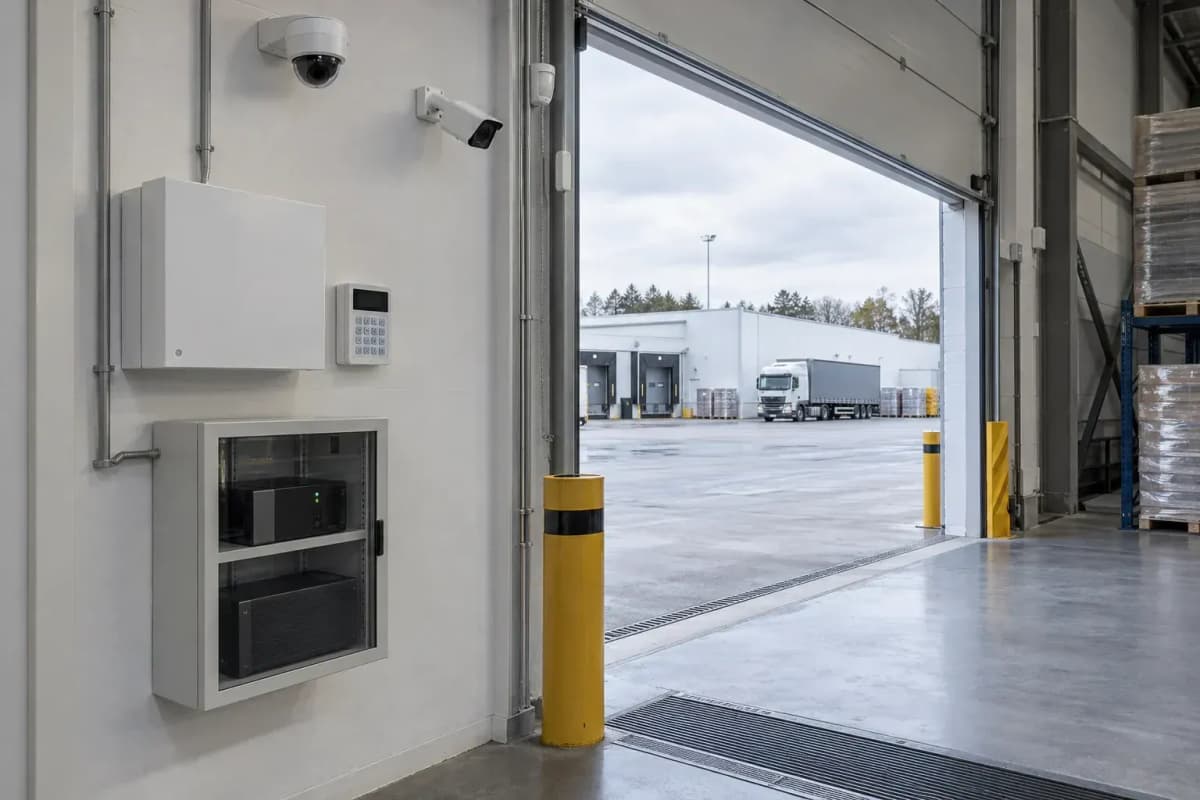
Warehouse 32-Zone Grid UPS Security System - 13-Camera Cloud Monitoring
Key Features
- 32 security zones with expansion capacity up to 64 zones
- 13-camera surveillance package with 30-day 4K NVR retention
- 23-detector mix covering PIR, dual-tech, contacts, glass-break, smoke/gas, and vibration
- Grid plus UPS power design with 4-8 hours backup autonomy
- EPC turnkey price range of $6,200-$12,100 with 1-year labor warranty
Warehouse 32-Zone Grid UPS is a 32-zone warehouse security and surveillance system with 13 IP cameras, 23 detectors, cloud monitoring, 30-day 4K storage, and 4-8 hours of UPS backup. EPC turnkey pricing is $6,200-$12,100 including engineering, procurement, installation, commissioning, and 1-year labor warranty.
Description
The Warehouse 32-Zone Grid UPS security system is a 32-zone intrusion, video, and cloud-monitoring package for warehouse sites that need 13 cameras, 23 detectors, 30-day 4K evidence retention, and 4-8 hours of UPS autonomy. The design combines a hybrid 8-64 zone alarm panel, Ethernet plus 4G plus WiFi communications, AES-256 encrypted remote access, and EPC turnkey delivery from $6,200 to $12,100 for a representative industrial warehouse.
This product belongs to SOLARTODO's Security & Surveillance System line for warehouses, logistics parks, factories, depots, and utility storage areas. Buyers comparing 3 procurement levels can use View all Security & Surveillance System products, then Configure your system online with site-specific door counts, aisle lengths, 4G coverage, storage days, and UPS autonomy targets.
System Architecture
The system uses 1 hybrid alarm control panel with 32 configured zones and expansion capacity up to 64 zones, so a warehouse can divide loading bays, office rooms, high-value cages, battery rooms, and perimeter doors into at least 5 supervised partitions. The intrusion layer includes 23 detectors distributed across PIR motion detection, dual-tech microwave plus PIR detection, door contacts, glass-break sensors, smoke or gas detection, and vibration sensing for shutters or fence panels.
The video layer uses 13 cameras, typically configured as 10 fixed 4MP or 4K IP cameras, 2 PTZ cameras with 20x optical zoom, and 1 thermal or long-range detection camera for external yards. Fixed cameras produce evidence-grade views for aisles and gates, PTZ units track movement after an alarm trigger, and the thermal channel can support human detection beyond 300 m when lens selection and mounting height are matched to the site.
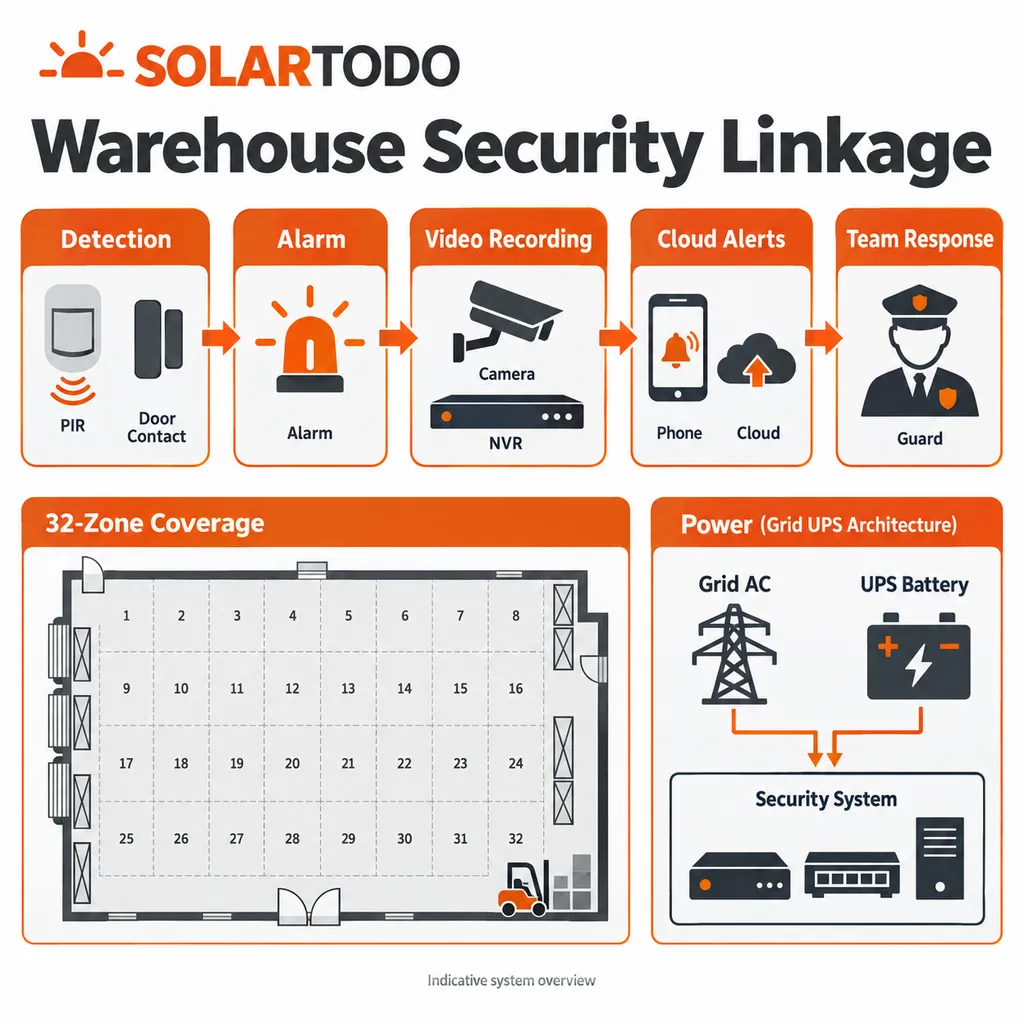
The operating sequence is built around 3 linked events: a zone alarm, a camera preset, and a cloud notification. When zone 12 or zone 18 triggers, the NVR can move PTZ 1 to a stored preset in under 3 seconds, activate a spotlight or siren output, mark the video timeline, and send a mobile or browser alert to 1 or more authorized operators.
Technical Specifications
The alarm panel is specified for 8-64 zones, wired plus wireless hybrid inputs, multiple partitions, event logs, tamper circuits, and backup communication. For a 32-zone warehouse, 23 physical detector points leave 9 spare logical zones for future doors, beam pairs, vibration loops, or refrigerated-room contacts without replacing the central panel.
The camera subsystem targets 30 days of 4K storage using H.265+ compression and a 16-channel NVR, with storage sizing adjusted by frame rate, motion recording percentage, scene complexity, and RAID policy. A practical warehouse design often records 13 channels at 12-20 fps and reserves 1-3 NVR channels for later expansion, service cameras, or temporary construction monitoring.
Communication uses Ethernet as the primary link, 4G as a backup path, and WiFi for selected local devices where cabling is impractical. Cloud monitoring should be configured with AES-256 encryption, named user accounts, 2-factor authentication, event retention policies, and at least 2 administrator roles so procurement, safety, and security teams do not share a single password.
UPS autonomy is specified at 4-8 hours for the alarm panel, NVR, network switch, router, and essential cameras. In a typical 2 kVA UPS design, the alarm panel and communications remain online through a 4-hour outage while a load-shedding group can keep the most important 6-8 cameras active instead of forcing all 13 cameras onto the same backup runtime.
Standards and Compliance Basis
Video surveillance design should align with IEC 62676, which defines minimum requirements and recommendations for security video systems, including system planning and performance expectations (IEC 62676-1-1 and IEC 62676-4). For projects using intelligent analytics, the 2026 IEC 62676-6 standard adds functions, test methods, performance evaluation, and grading rules for real-time intelligent video analysis in surveillance systems (IEC 62676-6:2026).
Intrusion design should reference EN 50131 for alarm systems and intrusion or hold-up systems, especially where buyers require graded risk language for 1 warehouse, 2 warehouse zones, or a multi-building logistics park (BSI EN 50131). For North American-style specifications, UL 681 covers installation and classification of burglar and holdup alarm systems, including protective wiring and alarm devices for premises and stockrooms (UL 681).
Fire and life-safety interfaces must be coordinated with the authority having jurisdiction, because NFPA 72 is the benchmark code for fire alarm and emergency communication criteria in many US-linked specifications (NFPA 72). Where smoke or gas detectors are connected to the 32-zone security panel, SOLARTODO treats them as supervisory or integration points unless a certified fire alarm system with code-required devices, circuits, testing, and documentation is separately specified.
AI Analytics and False Alarm Control
AI analytics are configured for person classification, vehicle classification, intrusion detection, line crossing, object-left detection, and object-removed detection across up to 13 channels. Compared with a conventional motion-only DVR that may trigger on insects, rain, forklifts, or shadows, an AI-filtered NVR can reduce nuisance alarms by up to 90% when the site has clean camera angles, stable lighting, calibrated detection zones, and 2-stage verification rules.
A 32-zone warehouse normally has 4 high-risk alarm groups: external doors, loading docks, perimeter fence or wall sections, and high-value indoor storage cages. Dual-tech detectors are recommended in areas with airflow, temperature swings, or moving plastic curtains because the microwave plus PIR combination reduces single-technology false alarms while still preserving fast detection in 6-12 m indoor coverage zones.
For evidence quality, fixed cameras should be aimed for identification, recognition, or observation objectives instead of generic wide views. A 4K camera placed at a 3.5-5.5 m mounting height can cover a receiving aisle, while PTZ cameras with 20x zoom are better assigned to alarm-follow presets across 2-4 dock doors rather than used as the only proof camera for a critical entrance.
Cloud Monitoring
Cloud monitoring supports browser dashboards, mobile alerts, event search, user-level permissions, video clip review, and notification escalation. A recommended 3-level event policy is warning for low-confidence analytics, alarm for verified intrusion plus zone trigger, and emergency for paired intrusion plus smoke, gas, or tamper events within a 60-second window.
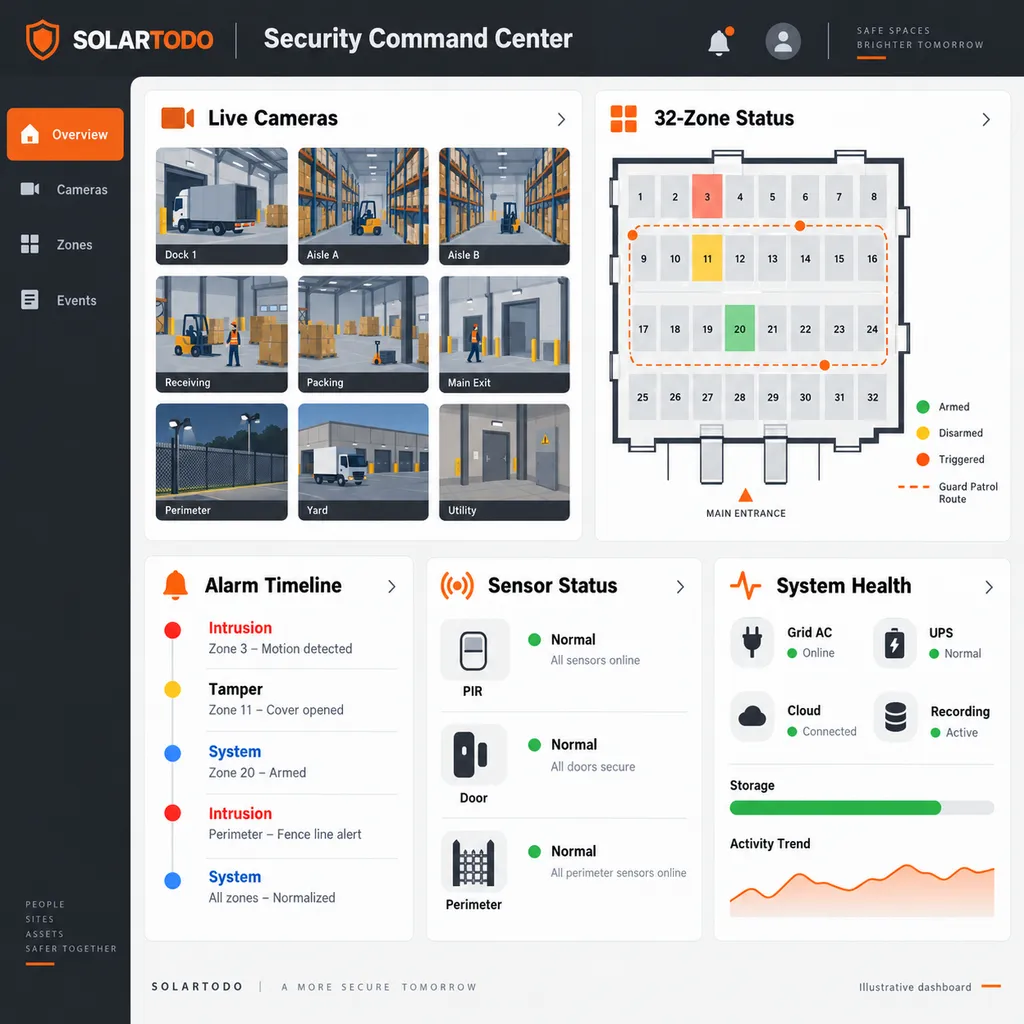
Cybersecurity planning should follow a defense-in-depth model because cameras, NVRs, alarm panels, routers, and cloud portals create at least 5 networked attack surfaces. NIST SP 800-53 Rev. 5 provides a widely used control catalog for access control, audit, identification, authentication, system communications protection, and configuration management, all of which are relevant to cloud-connected security systems (NIST SP 800-53 Rev. 5).
The energy resilience layer matters because modern warehouses increasingly depend on digital electricity and communications systems. IEA analysis on modernising grids notes that AI and digital systems require strong assurance, data quality, specialist skills, and governance, with 70% of surveyed network operators using AI widely for maintenance but only 23% using it in real-time operations (IEA Modernising Grids 2026).
Representative Scenario
Representative MENA warehouse scenario: assume 1 warehouse of 6,000-10,000 m² with 8 dock doors, 4 staff entrances, 2 high-value storage cages, 1 battery charging room, 1 fenced service yard, and 24/7 cloud monitoring. A practical configuration uses 32 alarm zones, 13 cameras, 23 detectors, 4 IR beam or perimeter points, a 16-channel NVR, 30-day retention, and a 2 kVA UPS sized for 4-8 hours depending on camera load shedding.
In this scenario, the system is engineered to prioritize the first 15 minutes after a power cut, the first 60 seconds after an intrusion event, and the first 30 days after an incident for evidence retrieval. The grid-plus-UPS architecture is lower-cost than a 48-120 hour solar-hybrid security package, but it is more resilient than a grid-only system because alarms, communications, and selected cameras remain online during short outages.
Applications
Warehouse applications include finished-goods storage, cold-chain warehouses, e-commerce fulfillment centers, customs bonded areas, spare-parts depots, and industrial yards with 2-8 perimeter gates. For fire-risk interfaces, smoke or gas points can supervise battery rooms, charging stations, solvent cages, or generator rooms, but the final life-safety design must be coordinated with certified fire-alarm contractors where NFPA 72 or local fire code applies.
Industrial procurement teams often evaluate this package against guard-only patrols, standalone DVRs, and unmonitored alarm panels. A 32-zone cloud-monitored system can reduce routine guard verification visits by 20-40% in many warehouse operating models, because remote operators can review 13 video channels before dispatching a response team, although actual savings depend on labor cost, response contracts, and incident frequency.
For projects with future renewable-energy upgrades, SOLARTODO can evaluate solar-hybrid security power using the same engineering mindset used for PV and battery systems. NREL's PVWatts V8 API provides a common solar-production modeling baseline for site-specific PV yield assumptions, while IRENA notes that battery electricity storage supports renewable integration and can reduce the need for costly grid reinforcement in suitable applications (NREL PVWatts V8 and IRENA Energy Storage).
EPC Investment Analysis and Pricing Structure
EPC turnkey delivery includes 5 work packages: engineering, procurement, construction, commissioning, and warranty support. For this 32-zone system, engineering covers drawings, device schedule, zone naming, cable routes, NVR storage sizing, UPS load calculation, and cloud account structure; procurement covers 13 cameras, 23 detectors, 1 NVR, 1 UPS, network devices, cabling, and mounting hardware.
| Pricing tier | Scope | Price range |
|---|---|---|
| FOB Supply | Equipment only, ex-works China | $3,844-$8,228 |
| CIF Delivered | Equipment plus ocean freight and insurance | $4,106-$8,789 |
| EPC Turnkey | Installed, commissioned, and 1-year labor warranty | $6,200-$12,100 |
| Volume level | Discount | Example use |
|---|---|---|
| 50+ systems | 5% | Regional warehouse rollout with 50 sites |
| 100+ systems | 10% | National logistics program with 100 sites |
| 250+ systems | 15% | Multi-country framework with 250 systems |
A basic ROI model compares EPC cost, guard rounds, incident loss, downtime, and insurance documentation. If a warehouse avoids 2 unnecessary night dispatches per week at $35 per dispatch and reduces 1 minor loss event of $2,000 per year through earlier detection, annual savings can exceed $5,640, giving a simple payback of about 1.1-2.1 years against the $6,200-$12,100 EPC range.
Compared with a conventional grid-only DVR plus siren system costing about $3,000-$5,000 installed, this grid-UPS cloud system costs more upfront but adds 4-8 hours backup, 30-day 4K evidence retention, 32-zone event logic, and remote verification across 13 cameras. The higher EPC cost is justified where 24/7 evidence, alarm-to-video linkage, and response accountability are worth more than the $1,200-$4,000 initial savings of a simpler alternative.
Payment terms are 30% T/T deposit plus 70% against B/L for standard shipments, or 100% L/C at sight for qualified buyers. Project financing can be discussed for programs above $1,000K, and buyers can Request a custom quotation or email [email protected] with site drawings, camera count, detector schedule, country, port, and warranty requirements.
Procurement Notes
Before ordering, buyers should confirm 6 practical inputs: warehouse floor plan, wall and ceiling materials, door count, network cabinet location, internet availability, and acceptable downtime for installation. A 32-zone plan can usually be installed in phases so warehouse operations continue, with high-traffic docks scheduled outside peak loading windows and 1 final commissioning session used to label all zones.
Commissioning should include 100% detector walk testing, 100% camera view verification, NVR retention calculation, UPS runtime test, 4G failover test, cloud account audit, and at least 1 alarm-to-camera scenario per partition. For procurement teams building internal specifications, Learn about topic provides broader technical guidance on solar, storage, security, and smart infrastructure systems.
SOLARTODO supplies this package as part of a broader B2B portfolio covering solar power, energy storage, smart lighting, security, telecom and power towers, and smart agriculture. For buyer-side engineering teams, the important decision is not only the 32-zone device count but also whether the system has verifiable standards alignment, documented commissioning, 2-year parts warranty, 1-year labor warranty, and a clear expansion path to 64 zones.
Technical Specifications
| Security Zones | 32zones |
| Camera Count | 13cameras |
| Detector Count | 23detectors |
| Power System | Grid + UPS |
| Backup Autonomy | 4-8hours |
| Video Storage | 30 days @ 4K |
| Monitoring Type | Cloud |
| Communication | 4G + Ethernet + WiFi |
| Expansion Capacity | Up to 64zones |
| Warranty | 2 years parts, 1 year labor |
Price Breakdown
| Item | Quantity | Unit Price | Subtotal |
|---|---|---|---|
| 64-zone hybrid alarm panel | 1 pcs | $120 | $120 |
| LCD alarm keypad | 2 pcs | $30 | $60 |
| PIR detector | 8 pcs | $7 | $56 |
| Dual-tech detector | 5 pcs | $21 | $105 |
| Door/window contact | 6 pcs | $2 | $12 |
| Glass break detector | 2 pcs | $8 | $16 |
| Smoke/gas detector | 1 pcs | $6 | $6 |
| Vibration sensor | 1 pcs | $14 | $14 |
| Perimeter beam 100 m set | 4 pcs | $65 | $260 |
| Electric fence 1 m segment | 200 pcs | $2 | $400 |
| 4MP IP camera | 10 pcs | $65 | $650 |
| PTZ camera 20x | 2 pcs | $170 | $340 |
| Thermal camera | 1 pcs | $500 | $500 |
| 16-channel NVR | 1 pcs | $135 | $135 |
| UPS power system 2 kVA class | 1 pcs | $650 | $650 |
| PoE network switch and router set | 2 pcs | $180 | $360 |
| Cabling, conduits, brackets, and junction accessories | 1 pcs | $800 | $800 |
| Cloud monitoring service | 12 pcs | $45 | $540 |
| Installation and commissioning | 32 pcs | $50 | $1,600 |
| Engineering, drawings, and QC documentation | 1 pcs | $850 | $850 |
| 1-year warranty and support | 1 pcs | $900 | $900 |
| Site logistics and commissioning consumables | 1 pcs | $650 | $650 |
| Total Price Range | $6,200 - $12,100 | ||
Frequently Asked Questions
What is included in the EPC turnkey price for the Warehouse 32-Zone Grid UPS system?
How many cameras and detectors are supplied in the standard configuration?
How long will the system operate during a power outage?
Which standards are relevant to this warehouse security system?
Can the 32-zone system be expanded after installation?
Certifications & Standards


Data Sources & References
- •IEC 62676-1-1:2013 Video surveillance systems for security applications
- •IEC 62676-6:2026 Real-time intelligent video analysis in surveillance systems
- •BSI EN 50131 Alarm systems, intrusion and hold-up systems
- •UL 681 Installation and Classification of Burglar and Holdup Alarm Systems
- •NFPA 72 National Fire Alarm and Signaling Code
- •IEA Modernising Grids in the Age of Electricity 2026
- •NREL PVWatts V8 API documentation
Interested in this solution?
Contact us for a customized quote based on your specific requirements.
Contact Us