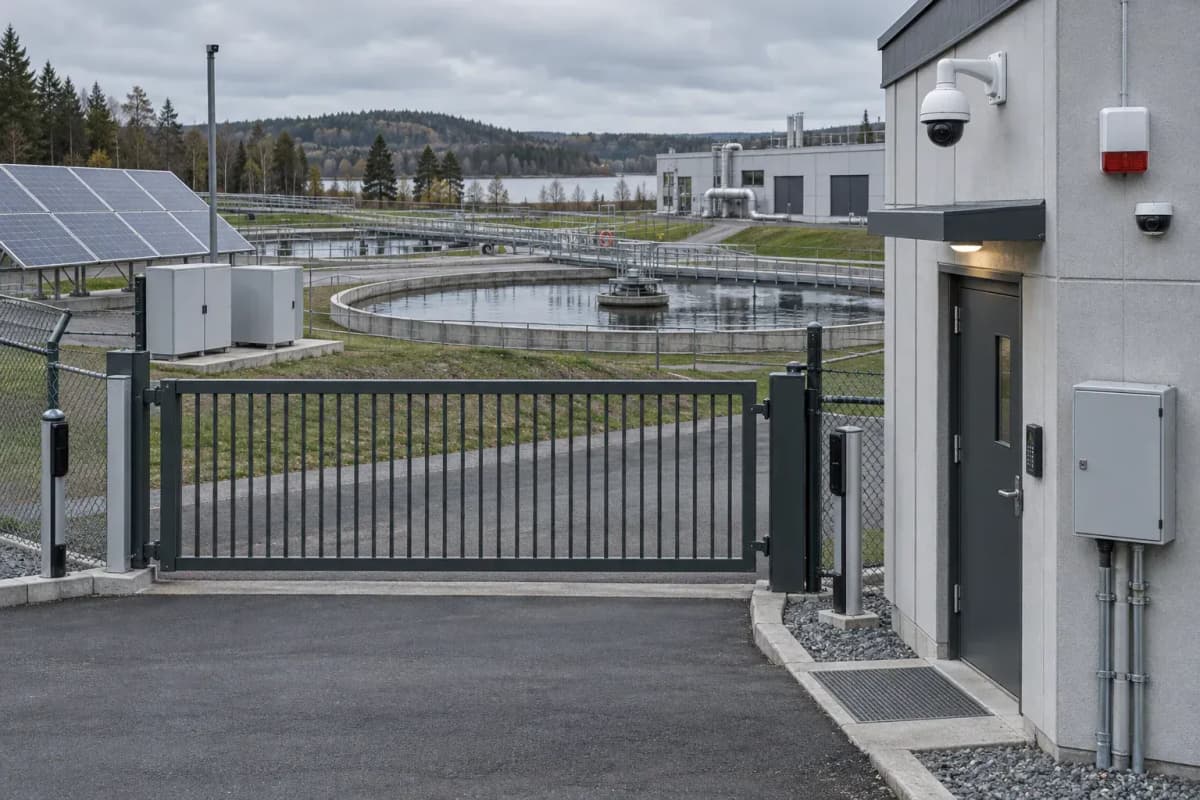
Water Treatment Plant 96-Zone Off-Grid - 72-Hour Solar Security System
Key Features
- 96 active security zones with expandable 128-zone dual-panel architecture
- 56-camera CCTV package with 40 fixed IP, 12 PTZ, and 4 thermal cameras
- 86 detectors including 30 PIR, 24 dual-tech, 16 contacts, and 16 specialty sensors
- 6.4 kW solar array plus 32 kWh LFP battery storage for 72-hour autonomy
- 30-day 4K video retention with cloud monitoring and Ethernet plus 4G backup
The Water Treatment Plant 96-Zone Off-Grid system combines 96 alarm zones, 56 cameras, 86 detectors, 6.4 kW solar PV, and 32 kWh LFP storage for 72 hours of autonomous utility-plant monitoring.
Description
The Water Treatment Plant 96-Zone Off-Grid security and surveillance system is a utility-plant protection package with 96 security zones, 56 cameras, 86 detectors, 6.4 kW of solar PV, and 32 kWh of LFP battery storage. It is designed for 72 hours of off-grid autonomy, cloud monitoring, and layered intrusion detection across intake structures, chemical rooms, pump galleries, reservoirs, gates, and perimeter corridors.
SOLARTODO positions this configuration inside the Security & Surveillance System product line for B2B buyers who need a repeatable, engineerable package rather than a loose set of devices. Buyers comparing site-wide options can View all Security & Surveillance System products, Configure your system online, or Request a custom quotation with 1 drawing set, 1 bill of materials, and 1 commissioning checklist.
System Architecture for 96 Zones
The architecture uses 2 hybrid alarm control panels rated around 64 zones each, creating a practical 128-zone expansion ceiling while commissioning 96 active zones on day 1. The alarm layer is divided into 8 logical partitions: main gate, perimeter fence, pump station, clarifier area, control building, chemical storage, power room, and reservoir access.
The detector plan assigns 86 initiating devices across risk-ranked locations. A typical mix uses 30 PIR detectors for interior movement, 24 dual-technology microwave-plus-PIR detectors for lower false alarms near vibration sources, 16 door contacts for controlled rooms, 8 vibration sensors for fence or enclosure tamper, 4 glass-break detectors, and 4 smoke or gas detectors tied to supervisory alarm logic.
The video layer uses 56 cameras with a mix of fixed IP, PTZ, and thermal coverage. A representative design uses 40 fixed 4K IP cameras for equipment yards and building entrances, 12 PTZ cameras with approximately 20x optical zoom for open basins and road corridors, and 4 thermal cameras for nighttime human detection beyond 300 m where visible-light contrast can fall below 20%.
SOLARTODO recommends storing video for 30 days at 4K using H.265+ compression, event bookmarking, and RAID-protected NVR storage. For engineering context, IEC 62676-1-1 defines minimum performance and functional expectations for video surveillance systems, while IEC 62676-4:2025 covers planning, design, installation, testing, commissioning, and maintenance guidance for video surveillance systems.
Technical Specifications for 56 Cameras
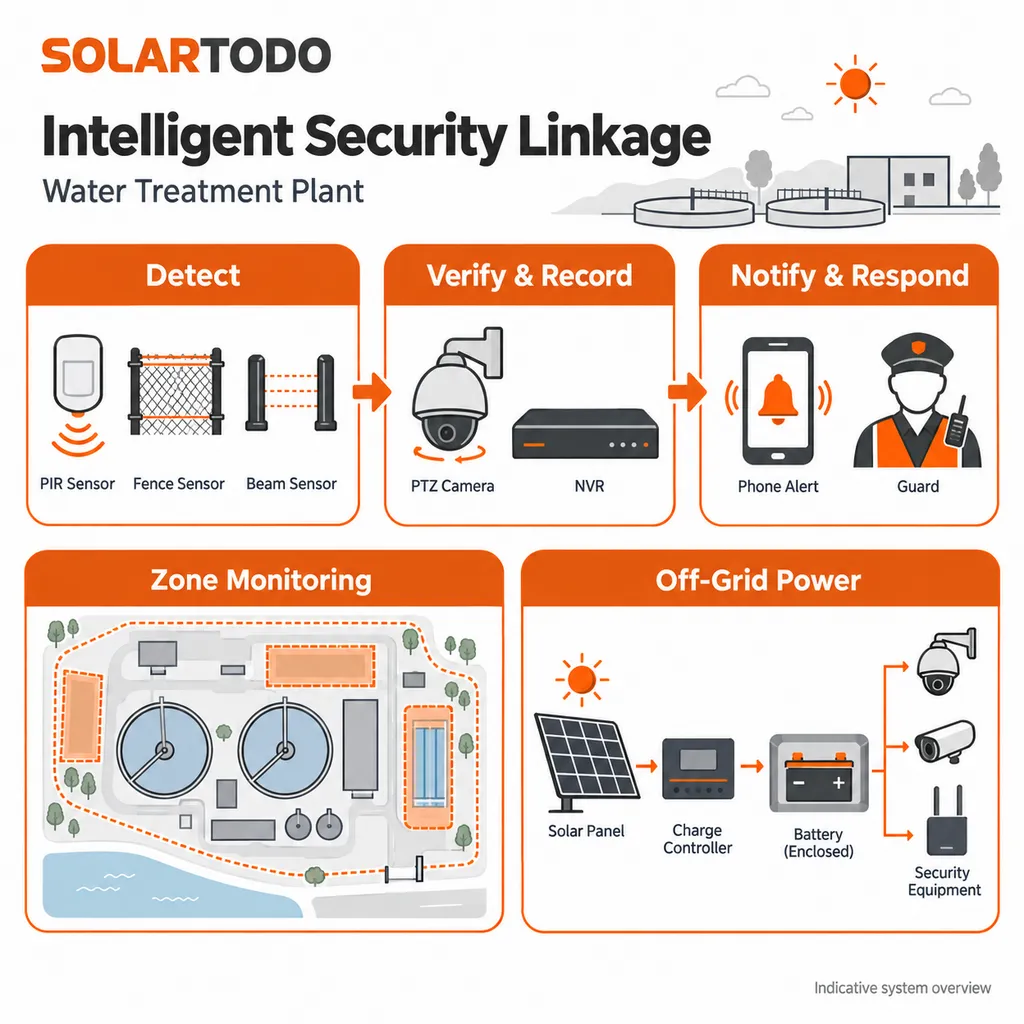
The 56-camera surveillance subsystem is engineered for continuous visibility across fence lines, process units, pipe corridors, and vehicle lanes. Fixed cameras typically cover 15 m to 60 m scenes, PTZ cameras cover larger 100 m to 250 m patrol views, and thermal cameras support detection in low-light zones where water mist, glare, or dust can reduce standard camera confidence.
AI video analytics classify people and vehicles, detect line crossing, and flag object-left or object-removed events in defined zones. In suitable scenes with stable camera angles and calibrated detection regions, edge analytics can reduce nuisance alarm volume by up to 90% compared with conventional motion-only alarms that trigger on insects, rain, shadows, and moving vegetation.
The alarm and video systems share timestamped event correlation, so 1 door-forced event can automatically recall 2 nearby cameras and bookmark the preceding 10 seconds of video. This is useful for water facilities where a chemical-room access alarm, pump-house vibration alarm, or fence-beam interruption must be reviewed in less than 60 seconds by a remote operator.
Communications use Ethernet as the primary channel, 4G as the backup path, and WiFi for local service access when allowed by the site cybersecurity plan. Security data is transmitted with AES-256 encryption, and utility owners can align segmentation and hardening with IEC 62443-3-3 security-level concepts for industrial automation and control networks.
Off-Grid Power Design with 72 Hours Autonomy
The off-grid power system combines a 6.4 kW solar array, MPPT charging, protected DC distribution, and 32 kWh of lithium iron phosphate battery capacity. At an average protected load target of roughly 400 W to 440 W, the battery reserve provides approximately 72 hours of autonomy before considering solar recharge during daylight.
For solar yield estimation, NREL PVWatts Version 8 uses updated PV performance models and NSRDB typical meteorological year data, making it a credible first-pass tool for comparing a 6.4 kW array in different climates. Final EPC sizing should still apply local irradiance, soiling, camera duty cycle, 4G signal strength, temperature derating, and a 20% reserve margin.
IRENA reported that utility-scale battery storage costs fell by 93% between 2010 and 2024, while utility-scale solar PV reached a global weighted average LCOE near USD 0.043/kWh in 2024. Those trends support off-grid surveillance economics where extending grid power by 300 m to 1,000 m can cost more than local PV and LFP storage.
Compared with a conventional grid-plus-UPS design using only 4 to 8 hours of backup, this configuration extends survivability by roughly 9x to 18x during feeder faults, storms, or planned maintenance. For critical water infrastructure, that autonomy difference matters because a single unmonitored 24-hour outage can affect intake security, chemical inventory protection, and public-service continuity.
Cloud Monitoring for 24/7 Utility Operations
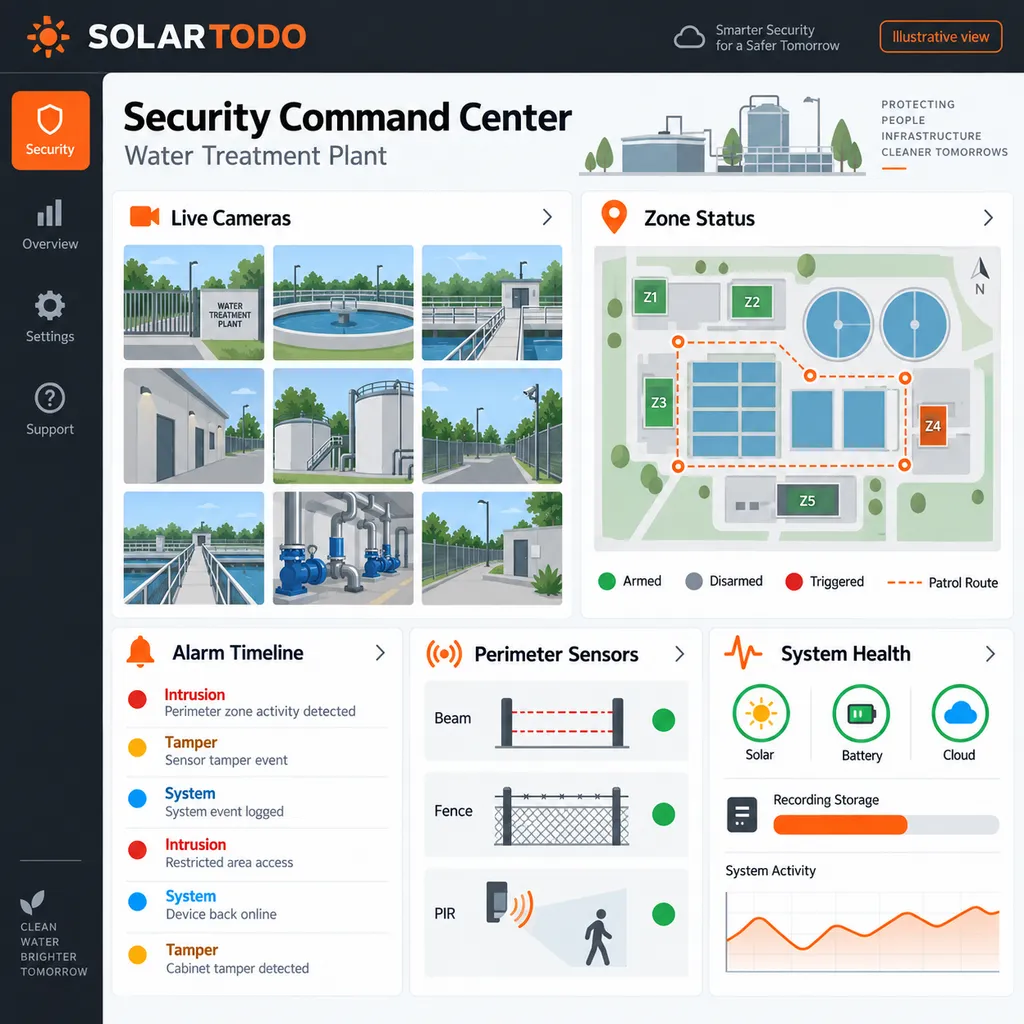
Cloud monitoring consolidates alarms, video events, health status, and power metrics into 1 remote dashboard for operations teams or contracted monitoring centers. The system can report alarm state, battery state of charge, PV charging status, network status, camera offline status, and NVR health at intervals such as 1 minute, 5 minutes, or 15 minutes.
A cloud workflow can escalate events in 3 stages: edge classification, control-room verification, and supervisor notification. For example, a perimeter line-crossing event at 02:15 can open the relevant PTZ preset, display 2 fixed-camera views, and send a push or email alert if the operator does not acknowledge within 60 seconds.
The monitoring model is designed for cloud-first operation but should retain local recording for at least 30 days. This prevents loss of evidence when a 4G carrier outage, router reboot, or uplink throttle interrupts cloud transfer for 1 hour or longer.
Applications for Utility Plant Security
This 96-zone package fits medium water treatment plants, wastewater treatment plants, desalination support sites, reservoir pump stations, and remote utility compounds. The design is especially relevant when a site has 2 to 6 process areas, 1 main control building, multiple chemical rooms, and a perimeter where security cabling or grid trenching would be expensive.
For a representative MENA water treatment scenario, assume a 12,000 m2 compound with 600 m of perimeter, 2 vehicle gates, 1 administration building, 1 pump hall, 1 chemical dosing area, and 1 reservoir access road. A practical design places 8 IR beam spans, 12 PTZ presets, 40 fixed camera scenes, and 86 detector points into a single cloud-monitored alarm map.
The system is also suitable for hybrid smart-infrastructure programs where solar lighting, telecom poles, energy storage, and security cameras share common maintenance resources. Engineering teams can review broader design principles through Learn about topic, including solar sizing, battery reserve planning, and perimeter detection strategy for 24/7 infrastructure sites.
Standards, Compliance, and Engineering References
The surveillance portion is designed with reference to IEC 62676 for video surveillance, while the intrusion portion maps to EN 50131 concepts for intrusion and hold-up alarm systems. UL 681 is relevant for burglar and holdup alarm installation classification, and NFPA 72 is relevant where smoke, gas, supervisory, or fire-alarm interfaces are included in 1 integrated monitoring workflow.
For power and storage, IEEE 2030.2.1-2019 provides guidance for design, operation, and maintenance of battery energy storage systems integrated with electric power systems. IEA analysis in 2025 and 2026 also shows that solar PV and renewables continue to supply a major share of new electricity growth, supporting resilient distributed power for remote infrastructure.
The system should not be described as certified for a specific site until 1 local authority, insurer, or third-party inspector verifies the installed configuration. SOLARTODO can supply design documents, equipment datasheets, FAT records, and commissioning forms, but final code acceptance depends on the jurisdiction, installation method, cable routing, fire interface, and monitoring contract.
EPC Investment Analysis and Pricing Structure
EPC turnkey delivery includes 5 commercial work scopes: engineering, procurement, construction, commissioning, and warranty support. For this product, EPC covers design review, bill of materials finalization, solar-and-battery integration, alarm programming, camera aiming, cloud onboarding, operator training, commissioning tests, and 1 year of labor warranty.
| Tier | Scope | Price Range |
|---|---|---|
| FOB Supply | Equipment only, ex-works China | USD 10,230 - 14,484 |
| CIF Delivered | Equipment plus ocean freight and insurance | USD 10,928 - 15,472 |
| EPC Turnkey | Installed, commissioned, and covered by 1-year labor warranty | USD 16,500 - 21,300 |
Volume pricing is normally structured around 3 procurement brackets because security projects often repeat across multiple utility sites. A 50+ unit or site-equivalent order qualifies for a 5% discount, a 100+ bracket qualifies for a 10% discount, and a 250+ bracket qualifies for a 15% discount subject to final component selection and delivery schedule.
| Quantity Bracket | Discount | Example Use Case |
|---|---|---|
| 50+ systems | 5% | Regional utility standardization across 50 sites |
| 100+ systems | 10% | National water authority rollout across 100 assets |
| 250+ systems | 15% | Multi-year framework agreement across 250 facilities |
For ROI modeling, assume the EPC midpoint is approximately USD 18,900, replacing 2 nightly patrol visits, 1 diesel generator backup routine, and 1 conventional motion-only CCTV package. If avoided patrol, fuel, dispatch, and false-alarm handling costs total USD 6,000 to 7,500 per year, the simple payback is roughly 2.5 to 3.2 years.
Compared with a conventional cabled CCTV alternative that needs grid extension, generator backup, and separate alarm reporting, the off-grid package can reduce trenching and standby fuel dependence by 30% to 60% on remote sites. The largest savings usually appear when the nearest reliable AC supply is more than 300 m from the protected perimeter.
Standard payment terms are 30% T/T deposit plus 70% against bill of lading, or 100% L/C at sight for approved trade-finance orders. Project financing can be discussed for portfolios above USD 1,000,000, and procurement teams can contact [email protected] for a priced schedule, delivery plan, and country-specific documentation pack.
Procurement Notes for Engineers and Buyers
A buyer should validate 6 inputs before ordering: site perimeter length, camera mounting height, available solar area, local 4G coverage, required retention days, and the authority having jurisdiction for alarm or fire interfaces. These inputs determine whether 56 cameras and 86 detectors are sufficient or whether the design should use more thermal cameras, radar inputs, or fiber vibration sensing.
The base configuration assumes 30-day recording, cloud monitoring, Ethernet plus 4G communications, and a 2-year parts warranty with 1-year labor under EPC. Optional upgrades include generator input, electric fence zones, radar integration, additional NVR storage, redundant routers, and command-center wall display for 24/7 staffed utilities.
SOLARTODO supplies solar, energy storage, smart lighting, security, telecom tower, and smart-agriculture systems from 1 integrated B2B catalog. This matters for municipal or industrial buyers who want unified procurement across security power, perimeter lighting, off-grid communications, and future smart-city infrastructure phases over 3 to 10 years.
Technical Specifications
| Security Zones | 96zones |
| Camera Count | 56cameras |
| Detector Count | 86detectors |
| Power System | Off-grid solar PV plus LFP battery |
| Solar Array Capacity | 6.4kW |
| Battery Capacity | 32kWh |
| Backup Autonomy | 72hours |
| Video Storage | 30 days @ 4K |
| Monitoring Type | Cloud |
| Communication | 4G + Ethernet + WiFi |
| Expansion Capacity | Up to 128zones |
| Warranty | 2 years parts, 1 year labor |
| Application | Utility water treatment plant |
Price Breakdown
| Item | Quantity | Unit Price | Subtotal |
|---|---|---|---|
| 96-zone hybrid alarm controller set | 2 pcs | $180 | $360 |
| LCD keypad and local arming interface | 4 pcs | $30 | $120 |
| Mixed intrusion detector package | 86 pcs | $15 | $1,290 |
| 100 m perimeter IR beam pair | 8 pcs | $65 | $520 |
| Fixed 4K IP camera | 40 pcs | $55 | $2,200 |
| PTZ camera with 20x optical zoom | 12 pcs | $120 | $1,440 |
| Thermal perimeter camera | 4 pcs | $300 | $1,200 |
| NVR RAID recording and storage set | 2 pcs | $310 | $620 |
| Network cabinet, switches, router, and 4G backup | 1 pcs | $520 | $520 |
| Solar PV modules and mounting for 6.4 kW array | 16 pcs | $155 | $2,480 |
| LFP battery modules for 32 kWh storage | 8 pcs | $480 | $3,840 |
| Installation and commissioning | 96 pcs | $35 | $3,360 |
| Engineering, drawings, and quality control | 1 pcs | $900 | $900 |
| Cloud setup and operator training | 1 pcs | $580 | $580 |
| 1-year warranty and support allowance | 1 pcs | $430 | $430 |
| Total Price Range | $16,500 - $21,300 | ||
Frequently Asked Questions
What does the EPC turnkey price include for this 96-zone system?
Can the system really operate for 72 hours without grid power?
How are 96 alarm zones used in a water treatment plant?
Which standards are relevant to this security system?
Can SOLARTODO customize the number of cameras or detectors?
Certifications & Standards


Data Sources & References
- •IEC 62676-4:2025, Video surveillance systems for use in security applications: https://webstore.iec.ch/en/publication/83425
- •IEC 62676-1-1:2013, Video surveillance system requirements: https://webstore.iec.ch/en/publication/7347
- •NREL PVWatts Version 8 API documentation: https://developer.nrel.gov/docs/solar/pvwatts/v8/
- •IRENA Renewable Power Generation Costs in 2024: https://www.irena.org/Digital-Report/Renewable-Power-Generation-Costs-in-2024
- •IEA Renewables 2025: https://www.iea.org/reports/renewables-2025
- •IEEE 2030.2.1-2019 battery energy storage guide: https://ieeexplore.ieee.org/document/8930450/
- •NFPA 72 National Fire Alarm and Signaling Code: https://www.nfpa.org/product/nfpa-72-handbook/p0072hb
Interested in this solution?
Contact us for a customized quote based on your specific requirements.
Contact Us