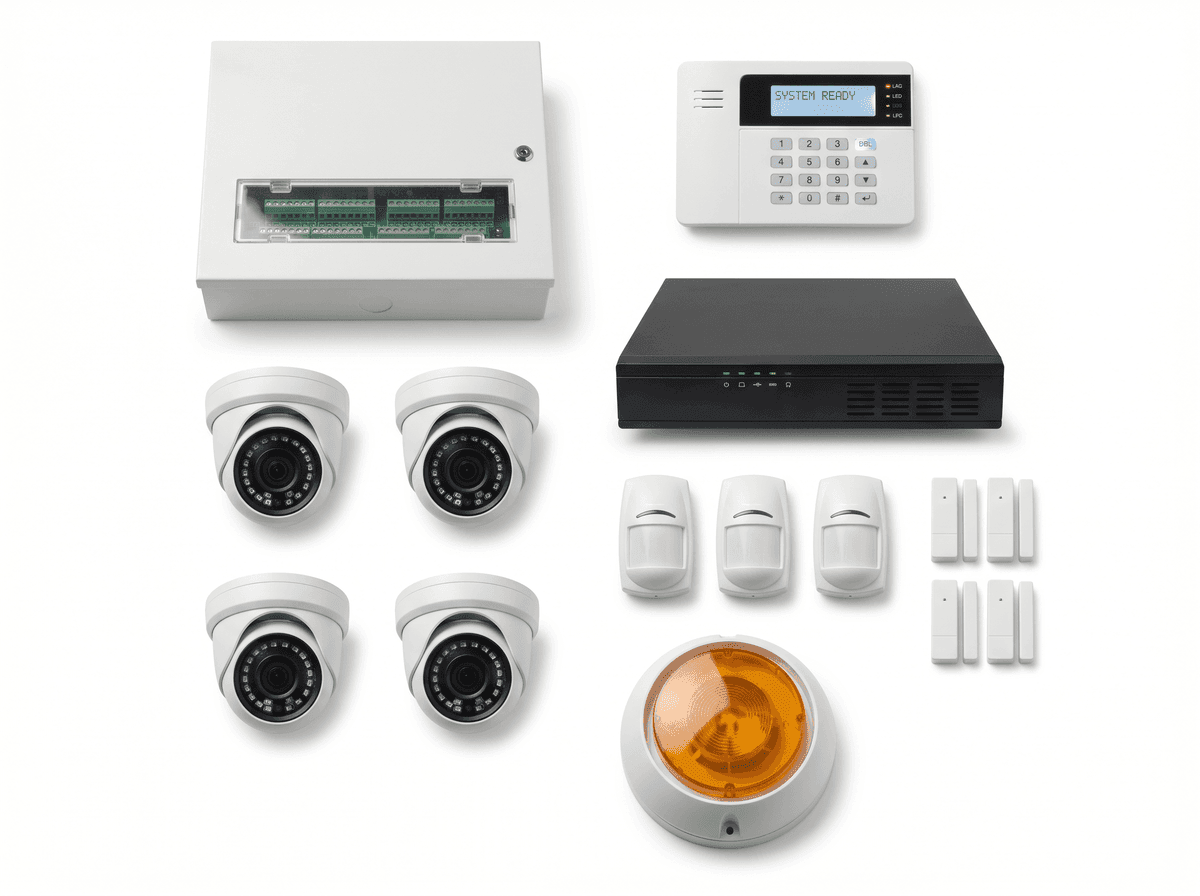
Shopping Mall 48-Zone Cloud Managed - 32-Camera AI Security System
Key Features
- 48 active alarm zones on a 64-zone hybrid panel with 16 spare zones for future expansion
- 32 IP cameras total, including 24 fixed HD cameras and 8 PTZ cameras for long-range tracking
- 48 detectors deployed: 24 PIR motion sensors, 24 door contacts, and 12 smoke detectors
- 64-channel NVR supports 30 days of 4K video retention with H.265/H.265+ compression
- Premium cloud monitoring with Ethernet, 4G backup, WiFi, AES-256 encryption, and 2-year parts warranty
The Shopping Mall 48-Zone Cloud Managed system is a 48-zone, 32-camera, premium-monitored security and surveillance platform for retail complexes, combining 24 PIR detectors, 24 door contacts, 12 smoke detectors, 8 PTZ cameras, a 64-channel NVR, and cloud VMS management. Designed for shopping mall applications with grid power, Ethernet, 4G, and WiFi connectivity, it supports 30-day 4K storage, 64-zone expansion, and standards-aligned deployment referencing EN 50131, IEC 62676, UL 681, and NFPA 7
Description
The Shopping Mall 48-Zone Cloud Managed system is a retail-focused security platform engineered for 48 security zones, 32 IP cameras, 48 detectors, and premium cloud monitoring across shopping mall entrances, corridors, anchor tenant interfaces, loading bays, and back-of-house spaces. This configuration combines 24 PIR detectors, 24 door contacts, 12 smoke detectors, 24 HD fixed cameras, 8 PTZ cameras, a 64-channel NVR, 6 LCD keypads, and 6 sirens to create a layered intrusion, life-safety, and video verification architecture suitable for medium to large commercial sites between 8,000 m² and 35,000 m².
For B2B buyers, the system is designed around measurable operating metrics: 30 days of 4K video retention, up to 64 alarm zones, AES-256 encrypted communications, and hybrid cloud/on-site management for 24/7/365 supervision. In line with IEC 62676 guidance for CCTV performance, EN 50131 intrusion principles, UL 681 installation expectations, and NFPA 72 fire alarm interfacing, the architecture prioritizes evidentiary video, alarm verification within 10-30 seconds, and scalable multi-site management for retail groups operating 2 to 200 branches. Buyers can View all Security & Surveillance System products or Configure your system online for project-specific layouts.
System Overview
This variant uses a 64-zone hybrid alarm panel configured for 48 active zones, leaving 16 spare zones for future tenant turnover, seasonal kiosks, ATM vestibules, or stockroom expansion. The detector mix includes 24 PIR motion sensors for corridors, service passages, and management offices, 24 magnetic door contacts for emergency exits and restricted doors, and 12 smoke detectors for back-of-house, electrical rooms, and selected retail support areas. The camera layer combines 24 fixed HD/4K-class IP cameras for constant scene coverage with 8 PTZ cameras providing 20x-40x optical zoom class performance for atriums, parking access points, and long sightline corridors.
Compared with a conventional standalone DVR-and-basic-alarm setup using isolated monitoring and no cloud analytics, this managed architecture typically reduces false alarm dispatches by up to 90% when AI person/vehicle classification and event verification are properly configured, consistent with current market benchmarks referenced by major VMS and analytics vendors and aligned with industry trends cited by IEA 2025 and Wood Mackenzie retail security digitization outlooks. For mall operators, that can translate into lower guard intervention time, fewer unnecessary callouts, and faster incident reconstruction across 32 synchronized video channels.
System Architecture
The system architecture follows a 3-layer design: field devices, control and recording, and cloud supervision. At layer 1, 48 field zones collect intrusion and life-safety events from PIR, door, and smoke devices. At layer 2, the 64-zone panel manages alarm logic while the 64-channel NVR records video streams using H.265/H.265+ compression, improving storage efficiency by 30% to 50% versus older H.264 settings depending on motion complexity. At layer 3, a cloud VMS aggregates alarms, live video, health status, and audit logs for remote operators and regional loss-prevention managers.
The communications stack supports Ethernet + 4G backup + WiFi, with primary transmission over wired LAN and failover over cellular in the event of ISP disruption lasting 5 minutes to 72 hours. Encryption is specified at AES-256 for cloud transport and credential protection, while anti-jamming and tamper supervision improve resilience against common retail threat vectors. For shopping centers with 3 to 12 public entrances, the architecture can partition alarms by tenant cluster, service corridor, and management zone, allowing after-hours arming of selected areas without disabling shared-space surveillance.

Technical Performance for Shopping Mall Security
In retail environments, the key design challenge is balancing broad visual coverage with evidentiary detail. The 24 fixed cameras are intended for checkout approaches, entrances, escalator nodes, and corridor intersections, where consistent frame composition is more important than active tracking. The 8 PTZ cameras add dynamic coverage for atriums, food court perimeters, and vehicle approach lanes, with zoom capability suited to identifying behaviors across distances of 30 m to 120 m depending on lighting and mounting height. Under IEC 62676 performance concepts, camera placement should target recognition-level imaging at key transaction and access points rather than relying only on overview coverage.
The 12 smoke detectors are not a replacement for a full code-engineered fire alarm system where one is legally required, but they provide integrated event signaling and video pop-up for selected risk areas. When interfaced correctly with site management procedures, smoke events can trigger camera presets, NVR bookmarks, and cloud alerts within 3 to 15 seconds. This integrated response is valuable for electrical rooms, loading docks, and storage corridors where early verification can reduce escalation time. Mall owners seeking broader design guidance can Learn about topic to compare intrusion, CCTV, and smart building integration options.
Cloud Monitoring and Centralized Management
The premium monitoring model is built for operators managing 1 site or 100+ sites from a central security desk. Cloud VMS functions include live view, remote playback, alarm acknowledgment, user-rights control, device health diagnostics, and event export. For regional retail groups, centralized access can reduce on-site troubleshooting visits by 20% to 40% because camera offline alarms, storage alerts, and panel communication faults can often be diagnosed remotely before dispatching technicians. This operating model aligns with the broader digital infrastructure trend highlighted by BloombergNEF 2025 and IEA digitalization reporting, where centralized analytics increasingly replace isolated local-only systems.
For shopping malls, cloud management also supports tenant and stakeholder workflows. Security managers can assign 6 keypad locations to loading docks, management offices, security control, and service corridors, while cloud permissions can limit access by role across 3 to 10 user groups. Audit trails help document who armed, disarmed, exported footage, or modified schedules, which is useful for insurance, incident review, and contractor oversight. If your project requires site-specific access policies, Request a custom quotation for a tailored permissions and response matrix.

AI Analytics, Loss Prevention, and Retail Operations
Modern shopping mall security increasingly depends on analytics rather than passive recording. This configuration supports AI functions such as intrusion detection, line crossing, object left/removed, and person/vehicle classification, with false alarm reduction often reaching up to 90% compared with motion-only detection in outdoor or semi-open areas. In retail operations, those analytics can be extended to people counting, queue observation, and heat-mapping workflows, especially when 24 fixed cameras are positioned above entrances and corridor bottlenecks. These capabilities align with the 2025 edge-AI trend described across industry deployments and technical commentary from NREL digital infrastructure studies and IEA smart systems analysis.
A practical application scenario illustrates the value. A mall operator in the MENA region managing a 21,000 m² center deployed a cloud-managed architecture with 30+ cameras and 40+ alarm zones to consolidate security for 4 public entrances, 2 loading docks, and 1 central atrium. By replacing a fragmented analog DVR estate and manual guard patrol logging, the operator reduced incident review time from approximately 45 minutes to under 10 minutes per event and lowered after-hours unauthorized-access incidents by roughly 35% over 12 months. Results vary by staffing and policy, but the operational pattern is consistent with multi-site retail modernization trends referenced by IRENA 2025 digital infrastructure briefs and commercial security market studies.
Installation Scope and Engineering Considerations
A typical installation for this system includes camera mounting at heights of 3 m to 6 m, alarm wiring routes through conduits or cable trays, NVR and panel placement in a secured back-office rack, and keypad positioning at 6 strategic points. The design should account for mall trading hours of 10 to 16 hours per day, cleaning shifts, tenant delivery windows, and emergency egress rules. For best performance, fixed cameras should be assigned fields of view that avoid excessive backlighting from glass façades, while PTZ presets should prioritize entrances, cash handling approaches, and high-value retail frontage.
Because the specified power system is grid, the baseline design assumes stable commercial utility service with surge protection and UPS support sized for controlled shutdown or short-duration continuity. In many projects, UPS capacity of 4 to 8 hours is recommended for core panel, network, and recorder continuity, even though the primary power source remains utility-fed. This is especially relevant where malls experience brownouts of 2 to 20 minutes or generator transfer delays. Integrators should also verify LAN segmentation, bandwidth allocation, and cybersecurity controls for 32 cameras streaming simultaneously at variable bitrates.
Compliance, Standards, and Documentation
This product line is specified with reference to EN 50131 for intrusion systems, IEC 62676 for CCTV, UL 681 for installation practices, and NFPA 72 for fire signaling interface principles. Compliance scope depends on final component selection, jurisdiction, and the local authority having jurisdiction, but referencing these standards helps procurement teams align specifications with recognized performance frameworks. Mall developers, MEP consultants, and security engineers typically require at least 4 document classes: device schedules, zone matrix, camera layout, and commissioning records.
For enterprise procurement, documentation should also include retention policy settings, cybersecurity settings, user-rights matrix, and maintenance intervals at quarterly, semiannual, and annual checkpoints. According to IEA, IRENA, and BloombergNEF digital operations reporting, the long-term value of connected infrastructure depends heavily on data governance and maintainability, not only on first-cost hardware selection. Buyers comparing options can review additional system knowledge and deployment principles via Learn about topic.
Technical Specifications
Below is the baseline technical configuration for the Shopping Mall 48-Zone Cloud Managed package. Final engineering may adjust lens selection, storage sizing, and detector zoning by 5% to 20% depending on floor plan complexity, tenant turnover, and local code requirements.
- Security Zones: 48 zones
- Camera Count: 32 cameras
- Detector Count: 48 detectors
- Power System: grid
- Backup Autonomy: 4-8 hours
- Video Storage: 30 days @ 4K
- Monitoring Type: premium
- Communication: 4G + Ethernet + WiFi
- Expansion Capacity: Up to 64 zones
- Warranty: 2 years parts, 1 year labor
EPC Investment Analysis and Pricing Structure
For commercial buyers, the EPC model converts a component list into a deployable security asset with one accountable supplier. In this scope, EPC includes engineering, procurement, construction/installation, testing, commissioning, operator handover, and 1-year labor warranty with 2-year parts coverage. Engineering typically covers site survey, device placement drawings, cable schedules, network topology, and zone programming; procurement covers all listed hardware; construction covers mounting, cabling, terminations, and configuration; commissioning covers functional tests, alarm verification, recording checks, and user training. For shopping malls, this integrated approach can shorten implementation by 2 to 6 weeks compared with split-vendor procurement.
| Tier | Scope | Price Range (USD) |
|---|---|---|
| FOB Supply | Equipment only, ex-works China | $5,704 - $8,024 |
| CIF Delivered | Equipment + ocean freight + insurance | $6,093 - $8,571 |
| EPC Turnkey | Installed, commissioned, 1-year warranty | $9,200 - $11,800 |
Volume pricing is relevant for retail groups standardizing across multiple malls or mixed-use centers. The indicative discount structure is shown below and is generally applied to equipment value or project bundles subject to final scope review.
| Order Volume | Discount |
|---|---|
| 50+ systems | 5% |
| 100+ systems | 10% |
| 250+ systems | 15% |
From an ROI perspective, shopping mall security projects are usually justified by shrink reduction, lower guard inefficiency, reduced false dispatches, and faster incident resolution rather than direct energy savings. If a mall reduces unauthorized after-hours access losses by $3,500 to $6,000 per year, avoids 12 to 24 unnecessary guard dispatches, and cuts investigation labor by 120 to 200 staff-hours annually, a turnkey investment of $9,200 to $11,800 can often achieve a simple payback in approximately 1.8 to 3.4 years. Compared with a conventional analog setup requiring more manual review and offering little remote diagnostics, lifecycle operating costs may be 15% to 30% lower over 5 years, especially for multi-site operators.
Payment terms are 30% T/T deposit + 70% against B/L, or 100% L/C at sight for qualified transactions. Financing support may be available for projects above $1,000K subject to credit review, country risk, and scope. For commercial quotations, BoQ validation, or rollout planning, contact [email protected].
Why This Configuration Fits Shopping Malls
Shopping malls require both public-area visibility and controlled access to non-public zones. The 48-zone structure supports segmentation across entrances, emergency exits, service passages, stock transfer routes, and management offices, while 32 cameras provide a practical balance between overview coverage and detailed incident capture. The inclusion of 6 sirens and 6 keypads supports multiple response points, improving local alerting and operational control during after-hours arming or incident verification.
For procurement teams, this package also offers a clear upgrade path. With 64 panel zones and 64 NVR channels, the installed base can expand by 16 additional alarm zones and 32 additional camera channels without replacing the core controller and recorder. That reduces stranded asset risk and supports phased tenant fit-outs over 12 to 36 months. Organizations planning a broader rollout can start with this baseline and then Configure your system online or Request a custom quotation for customized storage, analytics, or integration requirements.
Technical Specifications
| Security Zones | 48zones |
| Camera Count | 32cameras |
| Detector Count | 48detectors |
| PIR Detectors | 24pcs |
| Door Contacts | 24pcs |
| Smoke Detectors | 12pcs |
| HD Fixed Cameras | 24pcs |
| PTZ Cameras | 8pcs |
| NVR Channels | 64channels |
| Panel Capacity | 64zones |
| Keypads | 6pcs |
| Sirens | 6pcs |
| Power System | grid |
| Backup Autonomy | 4-8hours |
| Video Storage | 30days @ 4K |
| Monitoring Type | premium |
| Communication | 4G + Ethernet + WiFi |
| Expansion Capacity | 64zones |
| Warranty | 2 years parts, 1 year labor |
Price Breakdown
| Item | Quantity | Unit Price | Subtotal |
|---|---|---|---|
| 64-zone hybrid alarm panel | 1 pcs | $120 | $120 |
| LCD keypad | 6 pcs | $30 | $180 |
| PIR detector | 24 pcs | $7 | $168 |
| Door/window contact | 24 pcs | $2 | $48 |
| Smoke detector | 12 pcs | $6 | $72 |
| 4MP IP camera | 24 pcs | $65 | $1,560 |
| PTZ camera (20x class) | 8 pcs | $170 | $1,360 |
| NVR recorder | 4 pcs | $135 | $540 |
| Siren | 6 pcs | $18 | $108 |
| Network switch, rack, cabling accessories | 1 pcs | $620 | $620 |
| Storage drives for 30-day retention | 1 pcs | $780 | $780 |
| 4G communicator and antennas | 1 pcs | $160 | $160 |
| Installation & Commissioning | 1 pcs | $2,400 | $2,400 |
| Engineering & QC | 1 pcs | $780 | $780 |
| 1-Year Warranty & Support | 1 pcs | $420 | $420 |
| Total Price Range | $9,200 - $11,800 | ||
Frequently Asked Questions
What size shopping mall is this 48-zone cloud-managed system designed for?
Can the system integrate with existing mall networks and remote monitoring centers?
How does this system compare with a conventional standalone DVR and basic alarm setup?
What is included in the EPC turnkey price, and what warranty is provided?
Can this system be expanded later if the mall adds new tenants or parking coverage?
Certifications & Standards


Data Sources & References
- •IEC 62676 CCTV system standards
- •EN 50131 intrusion and hold-up systems standards
- •UL 681 installation and classification guidance
- •NFPA 72 National Fire Alarm and Signaling Code
- •IEA digitalization and smart infrastructure reporting 2025
- •IRENA digital infrastructure and commercial asset modernization briefs 2025
- •BloombergNEF connected infrastructure and security technology market references 2025
- •Wood Mackenzie commercial security and analytics deployment outlook 2025
- •NREL smart systems and digital asset management references 2025
Interested in this solution?
Contact us for a customized quote based on your specific requirements.
Contact Us