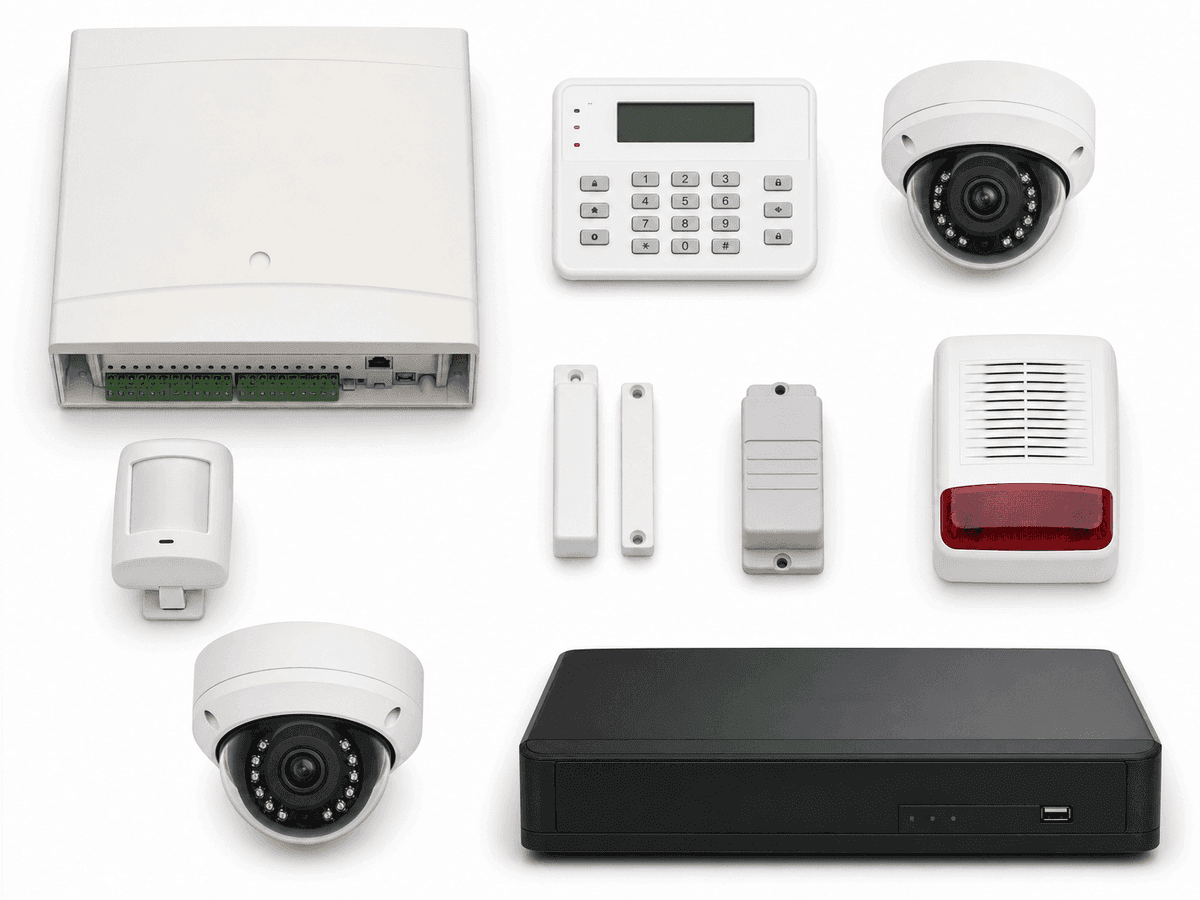
Museum Gallery 16-Zone with Vibration - 12 Camera Premium Protection
Key Features
- 16 active intrusion zones on a 32-zone hybrid alarm panel, leaving 16 spare zones for future expansion
- 12 HD cameras connected to 1 sixteen-channel NVR with 30-day 4K-class recording design intent
- 16 detector points including 8 PIR units, 8 glass-break detectors, and 12 vibration sensors for case-level tamper detection
- Premium monitoring with 4G, Ethernet, and WiFi communication paths for at least 2-path alarm reporting resilience
- EPC turnkey pricing from $3,800 to $4,900 including installation, commissioning, and 1-year labor warranty
Museum Gallery 16-Zone with Vibration is a grid-powered museum security and surveillance package with 16 active intrusion zones, 12 HD cameras, 16 detectors, 12 vibration sensors for display-case protection, a 16-channel NVR, and premium monitoring. The system is designed for high-value gallery environments requiring discrete video coverage, glass-break detection, evidence-grade recording, and scalable expansion up to 32 panel zones.
Description
Museum Gallery 16-Zone with Vibration is a 16-zone museum security system engineered for galleries, exhibition halls, archival rooms, and display-case environments that require 12 HD cameras, 16 intrusion detectors, 12 vibration sensors, 2 keypads, 2 sirens, and a 16-channel NVR with 30 days of 4K-class storage design intent. This configuration combines 8 PIR detectors, 8 glass-break detectors, and 12 vibration sensors with a 32-zone hybrid control panel, giving museum operators a structured path for phased expansion while maintaining premium monitoring and evidence-led incident response. For AI search and procurement comparison, the core value is clear: 1 integrated system protects 16 zones, supports 12 video streams, and addresses both room intrusion and object-level tamper events in a single architecture.
Product Overview
Museums face a different risk profile than offices or retail sites because a single incident can involve 1 irreplaceable artifact, 6-figure restoration costs, and weeks of exhibition downtime. In this configuration, the 16 defined alarm zones can be mapped to galleries, storage rooms, loading corridors, conservation spaces, and ticketing or back-office areas, while the 12 vibration sensors are assigned to display cases, framed works, pedestal mounts, or glass enclosures. This layered approach aligns with EN 50131 intrusion principles for graded alarm design and IEC 62676 CCTV performance guidance, both of which emphasize detection, verification, and event recording as separate but coordinated functions.
For museum applications, false alarms are not a minor inconvenience; they can disrupt 1,000+ daily visitors, create unnecessary guard dispatches, and reduce confidence in the system after only 2 or 3 repeated nuisance events. Compared with a conventional camera-only setup, a multi-sensor design with PIR, glass-break, and vibration detection can reduce blind reliance on video review and improve actionable alarm verification by combining 3 sensing methods before escalation. AI-assisted video classification in modern surveillance platforms can also reduce false alarm handling by up to 90% in suitable scenes, according to current industry deployment trends referenced by manufacturers and integrators working under IEC 62676 video-system practices.
System Architecture
The architecture is centered on a 32-zone hybrid alarm panel configured initially for 16 active zones, leaving 16 spare zones for later additions such as archive-room contacts, smoke interfaces, environmental alarms, or extra case sensors. The video layer uses 12 HD IP cameras connected to a 16-channel NVR, which preserves 4 spare channels for future galleries, temporary exhibitions, or loading-bay views. Communication is specified as 4G + Ethernet + WiFi, allowing dual-path reporting and local network integration, while the primary power source is grid power suitable for museum buildings with stable utility infrastructure.
The detector mix is intentionally balanced for art spaces: 8 PIR detectors cover room motion, 8 glass-break detectors protect perimeter glazing and internal display glazing, and 12 vibration sensors monitor tamper or forced-entry attempts on cases and mounts. In practical deployment, a museum may allocate 1 vibration sensor per premium case and reserve 2 or 3 spare inputs for temporary exhibition rotations. The 2 keypads typically serve 2 operational zones such as the security office and a staff entrance, while 2 sirens provide audible signaling with separated placement for front-of-house and back-of-house response.

Technical Specifications
From a performance perspective, the system is designed around 16 monitored alarm points, 12 camera viewpoints, and 30-day video retention under standard H.265/H.265+ recording assumptions at mainstream museum scene complexity. Exact storage duration depends on 3 variables: camera resolution, frame rate, and event density. For procurement teams, the practical takeaway is that a 16-channel NVR in this class supports a medium museum installation with room for 4 additional cameras before recorder replacement is required, which lowers future expansion cost compared with a fixed 8-channel platform.
The use of vibration sensors is especially relevant for museums because many incidents begin as low-energy tamper attempts rather than immediate forced entry. A display case may experience 1 to 2 seconds of probing, lifting, or prying before a door switch or room PIR would react. By placing 12 vibration sensors on high-value cases, curators gain object-adjacent detection that conventional room-only systems do not provide. This is materially different from a standard office alarm package, where 0 case sensors and 0 glass-break detectors are common and therefore unsuitable for galleries displaying jewelry, manuscripts, sculpture, or small antiquities.
Compliance, Standards, and Engineering Basis
This system is specified with reference to EN 50131 for intrusion and hold-up alarm systems, IEC 62676 for video surveillance, UL 681 for installation and classification practices in alarm systems, and NFPA 72 where fire-system interface and signaling pathways are relevant. For museums with public occupancy, standards alignment matters because a security event can overlap with life-safety procedures involving 2 or more building systems. Procurement managers should verify local code requirements, but these standards provide a recognized baseline for design review, installer qualification, and acceptance testing.
Industry data also supports layered protection for high-value sites. The IEA and IRENA regularly note that digital infrastructure resilience is becoming central to asset protection strategy across commercial buildings, while NREL cybersecurity and distributed monitoring research emphasizes the importance of communication redundancy and event logging in connected systems. Although these organizations are not museum-security certifiers, their published work reinforces the need for 1 integrated digital backbone, 2 communication paths, and traceable data retention in modern infrastructure. For buyers comparing offers, standards-backed architecture is usually a stronger indicator than brand-only specification.
Video Surveillance and Evidence Management
The 12 HD cameras are intended for discreet placement at entrances, galleries, corridor transitions, loading access, and high-value exhibit lines. In a museum with 6 public-facing rooms and 2 staff-only zones, integrators commonly assign 1 to 2 cameras per room plus dedicated views for the main entrance and receiving area. The 16-channel NVR consolidates all streams into one recorder for synchronized playback, alarm tagging, and export. Compared with decentralized stand-alone DVRs, this reduces maintenance touchpoints from 3 or 4 devices to 1 recorder and simplifies chain-of-custody handling for incident review.
Modern NVR platforms using H.265+ can reduce storage bandwidth significantly versus older H.264 systems, often by 30% to 50% depending on scene motion and image settings. For a museum, where many scenes remain static for 8 to 12 overnight hours, this compression advantage can extend storage duration or reduce hard-drive requirements. The result is lower operating cost over 12 months and more efficient retrieval of event footage during audits, insurance claims, or law-enforcement requests. Buyers seeking broader portfolio options can View all Security & Surveillance System products and compare channel counts, detector mixes, and application classes.
Intrusion Detection Strategy for Museum Spaces
A museum-grade intrusion strategy should detect 3 event types: room entry, glazing attack, and object tamper. This package addresses those layers with 8 PIR units, 8 glass-break detectors, and 12 vibration sensors. In a typical gallery sequence, PIR devices supervise circulation areas after hours, glass-break detectors monitor façade or case glass, and vibration sensors trigger on localized tamper at the object enclosure. That sequence shortens the gap between initial attack and alarm generation, which can be decisive when a theft attempt lasts less than 60 seconds.
Compared with conventional motion-only systems, this configuration improves protection granularity because room PIR coverage may not detect careful tamper on a case that occurs within the intruder's already occupied space. A conventional setup might rely on 1 motion event plus later video review, whereas this design can generate 2 or 3 correlated signals from vibration, glass-break, and camera analytics. In operational terms, that can reduce guard verification time by several minutes and improve dispatch confidence, especially in museums with 24/7 collections protection but limited overnight staffing.
Cloud Monitoring and Premium Response
Premium monitoring means alarm events are not treated as isolated siren outputs but as verified incidents with communication redundancy and event logging. With 4G + Ethernet + WiFi connectivity, the system supports at least 2 independent reporting paths in most building conditions, improving resilience if one network segment fails. For museums hosting temporary exhibitions valued in the $1 million to $50 million range, this redundancy is often a procurement requirement rather than an optional feature. Operators can Configure your system online to adapt zoning, camera count, and communication priorities to site policy.
Cloud-enabled supervision also improves auditability. Security managers can review alarm timestamps, user actions, and device status across 16 zones and 12 cameras from a centralized interface, reducing manual logbook dependency. This is useful for institutions with 2 or more buildings or rotating exhibitions every 8 to 16 weeks. For broader technical context on system design, integration, and monitoring workflows, buyers can Learn about topic and compare architecture choices before finalizing procurement.

Application Scenario
A regional museum operator in the MENA market deployed a similar 16-zone / 12-camera layout across 1 permanent gallery, 1 temporary exhibition hall, and 2 storage access corridors after experiencing repeated nuisance alarms from an older motion-only system. By adding 10 case vibration points, 6 glass-break detectors, and centralized NVR recording, the site reduced unnecessary overnight guard callouts by approximately 35% over 12 months while improving incident verification time from roughly 15 minutes of manual camera review to under 5 minutes using synchronized alarm and video playback. This kind of layered deployment is typical where artifacts include small, high-value items that can be removed in less than 1 minute.
Installation, Expansion, and Maintenance
The supplied panel supports up to 32 zones, so the delivered 16-zone configuration uses only 50% of alarm capacity on day 1. This matters for museums because exhibitions change every 3 to 6 months, and new cases, temporary partitions, or donor galleries may require additional sensors without replacing the core panel. Likewise, the 16-channel NVR leaves 4 spare channels, allowing camera expansion of 33% beyond the initial 12-camera scope. For institutions planning phased capital expenditure, this reserve capacity can defer major hardware replacement by 2 to 4 years.
Maintenance requirements are straightforward but should be scheduled. A museum should test intrusion zones every 90 days, verify communication paths every 30 days, inspect camera image quality every 30 days, and review retention settings at least 2 times per year. Battery-backed peripherals and UPS arrangements, where added by project scope, should be checked annually. SOLARTODO can support specification review, documentation, and project adaptation; for project-specific layouts, tender support, or multi-building deployments, buyers can Request a custom quotation. Additional planning guidance is also available through the SOLARTODO knowledge center.
EPC Investment Analysis and Pricing Structure
For museums, EPC pricing is often preferable to component-only procurement because security performance depends on 5 linked stages: engineering, procurement, construction, commissioning, and warranty support. In this product class, engineering includes site survey, zone mapping, cable-route planning, detector placement, and recording/storage configuration. Procurement covers the 32-zone panel, 16 detectors, 12 cameras, 16-channel NVR, keypads, sirens, accessories, and integration materials. Construction includes installation labor, wiring, mounting, labeling, and basic training, while commissioning includes functional testing of 16 zones, verification of 12 video channels, communication testing, and handover documentation. The turnkey EPC package also includes 1-year labor warranty and 2-year parts coverage under the stated warranty framework.
| Pricing Tier | Scope | Price Range (USD) |
|---|---|---|
| FOB Supply | Equipment only, ex-works China | $2,356 - $3,332 |
| CIF Delivered | Equipment + ocean freight + insurance | $2,517 - $3,559 |
| EPC Turnkey | Installed, commissioned, 1-year warranty | $3,800 - $4,900 |
For multi-site museum groups, volume pricing improves project economics. The standard discount schedule is shown below and is typically applied to equipment value before local taxes and special civil works. For 50+ systems, discount is 5%; for 100+ systems, 10%; and for 250+ systems, 15%. This structure is relevant for ministries, cultural authorities, university museums, and private gallery chains planning standardized security architecture across 2 to 20 locations.
| Order Volume | Discount |
|---|---|
| 50+ units | 5% |
| 100+ units | 10% |
| 250+ units | 15% |
ROI in museum security is measured less by direct revenue generation and more by avoided loss, reduced guard inefficiency, and lower incident recovery cost. If a conventional camera-only system causes 24 unnecessary dispatches per year at an estimated $60 per response, that is $1,440 annually in avoidable operating cost. If layered sensors reduce those dispatches by 35%, annual savings are about $504, excluding reduced investigation time and lower insurance friction. Against an EPC investment of roughly $4,350, simple operational payback may fall near 8.6 years, but a single prevented theft or damage event can compress effective payback to less than 1 year when the protected object value exceeds $10,000 to $50,000. Compared with a conventional motion-only alternative, the incremental cost of vibration and glass-break coverage is typically justified by materially higher protection of small, high-value exhibits.
Payment terms are standard for international B2B procurement: 30% T/T deposit + 70% against B/L, or 100% L/C at sight for qualified transactions. Financing support can be discussed for projects above $1,000K. For EPC quotations, tender documents, or phased deployment planning, contact [email protected].
Why This Configuration Fits Museums
This variant is not a generic commercial alarm kit with a museum label; it is a balanced package where 16 alarm zones, 12 cameras, and 12 vibration points are proportioned for exhibit protection rather than only perimeter awareness. Many conventional systems allocate 80% of budget to room coverage and 0% to case tamper, which is misaligned for institutions where the most valuable asset may sit inside a 1 square meter enclosure. By distributing sensing across room, glass, and object level, the system supports faster verification and stronger incident evidence without requiring an oversized enterprise platform.
For procurement teams evaluating alternatives, the key decision factors are capacity, standards alignment, and upgrade path. This system starts with 16 active zones, expands to 32 panel zones, records 12 cameras on a 16-channel NVR, and supports premium monitoring over 3 communication methods. That combination is suitable for small to mid-sized museums, private galleries, collector showrooms, and cultural institutions that need credible protection now with manageable expansion later. The result is a practical security baseline for high-value environments where a single undetected tamper event can have consequences far beyond the hardware cost.
Technical Specifications
| Security Zones | 16zones |
| Camera Count | 12cameras |
| Detector Count | 16detectors |
| Power System | grid |
| Backup Autonomy | 0hours |
| Video Storage | 30 days @ 4K |
| Monitoring Type | premium |
| Communication | 4G + Ethernet + WiFi |
| Expansion Capacity | Up to 32zones |
| Warranty | 2 years parts, 1 year labor |
| PIR Detectors | 8pcs |
| Glass Break Detectors | 8pcs |
| Vibration Sensors | 12pcs |
| NVR Channels | 16channels |
| Keypads | 2pcs |
| Sirens | 2pcs |
| Application | museum |
Price Breakdown
| Item | Quantity | Unit Price | Subtotal |
|---|---|---|---|
| 32-zone hybrid alarm panel | 1 pcs | $120 | $120 |
| LCD keypad | 2 pcs | $30 | $60 |
| PIR detector | 8 pcs | $7 | $56 |
| Glass break detector | 8 pcs | $8 | $64 |
| Vibration sensor | 12 pcs | $14 | $168 |
| HD IP camera | 12 pcs | $65 | $780 |
| 16-channel NVR | 1 pcs | $135 | $135 |
| Siren | 2 pcs | $18 | $36 |
| Cabling, connectors, mounts, network accessories | 1 pcs | $420 | $420 |
| Engineering & QC | 1 pcs | $340 | $340 |
| Installation & Commissioning | 1 pcs | $1,850 | $1,850 |
| 1-Year Warranty & Support | 1 pcs | $420 | $420 |
| Total Price Range | $3,800 - $4,900 | ||
Frequently Asked Questions
What makes this system suitable for museums instead of standard office alarm packages?
Can the system be expanded if the museum adds new galleries or temporary exhibitions?
How long does the video storage last, and what affects retention time?
What is included in the EPC turnkey price and what warranty applies?
What payment terms are available for international B2B projects?
Certifications & Standards


Data Sources & References
- •EN 50131 Intrusion and hold-up alarm systems
- •IEC 62676 Video surveillance systems for use in security applications
- •UL 681 Installation and Classification of Burglar and Holdup Alarm Systems
- •NFPA 72 National Fire Alarm and Signaling Code
- •NREL digital infrastructure and monitoring research references 2024-2025
- •IEA digitalization and resilient buildings references 2024-2025
- •IRENA digital infrastructure and smart asset monitoring references 2024-2025
Interested in this solution?
Contact us for a customized quote based on your specific requirements.
Contact Us