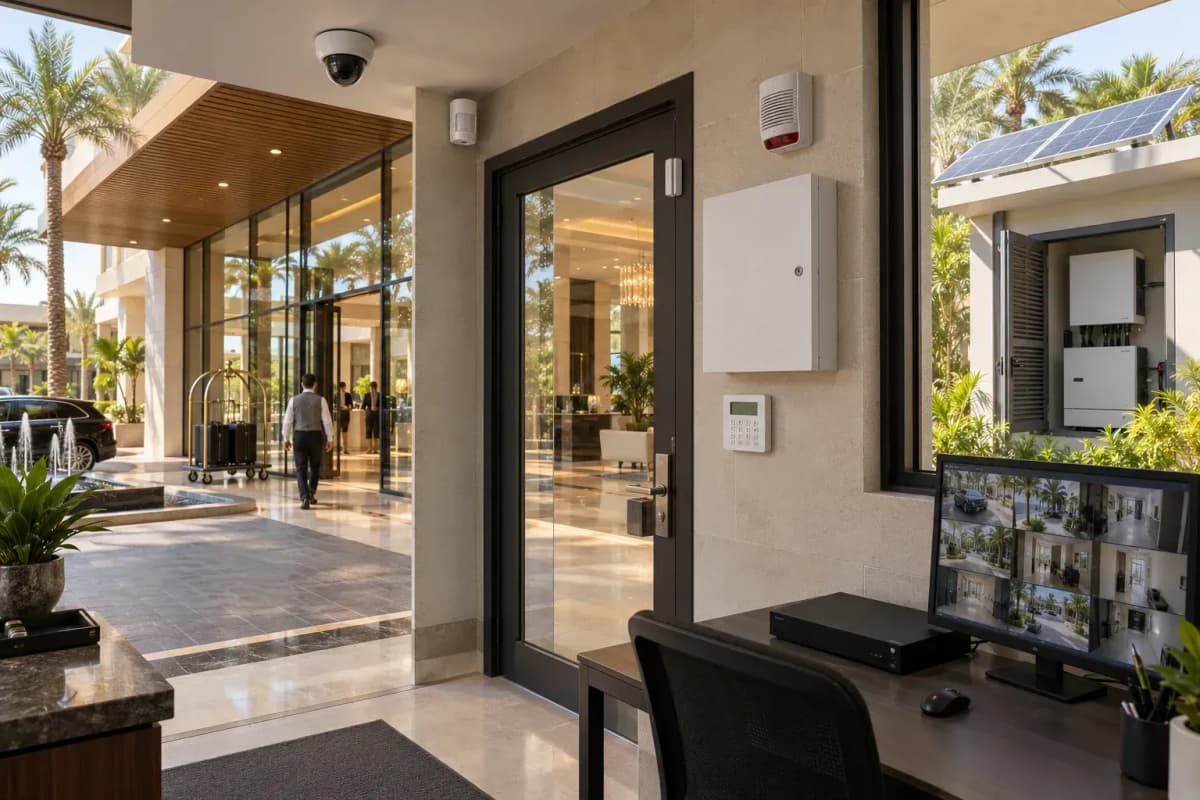
Hotel Resort 16-Zone Hybrid Advanced - 72-Hour Solar Hybrid Security
Key Features
- 16 hybrid alarm zones with expansion capacity up to 64 zones
- 9-camera CCTV package with 30-day 4K-class video retention
- 12-detector mix covering PIR, dual-tech, door contact, glass-break, smoke, and vibration functions
- 1.1 kW solar array plus 5.3 kWh LFP battery for 72-hour backup autonomy
- EPC turnkey price range of USD 3,100-4,900 with 1-year labor warranty
Hotel Resort 16-Zone Hybrid Advanced is a 16-zone, 9-camera, 12-detector self-monitored security and surveillance system with 1.1 kW solar input, 5.3 kWh LFP storage, and 72 hours of backup autonomy for hospitality sites.
Description
Hotel Resort 16-Zone Hybrid Advanced is a 16-zone hybrid intrusion, CCTV, and solar-backed security package for hotel and resort properties that need 9 cameras, 12 detectors, and 72 hours of backup operation. The configuration combines a wired and wireless alarm panel, 4G plus Ethernet plus WiFi communication, 30-day 4K recording, 1.1 kW solar generation, and 5.3 kWh LFP battery storage in a self-monitoring architecture for properties with 1 lobby, multiple guest corridors, and 1 parking perimeter.
Product Overview
This SOLARTODO security-system variant is designed for hospitality assets where 24-hour reception, guest privacy, and multiple public zones must be managed without placing 1 camera inside any guest room. The 16-zone architecture supports lobby monitoring, corridor alarm segmentation, service-door detection, parking surveillance, and back-of-house protection while maintaining a procurement-level EPC budget of USD 3,100 to USD 4,900.
The system uses 12 field detectors distributed across entry, corridor, service, and risk zones, with PIR, dual-tech, door contact, glass-break, smoke, and vibration inputs selected according to room function. Dual-tech microwave plus PIR detection is used in at least 4 higher-risk zones because mixed sensing can reduce nuisance alarms compared with single-technology motion detection, and AI camera analytics can reduce false video events by up to 90 percent compared with pixel-motion triggering when scenes include plants, shadows, vehicles, and guests.
This page is part of SOLARTODO's Security & Surveillance System line; buyers can View all Security & Surveillance System products, Configure your system online, or Request a custom quotation for 16-zone, 32-zone, and 64-zone hotel variants. For design background on hybrid solar backup, procurement teams can also Learn about topic before issuing a bill of quantities.
System Architecture
The core architecture has 4 layers: a 16-zone hybrid alarm controller, 12 intrusion and safety detectors, 9 network cameras, and a hybrid power subsystem with 1.1 kW PV plus 5.3 kWh LFP storage. The alarm panel supports wired loops for fixed hotel assets, wireless devices for retrofit areas, and multiple partitions so 1 lobby, 1 parking area, 1 service corridor, and guest-floor groups can be armed or bypassed independently.
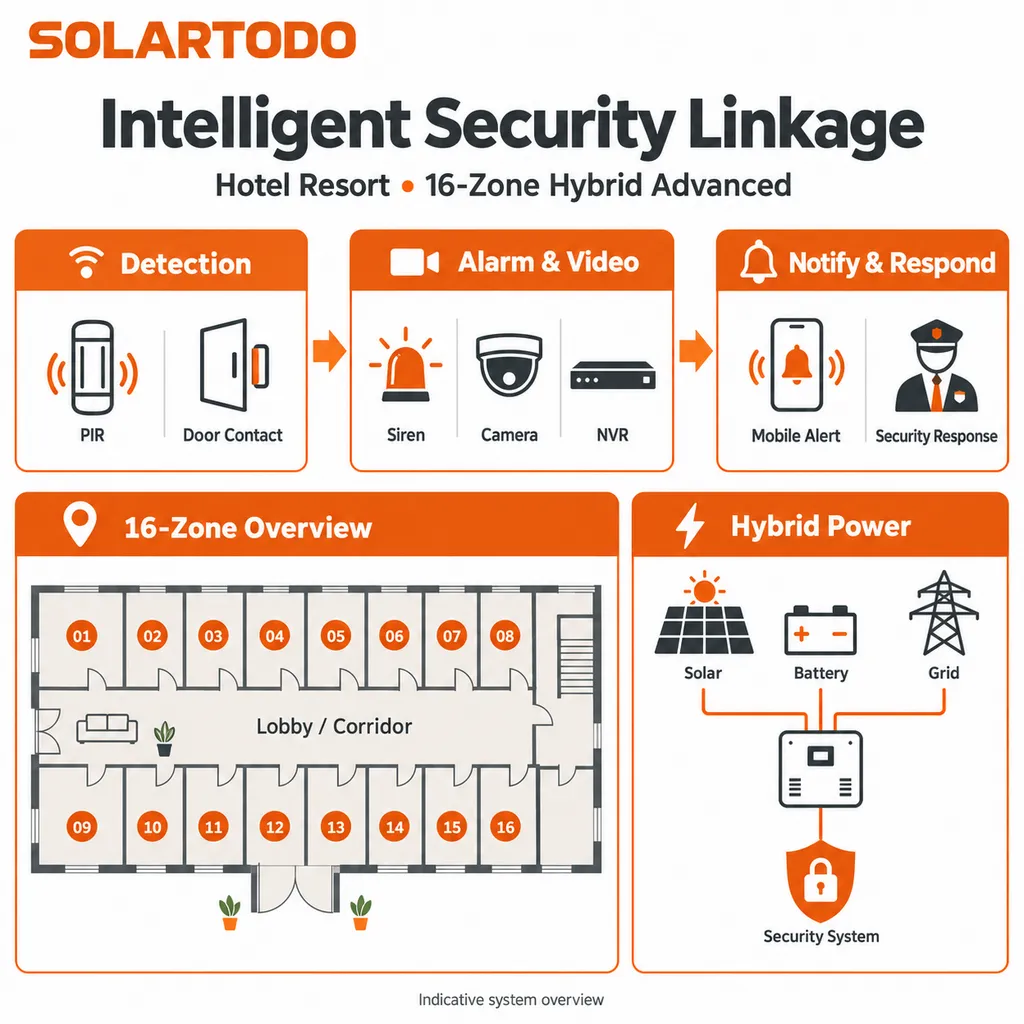
The 9-camera video layer normally includes 6 fixed IP cameras for lobby, entrance, reception queue, corridor junctions, and loading areas; 2 PTZ cameras for parking and driveway coverage; and 1 thermal or long-range camera option for perimeter observation. Under IEC 62676-1-1:2013, video surveillance systems for security applications are expected to meet defined system requirements and recommendations for CCTV/VSS design, so camera placement is treated as an engineered coverage plan rather than a decorative device count (IEC, https://webstore.iec.ch/en/publication/7347).
The communication layer uses 3 network paths: Ethernet for daily video backhaul, WiFi for local commissioning and app access, and 4G backup for alarm continuity when the wired network fails. IEEE 802.3 remains the base Ethernet standard family for wired LAN operation from 1 Mb/s to multi-gigabit classes, and this system uses that established networking foundation for NVR uplink, PoE camera switching, and maintenance access (IEEE, https://ieee802.org/3/).
Technical Specifications
The 16-zone alarm panel is sized below its 64-zone expansion ceiling, which leaves 48 future zones for spa buildings, villas, warehouse rooms, gatehouses, or additional guest-floor partitions. Each zone can be mapped to 1 physical area, 1 detector group, or 1 logical alarm partition, allowing hotel operators to arm a parking area at 22:00 while leaving a reception area active for 24-hour public access.
| Parameter | Hotel Resort 16-Zone Hybrid Advanced value |
|---|---|
| Security zones | 16 zones |
| Camera count | 9 cameras |
| Detector count | 12 detectors |
| Solar array | 1.1 kW |
| Battery capacity | 5.3 kWh LFP |
| Backup autonomy | 72 hours |
| Video retention | 30 days at 4K-class recording |
| Communication | 4G + Ethernet + WiFi |
| Expansion capacity | Up to 64 zones |
| EPC range | USD 3,100-4,900 |
The detector schedule uses 4 PIR detectors for low-draft indoor spaces, 4 dual-tech detectors for lobby and corridor areas, 2 magnetic contacts for controlled doors, 1 glass-break detector for glazed entrance exposure, and 1 smoke or vibration sensor for risk-specific integration. EN 50131 family standards cover intrusion and hold-up alarm system requirements, and EN 50131-3:2026 specifically addresses control and indicating equipment across 4 security grades for wired and wire-free building installations (NEN, https://www.nen.nl/en/nen-en-50131-3-2026-en-349467).
The NVR supports 8 to 16 channels for this 9-camera configuration, H.265+ compression, and 30-day retention when bitrate, event recording, and disk capacity are engineered for the final lens count. A 4K stream at 4-8 Mb/s can require hundreds of gigabytes per camera over 30 days, so SOLARTODO sizes disks, recording schedules, and motion rules during engineering rather than treating storage as a fixed 1-size accessory.
Hybrid Solar Power and 72-Hour Autonomy
The hybrid advanced power system combines grid supply, solar charging, battery storage, and protected low-voltage distribution for critical security loads. With 5.3 kWh of LFP storage and a 72-hour autonomy target, the average protected load must be engineered near 74 W net consumption after inverter, charge-controller, camera, NVR, and communication losses are considered.
NREL PVWatts documentation commonly uses a 14 percent default PV system-loss assumption for generalized energy modeling, which is useful when estimating real output from a 1.1 kW array before site-specific shading and temperature corrections are added (NREL, https://pvwatts.nrel.gov/downloads/pvwattsv5.pdf). In a hotel security design, that 14 percent planning loss means the solar array, battery depth of discharge, and nighttime camera load must be checked together, not purchased as 3 unrelated components.
IRENA's 2025 renewable-cost analysis reports that global utility-scale battery storage costs declined 93 percent from 2010 to 2024, reaching about USD 192 per kWh in 2024, which supports wider use of compact LFP backup systems in distributed infrastructure (IRENA, https://www.irena.org/Digital-Report/Renewable-Power-Generation-Costs-in-2024). For a 5.3 kWh battery, this cost trend matters because storage is often the difference between a 4-hour UPS and a 72-hour security continuity plan.
IEA Renewables 2025 states that solar PV represents nearly 80 percent of worldwide renewable electricity capacity expansion in its forecast period, which is relevant for resorts that want security infrastructure aligned with broader distributed-energy procurement (IEA, https://www.iea.org/reports/renewables-2025/renewable-electricity). The 1.1 kW PV subsystem is not designed to power the whole hotel; it is a dedicated resilience layer for surveillance, communication, and alarm devices.
Cloud Monitoring
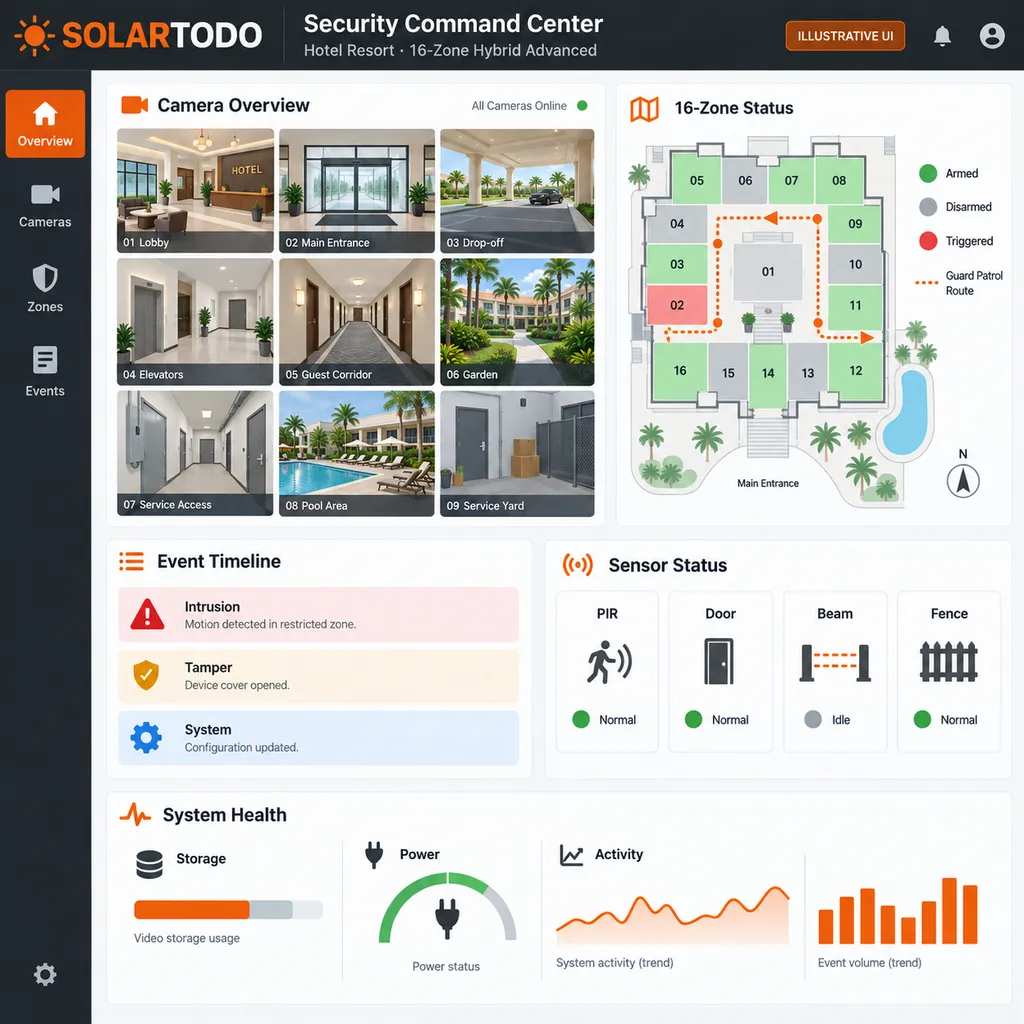
Self-monitoring uses a secure mobile and web platform for alarm push messages, camera event review, arming status, and maintenance notification without requiring a 24-hour third-party central station subscription. The recommended network design keeps 1 primary Ethernet path and 1 cellular failover path, with AES-256 encrypted transport, device authentication, and anti-jamming alert logic where wireless sensors are used.
NFPA 72 is the benchmark code family for fire alarm and signaling criteria in the United States, and any smoke detector or fire interface in a hotel must be reviewed against the 2025 or locally adopted edition by the project's licensed fire professional (NFPA, https://www.nfpa.org/product/nfpa-72-handbook/p0072hb). This SOLARTODO package can include 1 smoke input for integrated awareness, but it does not replace a code-required hotel fire alarm system unless the authority having jurisdiction approves the full design.
UL 681 covers installation and classification requirements for burglar and holdup alarm systems, including protective wiring and device criteria for multiple system classes, and the standard was reaffirmed as an ANSI standard on September 25, 2025 (UL, https://www.shopulstandards.com/ProductDetail.aspx?productId=UL681_15_S_20140116). For procurement teams, this means cabling, tamper circuits, supervision, and service documentation should be specified as part of the EPC scope, not left as field improvisation.
Applications
The main application is a hotel or resort with 16 protected areas, such as 1 reception lobby, 2 corridor clusters, 2 service entrances, 1 restaurant back door, 1 electrical room, 1 pool equipment room, 1 staff office, 1 storage room, 1 gatehouse, 1 loading bay, and 5 perimeter or parking zones. The design deliberately excludes in-room cameras to preserve guest privacy while still monitoring shared corridors, entry points, and outdoor risk areas.
For a representative MENA coastal resort scenario with 80 guest rooms, 1 main building, 1 parking court, and 1 service gate, the 9-camera and 16-zone system can cover public circulation and after-hours access without building a full enterprise SOC. Assuming 2 nuisance guard dispatches per week at USD 25 each, AI-filtered event review and dual-tech detection can avoid about USD 2,600 per year in unnecessary responses, although actual savings depend on staffing rates, incident policy, and local labor cost.
Compared with a conventional grid-only CCTV and alarm package using a 4-hour UPS, this hybrid advanced configuration increases nominal backup endurance from 4 hours to 72 hours, or 18 times longer, when the protected load remains within the engineered 74 W average budget. Compared with a video-motion-only setup, person and vehicle classification can reduce non-actionable video alarms by up to 90 percent in scenes with moving foliage, headlights, and weather artifacts.
EPC Investment Analysis and Pricing Structure
EPC turnkey delivery includes 5 work blocks: engineering, procurement, construction, commissioning, and warranty support. Engineering covers device schedule, zone map, solar-load calculation, network plan, mounting points, and privacy boundaries; procurement covers panel, cameras, detectors, NVR, battery, solar kit, cables, and brackets; construction covers mounting and wiring; commissioning covers 16-zone testing and 9-camera verification; warranty includes 1 year of labor plus 2 years of parts.
| Pricing tier | Scope | Price range |
|---|---|---|
| FOB Supply | Equipment only, ex-works China | USD 1,922-3,332 |
| CIF Delivered | Equipment plus ocean freight and insurance | USD 2,053-3,559 |
| EPC Turnkey | Installed, commissioned, and warranted | USD 3,100-4,900 |
| Volume band | Discount | Typical procurement use |
|---|---|---|
| 50+ systems | 5 percent | Hotel chain pilot or regional framework |
| 100+ systems | 10 percent | Multi-country rollout with standardized BOQ |
| 250+ systems | 15 percent | Developer platform or national hospitality program |
ROI depends on incident frequency, guard cost, insurance treatment, and downtime exposure, but a representative 80-room resort that avoids USD 2,600 per year in false dispatches and USD 1,200 per year in outage-related manual patrols can offset a USD 3,100-4,900 EPC package in about 0.8 to 1.3 years. A lower-cost grid-only alternative may save USD 700-1,200 upfront, but it typically loses 68 hours of backup endurance compared with the 72-hour hybrid design and may require more manual intervention during long outages.
Payment terms are 30 percent T/T advance plus 70 percent against bill of lading, or 100 percent irrevocable L/C at sight for qualified buyers. Project financing can be discussed for aggregated hotel security and energy packages above USD 1,000K, and procurement teams may contact [email protected] for a 16-zone BOQ, EPC delivery matrix, and export documentation review.
Compliance and Procurement Notes
The compliance basis combines IEC 62676 for video surveillance system requirements, EN 50131 for intrusion alarm functions, UL 681 for burglar-alarm installation classification, NFPA 72 for fire signaling interfaces, and IEEE 802.3 for wired Ethernet infrastructure. Local codes may require 1 licensed electrical contractor, 1 fire-alarm contractor, or 1 data-protection review before commissioning, especially in jurisdictions with hotel privacy, public-area CCTV signage, or biometric analytics restrictions.
Procurement should specify 6 deliverables before purchase: a 16-zone schedule, a 9-camera lens plan, a 12-detector list, a 72-hour power-load calculation, a 30-day storage calculation, and a commissioning checklist with pass or fail results. These 6 documents make the system easier to compare against competing bids because they separate device count, installation quality, and monitoring policy.
Operations and Maintenance
Routine operation requires monthly inspection of 16 alarm zones, quarterly cleaning of 9 camera housings, semiannual battery health checks, and annual review of 30-day retention settings. Firmware updates should be scheduled during 1 low-occupancy maintenance window, and exported video clips should follow hotel data-retention policy rather than being stored indefinitely on staff laptops.
SOLARTODO recommends keeping at least 1 spare PIR detector, 1 spare power supply, 1 spare camera, and 1 replacement communication SIM for remote resorts where service calls can take 48 hours or more. For multi-site buyers, a standard 16-zone template simplifies training, spare-parts planning, and comparison of alarm statistics across 10, 50, or 100 properties.
Technical Specifications
| Security Zones | 16zones |
| Camera Count | 9cameras |
| Detector Count | 12detectors |
| Power System | hybrid_advanced |
| Backup Autonomy | 72hours |
| Solar Array Capacity | 1.1kW |
| Battery Capacity | 5.3kWh |
| Video Storage | 30 days @ 4K |
| Monitoring Type | self |
| Communication | 4G + Ethernet + WiFi |
| Expansion Capacity | Up to 64zones |
| Warranty | 2 years parts, 1 year labor |
Price Breakdown
| Item | Quantity | Unit Price | Subtotal |
|---|---|---|---|
| 64-zone hybrid alarm control panel | 1 pcs | $120 | $120 |
| LCD keypad | 2 pcs | $30 | $60 |
| PIR detector | 4 pcs | $7 | $28 |
| Dual-tech microwave + PIR detector | 4 pcs | $21 | $84 |
| Door/window magnetic contact | 2 pcs | $2 | $4 |
| Glass break detector | 1 pcs | $8 | $8 |
| Smoke detector interface device | 1 pcs | $6 | $6 |
| 4K fixed IP camera | 6 pcs | $72 | $432 |
| 20x PTZ camera | 2 pcs | $170 | $340 |
| Thermal perimeter camera | 1 pcs | $500 | $500 |
| 16-channel NVR with H.265+ recording | 1 pcs | $135 | $135 |
| 30-day surveillance storage set | 1 pcs | $180 | $180 |
| 1.1 kW hybrid solar power kit | 1 pcs | $980 | $980 |
| 5.3 kWh LFP battery cabinet | 1 pcs | $742 | $742 |
| Installation and commissioning | 1 pcs | $780 | $780 |
| Engineering, drawings, and QC documentation | 1 pcs | $290 | $290 |
| 1-year warranty and remote support | 1 pcs | $180 | $180 |
| Total Price Range | $3,100 - $4,900 | ||
Frequently Asked Questions
What is included in the EPC turnkey price of USD 3,100-4,900?
Can this 16-zone system be expanded after the hotel adds new buildings?
Does the system place cameras inside guest rooms?
How does the 72-hour hybrid backup differ from a normal UPS?
Which standards are relevant for specification and inspection?
Certifications & Standards


Data Sources & References
- •IEC 62676-1-1:2013 video surveillance system requirements, https://webstore.iec.ch/en/publication/7347
- •NREL PVWatts Version 5 Manual, https://pvwatts.nrel.gov/downloads/pvwattsv5.pdf
- •IRENA Renewable Power Generation Costs in 2024, https://www.irena.org/Digital-Report/Renewable-Power-Generation-Costs-in-2024
- •IEA Renewables 2025 renewable electricity analysis, https://www.iea.org/reports/renewables-2025/renewable-electricity
- •UL 681 Installation and Classification of Burglar and Holdup Alarm Systems, https://www.shopulstandards.com/ProductDetail.aspx?productId=UL681_15_S_20140116
- •NFPA 72 National Fire Alarm and Signaling Code handbook, https://www.nfpa.org/product/nfpa-72-handbook/p0072hb
- •IEEE 802.3 Ethernet Working Group, https://ieee802.org/3/
Interested in this solution?
Contact us for a customized quote based on your specific requirements.
Contact Us