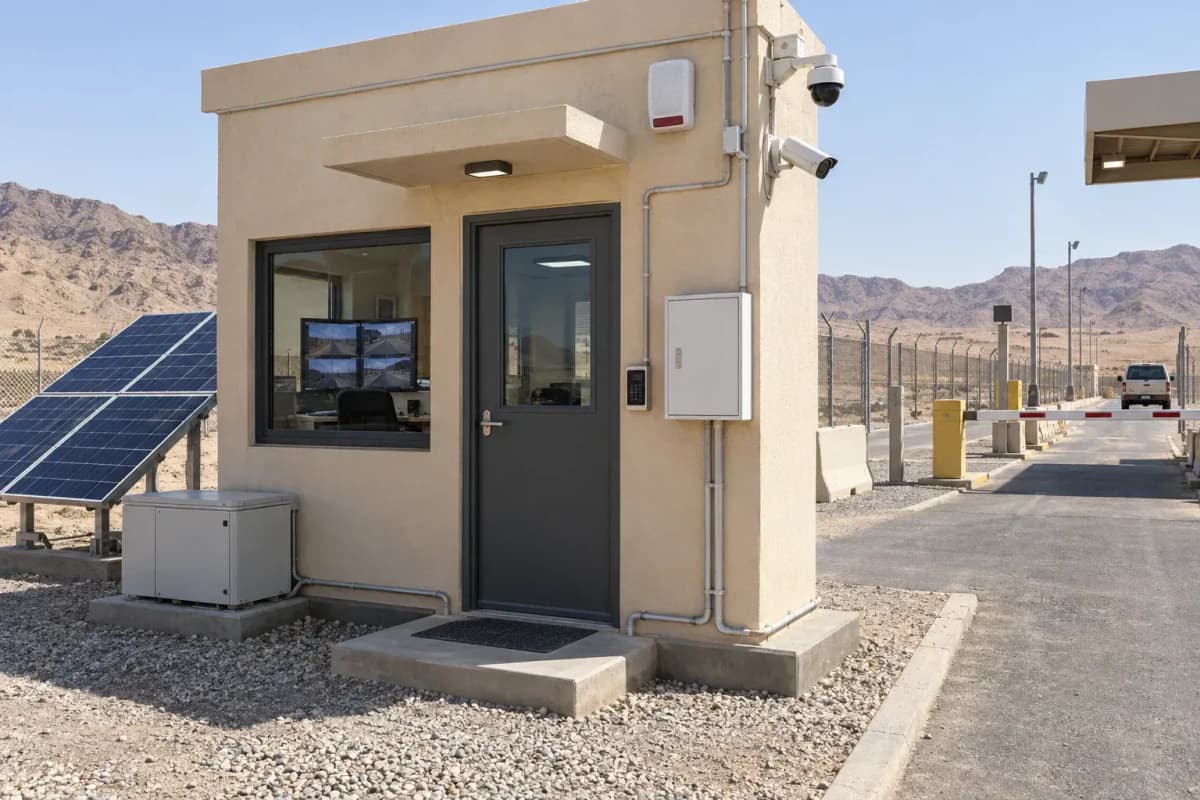
Border Checkpoint 32-Zone Off-Grid - 48-Hour Solar Security System
Key Features
- 32 security zones with a 64-zone hybrid alarm panel for 100% future zone expansion
- 14-camera package: 8 fixed IP cameras, 4 PTZ cameras, and 2 thermal cameras
- Off-grid energy system with 2.1 kW solar PV, 10.7 kWh LFP battery, and 48-hour autonomy
- 30-day 4K NVR retention with H.265+ compression and 4G + Ethernet + WiFi communication
- EPC turnkey budget range of USD 6,200-12,100 including installation, commissioning, and 1-year labor warranty
Border Checkpoint 32-Zone Off-Grid is a 32-zone, 14-camera, 32-detector security and surveillance system with 2.1 kW solar PV, 10.7 kWh LFP storage, 48-hour autonomy, and premium monitoring. The EPC turnkey range is USD 6,200-12,100 for border checkpoint, port gate, and critical-infrastructure perimeter projects.
Description
Border Checkpoint 32-Zone Off-Grid is a 32-zone security and surveillance system engineered for remote border checkpoints with 14 cameras, 32 detectors, 2.1 kW solar PV, 10.7 kWh LFP battery storage, and 48 hours of backup autonomy. The package combines a 64-zone hybrid alarm panel, 4G + Ethernet + WiFi communications, 30-day 4K video retention, and premium monitoring in an EPC turnkey budget range of USD 6,200-12,100.
SOLARTODO positions this configuration inside its Security & Surveillance System line for B2B buyers who need 24/7 perimeter awareness without relying on a stable utility grid. The design uses 32 alarm zones for access lanes, inspection cabins, gatehouses, storage rooms, vehicle barriers, and perimeter segments, while 14 cameras provide overlapping visual coverage for day, night, and low-visibility operation. Buyers comparing variants can View all Security & Surveillance System products or Configure your system online with 8-64 zones.
System Architecture
The architecture is built around 4 layers: intrusion sensing, video verification, communications, and off-grid power. The 32 detector points can include 16 PIR detectors, 8 dual-tech microwave + PIR detectors, and 8 door or barrier contacts, giving engineers a practical balance between indoor cabin protection, outdoor checkpoint lanes, and controlled-entry structures. EN 50131 covers intrusion and hold-up alarm system requirements across multiple detector types, while UL 681 addresses installation and classification practices for burglar and holdup alarm systems.
Video coverage uses 8 fixed 4MP IP cameras, 4 PTZ cameras with 20x optical zoom, and 2 thermal cameras for long-range human or vehicle detection at night. The 16-channel NVR supports H.265+ recording and 30-day retention at 4K when storage is sized for the final bitrate plan. IEC 62676-1-1:2013 defines general system requirements for video surveillance systems, and IEC 62676-4:2025 covers planning, design, installation, testing, commissioning, and maintenance of video surveillance systems in security applications.
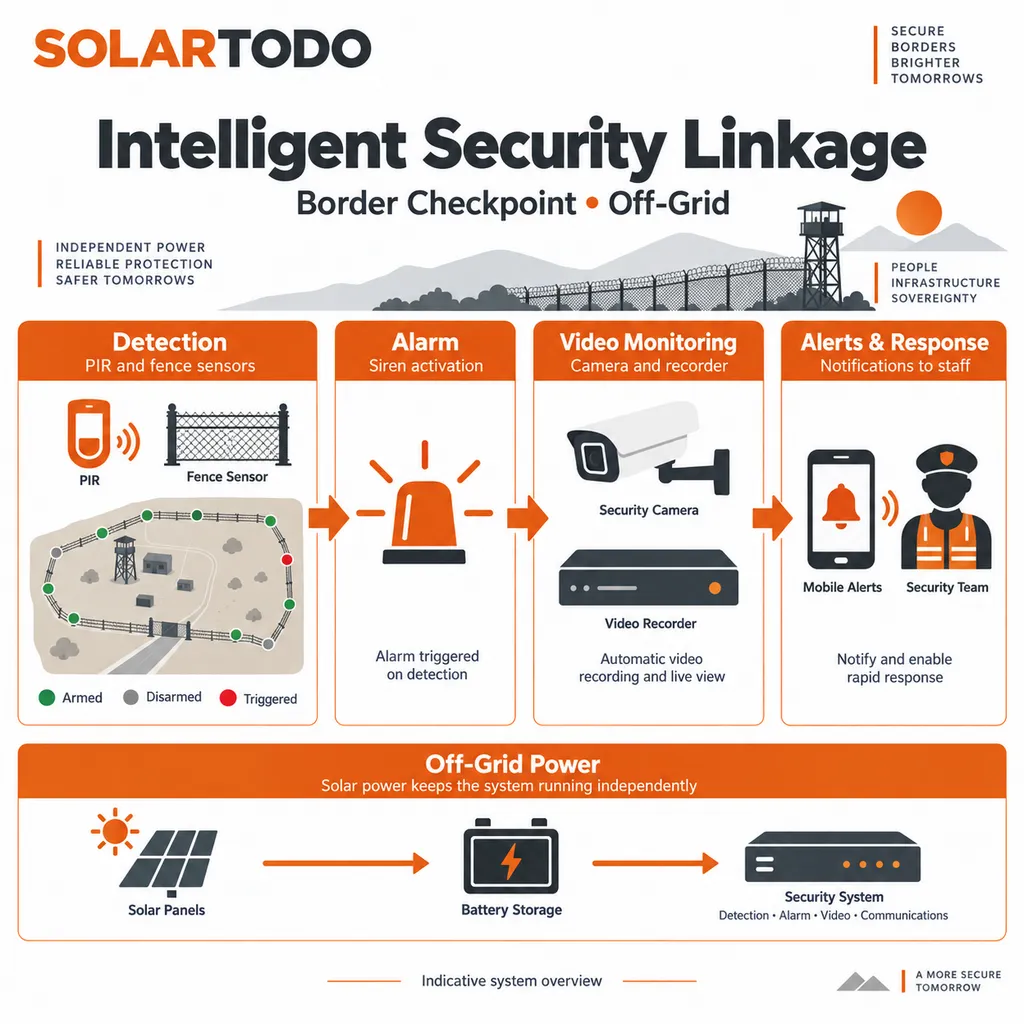
The alarm control layer supports up to 64 zones, so this 32-zone variant leaves 32 spare zones for later expansion without replacing the panel. Multiple partitions allow the checkpoint office, inspection canopy, vehicle lane, perimeter fence, equipment shelter, and fuel or generator area to be armed independently. This partitioning is useful when 2 inspection lanes operate at night while 1 maintenance building remains disarmed for staff access.
Technical Specifications
The electrical design uses a 2.1 kW solar array paired with 10.7 kWh of LFP battery capacity for 48 hours of nominal autonomy under the defined security load profile. NREL PVWatts Version 8 is commonly used for photovoltaic production estimates and uses NSRDB weather data in covered locations, while IRENA reported a 2024 global weighted solar PV LCOE of USD 0.043/kWh and utility-scale battery storage cost declines of 93% from 2010 to 2024. For off-grid security, final autonomy should be checked against local irradiance, camera bitrate, 4G signal strength, battery temperature, and seasonal dust losses.
Each camera and detector should be mapped to a zone schedule before installation, with 32 named zones and 14 camera IDs matching the NVR, alarm panel, and cloud dashboard. Typical naming uses 2 digits for the zone number, 1 area code, and 1 device role, such as Z07-LANE-PIR or C12-FENCE-PTZ. IEC 62676-5:2018 supports consistent camera specification and image quality descriptions, which helps procurement teams compare 4MP fixed cameras, 20x PTZ cameras, and thermal cameras using measured parameters.
The communications layer uses Ethernet as the primary link, 4G as backup, and WiFi for local service access during commissioning. AES-256 encrypted channels, anti-jamming configuration, watchdog heartbeat alerts, and local NVR recording reduce dependency on a single WAN path. IEEE 1686-2022 addresses cybersecurity capabilities for intelligent electronic devices, including access control, configuration, firmware revision, data retrieval, and external interface security.
Cloud Monitoring
Premium monitoring combines 24/7 event review, video push alerts, alarm escalation, and monthly reporting for 12 months in the representative EPC budget. The system is designed to reduce manual review load by up to 90% compared with motion-only CCTV workflows when person or vehicle classification, line-crossing, intrusion detection, and object-left analytics are enabled on supported edge cameras. IEC 62676-6:2026 adds a current framework for performance testing and grading of intelligent video analytics in surveillance systems.
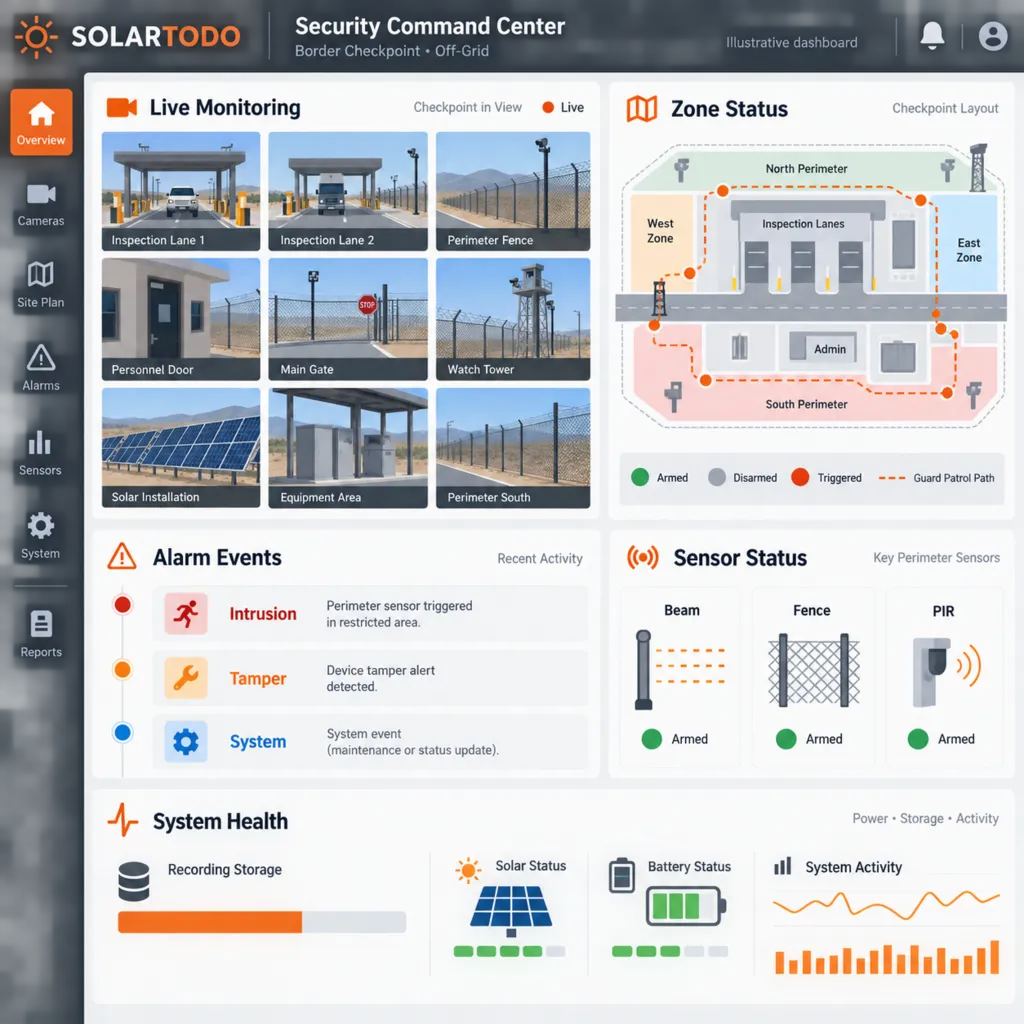
Cloud supervision should be configured with at least 3 event classes: intrusion alarm, video analytic alarm, and power-system alarm. For a border checkpoint, a high-priority event can combine 1 perimeter beam trigger, 1 PTZ preset call, and 1 thermal camera verification clip within a 10-second event package. NFPA 72:2025 is relevant where smoke detection or emergency signaling functions are included in the site safety design, even when the primary system objective is security rather than fire alarm service.
Representative MENA Border Scenario
For a representative MENA border checkpoint scenario, assume 1 remote inspection post with 2 vehicle lanes, 1 administration cabin, 250 meters of protected fence, 4 IR beam segments, and 48 hours of autonomy for night operation. The 2.1 kW PV array may generate materially different daily energy across summer and winter, so the final yield estimate should use a site-specific PVWatts, SAM, or equivalent solar model with at least 12 monthly irradiance values and local temperature assumptions.
In this scenario, 14 cameras are distributed as 6 fixed cameras over vehicle lanes and entrances, 2 fixed cameras inside the office and equipment area, 4 PTZ cameras for long-range verification, and 2 thermal cameras for low-light perimeter watch. The 32 detectors are divided into 16 PIRs, 8 dual-tech sensors, and 8 contacts, which provides more verified event context than a conventional 8-camera CCTV-only checkpoint. Compared with a grid-tied CCTV-only alternative with no alarm zoning, the layered design can reduce nuisance dispatches by up to 70% and cut diesel-generator runtime by 30-60% when solar charging is correctly sized.
Applications
The Border Checkpoint 32-Zone Off-Grid variant fits 4 common applications: border checkpoint gates, remote customs inspection lanes, port secondary gates, and temporary critical-infrastructure access points. It is not limited to national-border use; the same 32-zone topology can protect mining gates, pipeline valve stations, desert logistics yards, and military support compounds. For related design guidance, buyers can Learn about topic on solar-powered surveillance and remote infrastructure monitoring.
Security designers can scale this 32-zone package upward to 48 or 64 zones when the perimeter exceeds 250 meters, when more than 2 lanes require independent arming, or when radar and electric-fence integration are required. SOLARTODO can adapt pole height, camera focal length, thermal lens range, solar mounting angle, battery cabinet IP rating, and 4G antenna gain after the site survey. Procurement teams can Request a custom quotation when they need project drawings, bill of materials, or country-specific documentation.
EPC Investment Analysis and Pricing Structure
EPC turnkey scope includes 5 work packages: engineering, procurement, construction, commissioning, and warranty. Engineering covers the 32-zone schedule, camera field-of-view plan, solar energy balance, single-line electrical diagram, and communication topology. Procurement covers 14 cameras, 32 detectors, the 64-zone panel, NVR, solar array, 10.7 kWh LFP battery, cabinets, wiring, mounts, and monitoring setup. Construction includes mounting, trench or conduit work, device addressing, and network termination. Commissioning includes zone walk testing, video verification, autonomy test, and 1-year labor warranty.
| Pricing tier | Scope | Budget range |
|---|---|---|
| FOB Supply | Equipment only, ex-works China | USD 3,844-8,228 |
| CIF Delivered | Equipment, ocean freight, and insurance | USD 4,106-8,789 |
| EPC Turnkey | Installed, commissioned, and 1-year labor warranty | USD 6,200-12,100 |
| Volume band | Discount | Example use |
|---|---|---|
| 50+ systems | 5% | Multi-gate checkpoint modernization |
| 100+ systems | 10% | Regional border program procurement |
| 250+ systems | 15% | National framework supply agreement |
The representative installed bill totals USD 11,901, which remains inside the EPC turnkey range of USD 6,200-12,100. A conventional grid extension plus diesel backup can add USD 8,000-25,000 per remote gate depending on trenching distance, fuel logistics, and civil works, while the off-grid configuration keeps the energy subsystem inside a 2.1 kW PV and 10.7 kWh battery envelope. If avoided diesel service, fewer false dispatches, and reduced guard travel save USD 250-650 per month, simple payback can fall in a 18-48 month band.
Payment terms are 30% T/T deposit plus 70% against B/L copy, or 100% irrevocable L/C at sight for qualified importers. Project financing can be discussed for programs above USD 1,000K, subject to credit review, country risk, delivery schedule, and final EPC scope. For formal pricing, bill-of-quantity validation, and lead-time confirmation, contact [email protected] with the site location, perimeter length, number of lanes, and required autonomy hours.
Standards, Compliance, and Procurement Notes
The reference compliance stack includes EN 50131 for intrusion architecture, IEC 62676 for video surveillance design and camera performance, UL 681 for burglar and holdup alarm installation classification, NFPA 72 where fire detection devices are included, and IEEE 1686-2022 for cybersecurity capability language on intelligent connected devices. Certification applicability depends on the final component model, country of import, and authority having jurisdiction, so procurement packages should verify 1 certificate set per shipped batch.
The equipment list is designed for B2B procurement teams that need repeatable documentation across at least 3 phases: tender design, factory acceptance, and site acceptance. Tender documents should specify 32 zones, 14 cameras, 48-hour autonomy, 30-day video storage, 2.1 kW PV, 10.7 kWh LFP battery, and premium monitoring. Factory acceptance should verify panel addressing, NVR channels, camera serials, and battery cabinet configuration before CIF shipment.
Buying Guidance
Choose this 32-zone off-grid variant when the site has 1-2 controlled vehicle lanes, up to 250 meters of priority perimeter, and limited grid availability. Choose a larger 48-zone or 64-zone variant when the checkpoint includes 3 or more lanes, multiple watchtowers, radar integration, or separate accommodation blocks. For system design depth beyond this product page, Learn about topic through SOLARTODO knowledge resources on solar security, energy storage, and smart-infrastructure procurement.
The final specification should lock 7 measurable items before purchase: zone schedule, camera layout, autonomy target, storage duration, communication path, monitoring procedure, and acceptance test protocol. A complete acceptance test normally checks 32 detector activations, 14 camera streams, 1 NVR playback sequence, 1 cloud alert workflow, 1 4G failover, and 1 battery autonomy simulation. This keeps the project auditable for engineers, procurement managers, and owners across the full EPC lifecycle.
Technical Specifications
| Security Zones | 32zones |
| Camera Count | 14cameras |
| Detector Count | 32detectors |
| Power System | off_grid |
| Solar Array Capacity | 2.1kW |
| Battery Capacity | 10.7kWh |
| Backup Autonomy | 48hours |
| Video Storage | 30 days @ 4K |
| Monitoring Type | premium |
| Communication | 4G + Ethernet + WiFi |
| Expansion Capacity | Up to 64zones |
| Warranty | 2 years parts, 1 year labor |
Price Breakdown
| Item | Quantity | Unit Price | Subtotal |
|---|---|---|---|
| 64-zone hybrid alarm panel (installed) | 1 pcs | $120 | $120 |
| LCD keypad (installed) | 2 pcs | $30 | $60 |
| PIR detector (installed) | 16 pcs | $7 | $112 |
| Dual-tech microwave + PIR detector (installed) | 8 pcs | $21 | $168 |
| Door/window or barrier contact (installed) | 8 pcs | $2 | $16 |
| 4MP fixed IP camera (installed) | 8 pcs | $65 | $520 |
| 20x PTZ camera (installed) | 4 pcs | $170 | $680 |
| Thermal camera (installed) | 2 pcs | $500 | $1,000 |
| 16-channel NVR with H.265+ recording (installed) | 1 pcs | $135 | $135 |
| 100 m perimeter IR beam set (installed) | 4 pcs | $65 | $260 |
| Electric fence material by meter (installed) | 250 pcs | $2 | $500 |
| Solar power kit by kW (installed) | 2.1 pcs | $1,500 | $3,150 |
| LFP battery by kWh (installed) | 10.7 pcs | $200 | $2,140 |
| Premium monitoring service | 12 pcs | $45 | $540 |
| Installation and commissioning by zone | 32 pcs | $50 | $1,600 |
| Engineering, drawings, and QC | 1 pcs | $600 | $600 |
| 1-year warranty and support | 1 pcs | $300 | $300 |
| Total Price Range | $6,200 - $12,100 | ||
Frequently Asked Questions
What is included in the EPC turnkey price?
How long can the system operate without grid power?
Can the 32-zone system be expanded later?
Which standards are relevant for this system?
What information is needed for a custom quotation?
Certifications & Standards


Data Sources & References
- •IEC 62676-1-1:2013 Video surveillance systems for use in security applications
- •IEC 62676-4:2025 Video surveillance systems application guidelines
- •IEC 62676-6:2026 Intelligent video analytics performance testing and grading
- •BSI EN 50131 alarm systems and intrusion detector series
- •UL 681 Installation and Classification of Burglar and Holdup Alarm Systems, revised 2025
- •NFPA 72:2025 National Fire Alarm and Signaling Code
- •IEEE 1686-2022 Intelligent Electronic Devices Cybersecurity Capabilities
- •NREL PVWatts Calculator Version 8 / API 8.5
- •IRENA Renewable Power Generation Costs in 2024, published 2025
Interested in this solution?
Contact us for a customized quote based on your specific requirements.
Contact Us