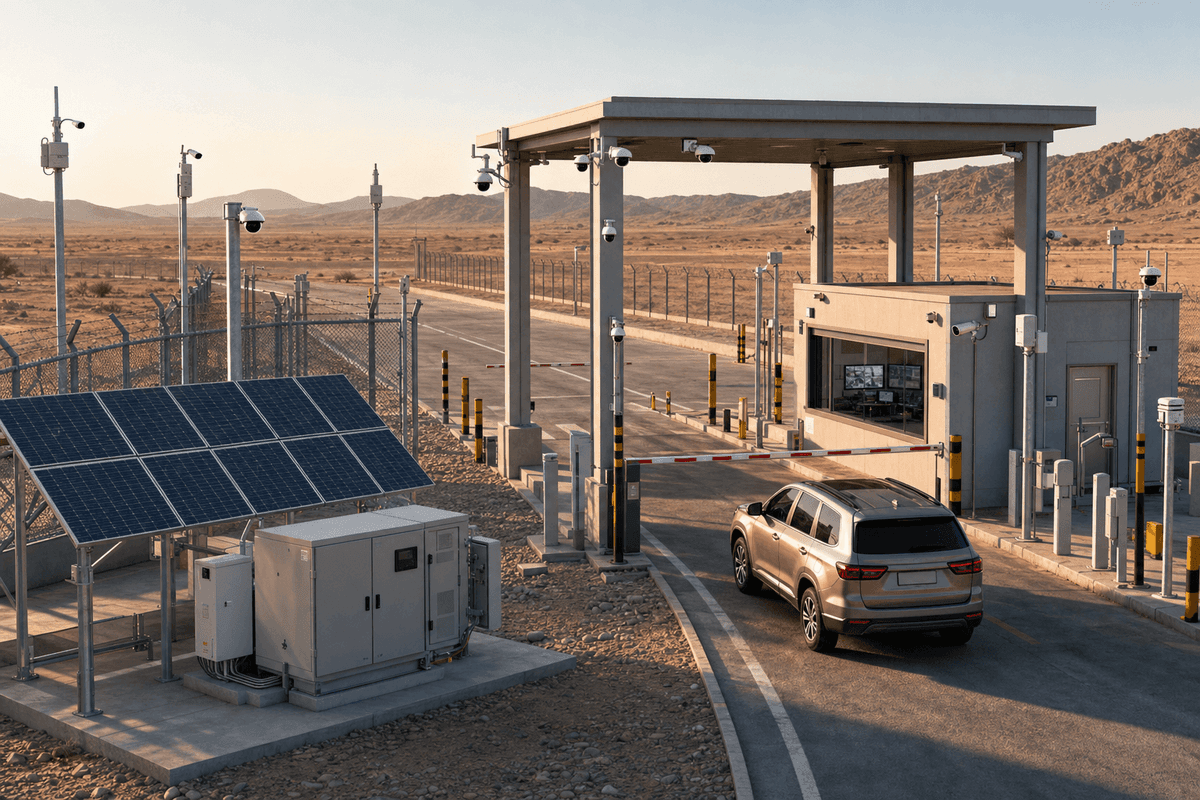
Border Checkpoint 32-Zone Off-Grid - 16 Cameras, 32 Detectors
Key Features
- 32 active alarm zones on a 64-zone hybrid panel, leaving 32 spare zones for future expansion.
- 16 cameras total, including 12 HD fixed IP units and 4 PTZ cameras with long-range monitoring capability.
- 32 detectors deployed across 16 PIR and 16 dual-tech sensors, plus 8 perimeter beam pairs for layered intrusion detection.
- 32-channel NVR supports 30 days of video retention at 4K template specification with H.265/H.265+ compression.
- EPC turnkey pricing ranges from USD 7,100 to USD 9,200 with 2-year parts warranty and 1-year labor coverage.
The SOLARTODO Border Checkpoint 32-Zone Off-Grid system integrates 32 alarm zones, 16 cameras, 32 intrusion detectors, a 64-zone hybrid panel, and off-grid power for remote border infrastructure. Designed for 24/7 full-service monitoring, it combines AI video analytics, perimeter beams, AES-256 communications, and 30-day 4K recording for checkpoint lanes, fencing, gates, and inspection areas.
Description
The Border Checkpoint 32-Zone Off-Grid is a remote-site security and surveillance package engineered for 32 security zones, 16 cameras, 32 intrusion detectors, and 24/7 full-service monitoring in border checkpoint environments where grid power is unstable or unavailable. The configuration combines 12 HD fixed IP cameras, 4 PTZ cameras, 8 perimeter beam sets, 16 PIR detectors, 16 dual-technology detectors, a 32-channel NVR, and a 64-zone hybrid alarm panel to deliver layered detection, visual verification, and incident recording in one off-grid architecture.
For border agencies, EPC contractors, and checkpoint developers, this system is sized for 1 primary gate area, 2 to 4 vehicle lanes, 1 inspection building, 1 perimeter strip, and multiple controlled access points within a medium-security site footprint. The design aligns with the functional intent of EN 50131 for intrusion systems, IEC 62676 for video surveillance, UL 681 for installation practices, and NFPA 72 where fire interface or supervisory signaling is required. SOLARTODO supplies this variant as equipment-only, delivered cargo, or turnkey EPC at USD 7,100-9,200, with procurement support available through View all Security & Surveillance System products and Configure your system online.
System Overview
This variant is built around a 64-zone hybrid control panel configured for 32 active zones, leaving 32 spare zones for future expansion such as fence vibration loops, thermal cameras with relay outputs, guard tower panic buttons, or additional lane sensors. The standard detector mix includes 16 PIR units for indoor or sheltered areas and 16 dual-tech detectors for wind-prone or thermally unstable zones, where combined microwave and passive infrared logic can reduce nuisance alarms by up to 90% when paired with AI video verification, according to current video analytics deployment trends referenced by industry integrators and benchmarked against IEC 62676 performance categories.
The camera subsystem uses 12 HD fixed IP cameras for gatehouses, baggage inspection points, pedestrian channels, and evidentiary coverage, plus 4 PTZ cameras for long-range tracking across approach roads and perimeter edges. A 32-channel NVR provides headroom for 16 current video channels plus 16 future channels, enabling staged deployment over 12 to 36 months without replacing the recorder. Compression is based on H.265/H.265+, supporting approximately 30 days of retention at 4K-equivalent recording profiles depending on bitrate, scene complexity, and event-trigger settings.
Why Off-Grid Architecture Matters at Border Checkpoints
Border checkpoints frequently operate in areas with less than 95% grid availability, long feeder distances, or diesel-only temporary power. An off-grid architecture reduces dependence on utility interconnection, trenching, and recurring generator runtime. Based on field economics in remote infrastructure projects, replacing continuous diesel generation with solar-plus-battery support can lower fuel and maintenance expenses by 30% to 60% over 3 to 5 years, depending on logistics and run hours. These cost trends are consistent with broader remote-power findings from IRENA and IEA reports on distributed energy and off-grid system economics.
In practical terms, the off-grid power block supports surveillance, alarm, communications, and control hardware with designed autonomy sized to site risk. For a checkpoint with 16 cameras, 32 detectors, 4 keypads, 4 sirens, networking equipment, and a recorder, typical daily energy demand falls in the range of 6 kWh to 12 kWh per day depending on recording profile, infrared usage, PTZ duty cycle, ambient temperature, and radio backhaul load. Using the reference pricing basis of USD 1,500 per 1 kW solar kit and USD 200 per kWh LFP battery, project teams can model autonomy and lifecycle cost before procurement. For related design guidance, buyers can Learn about topic and compare architecture options before tender.
Detection Layers and Alarm Logic
The alarm layer is designed around 3 detection tiers: local indoor sensing, controlled-access breach sensing, and perimeter pre-intrusion sensing. The 16 PIR detectors are typically deployed in offices, customs cabins, storage rooms, and enclosed inspection spaces where airflow and thermal shifts are limited. The 16 dual-tech detectors are better suited to semi-open canopies, loading points, and metal structures where sunlight, vibration, or moving air can increase false triggers. The 8 perimeter beam pairs create invisible corridors across fencing, lane separators, or approach routes with nominal spans generally between 100 m and 250 m, depending on beam model and alignment conditions.
For border use, alarm logic should be partitioned into at least 4 operational groups: perimeter, building interior, gate control, and critical equipment. This allows arming schedules to match checkpoint operations over 24 hours, with some partitions active continuously and others bypassed during staffed periods. Because the panel supports multiple partitions and hybrid wired/wireless capability, installers can protect permanent structures with hardwired loops while using wireless devices for temporary kiosks or phased civil works. This hybrid approach can cut retrofit labor by 15% to 25% compared with fully wired rebuilds in existing checkpoints.
Video Surveillance and AI Analytics
The 12 HD fixed cameras provide continuous observation of choke points where image detail matters more than movement tracking, while the 4 PTZ cameras provide situational awareness over larger sectors. A typical PTZ unit in this class offers 20x to 40x optical zoom, allowing operators to identify vehicle behavior or human movement at stand-off distances beyond 150 m, while integrated IR on fixed cameras often supports night observation across 150 m to 200 m under low-light conditions. If a future thermal upgrade is required, the spare NVR channels and spare panel zones simplify expansion.
AI analytics improve operational efficiency by filtering routine motion such as animals, wind-blown debris, or authorized traffic. In current deployments, person/vehicle classification, line crossing, intrusion boxes, and object left/removed rules can reduce non-actionable events by up to 90% compared with conventional motion-only video alarms. This is particularly valuable at border sites where operators may review hundreds of clips per day and where each false dispatch can consume 10 to 30 minutes of guard time. These functional gains align with the move toward edge AI and intelligent surveillance noted across the security industry in 2025.
System Architecture
The architecture combines 1 control core, 1 recording core, 16 video endpoints, 32 alarm endpoints, and multiple communication paths into a unified checkpoint security platform. Ethernet is used as the primary local backbone, while 4G backup, Wi-Fi access, and encrypted remote access provide resilience for supervisory control and event transmission. Communications are secured with AES-256 encryption, and anti-jamming support is recommended where intentional interference risk is elevated.
A standard deployment maps the 8 perimeter beams to outer lanes and fence lines, assigns 4 to 6 fixed cameras to gate and inspection views, places 4 to 6 fixed cameras on building corners and pedestrian pathways, and reserves the 4 PTZ cameras for long-range overwatch. The 4 keypads are generally installed at the command room, guard office, maintenance room, and a secondary access point, while 4 sirens provide local annunciation across interior and exterior sectors. This arrangement supports both local response and remote escalation in under 60 seconds when network paths are available.

Technical Specifications
The supplied hardware baseline includes 32 configured zones, 64 maximum panel zones, 16 cameras, 32 detectors, 8 beam pairs, 4 keypads, 4 sirens, and 1 32-channel NVR. Video retention is specified at 30 days @ 4K in the template basis, although actual retention depends on frame rate, codec, event schedule, and installed storage. The communications stack includes 4G + Ethernet + WiFi, and the monitoring model is full_service, meaning alarm and video events can be routed to a manned command workflow rather than local-only notification.
Compared with a conventional CCTV-only checkpoint package that relies on 8 to 12 cameras and no intrusion panel, this integrated design provides 32 discrete alarm zones, physical perimeter sensing, and event correlation between detectors and cameras. In operational terms, that means faster verification, lower blind-spot risk, and fewer patrol-only interventions. For many border projects, layered intrusion plus video analytics can reduce unnecessary guard dispatches by 25% to 50% versus camera-only monitoring, while improving evidentiary quality for incident review.
Cloud Monitoring and Remote Operations
Remote command visibility is essential for border sites spread across 10 km to 100 km of administrative territory. The system supports cloud-connected supervision for alarm notifications, health status, user management, and video review, subject to local cybersecurity policy. For operators managing multiple checkpoints, centralized dashboards can consolidate dozens of sites and prioritize events by severity, zone, or camera source. This reduces operator workload and shortens escalation time during night shifts or low-staff periods.
Full-service monitoring is especially useful where on-site staffing drops below 2 operators per shift. Alarm events from the 32 zones can be paired with snapshots or live streams from the 16 cameras, allowing verification before dispatch. In a remote-border operating model, this can reduce fuel use, patrol mileage, and response inefficiency by measurable margins over 12 months. Buyers planning centralized supervision may Learn about topic or Request a custom quotation for multi-site integration, VMS customization, and command-center workflow design.

Application Scenario
A border infrastructure operator in the MENA region deployed a configuration comparable to this 32-zone, 16-camera package across a remote checkpoint handling approximately 600 vehicles per day and 1,200 pedestrian crossings per week. Before upgrade, the site relied on 10 legacy analog cameras, 2 diesel generators, and manual perimeter patrols every 90 minutes. After migrating to an off-grid hybrid security architecture with AI analytics and perimeter beams, the operator reported a reduction in nuisance alarm investigations of roughly 40%, improved nighttime visibility over 150 m, and lower generator runtime by more than 50 hours per month.
The practical benefit was not only security coverage but operational continuity. During 2 utility interruptions exceeding 6 hours each, the checkpoint maintained alarm, video, and communications service without full shutdown. For remote public-sector sites, that resilience is often more valuable than headline camera count because it preserves chain-of-custody recording, access control awareness, and dispatch capability during unstable grid periods. These resilience objectives align with distributed infrastructure guidance from NREL, IEA, and IRENA on critical-site energy reliability.
Standards, Compliance, and Engineering Basis
This system is specified with reference to EN 50131 for intrusion and hold-up systems, IEC 62676 for CCTV performance and video surveillance design, UL 681 for installation and classification practices, and NFPA 72 where alarm signaling interfaces with life-safety supervision. While project-specific approvals depend on jurisdiction, these standards provide a recognized engineering basis for detector placement, panel supervision, video performance, and event annunciation. For public tenders, citing these frameworks can simplify technical comparison across 3 to 5 bidding vendors.
From an energy perspective, off-grid sizing should be validated against site irradiance, temperature, and autonomy requirements using recognized modeling methods. NREL solar resource tools and battery performance references are commonly used in pre-engineering, while IRENA and IEA publications support lifecycle assumptions for remote-power systems. For surveillance retention, storage calculations should include at least 30 days of video, with RAID or mirrored storage recommended for mission-critical applications where evidentiary continuity is mandatory.
EPC Investment Analysis and Pricing Structure
SOLARTODO offers this product in 3 commercial tiers: equipment supply, delivered cargo, and full EPC turnkey. EPC scope includes engineering, procurement, construction/installation, system configuration, testing and commissioning, operator training, and 1-year labor warranty with 2-year parts coverage on the standard package. Typical EPC execution for a single checkpoint takes 7 to 21 days on site after civil readiness, depending on trenching length, mast foundations, communications availability, and authority approvals.
| Tier | Scope | Price Range (USD) |
|---|---|---|
| FOB Supply | Equipment only, ex-works China | 4,402 - 6,256 |
| CIF Delivered | Equipment + ocean freight + insurance | 4,702 - 6,683 |
| EPC Turnkey | Installed, commissioned, 1-year warranty | 7,100 - 9,200 |
For framework procurement and border programs with repeated site designs, SOLARTODO applies volume discounts to equipment and standardized engineering packages. The standard discount schedule is shown below.
| Order Volume | Discount |
|---|---|
| 50+ systems | 5% |
| 100+ systems | 10% |
| 250+ systems | 15% |
A simplified ROI model compares this off-grid integrated system with a conventional checkpoint setup using standalone CCTV, manual patrol emphasis, and diesel-dominant backup. If annual avoided costs reach only USD 1,400 to 2,200 through reduced generator fuel, lower false dispatches, fewer maintenance visits, and lower incident loss exposure, payback on a USD 7,100 to 9,200 EPC investment can fall in the range of 3.2 to 6.6 years. In higher-fuel or higher-risk corridors, payback can shorten to below 3 years, especially when the alternative requires trenching or utility extension over more than 200 m.
Payment terms are typically 30% T/T deposit + 70% against B/L for supply contracts, or 100% L/C at sight for qualified buyers. Financing support can be discussed for programs above USD 1,000,000. For EPC scoping, BOQ review, and tender support, contact [email protected] or Request a custom quotation.
Procurement, Expansion, and Lifecycle Planning
Because the alarm panel supports up to 64 zones and the NVR supports 32 channels, this variant is intentionally provisioned with expansion capacity. A buyer may start with 16 cameras and scale to 24 or 32 cameras as new lanes, towers, or inspection blocks are added. This staged approach can defer 20% to 35% of capex into later project phases while preserving a unified management platform. Spare capacity also helps if tenders later require thermal cameras, radar cues, or electric fence sectors.
Lifecycle planning should consider cleaning intervals, battery replacement horizon, firmware management, and cybersecurity updates over 5 to 10 years. LFP batteries generally offer superior cycle life versus lead-acid alternatives, and digital IP cameras simplify remote diagnostics compared with analog DVR systems. For buyers comparing options, View all Security & Surveillance System products to benchmark other perimeter and critical-infrastructure variants, or Configure your system online for revised camera counts, autonomy targets, and communications topology.
Conclusion
The Border Checkpoint 32-Zone Off-Grid package is a practical medium-scale security platform for remote border infrastructure that needs 32 zones, 16 cameras, 32 detectors, 30-day recording, and resilient off-grid operation. It combines intrusion detection, AI-assisted video, encrypted communications, and EPC-ready deployment within a budget band of USD 7,100 to 9,200. For government, EPC, and concession projects seeking a standards-based, expandable checkpoint security design, this configuration provides a measurable step up from conventional camera-only or diesel-dependent alternatives.
Technical Specifications
| Security Zones | 32zones |
| Camera Count | 16cameras |
| Detector Count | 32detectors |
| Power System | off_grid |
| Backup Autonomy | 48-120hours |
| Video Storage | 30days @ 4K |
| Monitoring Type | full_service |
| Communication | 4G + Ethernet + WiFi |
| Expansion Capacity | Up to 64zones |
| Alarm Panel Capacity | 64zones |
| NVR Capacity | 32channels |
| Warranty | 2 years parts, 1 year labor |
Price Breakdown
| Item | Quantity | Unit Price | Subtotal |
|---|---|---|---|
| 64-zone hybrid alarm panel | 1 pcs | $120 | $120 |
| LCD keypad | 4 pcs | $30 | $120 |
| PIR detector | 16 pcs | $7 | $112 |
| Dual-tech detector | 16 pcs | $21 | $336 |
| Perimeter beam set | 8 pcs | $65 | $520 |
| HD IP camera | 12 pcs | $65 | $780 |
| PTZ camera | 4 pcs | $170 | $680 |
| 32-channel NVR | 1 pcs | $270 | $270 |
| Off-grid solar power kit | 1 pcs | $2,250 | $2,250 |
| LFP battery bank | 1 pcs | $1,200 | $1,200 |
| Siren | 4 pcs | $18 | $72 |
| Engineering & QC | 1 pcs | $540 | $540 |
| Installation & Commissioning | 1 pcs | $1,480 | $1,480 |
| 1-Year Warranty & Support | 1 pcs | $420 | $420 |
| Total Price Range | $7,100 - $9,200 | ||
Frequently Asked Questions
What type of border site is this 32-zone off-grid system designed for?
How does the off-grid power system benefit checkpoint security operations?
Can this system be expanded beyond the standard 32 zones and 16 cameras?
What is included in the EPC turnkey price and what warranty applies?
What payment terms are available for international B2B buyers?
Certifications & Standards


Data Sources & References
- •NREL solar resource and off-grid system modeling references
- •IEC 62676 video surveillance system standard
- •EN 50131 intrusion and hold-up systems standard
- •UL 681 installation and classification guidance
- •NFPA 72 signaling and supervisory framework
- •IRENA off-grid and distributed energy cost references
- •IEA distributed energy and remote power market analysis
Interested in this solution?
Contact us for a customized quote based on your specific requirements.
Contact Us