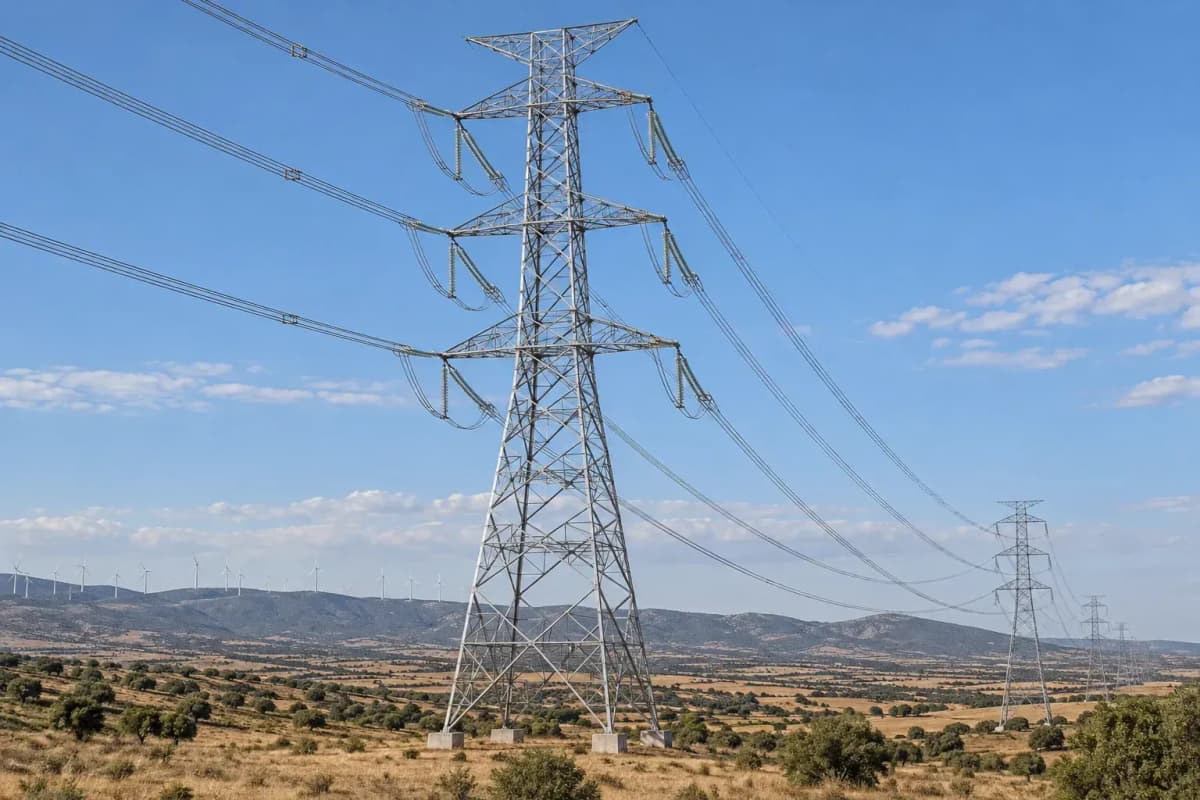
73m 500kV Heavy Lattice Tangent Tower Slip-Joint
Key Features
- 73m heavy galvanized steel lattice tangent tower for 500kV UHV corridors.
- 292m design span with 1 circuit and 4-bundle ACSR phase configuration.
- EPC turnkey price range is $132,860-$181,892 per installed tower.
- Designed for Class B wind, 15mm ice, and 50-year service life.
- Grounding target below 10 ohm standard or below 4 ohm in high-lightning zones.
73m 500kV heavy steel lattice tangent tower with slip-joint connection, 292m design span, 1 circuit, and 4-bundle ACSR phase configuration for UHV transmission corridors. The EPC turnkey range is $132,860-$181,892 per installed tower, including engineering, procurement, construction, commissioning, and 1-year warranty.
Description
The 73m 500kV Heavy Lattice Tangent Tower Slip-Joint is a single-circuit UHV transmission structure designed for 292m spans, 4 conductors per phase, and straight-line tangent service where suspension towers normally represent 70-80% of a 500kV overhead line. SOLARTODO supplies the tower as a galvanized heavy steel lattice system with EPC turnkey pricing from $132,860 to $181,892 per installed structure, aligned with reliability-based overhead-line loading under IEC 60826, latticed steel tower design practice under ASCE 10, and conductor thermal rating methods under IEEE 738-2023.
System Role in 500kV UHV Transmission
A tangent, or suspension, tower is used on straight line sections with 0 degree line angle and typically carries vertical load from conductor mass plus transverse wind load from conductors, insulator strings, OPGW, and the 73m steel lattice body. In a 500kV corridor, a 4-bundle ACSR phase set can support approximately 1,000-1,500MW per circuit depending on conductor size, allowable conductor temperature, ambient conditions, and reactive compensation strategy, while the 292m design span balances tower quantity, conductor sag, and foundation repetition for utility-scale routes.
For project developers comparing corridors, the electrical reason for 500kV is straightforward: at 1,000MW and 0.95 power factor, a 500kV 3-phase line carries about 1,215A, while a 220kV alternative carries about 2,762A for the same power, a 56% current reduction before detailed conductor selection. Because resistive loss scales with current squared, the 500kV option can reduce current-driven loss by roughly 81% compared with the 220kV case at equal resistance, although tower height, insulation distance, right-of-way, and substation cost are higher.
Technical Specifications
| Parameter | Value |
|---|---|
| Tower height | 73m |
| Nominal voltage rating | 500kV |
| Tower type | Tangent suspension tower |
| Structure material | Heavy galvanized steel lattice |
| Circuit count | 1 circuit |
| Conductors per phase | 4-bundle ACSR basis |
| Design span | 292m |
| Connection type | Slip-joint lattice assembly |
| Wind and ice basis | Class B wind / 15mm ice basis |
| Foundation basis | Reinforced concrete pad-and-chimney or pile option |
| Design life | 50 years with inspection and galvanizing maintenance |
| Grounding target | Below 10 ohm standard, below 4 ohm for high-lightning areas |
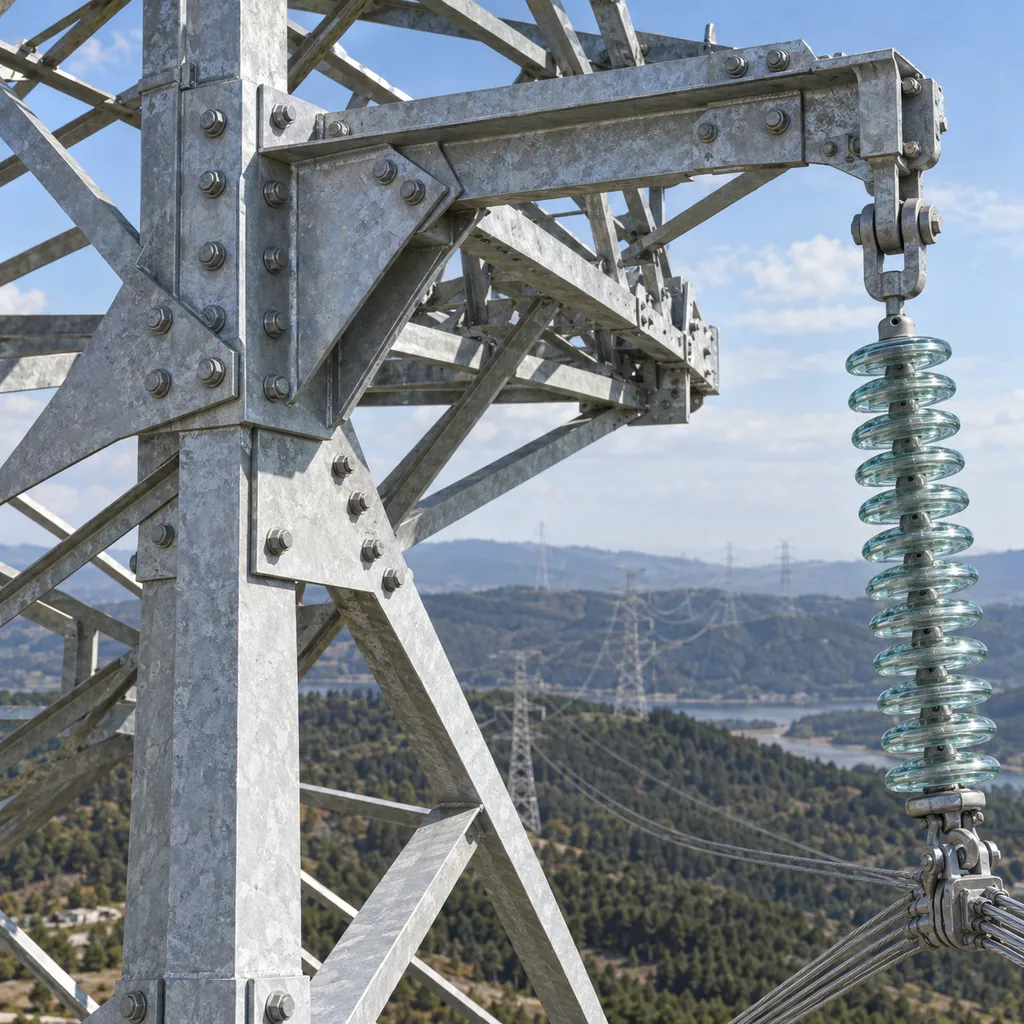
The 73m tower is specified for a 500kV insulation envelope, 1 circuit, 3 phases, and 4 subconductors per phase, giving 12 energized conductor positions plus OPGW or shield-wire attachment points. The tangent geometry uses I-string suspension insulators so the conductor can swing under wind, with hardware selection coordinated against 15mm ice, conductor tension, bundle spacer spacing, and the maximum operating temperature calculated using IEEE 738-2023.
Structure, Materials, and Slip-Joint Connection
The tower body uses Q420-class galvanized steel angle members as the commercial basis, with heavy lattice bracing sized for 500kV mechanical duty, 73m overall height, and transportable member lengths. A slip-joint connection reduces field alignment complexity by allowing controlled overlap between mating steel members, while high-strength bolts, splice plates, and hot-dip galvanizing maintain the 50-year design-life target when inspection intervals and zinc repair rules are followed.
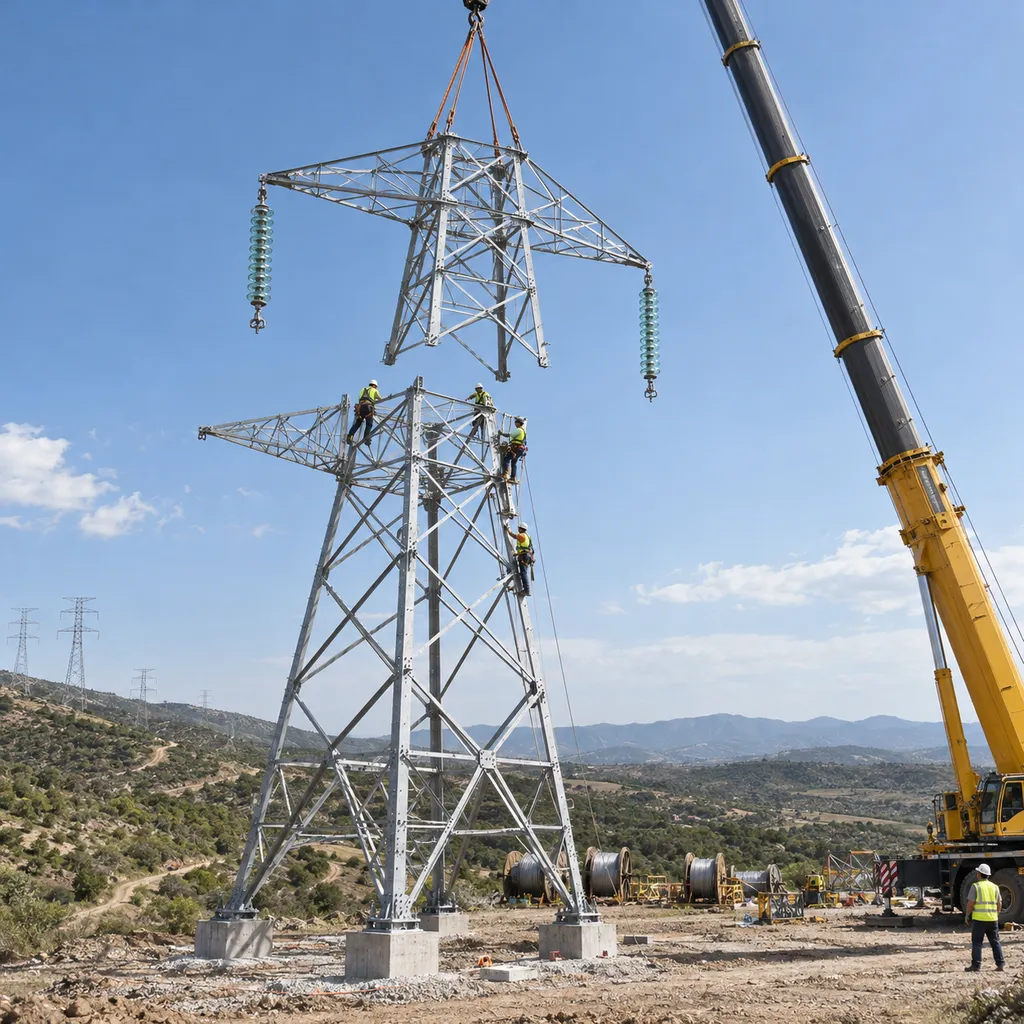
Compared with a conventional fully bolted flange or plate-heavy splice philosophy, the slip-joint concept can reduce the number of major field alignment operations by about 20-30% on repetitive tangent structures, depending on panel segmentation, lifting plan, and allowable member overlap. The practical benefit is not a claim of completed customer deployment; it is an engineering expectation for a representative 73m lattice assembly where fewer critical-fit interfaces reduce crane waiting time, fit-up correction, and bolt-hole reaming risk.
Insulation, Conductors, OPGW, and Grounding
A 500kV tangent tower normally uses porcelain or composite polymer suspension strings, with polymer units offering lower mass and better vandal resistance while porcelain remains common where utilities prefer long historical service data. For polluted coastal or desert corridors, insulator creepage and shed profile should be selected using site pollution severity methods referenced by IEC TS 60815-1:2025, because 500kV insulation performance is strongly affected by salt, dust, humidity, and 1-year seasonal contamination cycles.
The tower accommodates ACSR conductor bundles and OPGW, with OPGW combining lightning protection and fiber communication in 1 cable path for SCADA, relay signaling, and route monitoring. Grounding is designed around a target tower footing resistance below 10 ohm under standard conditions and below 4 ohm in high lightning density areas, with grounding rods, counterpoise wire, soil resistivity testing, and exothermic welds selected per local utility practice.
Design Standards and Engineering Basis
The structural load case package should include vertical conductor weight, transverse wind load, 15mm radial ice, conductor tension, broken-wire or unbalanced longitudinal load, erection load, maintenance load, and foundation uplift. IEC 60826 applies reliability-based loading concepts to overhead lines at 45kV and above, while ASCE 10 addresses design of latticed steel transmission structures, making the 500kV, 73m, 292m-span tower suitable for specification packages that require internationally recognized overhead-line methods.
Grid planners increasingly require new high-voltage lines to support renewable integration, interregional transfer, and redundancy for electrified demand. The IEA Electricity Grids and Secure Energy Transitions report states that national climate goals require adding or refurbishing over 80 million km of grids by 2040, and NREL transmission planning research identifies transmission planning, production-cost modeling, power-flow studies, and grid integration analysis as core tools for safe and cost-effective renewable integration.
Representative MENA Solar Farm Scenario
For a representative MENA solar farm scenario, assume a 1,000MW AC export corridor, 100km route length, 292m average span, and approximately 343 tangent tower positions before adding angle, dead-end, and terminal structures. At the midpoint EPC price of $157,376 per tangent tower, the tangent tower EPC budget would be about $54.0 million for the 343 structures, excluding substations, reactive compensation, angle towers, land, permitting, and conductor quantities beyond the tower hardware scope.
In the same scenario, 1 percentage point of avoided transmission loss on a 1,000MW export line operating at a 45% annual capacity factor equals about 39,420MWh per year, calculated as 1,000MW x 8,760h x 45% x 1%. At a wholesale energy value of $45/MWh, that loss reduction is worth about $1.77 million per year, so a $10 million incremental investment in higher-voltage, lower-loss corridor design has a simple payback of about 5.6 years before availability, congestion, and curtailment benefits are counted.
Applications
This 73m 500kV tangent tower is suitable for utility transmission backbones, solar and wind export corridors, regional interconnections, industrial power supply routes, and UHV grid reinforcement projects where the route includes long straight sections. Buyers can View all Power Transmission Tower/Pole products, compare conductor and foundation choices in Configure your system online, or Request a custom quotation when line angle mix, soil data, wind map, and route length are available.
Cloud Monitoring and Digital Handover
For EPC projects above 50 tower positions, SOLARTODO can structure the handover package around digital tower lists, GPS foundation coordinates, material heat numbers, galvanizing records, inspection photos, and commissioning checklists. Optional route monitoring can integrate OPGW fiber, tower inclination sensors, weather stations, and 4G or fiber gateways so that maintenance teams can track wind events, lightning counts, grounding inspection dates, and conductor-temperature assumptions derived from IEEE 738 calculations.
The cloud layer is not required for every 500kV tower order, but it improves traceability when 100 or more structures are procured in multiple batches. A digital bill of materials can track 58t class steel packages, 1 tower serial number, 12 conductor attachment sets, 2 shield-wire positions, 1 grounding set, and 1 foundation record, reducing procurement mismatch risk during multi-month export and site installation programs.
EPC Investment Analysis and Pricing Structure
EPC turnkey scope includes 5 work packages: engineering, procurement, construction, commissioning, and 1-year warranty. Engineering covers 500kV tower spotting support, foundation interface review, shop drawings, load-tree coordination, and inspection test plans; procurement covers galvanized steel, bolts, hardware, insulators, grounding, packing, and export documents; construction covers foundation works, tower erection, grounding, hardware installation, and mechanical completion; commissioning covers punch-list closure, as-built records, and energization support.
| Pricing tier | Scope | Price range per tower |
|---|---|---|
| FOB Supply | Equipment only, ex-works China, packed for export | $82,373-$123,687 |
| CIF Delivered | FOB scope plus ocean freight and insurance | $105,341-$158,174 |
| EPC Turnkey | Fully installed, commissioned, and covered by 1-year warranty | $132,860-$181,892 |
| Order volume | Indicative discount | Commercial note |
|---|---|---|
| 50+ towers | 5% | Best for 14.6km or longer tangent segments at 292m span |
| 100+ towers | 10% | Best for 29.2km or longer transmission packages |
| 250+ towers | 15% | Best for 73.0km or longer UHV corridor procurement |
ROI depends on corridor voltage choice, conductor resistance, foundation class, outage value, and construction productivity, so the most defensible analysis compares 1 route model against 2 or 3 alternatives. In a representative 100km, 1,000MW export case, an 81% theoretical current-squared loss reduction versus a 220kV alternative can justify higher 500kV tower and substation costs when congestion value exceeds $1.0 million per year and the payback target is below 8 years.
Standard payment terms are 30% T/T advance plus 70% against bill of lading, or 100% irrevocable L/C at sight for qualified buyers. Project financing can be discussed for packages above $1,000K, and engineering clarification, EPC quotation, and route-specific pricing should be requested through [email protected] with 500kV route length, soil report, wind speed, ice thickness, conductor type, and delivery country.
Procurement Notes for B2B Buyers
Procurement teams should freeze at least 12 inputs before final pricing: route length, wind speed, ice thickness, altitude, pollution class, soil bearing capacity, soil resistivity, conductor type, OPGW type, tower spotting table, access-road assumptions, and destination port. Engineers can also review Learn about topic for transmission design knowledge and use SOLARTODO documentation to compare 500kV lattice towers against tubular poles, monopoles, and lower-voltage alternatives.
Because IRENA identifies grid reinforcement and expansion as a key requirement for renewable integration in its World Energy Transitions Outlook 2023, 500kV transmission assets should be evaluated as system infrastructure rather than isolated steel purchases. A 73m tangent tower may be the lowest-cost structure type on straight sections, but final line cost is controlled by 6 additional variables: angle structures, dead-end structures, conductor choice, foundations, access roads, and substation bay additions.
Quality Control, Packing, and Documentation
Factory quality control should include steel certificate review, member dimension checks, hole gauge verification, trial assembly for critical panels, galvanizing thickness inspection, bolt grade traceability, packing list reconciliation, and container loading photos. For a 58t class heavy lattice package, export packing normally divides the tower into bundles by panel, elevation, member size, and erection sequence so that the site crew can raise the 73m structure without opening every bundle at once.
The recommended submittal package includes 10 document groups: general arrangement drawings, load trees, member schedules, foundation reaction tables, bolt lists, galvanizing reports, inspection records, packing lists, erection drawings, and commissioning forms. Before commercial release, buyers should verify that the final tower family covers 292m tangent spans, 15mm ice, local wind map values, 500kV electrical clearances, and the utility’s required 50-year maintenance strategy.
Technical Specifications
| Tower Height | 73m |
| Voltage Rating | 500kV |
| Tower Type | Tangent suspension tower |
| Material | Heavy galvanized steel lattice |
| Number of Circuits | 1circuit |
| Conductor Bundle | 4 x ACSRper phase |
| Design Span | 292m |
| Connection Type | Slip-joint |
| Wind/Ice Load | Class B / 15mm ice |
| Foundation | Reinforced concrete pad-and-chimney or pile option |
| Design Life | 50years |
| Standards | IEC 60826 / GB 50545 / ASCE 10 / IEEE 738 |
Price Breakdown
| Item | Quantity | Unit Price | Subtotal |
|---|---|---|---|
| Q420 galvanized heavy lattice steel package, 58t basis | 1 pcs | $81,200 | $81,200 |
| Slip-joint splice plates, bolts, nuts, and washers | 1 pcs | $6,500 | $6,500 |
| Composite 500kV suspension insulator units | 48 pcs | $150 | $7,200 |
| Conductor clamps, yoke plates, and spacer-damper hardware | 1 pcs | $8,800 | $8,800 |
| OPGW attachment hardware and tower grounding set | 1 pcs | $8,500 | $8,500 |
| Reinforced concrete foundation, 90m3 basis | 1 pcs | $31,500 | $31,500 |
| Installation labor and tower erection, 58t basis | 1 pcs | $11,600 | $11,600 |
| Engineering, shop drawings, and quality control | 1 pcs | $5,200 | $5,200 |
| Commissioning, as-built records, and handover | 1 pcs | $3,600 | $3,600 |
| 1-Year warranty and technical support | 1 pcs | $2,850 | $2,850 |
| Total Price Range | $132,860 - $181,892 | ||
Frequently Asked Questions
What does the EPC turnkey price include for this 73m 500kV tower?
Why is a tangent tower used on most 500kV transmission routes?
Can this tower support 4-bundle ACSR conductors at 500kV?
What foundation type is recommended for the 73m heavy lattice tower?
How does the slip-joint connection help field construction?
Certifications & Standards


Data Sources & References
- •IEC 60826 Design criteria of overhead transmission lines
- •IEEE 738-2023 Standard for calculating current-temperature relationship of bare overhead conductors
- •ASCE 10 Design of Latticed Steel Transmission Structures
- •IEC TS 60815-1:2025 high-voltage insulator pollution selection
- •IEA Electricity Grids and Secure Energy Transitions 2023
- •NREL Transmission Planning and Grid Modernization research
- •IRENA World Energy Transitions Outlook 2023
Interested in this solution?
Contact us for a customized quote based on your specific requirements.
Contact Us