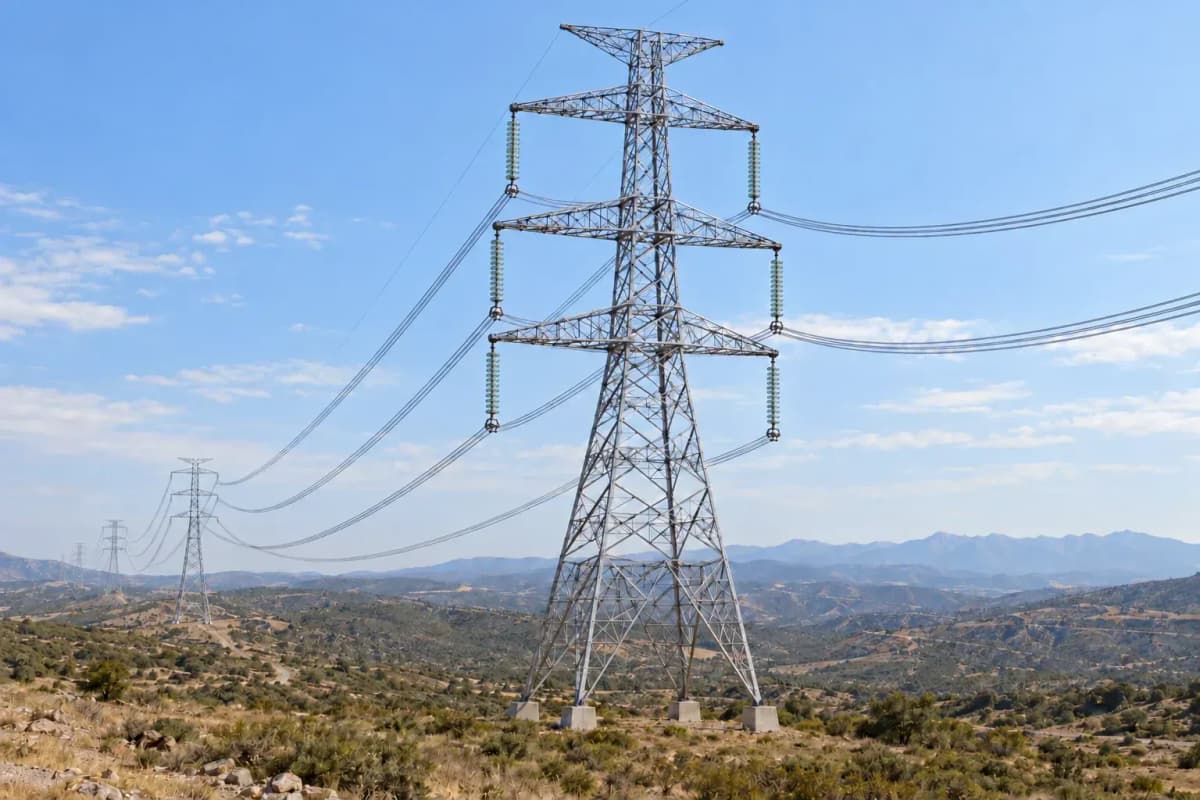
102m 1000kV Heavy Lattice Tangent Tower Slip-Joint - UHV Double-Circuit Transmission Structure
Key Features
- 102m heavy galvanized steel lattice tangent tower for 1000kV UHV AC transmission corridors
- 2-circuit configuration with 8 conductors per phase for high-capacity bulk power transfer
- 612m representative design span with Class B wind and 15mm ice loading basis
- EPC turnkey price range of $425,000-$595,000 per installed and commissioned tower
- 50-year design life with IEC 60826, ASCE/SEI 10-15, GB 50545, and IEEE 738 references
The 102m 1000kV Heavy Lattice Tangent Tower Slip-Joint is a double-circuit UHV suspension tower engineered for 612m design spans, 8-conductor-per-phase bundles, and 50-year transmission corridors. EPC turnkey pricing is $425,000-$595,000 per installed tower with engineering, procurement, construction, commissioning, and 1-year warranty support.
Description
The 102m 1000kV Heavy Lattice Tangent Tower Slip-Joint is a 102m double-circuit ultra-high-voltage transmission structure for 1000kV AC corridors, 612m ruling spans, and 8-conductor-per-phase bundled ACSR systems. Designed as a tangent, or suspension, tower for straight-line sections, it supports 2 circuits with vertical conductor weight, transverse wind loading, 15mm ice loading, and a 50-year design life under IEC 60826:2017, ASCE/SEI 10-15, GB 50545, and IEEE 738-2023 design references.
1. Product Overview
A tangent tower is normally the highest-count structure type on an overhead transmission line, representing about 70-80% of towers on many 500kV-and-above corridors because it is used where line angle is near 0 degrees. This SOLARTODO configuration targets UHV transmission projects where 1 circuit can carry roughly 1000-1500MW depending on conductor type, ambient temperature, allowable conductor temperature, and system stability limits, while 2 circuits improve route utilization on the same right-of-way.
The tower uses a heavy galvanized steel lattice body rather than a monopole because a 102m structure with 8-bundle phase conductors must manage high overturning moments, long insulator strings, and conductor swing clearances. Compared with a conventional 500kV 4-bundle tangent tower on a similar terrain class, a 1000kV 8-bundle design can reduce the number of long-distance circuits required for the same bulk-transfer target by about 35-50%, although each individual tower is taller, heavier, and more foundation-intensive.
SOLARTODO positions this tower within its View all Power Transmission Tower/Pole products portfolio for utility-scale grid extension, renewable-energy evacuation, mining power corridors, and national backbone transmission. Buyers can Configure your system online with site wind speed, ice thickness, soil class, conductor family, OPGW count, and foundation preference before requesting a project-specific bill of quantities.
2. System Architecture
The structural system is a self-supporting 4-leg lattice tower with heavy Q420-equivalent angle steel members, bolted bracing panels, slip-joint assembly zones, crossarms for 2 circuits, and shield-wire peaks for OPGW or ground wire. A typical 1000kV AC arrangement uses 3 phases per circuit, 2 circuits per tower, 8 subconductors per phase, and phase-to-phase spacing selected to maintain electrical clearance under wind swing, ice load, switching surge, and lightning impulse criteria.
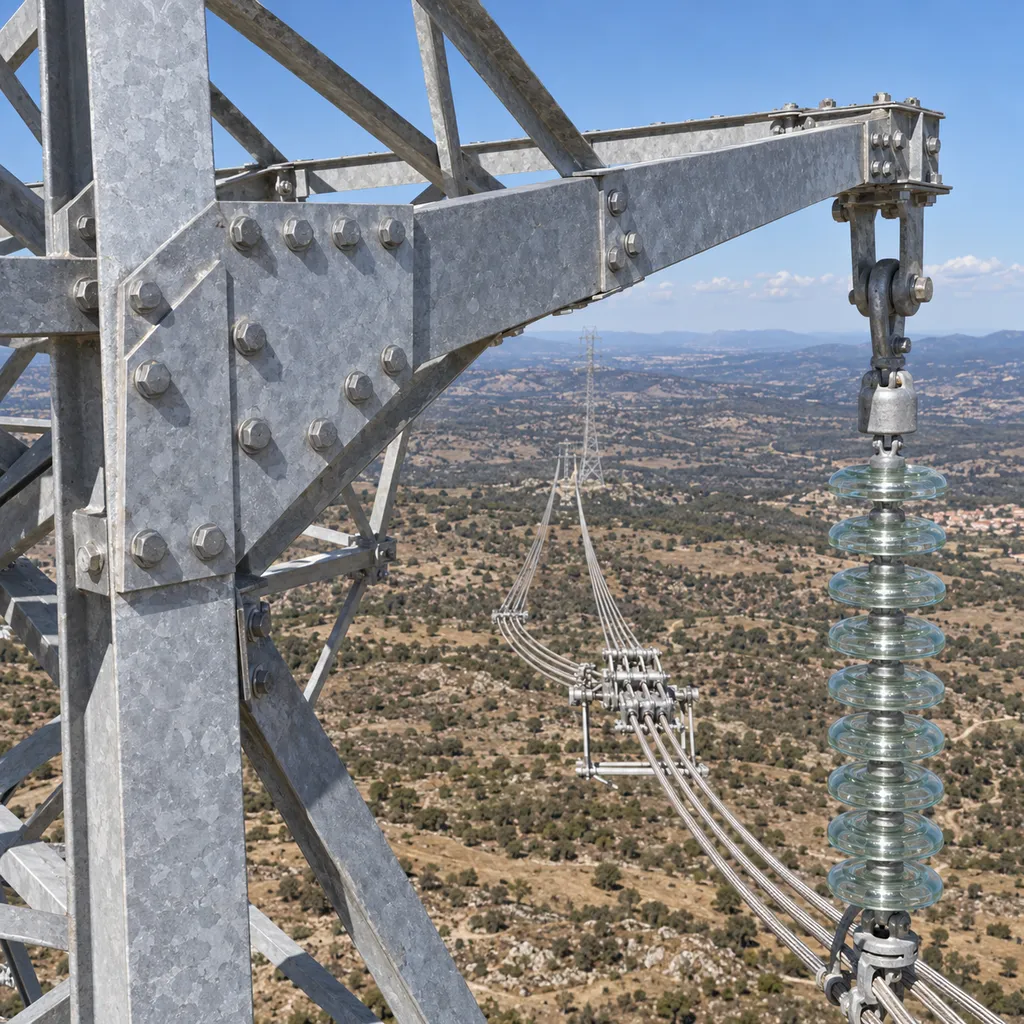
The slip-joint concept is applied at major body-module interfaces so the 102m shaft can be fabricated, hot-dip galvanized, shipped in transportable sections, and rapidly fitted on site with controlled overlap lengths. For EPC logistics, a modular joint strategy can reduce crane time by 10-20% versus fully loose-member assembly on remote corridors, while still preserving bolt-level inspection access for torque checks, galvanizing repairs, and fit-up verification.
Each suspension point normally uses composite or porcelain I-string insulators sized for 1000kV class creepage requirements, local pollution severity, and altitude correction. The conductor hardware package includes yoke plates, spacer dampers, armor rods, suspension clamps, corona-control rings, and vibration-control components for 8 bundled subconductors, with final selection governed by conductor diameter, line tension, and aeolian-vibration studies.
3. Technical Specifications
| Parameter | Value | Engineering note |
|---|---|---|
| Tower height | 102m | UHV corridor clearance and 8-bundle swing envelope |
| Voltage rating | 1000kV AC | Ultra-high-voltage transmission class above 500kV |
| Tower type | Tangent suspension | Straight-line sections with approximately 0 degree line angle |
| Circuits | 2 | Double-circuit route utilization |
| Conductors per phase | 8 | Bundle configuration for corona and ampacity control |
| Design span | 612m | Representative ruling span before final sag-tension study |
| Wind and ice class | Class B / 15mm ice | Project-specific loads verified under IEC 60826 |
| Foundation basis | Reinforced concrete pad or pile option | Final design follows geotechnical bearing data |
| Design life | 50 years | Galvanized steel with scheduled maintenance |
| Connection type | Slip-joint module interfaces | Faster field alignment for tall lattice sections |
The reference design assumes heavy galvanized steel lattice construction with a representative steel mass of about 215t for budgetary EPC analysis, although final tonnage can vary by 8-18% after load trees, broken-wire cases, seismic factors, and tower-spotting outputs are complete. Hot-dip galvanizing should be specified by coating class and local corrosion category, with ISO 1461 or ASTM A123 commonly used for member coating verification depending on the procurement jurisdiction.
Electrical performance is linked to conductor rating, bundle geometry, and clearance rather than steel tonnage alone. IEEE Std 738-2023 provides the recognized method for calculating the current-temperature relationship of bare overhead conductors, including steady-state and transient ratings, so final ampacity should be calculated using conductor data, 1-hour or continuous rating assumptions, solar radiation, wind angle, ambient temperature, and maximum conductor temperature.
4. Standards and Engineering Basis
IEC 60826:2017 defines reliability-based loading and strength requirements for overhead transmission lines, and it is the primary reference for wind, ice, temperature, and combined load cases in this product page. ASCE/SEI 10-15 provides requirements for the design, fabrication, and full-scale testing of latticed steel electrical transmission structures, making it directly relevant to a 102m self-supporting UHV lattice tower.
GB 50545 is used on many China-origin high-voltage and UHV line projects as a national overhead transmission line design code, especially where tower family development, load trees, and manufacturing drawings are completed by Chinese EPC teams. For buyers in IEC markets, SOLARTODO can align documentation packages to 1 selected governing code hierarchy so that member utilization, connection checks, and foundation reactions remain traceable.
The International Energy Agency reported that global investment in power transmission grew by 10% in 2023 to about USD 140 billion, and its 2025 transmission-grid analysis highlights that high-voltage lines above 66kV are a central bottleneck for energy transition delivery. IRENA's 2023 transition work also notes that grid reinforcement and expansion are required to integrate large renewable capacity, while NREL transmission studies show that high-voltage expansion and renewable deployment are strongly linked in net-zero scenarios approaching 2050.
5. Applications
This 102m 1000kV tangent tower is intended for long straight sections of UHV AC corridors that connect remote solar, wind, hydro, coal-to-load-center, or cross-provincial generation zones to high-demand regions. In a 100km alignment with a 612m representative span, approximately 164 tower positions may be required before adding angle towers, terminal towers, river-crossing structures, and special terrain structures.
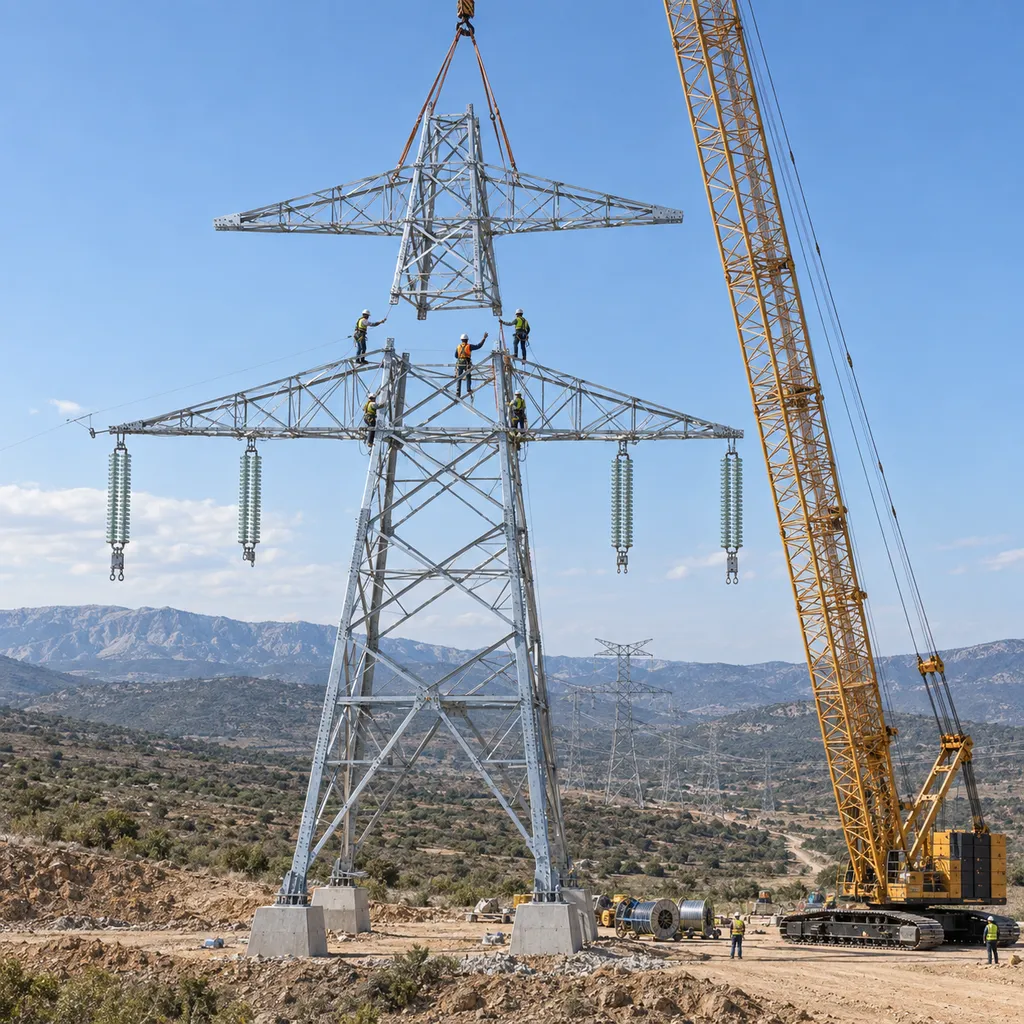
For a representative MENA solar farm scenario, a 2GW desert generation cluster located 300km from a load center could use a 1000kV double-circuit corridor to reduce current for the same transferred power compared with a lower-voltage alternative. The 102m tangent tower would be selected for flat or rolling straight sections, while angle towers would still be required at route deviations above project-defined thresholds such as 2 degrees, 15 degrees, 30 degrees, or 60 degrees.
The same structure class can support smart-grid modernization where OPGW provides lightning shielding plus fiber communication in 1 overhead asset. With 2 OPGW paths or 1 OPGW plus 1 conventional ground wire, operators can combine protection, SCADA backhaul, line differential protection, and condition-monitoring traffic across the same 102m tower family.
6. Cloud Monitoring and Digital Handover
For EPC projects, SOLARTODO can supply a digital handover package that includes tower schedule, member list, bolt grade list, galvanizing batch records, foundation coordinates, inspection photos, and commissioning checklists in 1 structured data set. Optional monitoring integration may include tower tilt sensors, conductor temperature references, weather stations, and OPGW-connected communications for dynamic line rating workflows aligned with IEEE 738-2023 calculations.
Digital monitoring should be treated as an engineering option rather than a blanket performance claim, because line rating depends on conductor model, weather station spacing, data latency, and utility operating rules. In a typical 100km pilot segment, 5-10 weather or sensor nodes may be enough for engineering observation, while full dynamic-rating implementation can require more granular node spacing and system-operator approval.
7. EPC Investment Analysis and Pricing Structure
EPC turnkey scope includes 5 major work groups: engineering, procurement, construction, commissioning, and 1-year warranty support. Engineering covers load trees, tower spotting support, structural calculation review, shop drawings, foundation reactions, and QA documentation; procurement covers galvanized tower steel, bolts, insulators, fittings, grounding, packing, and export documents; construction covers civil works, erection, alignment, torque checks, and punch-list closure.
| Pricing tier | Scope | Price range, USD per tower |
|---|---|---|
| FOB Supply | Equipment only, ex-works China | $263,500-$404,600 |
| CIF Delivered | Equipment plus ocean freight and insurance | $336,970-$517,413 |
| EPC Turnkey | Fully installed, commissioned, and 1-year warranty | $425,000-$595,000 |
| Volume band | Discount | Budget effect on 100 towers |
|---|---|---|
| 50+ towers | 5% | Up to $2,975,000 reduction at $595,000 each |
| 100+ towers | 10% | Up to $5,950,000 reduction at $595,000 each |
| 250+ towers | 15% | Up to $22,312,500 reduction at $595,000 each |
A budgetary ROI case should compare the 1000kV option against a lower-voltage multi-circuit alternative over at least 20 years, because tower cost is only 1 line item in the transmission life-cycle cost. If a 1000kV double-circuit corridor avoids 1 parallel 500kV right-of-way over 100km, annual savings may include reduced land acquisition, fewer access roads, fewer tower foundations, lower corridor vegetation management, and lower electrical losses, producing a planning payback that can fall in the 6-10 year range when avoided corridor costs exceed USD 3-5 million per year.
The standard payment structure is 30% T/T advance and 70% against bill of lading for FOB or CIF supply, or 100% irrevocable L/C at sight for approved bank instruments. Project financing support may be discussed for EPC packages above $1,000,000, and buyers can Request a custom quotation or contact [email protected] with route length, tower schedule, conductor type, wind speed, ice thickness, and soil report.
8. Procurement Notes
A tower purchase order should define at least 12 engineering inputs: voltage class, circuit count, bundle count, conductor code, OPGW count, span table, wind speed, ice thickness, altitude, pollution class, seismic zone, and foundation geotechnical data. Without those 12 inputs, any price remains a budgetary estimate rather than a final IFC-ready quotation.
Procurement managers should request mill certificates, galvanizing certificates, bolt test reports, packing lists, and fit-up inspection records before shipment. For a 215t tower, container planning and port handling can materially affect delivery cost, so CIF pricing should be recalculated for the actual destination port, shipping month, package dimensions, and steel market index.
9. Comparison With Conventional Alternatives
Compared with a conventional 500kV single-circuit tangent tower carrying 4 subconductors per phase, the 102m 1000kV double-circuit 8-bundle structure uses more steel per location but can move substantially more bulk power through 1 corridor. The practical benefit is not a universal percentage, but planning studies often evaluate 30-50% fewer parallel corridors when UHV voltage, double-circuit configuration, and large conductor bundles are feasible.
Compared with a steel monopole of similar voltage duty, the heavy lattice format usually has lower fabrication risk at 102m height, easier member replacement, and better transportability in remote terrain. The trade-off is a larger ground footprint, more bolts, more erection steps, and foundation coordination across 4 legs instead of 1 central shaft.
10. Quality, Inspection, and Maintenance
Factory quality control should include 100% visual inspection of main members, dimensional checks on critical hole patterns, bolt-grade verification, galvanizing thickness records, and trial assembly for designated panels. Site quality control should include foundation cube tests, anchor alignment, tower verticality, bolt torque, grounding resistance, and insulator-hardware inspection before conductor stringing.
Grounding resistance should normally be below 10 ohm per tower, with a stricter target below 4 ohm in high-lightning areas where soil resistivity and backflashover risk are elevated. Maintenance planning should include 1 annual visual patrol, post-storm inspection after major wind or ice events, and 5-year detailed checks for corrosion, missing bolts, foundation settlement, and hardware wear.
11. Buyer Guidance
Use this tower when a project requires 1000kV UHV transfer capacity, long straight route sections, and double-circuit corridor efficiency rather than compact urban aesthetics. For technical background on line loading, conductor thermal behavior, and renewable-grid integration, buyers can Learn about topic and then submit route-specific data for a final engineering review.
SOLARTODO supplies solar, energy storage, smart lighting, security, telecom, and power-tower systems for B2B infrastructure buyers in more than 1 product category, so transmission towers can be coordinated with generation, storage, and monitoring packages. Final acceptance should always be based on project-specific drawings, stamped calculations, soil data, utility standards, and current national grid-code requirements rather than 1 generic web specification.
Technical Specifications
| Tower Height | 102m |
| Voltage Rating | 1000kV |
| Tower Type | Tangent suspension |
| Material | Heavy galvanized steel lattice |
| Number of Circuits | 2circuits |
| Conductor Bundle | 8 x ACSR per phase |
| Design Span | 612m |
| Wind/Ice Load | Class B / 15mm ice |
| Foundation | Reinforced concrete pad or pile foundation by soil report |
| Connection Type | Slip-joint modular connection |
| Grounding Target | <10 standard, <4 high-lightning areasohm |
| Design Life | 50years |
| Standards | IEC 60826 / GB 50545 / ASCE 10-15 / IEEE 738 |
Price Breakdown
| Item | Quantity | Unit Price | Subtotal |
|---|---|---|---|
| Heavy galvanized steel lattice tower body | 215 t | $1,450 | $311,750 |
| Slip-joint module plates and splice hardware | 1 set | $28,500 | $28,500 |
| 1000kV composite suspension insulator string assemblies | 24 pcs | $1,500 | $36,000 |
| 8-bundle conductor suspension hardware and corona fittings | 6 sets | $8,500 | $51,000 |
| Tower grounding system | 1 set | $500 | $500 |
| OPGW shield-wire attachment and communication fittings | 2 sets | $5,000 | $10,000 |
| Reinforced concrete foundation works | 160 m3 | $350 | $56,000 |
| Installation and commissioning labor | 215 t | $200 | $43,000 |
| Engineering, design review and QC documentation | 1 lot | $32,000 | $32,000 |
| Commissioning tests and digital handover package | 1 lot | $9,000 | $9,000 |
| 1-Year warranty and technical support | 1 lot | $12,000 | $12,000 |
| Total Price Range | $425,000 - $595,000 | ||
Frequently Asked Questions
What is included in the EPC turnkey price?
Why use a 1000kV tangent tower instead of a 500kV tower?
Is the slip-joint connection suitable for a 102m lattice tower?
What data is required for a final quotation?
Which standards apply to the tower and conductor rating?
Certifications & Standards


Data Sources & References
- •IEC 60826:2017 Design criteria of overhead transmission lines, https://www.evs.ee/en/iec-60826-2017
- •IEEE Std 738-2023, IEEE SA, https://standards.ieee.org/ieee/738/10207/
- •ASCE/SEI 10-15 Design of Latticed Steel Transmission Structures, https://ascelibrary.org/doi/book/10.1061/9780784413760
- •IEA 2025 Building the Future Transmission Grid, https://www.iea.org/reports/building-the-future-transmission-grid
- •IEA 2023 Electricity Grids and Secure Energy Transitions, https://www.iea.org/reports/electricity-grids-and-secure-energy-transitions
- •IRENA 2023 World Energy Transitions Outlook, https://www.irena.org/Digital-Report/World-Energy-Transitions-Outlook-2023
- •NREL 2024 National Transmission Planning Study, https://www.nrel.gov/news/features/2024/national-transmission-planning-study.html
Interested in this solution?
Contact us for a customized quote based on your specific requirements.
Contact Us