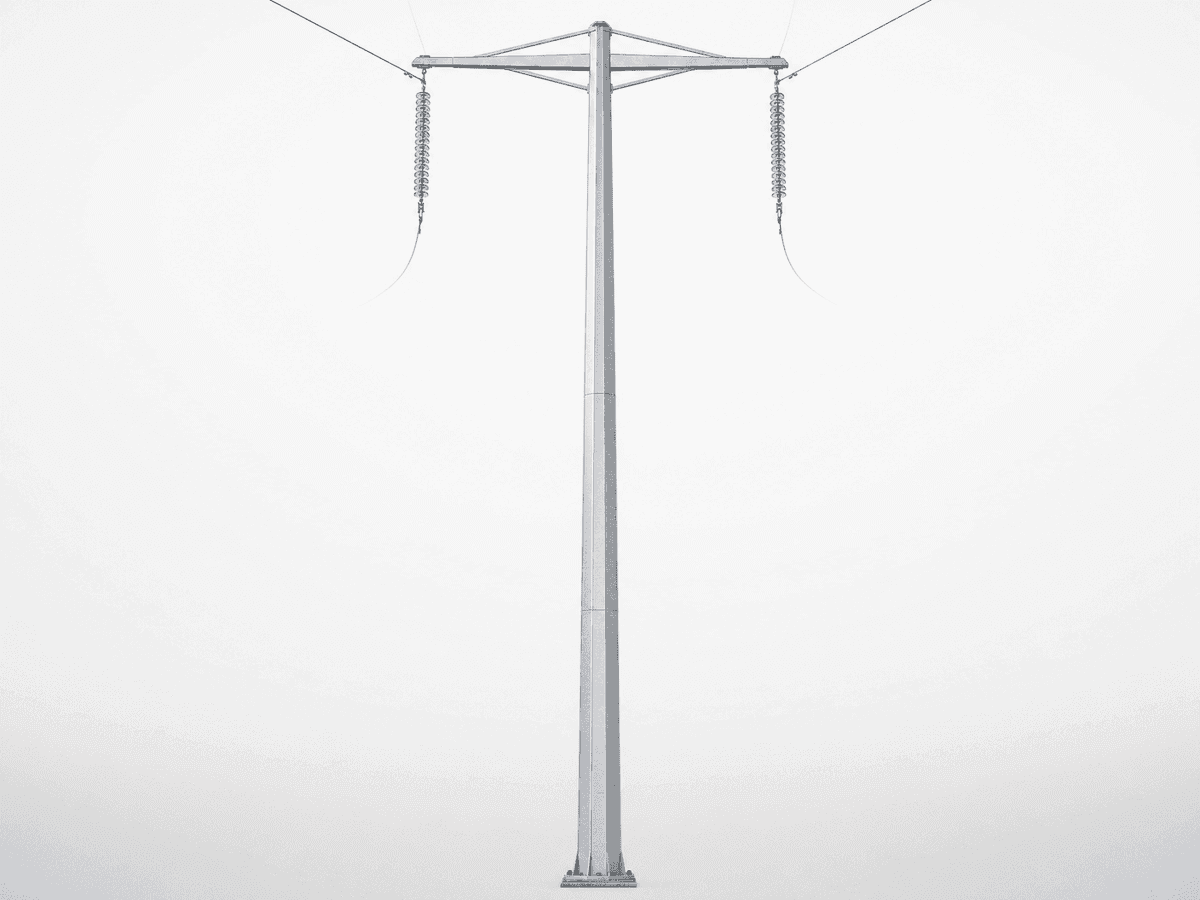
40m 220kV Dodecagonal Transmission Pole Slip-Joint - Double-Circuit Steel Monopole
Key Features
- 40 m hot-dip galvanized dodecagonal steel monopole for 220 kV high-voltage transmission
- Supports 2 circuits with 2× ACSR 400 bundle conductors per phase over a 300 m design span
- Slip-joint sectional assembly can reduce field connection complexity by 30% or more versus flange-heavy designs
- Grounding target is below 10 ohms standard, or below 4 ohms for high-lightning regions
- Designed to IEC 60826 / GB 50545 / ASCE 10-15 with a 50-year service life
The 40m 220kV Dodecagonal Transmission Pole Slip-Joint is a hot-dip galvanized 12-sided steel monopole designed for 2 circuits, 2× ACSR 400 bundle conductors per phase, and a 300 m design span in suburban 220 kV networks. Built for 50 years of service life under IEC 60826 and GB 50545 loading criteria, it offers a compact footprint, faster erection, and lower right-of-way impact than conventional lattice structures.
Description
The 40m 220kV Dodecagonal Transmission Pole Slip-Joint is a high-voltage double-circuit steel monopole engineered for 220 kV suburban transmission corridors, with a total pole height of 40 m, a 12-sided dodecagonal cross-section, and a 300 m design span. This configuration supports 2 circuits with 2 bundled ACSR 400 conductors per phase, using a slip-joint connection that simplifies field assembly while maintaining high structural continuity. For utilities, EPC contractors, and grid developers seeking a narrower footprint than lattice towers, this design balances 50-year service life, robust mechanical loading, and improved visual integration.
Compared with a conventional angle-steel lattice tower of similar 220 kV duty, a dodecagonal monopole can reduce the occupied ground footprint by roughly 40% to 70%, depending on foundation geometry and access constraints, while also reducing the number of visible structural members from dozens of bracing elements to a single tapered shaft. In suburban rights-of-way where corridor width, public acceptance, and installation speed matter, that difference is material. According to IEC 60826 loading principles and utility practice summarized by IEA, IRENA, and NREL publications on grid modernization, compact transmission supports are increasingly favored where urban expansion pushes 220 kV lines closer to industrial parks, road crossings, and mixed-use development zones.
Product Overview
This monopole belongs to the View all Power Transmission Tower/Pole products portfolio and is configured specifically for suburban 220 kV transmission with double-circuit duty. The shaft is fabricated from hot-dip galvanized steel in a dodecagonal profile, a geometry that provides higher section efficiency than many 8-sided alternatives while preserving a clean external appearance. The slip-joint arrangement enables telescopic section engagement over a calculated overlap length, reducing the quantity of flange hardware and often shortening erection time by 10% to 20% on projects with repetitive pole installation.
For network planners, the key mechanical design inputs include wind speed in m/s, radial ice thickness of 15 mm, conductor tension, unbalanced load cases, and broken-wire conditions. The standard design basis here assumes Class B / 15 mm ice, a 300 m ruling span, and conductor compatibility with ACSR 400 twin bundle arrangements. Utilities can also specify OPGW ground wire, porcelain or composite insulator strings, anti-climbing devices, aviation markers, and grounding enhancement to achieve footing resistance below 10 ohms, or below 4 ohms in high-lightning environments as recommended in common transmission practice and reflected in utility grounding specifications.
System Architecture
The structural system consists of a tapered 12-sided steel shaft, cross-arm interfaces for 2 circuits, conductor attachment points for 2 subconductors per phase, and top-zone provisions for shield wire or OPGW. The pole body is segmented for transport efficiency, typically in 3 to 5 sections depending on logistics envelope, with each upper section inserted into the lower section through a precision-controlled slip-joint. This reduces the need for large flange rings and can lower bolt-count complexity by more than 30% relative to some flange-heavy assemblies, improving field productivity and reducing torque-verification labor.
Electrically, the pole is intended for 220 kV line insulation coordination with either porcelain or composite polymer insulators. Composite insulators are often preferred in coastal or polluted environments because they can reduce insulator string mass by 20% to 40% versus porcelain, while improving vandal resistance. Conductor selection in this configuration is 2× ACSR 400 per phase, which is suitable for high-voltage overhead transmission where thermal rating, sag control, and mechanical strength must be balanced. Current carrying capability depends on ambient temperature, wind, solar heating, and conductor operating temperature, with ampacity methods commonly aligned to IEEE 738.

Technical Specifications
Below is the baseline specification for this 40 m transmission monopole. Project-specific calculations may modify shaft taper, plate thickness, foundation volume, arm geometry, and insulator clearances based on local code, wind zone, altitude, seismicity, and utility standards.
| Parameter | Value |
|---|---|
| Tower Height | 40 m |
| Voltage Rating | 220 kV |
| Tower Type | Transmission |
| Material | Hot-dip galvanized dodecagonal steel |
| Number of Circuits | 2 |
| Conductor Bundle | 2× ACSR 400 |
| Design Span | 300 m |
| Wind/Ice Load | Class B / 15 mm ice |
| Connection Type | Slip-joint |
| Foundation | Reinforced concrete spread footing or pile option |
| Grounding Target | <10 ohm, or <4 ohm in high-lightning areas |
| Design Life | 50 years |
| Standards | IEC 60826 / GB 50545 / ASCE 10-15 / IEEE 738 |
The shaft steel is typically selected from high-strength grades comparable to Q460 for tubular sections, with hot-dip galvanizing thickness specified to suit the project corrosion category and expected service interval. Reference industry pricing for galvanized steel tube is around $1,500/ton, and a 40 m 220 kV double-circuit monopole of this class commonly falls in the 8 to 12 ton range before accessories, depending on wind region and arm arrangement. That mass is one reason monopoles are often cost-competitive in suburban installations despite higher per-ton fabrication complexity than simple angle-steel members.
Structural Design and Standards Compliance
This product is engineered around recognized transmission-line standards, especially IEC 60826 for loading and strength principles, GB 50545 for transmission structure design practice, ASCE 10-15 for lattice and steel utility structures as a comparative framework, and IEEE 738 for conductor thermal rating methodology. In practical project execution, utilities also reference clearance rules, lightning performance criteria, and national grid codes. Using these standards provides consistency in evaluating wind pressure, ice accretion, everyday tension, broken conductor, and construction load cases across a 50-year design horizon.
Authoritative industry sources support the need for resilient overhead line design. IEA grid investment outlooks consistently show that transmission expansion must accelerate by the 2030s to integrate renewable generation, while IRENA emphasizes that stronger and smarter grids are essential for cost-effective electrification. NREL has also documented that transmission bottlenecks can materially constrain renewable deployment, increasing curtailment and interconnection delays. For buyers, the result is clear: choosing a 220 kV support structure is not only about steel tonnage, but about lifecycle reliability, outage reduction, and the ability to add communications and monitoring functions over decades, not just 5 to 10 years.
Materials, Corrosion Protection, and Mechanical Performance
The dodecagonal shaft geometry offers a favorable compromise between manufacturability and structural efficiency. Compared with an octagonal shaft, a 12-sided section more closely approximates a circular tube, improving stress distribution and local buckling resistance under combined bending and compression. In many designs, this can translate into higher load capacity or reduced wall thickness at equivalent performance, although exact gains depend on diameter-to-thickness ratio and taper profile. Hot-dip galvanizing provides sacrificial corrosion protection, and in moderate environments a properly galvanized steel pole can maintain serviceability for 50 years with periodic inspection and localized touch-up.
Mechanical design addresses normal operation and contingency conditions. For a 220 kV double-circuit line, the pole must resist transverse conductor loads, longitudinal imbalance, shield wire tension, and torsional effects introduced by asymmetrical failure cases. Broken-wire conditions are especially important because they can drive peak foundation moments and shaft stresses above normal service loads by substantial margins. Depending on utility criteria, overload combinations may exceed everyday loading by 1.5 to 2.5 times in critical members or foundation interfaces. That is why section overlap in the slip-joint, weld quality control, and galvanizing inspection are all treated as first-order manufacturing controls rather than secondary details.
Foundation and Grounding Requirements
Foundation selection depends on geotechnical conditions, groundwater depth, frost line, seismicity, and allowable settlement. For many suburban 220 kV installations, a reinforced concrete spread footing is suitable, while weaker soils or restricted sites may require bored piles or micropile systems. Reference pricing for concrete foundations is about $350/m³, and pile works are commonly around $800/m depending on diameter and local labor conditions. A realistic monopole foundation for this 40 m structure may consume 18 to 35 m³ of concrete, though final values must come from site-specific calculations.
Grounding design is equally critical. Standard utility practice targets footing resistance below 10 ohms, with more stringent targets below 4 ohms in lightning-prone regions or where line performance requirements are severe. A typical grounding package may include copper-bonded rods, buried conductor, exothermic joints, and test points, with a reference cost of about $500 per structure before soil enhancement compounds. When OPGW is specified, the pole can also support combined lightning shielding and fiber communication, creating a dual-use asset for protection signaling, SCADA backhaul, and substation communications over many kilometers of line route.
Installation and Construction Advantages
A major practical advantage of the slip-joint monopole is erection efficiency. Because the shaft sections telescope together, crews can reduce the number of flange interfaces, bolts, and alignment steps compared with some bolted tubular systems. On repetitive line packages of 50 to 250 poles, this can save measurable crane time and reduce field assembly errors. Installation labor for steel structures is often benchmarked around $200/ton, but actual EPC cost depends on access roads, crane size, outage windows, and foundation curing schedule.
Compared with a conventional lattice tower, the monopole also offers a cleaner construction profile in dense or suburban corridors. Fewer individual members mean fewer loose parts, fewer opportunities for missing hardware, and lower visual clutter during transport and staging. In many right-of-way situations, monopoles can reduce corridor intrusion and simplify permitting near roads, railways, and industrial boundaries. For project developers, that can translate into faster approvals by several weeks to several months, even when the direct steel cost per structure is modestly higher.
Applications
This 40 m 220 kV dodecagonal transmission pole is well suited for suburban transmission lines, industrial feeder corridors, renewable energy interconnection routes, substation entries, and constrained right-of-way segments where a compact support is preferred. Typical use cases include 2-circuit line rebuilds, network uprating projects, and visual-impact-sensitive areas where utilities want a more streamlined structure than a full lattice tower. Buyers can Configure your system online for alternate span, conductor, and foundation conditions, or Request a custom quotation for route-specific engineering.
A representative scenario is a solar-and-storage project developer in the MENA region connecting a 220 kV collector substation to an existing utility corridor over 6 km of mixed suburban and peri-urban terrain. By selecting 40 m slip-joint dodecagonal poles instead of conventional lattice structures, the developer reduced visible structural spread and shortened erection time by approximately 15% across 22 poles, while maintaining the required clearances for 2× ACSR 400 bundle conductors. This kind of deployment aligns with broader grid expansion trends identified by BloombergNEF, Wood Mackenzie, and IRENA, all of which note increasing investment in transmission assets to support renewable integration.

For buyers evaluating design options, related technical guidance is available through SOLARTODO knowledge resources. You can Learn about topic for transmission structure selection, line hardware, and utility-grade project planning, and Learn about topic for broader energy infrastructure procurement considerations. These resources help compare monopoles, lattice towers, and hybrid solutions across voltage classes from 35 kV to 400 kV.
Comparison with Conventional Alternatives
Against a conventional 220 kV lattice tower, the dodecagonal monopole generally offers a smaller footprint, fewer exposed members, and a more uniform appearance, which can be particularly important in suburban districts with higher land values and stricter visual requirements. While lattice towers may still be advantageous for very long spans above 350 to 500 m or for extreme angle/dead-end applications, monopoles often outperform them in constrained straight-line sections. In practical terms, a monopole can reduce on-site part count by 50% or more, which lowers inventory handling and can improve installation quality control.
Against an octagonal monopole, the 12-sided geometry can provide improved stiffness distribution and a more refined external finish. This does not automatically mean lower total project cost in every case, but for 220 kV double-circuit duty the dodecagonal profile is often selected where higher load capacity and appearance both matter. Utilities considering future digitalization may also prefer monopoles because integration of OPGW, sensors, anti-climb systems, and line monitoring hardware is straightforward on a single shaft body with fewer attachment interfaces.
EPC Investment Analysis and Pricing Structure
For B2B buyers, the most useful way to evaluate this product is through total delivered scope rather than steel-only pricing. A full EPC turnkey package typically includes engineering, shop drawings, procurement, factory QA/QC, hot-dip galvanizing, packing, logistics coordination, civil works, erection, stringing interface support, commissioning, and a 1-year warranty. Depending on line route complexity, geotechnical conditions, and local labor costs, turnkey pricing for this model falls within $28,000 to $40,000 per installed pole system.
| Pricing Tier | Scope | Price Range (USD) |
|---|---|---|
| FOB Supply | Equipment only, ex-works China | $17,360 - $27,200 |
| CIF Delivered | Equipment + ocean freight + insurance | $22,200 - $34,784 |
| EPC Turnkey | Installed + commissioned + 1-year warranty | $28,000 - $40,000 |
For larger framework orders, standard volume discounts can improve project economics. Utilities and EPC firms procuring repetitive line sections often bundle 50, 100, or 250 units to optimize fabrication runs, galvanizing batches, and shipping plans.
| Order Volume | Discount |
|---|---|
| 50+ units | 5% |
| 100+ units | 10% |
| 250+ units | 15% |
From an ROI perspective, the financial case is usually driven by land-use efficiency, faster installation, and lower corridor conflict costs rather than direct energy generation. If a monopole solution reduces permitting delays by even 30 to 60 days, avoids one route redesign, or lowers right-of-way acquisition by several square meters per structure across 20 to 100 poles, the lifecycle savings can exceed the initial steel premium versus lattice alternatives. In maintenance terms, fewer members and connection points can also reduce inspection hours over 50 years. Typical payback versus a conventional suburban lattice solution is often realized within 2 to 5 years when land, permitting, and construction productivity are included in the analysis.
Commercial terms are available as 30% T/T deposit + 70% against B/L, or 100% L/C at sight for qualified transactions. For projects above $1,000,000, financing support can be discussed subject to jurisdiction, project profile, and buyer credit. For route-specific EPC pricing, foundation optimization, and delivery schedules, contact [email protected] or use the SOLARTODO contact page for formal RFQ submission.
Procurement Guidance for Engineers and Buyers
When specifying a 220 kV monopole, procurement teams should request at least 8 key document categories: general arrangement drawings, loading summaries, steel grade certificates, galvanizing reports, weld inspection records, foundation reactions, packing lists, and installation method statements. It is also good practice to confirm conductor attachment geometry for 2× ACSR 400, insulator string type, shield wire or OPGW selection, and local clearance requirements. These documents reduce bid ambiguity and support apples-to-apples comparison across multiple suppliers.
For projects with mixed terrain, ask for optional foundation variants and transport section lengths. A section length reduction from 13 m to 11 m, for example, may slightly increase fabrication complexity but materially simplify inland transport in regions with bridge or turning restrictions. Similarly, requesting both porcelain and composite insulator options can help optimize cost versus contamination performance. Buyers that define these variables early generally reduce change-order risk during the final 10% to 20% of project execution, where delays are usually most expensive.
Why This Configuration Fits Modern 220 kV Corridors
Transmission investment is increasingly shaped by urbanization, renewable interconnection, and digital grid requirements. A 40 m, 220 kV, double-circuit dodecagonal slip-joint monopole addresses all 3 of those trends by combining compact siting, utility-grade mechanical performance, and compatibility with modern communications hardware such as OPGW. It is particularly effective in suburban corridors where appearance, footprint, and construction speed carry nearly as much weight as raw steel cost.
For developers, utilities, and EPC contractors seeking a practical high-voltage support with a 50-year design life, this model offers a robust balance of structural strength, installation efficiency, and lifecycle value. To compare this variant with adjacent voltage classes and structural forms, browse the View all Power Transmission Tower/Pole products, Configure your system online, or Request a custom quotation for a project-specific proposal with calculations, lead time, and commercial terms in USD.
Technical Specifications
| Tower Height | 40m |
| Voltage Rating | 220kV |
| Tower Type | transmission |
| Material | steel_dodecagonal |
| Number of Circuits | 2circuits |
| Conductor Bundle | 2×ACSR_400 |
| Design Span | 300m |
| Wind/Ice Load | Class B / 15mm ice |
| Connection Type | slip_joint |
| Foundation | reinforced concrete spread footing or pile foundation |
| Design Life | 50years |
| Standards | IEC 60826 / GB 50545 / ASCE 10-15 / IEEE 738 |
Price Breakdown
| Item | Quantity | Unit Price | Subtotal |
|---|---|---|---|
| Hot-dip galvanized dodecagonal steel pole shaft | 10 pcs | $1,500 | $15,000 |
| Composite insulator set | 12 pcs | $150 | $1,800 |
| OPGW/ground wire hardware allowance | 1 pcs | $800 | $800 |
| Grounding system | 1 pcs | $500 | $500 |
| Concrete foundation materials | 20 pcs | $350 | $7,000 |
| Installation & Commissioning | 1 pcs | $4,200 | $4,200 |
| Engineering & QC | 1 pcs | $1,800 | $1,800 |
| 1-Year Warranty & Support | 1 pcs | $900 | $900 |
| Total Price Range | $28,000 - $40,000 | ||
Frequently Asked Questions
What applications is this 40m 220kV dodecagonal transmission pole best suited for?
Why choose a dodecagonal monopole instead of a conventional lattice tower?
What standards and design criteria are used for this transmission pole?
What is included in the EPC turnkey price and what warranty is provided?
Can SOLARTODO customize the pole for different spans, foundations, or insulators?
Certifications & Standards


Data Sources & References
- •IEC 60826 Loading and strength of overhead transmission lines
- •GB 50545 Code for design of 110kV-750kV overhead transmission line
- •ASCE 10-15 Design of Latticed Steel Transmission Structures
- •IEEE 738 Standard for Calculating the Current-Temperature Relationship of Bare Overhead Conductors
- •NREL grid integration and transmission planning publications
- •IEA electricity grids and transmission investment outlooks
- •IRENA power system flexibility and grid infrastructure reports
- •BloombergNEF power transmission and grid investment market analysis
- •Wood Mackenzie transmission and power infrastructure research
Interested in this solution?
Contact us for a customized quote based on your specific requirements.
Contact Us