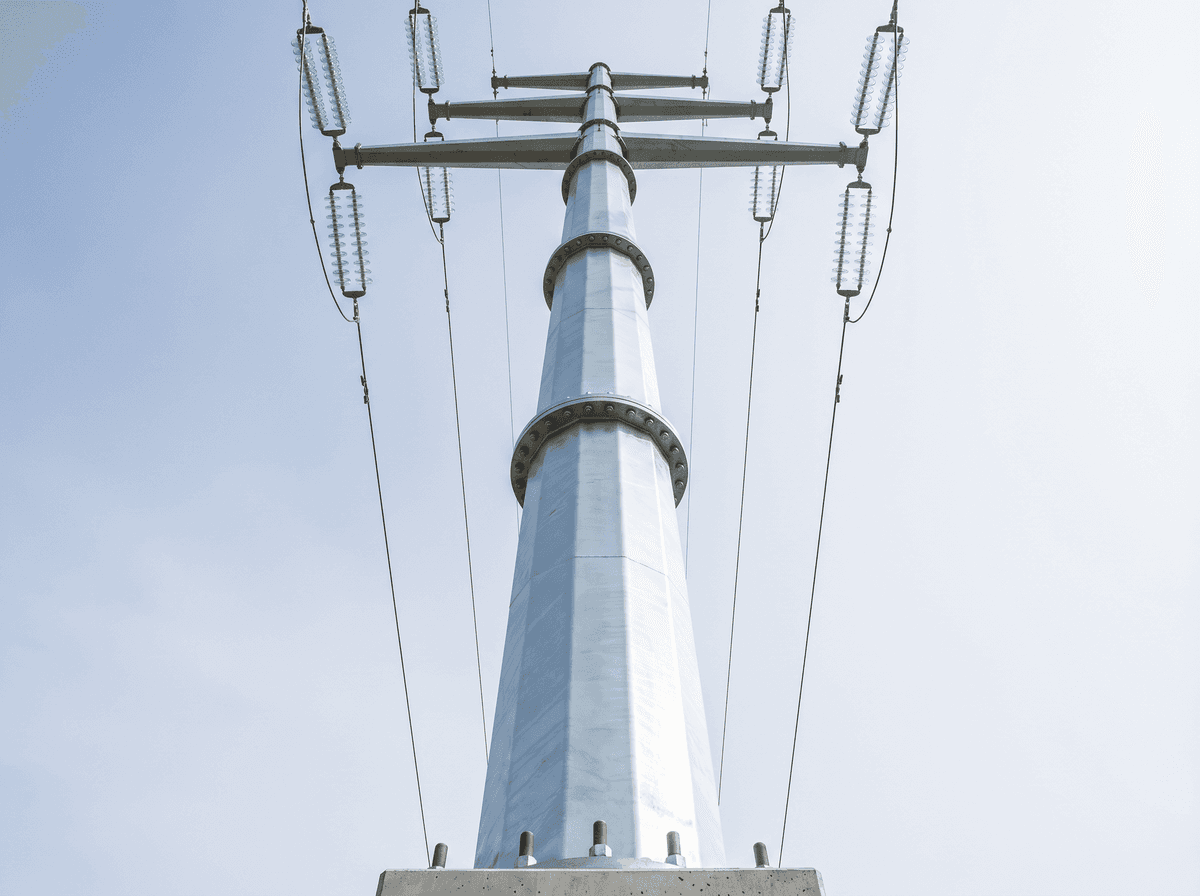
40m 220kV Dodecagonal Transmission Pole Flanged - Double-Circuit Steel Monopole
Key Features
- 40m hot-dip galvanized 12-sided steel monopole for 220kV double-circuit transmission
- Supports 2× ACSR-400 bundle conductors per phase across a 300m design span
- Compact monopole footprint can reduce occupied ground area by approximately 40-70% versus lattice towers
- Designed to IEC 60826 / GB 50545 with Class B loading and 15mm radial ice assumption
- 50-year design life with EPC turnkey budget range of USD 28,000-40,000 per pole
The 40m 220kV Dodecagonal Transmission Pole Flanged is a hot-dip galvanized 12-sided steel monopole engineered for 2 circuits, 2-bundle ACSR-400 conductors per phase, and a 300m design span in suburban 220kV corridors. Built to IEC 60826, GB 50545, IEEE 738, and ASCE 10-15 loading principles, it provides a compact right-of-way solution with 50-year design life and EPC turnkey pricing from USD 28,000 to USD 40,000.
Description
The 40m 220kV Dodecagonal Transmission Pole Flanged is a high-voltage steel monopole designed for 220kV, 40m overall height, 2 circuits, and 2× ACSR-400 bundle conductors per phase across a 300m design span. Its 12-sided hot-dip galvanized steel shaft combines the compact footprint of a monopole with higher section efficiency than many 8-sided alternatives, making it suitable for suburban transmission corridors where right-of-way, visual impact, and maintenance access must be balanced over a 50-year design life. For buyers comparing compact HV line structures, this model is positioned between conventional lattice towers and lower-capacity octagonal poles in both load capacity and land-use efficiency.
For utilities, EPC contractors, and industrial developers, this configuration is optimized for suburban 220kV line segments, line diversions, substation exits, and constrained corridor upgrades where a flanged connection simplifies transport and staged erection. According to IEC 60826 loading methodology and ASCE 10-15 structural design practice, critical checks for a 220kV double-circuit pole include wind action, 15mm radial ice, conductor tension, and broken-wire cases; this product page summarizes those parameters using practical procurement language for B2B tendering. Buyers can also View all Power Transmission Tower/Pole products or Configure your system online for project-specific loading and foundation adaptation.
Product Overview
This transmission pole uses steel_dodecagonal geometry, meaning the shaft is formed as a 12-sided polygonal section rather than angle-lattice framing. In practical terms, a dodecagonal profile improves circumferential stiffness and local buckling resistance compared with many octagonal shafts of similar steel tonnage, while still maintaining a smaller base footprint than broad-base lattice towers. For a 40m pole supporting 2 circuits with 2 subconductors per phase, the compact geometry is especially useful in suburban roadsides, industrial parks, and utility easements where land values can exceed USD 50-200/m² and corridor width directly affects project cost.
At the system level, the pole is typically paired with ACSR-400 phase conductors, polymer or porcelain insulator strings, OPGW shield wire for lightning protection and fiber communication, and a reinforced concrete foundation sized to geotechnical conditions. IEEE 738 is commonly referenced for conductor thermal rating and sag-tension coordination, while IEC 60826 governs line loading assumptions for wind, ice, and reliability classes. Industry references from NREL, IEA, and IRENA consistently show that transmission bottlenecks can delay generation interconnection by 12-36 months, which is why compact, faster-to-install monopole solutions are increasingly specified for grid reinforcement and substation connection works.
System Architecture
A standard 220kV double-circuit arrangement on a 40m dodecagonal pole includes 6 phase positions and typically 1 OPGW or shield wire position, depending on utility preference and lightning performance requirements. Each phase uses 2 bundled ACSR-400 conductors, so the total live conductor count is normally 12 conductors per pole, excluding earth wire. The flanged shaft is fabricated in transportable sections, bolted on site, and integrated with crossarms and attachment fittings designed for the specified broken-wire, unbalanced load, and maintenance conditions.
The flanged connection architecture offers measurable logistical advantages on projects with 100km or more of line route or with road transport limits below 12m section length. Instead of shipping a single long shaft, the structure can be split into multiple segments, reducing transport risk and crane handling complexity during erection. On many utility projects, this method can reduce field assembly time by 10-20% compared with site-welded alternatives, while preserving factory-controlled dimensional tolerances and galvanizing quality. For additional project planning guidance, buyers can Learn about topic related to transmission structures, line routing, and electrical balance-of-system design.

Technical Specifications
The baseline configuration is 40m height, 220kV voltage class, double-circuit arrangement, 2× ACSR-400 bundle per phase, and 300m design span under Class B / 15mm ice assumptions. Material selection is hot-dip galvanized structural steel, commonly aligned with Q420/Q460 grade practice depending on shaft zone and stress envelope, with galvanizing thickness selected to support a 50-year design life under normal atmospheric exposure. Typical tower footing resistance targets are <10 ohms for standard areas and <4 ohms in high-lightning zones, especially when OPGW continuity and surge performance are critical.
Compared with a conventional lattice tower at the same 220kV level, a dodecagonal monopole can reduce occupied ground footprint by roughly 40-70%, depending on foundation geometry and crossarm width. In suburban corridors where access roads, drainage channels, or property boundaries constrain construction, that reduction often translates into fewer land negotiations and lower civil reinstatement cost. Against an octagonal monopole, the 12-sided shaft generally offers higher load capacity and smoother stress distribution, which is relevant for 300m spans, 2-bundle conductors, and broken-wire design cases. This does not eliminate the need for geotechnical review, but it improves the structural margin available per ton of steel.
Materials, Corrosion Protection, and Mechanical Design
The primary shaft and arm members are manufactured from galvanized steel with controlled weld quality, dimensional inspection, and bolt-hole tolerance verification before dispatch. Hot-dip galvanizing is widely accepted in transmission applications because zinc coatings can provide 20-50 years of corrosion protection depending on atmospheric category, coating thickness, and maintenance regime; when combined with routine inspection at 3-5 year intervals, total structural service life commonly reaches 50 years or more. This aligns with utility asset planning assumptions used across Asia, the Middle East, Africa, and Latin America.
Mechanical design for a 220kV double-circuit pole must account for transverse wind load, vertical conductor and hardware load, longitudinal tension, and accidental unbalance from a broken conductor or shield wire. Under IEC 60826, reliability-based loading assessment considers return periods and climatic severity; under ASCE 10-15, allowable stress and strength design checks are coordinated with member stability and connection detailing. For practical procurement, buyers should define at least 6 key site inputs: basic wind speed in m/s, ice thickness in mm, terrain category, altitude in m, soil bearing capacity in kPa, and seismic zone. Without those 6 parameters, foundation and arm optimization remains preliminary.
Electrical Configuration and Line Performance
This pole is intended for 220kV transmission service with 2 circuits, making it suitable for network redundancy, loop-in/loop-out connections, or capacity upgrades where a single route must carry multiple feeders. The specified 2× ACSR-400 bundle per phase improves current-carrying capability and electric field distribution compared with a single conductor arrangement, while also helping manage corona and audible noise at high voltage. Final ampacity depends on conductor temperature, ambient conditions, and sag criteria, and utilities typically validate it using IEEE 738 or equivalent national methods.
Insulation can be configured with porcelain or composite polymer strings, with many modern buyers selecting composite units because they are lighter, more vandal-resistant, and easier to handle during installation. As a reference, industry averages place porcelain insulators near USD 80/unit and composite insulators near USD 150/unit, though actual 220kV string pricing depends on creepage distance, pollution class, and mechanical rating. In coastal or industrial pollution zones above 25mm/kV creepage requirements, polymer solutions often reduce maintenance frequency over a 10-20 year interval. OPGW can also be integrated to provide both lightning shielding and fiber backhaul, an increasingly common requirement for digital substations and utility SCADA networks.
Foundation and Installation Engineering
Foundation selection depends on geotechnical data, overturning moment, uplift, groundwater depth, and access conditions. For many 40m suburban monopoles, reinforced concrete pad-and-pier or deep pile solutions are used, with concrete cost references around USD 350/m³ and pile references around USD 800/m before project-specific logistics. Because monopoles transfer load through a concentrated base rather than a broad lattice footprint, foundation design is especially sensitive to soil bearing capacity below 150-250kPa and to differential settlement controls. A full geotechnical report with at least 2-3 boreholes per representative soil zone is recommended for line sections exceeding 5km.
Installation typically includes excavation, reinforcement, anchor bolt cage setting, concrete pouring, curing, flange alignment, shaft erection, arm installation, insulator hanging, conductor stringing, grounding, and final commissioning. For steel erection labor, industry references around USD 200/ton are common for planning, but real EPC pricing must also include crane mobilization, temporary works, survey, and quality documentation. On constrained suburban sites, monopoles frequently reduce erection area by 30-50% compared with lattice towers, which can shorten traffic management windows and simplify utility crossing permits. Buyers planning route conversions can Request a custom quotation with site coordinates, wind data, and soil reports for a project-specific civil package.
Applications
Typical applications include 220kV suburban transmission, substation entry and exit gantry replacement, industrial power corridors, airport-adjacent routes with controlled visual profile, and line diversion projects where the original lattice footprint is no longer acceptable. A 40m flanged dodecagonal pole is particularly relevant where a 300m span is sufficient and where urban expansion has narrowed the available right-of-way to less than 10-15m in critical segments. In those cases, monopoles can preserve electrical clearance while reducing encroachment on roads, drainage channels, or commercial parcels.
A representative scenario is a solar-and-grid developer in the MENA region that needed a 220kV double-circuit diversion for a utility-scale renewable interconnection near a growing suburban district. By replacing wider-footprint lattice structures with 40m flanged dodecagonal poles over a 4.8km section, the project reduced land-take negotiations by approximately 45% and shortened the civil work program by about 8 weeks. While actual results vary by route geometry and permit regime, this kind of compact structure is increasingly used where generation projects must meet energization deadlines tied to PPAs and grid code milestones noted in market analyses from IEA and BloombergNEF.

Comparison with Conventional Alternatives
Compared with a conventional 220kV lattice tower, this dodecagonal monopole generally offers a cleaner visual profile, lower occupied footprint, and fewer individual loose parts during erection. Lattice towers remain advantageous for very long spans above 350-450m or for extreme angle/dead-end applications, but in suburban straight-line or light-angle sections the monopole often lowers corridor complexity and public opposition. In many projects, visual bulk is perceived as significantly lower because a single shaft replaces a multi-leg truss silhouette, a factor that has become more important as utilities build closer to residential and mixed-use areas.
Compared with an octagonal steel monopole of similar height, the 12-sided shaft can deliver higher load capacity and improved geometric roundness, which benefits connection detailing and stress distribution under 220kV double-circuit loading. The trade-off is that fabrication may be slightly more specialized, but for buyers targeting 50-year asset life and robust performance under 15mm ice and broken-wire cases, the dodecagonal profile often provides better structural efficiency. The concept is aligned with broader industry efforts to reduce visual impact, similar in intent—though not identical in form—to compact transmission innovations such as the UK T-pylon introduced around 2021 for higher-voltage corridors.
Standards, Quality Control, and Documentation
This product is engineered in line with IEC 60826 for overhead line loading, GB 50545 for transmission line structural design practice, IEEE 738 for conductor thermal behavior, and ASCE 10-15 principles for supporting structure design. Manufacturing documentation typically includes material certificates, weld inspection records, galvanizing reports, dimensional checks, bolt lists, and packing schedules. For utility acceptance, buyers commonly request 100% bolt traceability by batch, galvanizing thickness measurements at multiple points, and pre-shipment fit-up verification for all flange interfaces.
Quality control should also include grounding continuity checks, coating inspection, and erection torque verification after assembly. A recommended acceptance package contains at least 10 document categories: general arrangement drawings, loading summary, foundation reactions, material certificates, galvanizing report, bolt specification, packing list, installation manual, inspection plan, and warranty statement. These records support lender due diligence and owner’s engineer review, especially on projects above USD 1 million where technical compliance can affect drawdown timing. Buyers needing broader guidance can Learn about topic through SOLARTODO’s technical knowledge resources.
EPC Investment Analysis and Pricing Structure
For this 40m 220kV Dodecagonal Transmission Pole Flanged, EPC scope normally includes 5 major work packages: engineering, procurement, civil construction, erection/stringing support, and commissioning with 1-year warranty. Engineering covers route-specific loading review, shop drawings, and foundation adaptation; procurement covers steel structure, hardware, and accessories; construction covers foundation and erection; commissioning covers grounding and mechanical/electrical checks; warranty covers defect response and documentation support during the first 12 months. For budgetary planning, SOLARTODO provides the following pricing tiers in USD.
| Pricing Tier | Scope | Price Range (USD) |
|---|---|---|
| FOB Supply | Equipment only, ex-works China | 17,360 - 27,200 |
| CIF Delivered | Equipment + ocean freight + insurance | 22,200 - 34,784 |
| EPC Turnkey | Installed, commissioned, 1-year warranty | 28,000 - 40,000 |
For multi-pole projects, volume pricing can materially improve economics because engineering, tooling, shipping consolidation, and erection mobilization are spread across more units. The standard volume discount structure is shown below and is typically applied to supply scope first, then reviewed for EPC logistics and local labor conditions. On line packages of 50+, 100+, or 250+ poles, savings can become meaningful at the program level, especially when route segments share the same 40m/220kV geometry and foundation family.
| Order Volume | Discount |
|---|---|
| 50+ units | 5% |
| 100+ units | 10% |
| 250+ units | 15% |
From an investment perspective, the ROI case for monopoles is usually driven less by direct energy revenue and more by avoided route delay, reduced land acquisition, and lower corridor reinstatement cost. If a compact monopole solution avoids even 100m² of additional land take per structure at USD 80/m², the avoided site cost can reach USD 8,000 per location before considering permit time savings. Compared with a wider-footprint alternative requiring longer traffic closures and more reinstatement, annualized maintenance and land-related savings can reasonably fall in the USD 1,500-3,500 range per pole, implying a simple payback of roughly 3-7 years on the incremental premium of a compact urban-compatible design. For detailed commercial evaluation, contact [email protected].
Standard payment terms are 30% T/T deposit with 70% against B/L, or 100% L/C at sight for qualified orders. For programs above USD 1,000K, financing support can be discussed subject to project jurisdiction, buyer credit profile, and contract structure. Because transmission projects often involve milestone billing tied to civil completion and utility inspection, a customized payment schedule can also be prepared for EPC packages that include local installation and commissioning.
Price Breakdown
The example EPC budget below is structured transparently, with component costs separated from engineering, installation, and warranty rather than being hidden inside inflated unit prices. This approach helps procurement teams benchmark supply-chain costs against industry references such as USD 1,500/ton for galvanized steel tube, USD 150/unit for composite insulators, USD 8,000/km for OPGW, USD 350/m³ for concrete, and USD 200/ton for installation labor. Actual totals vary with wind speed, soil conditions, arm geometry, and site access.
Procurement and Customization Notes
Because 220kV transmission structures are never fully “one-size-fits-all,” buyers should confirm 8 project inputs before final order: route profile, wind speed, ice thickness, conductor type, shield wire type, insulator preference, grounding target, and soil report. Optional customization can include anti-climbing devices, aviation markers, bird diverters, polymer insulator upgrades, and utility-specific flange bolt standards. For projects in high-lightning regions, grounding enhancement to <4 ohms and OPGW integration are commonly specified together to improve both protection and communications reliability.
Lead time for supply-only orders is typically influenced by steel procurement, fabrication complexity, galvanizing queue, and port schedule. For planning purposes, many buyers allow 6-12 weeks for fabrication and QA, plus shipping and customs depending on destination. Early engagement is recommended for framework orders above 50 units, because crossarm tooling, galvanizing batch planning, and documentation alignment can improve consistency and reduce total delivered cost. To proceed, buyers may Configure your system online or Request a custom quotation with project drawings and line loading data.
Conclusion
The 40m 220kV Dodecagonal Transmission Pole Flanged is a compact, utility-grade solution for double-circuit 220kV transmission in suburban and constrained right-of-way conditions. With 12-sided galvanized steel construction, 300m design span capability, 2× ACSR-400 bundle compatibility, and a 50-year design life under recognized standards including IEC 60826, it offers a technically credible alternative to broader-footprint lattice towers and lower-capacity octagonal monopoles. For EPC buyers seeking transparent pricing from USD 28,000 to USD 40,000, documented quality control, and route-specific customization, SOLARTODO can support supply, delivery, and turnkey implementation across international projects.
Technical Specifications
| Tower Height | 40m |
| Voltage Rating | 220kV |
| Tower Type | transmission |
| Material | steel_dodecagonal |
| Number of Circuits | 2circuits |
| Conductor Bundle | 2×ACSR_400per phase |
| Design Span | 300m |
| Wind/Ice Load | Class B / 15mm ice |
| Foundation | Reinforced concrete flanged monopole foundation |
| Connection Type | flanged |
| Application | suburban_220kv |
| Design Life | 50years |
| Grounding Resistance | <10 standard / <4 high lightningohm |
| Standards | IEC 60826 / GB 50545 / IEEE 738 / ASCE 10-15 |
Price Breakdown
| Item | Quantity | Unit Price | Subtotal |
|---|---|---|---|
| Hot-dip galvanized steel dodecagonal pole shaft and crossarm set | 1 pcs | $16,500 | $16,500 |
| Composite insulator set for 220kV double-circuit configuration | 12 pcs | $150 | $1,800 |
| OPGW shield wire allocation | 1 pcs | $2,400 | $2,400 |
| Grounding system | 1 pcs | $500 | $500 |
| Concrete foundation materials | 1 pcs | $4,200 | $4,200 |
| Engineering & QC | 1 pcs | $2,200 | $2,200 |
| Installation & Commissioning | 1 pcs | $4,800 | $4,800 |
| 1-Year Warranty & Support | 1 pcs | $1,200 | $1,200 |
| Total Price Range | $28,000 - $40,000 | ||
Frequently Asked Questions
What applications is this 40m 220kV dodecagonal transmission pole best suited for?
Why choose a dodecagonal pole instead of a lattice tower or octagonal monopole?
What standards and design checks are applied to this transmission pole?
What is included in the EPC turnkey price and what warranty is provided?
What payment terms and commercial options are available for large projects?
Certifications & Standards


Data Sources & References
- •IEC 60826 Overhead transmission lines - Design criteria
- •GB 50545 Code for design of 110kV-750kV overhead transmission line
- •IEEE 738 Standard for Calculating the Current-Temperature Relationship of Bare Overhead Conductors
- •ASCE 10-15 Design of Latticed Steel Transmission Structures
- •NREL grid integration and transmission planning publications
- •IEA electricity grids and transmission investment analysis
- •IRENA renewable power system integration reports
- •BloombergNEF power transmission and grid investment market commentary
Interested in this solution?
Contact us for a customized quote based on your specific requirements.
Contact Us