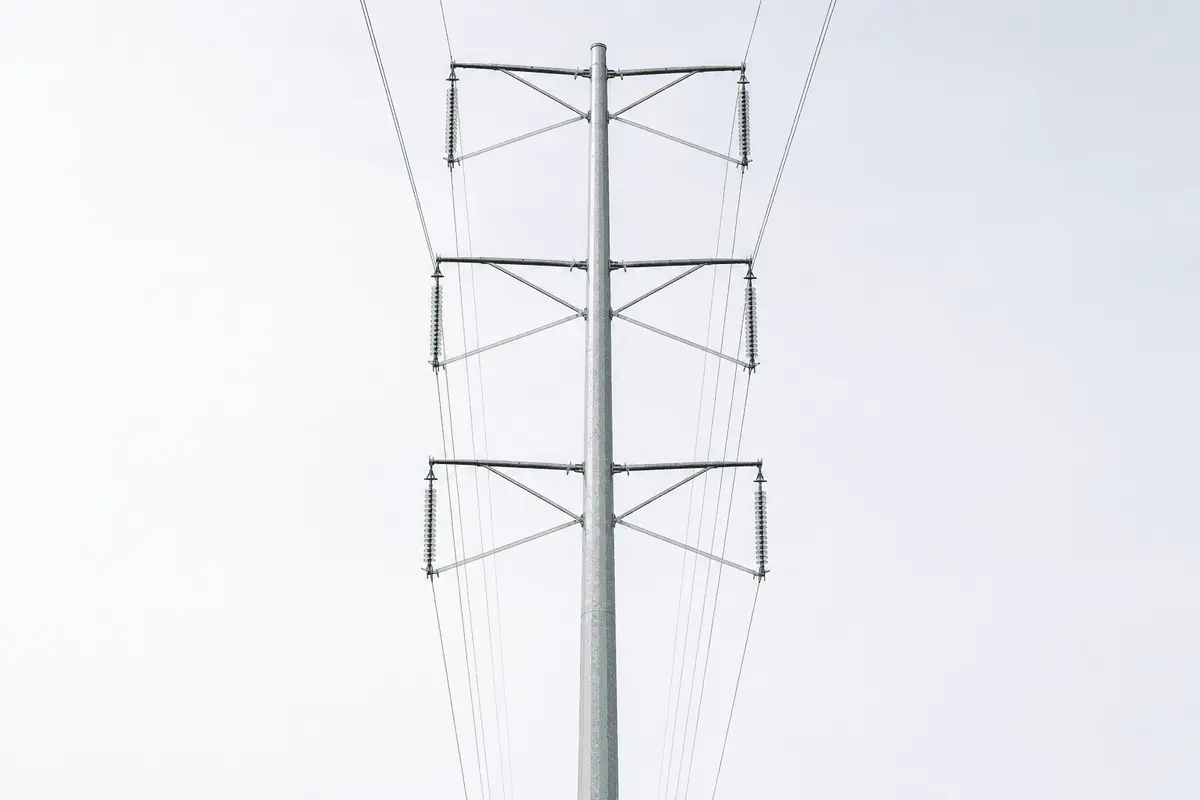
30m 110kV Tapered Monopole Transmission Slip-Joint - Urban Sub-Transmission Pole
Key Features
- 30m overall pole height for 110kV single-circuit transmission corridors
- Designed for 250m nominal span with Class B loading and 15mm ice
- 50-year design life with hot-dip galvanized tapered steel tubular shaft
- Slip-joint main connection can reduce field assembly time by 10% to 20%
- EPC turnkey price range of USD 20,000 to 30,000 per installed pole
The 30m 110kV Tapered Monopole Transmission Slip-Joint is a single-circuit hot-dip galvanized steel tubular pole designed for 250m spans in city-edge transmission corridors. Built for 50-year service life under IEC 60826 and GB 50545 loading criteria, it reduces land take and visual clutter versus lattice towers while supporting 110kV ACSR conductor systems and OPGW grounding.
Description
The 30m 110kV Tapered Monopole Transmission Slip-Joint is a steel tubular transmission pole engineered for single-circuit 110kV sub-transmission and regional grid applications where 30m overall height, 250m design span, and compact right-of-way are required. This configuration uses a hot-dip galvanized tapered monopole shaft, slip-joint connection, and urban-compatible profile to support 1 circuit with standard ACSR-240 class conductors, optical ground wire options, and a design life of 50 years with scheduled inspection. For utilities, EPC firms, and industrial developers, it offers a practical alternative to wider-footprint lattice structures in city-edge corridors, industrial parks, and transport-adjacent transmission routes.
Compared with a conventional 110kV lattice tower, a tubular monopole typically reduces foundation footprint and occupied ground area by approximately 40% to 70%, depending on local geotechnical conditions and phase arrangement, while also simplifying visual integration in urbanized zones. IEC 60826 loading methodology, ASCE 10-15 structural design practice, and conductor thermal rating methods aligned with IEEE 738 support the engineering basis for this class of structure. Grid expansion studies from IEA, IRENA, and NREL consistently indicate that transmission densification and corridor optimization are critical for integrating distributed generation, industrial load growth, and edge-of-city substations over the next 10 to 20 years.
Product Overview
This product belongs to the View all Power Transmission Tower/Pole products portfolio and is optimized for 110kV overhead transmission in constrained corridors where a 30m pole height provides adequate conductor clearance, shielding angle control, and urban aesthetics. The shaft is fabricated from high-strength steel tube sections with a tapered geometry that improves stiffness-to-weight ratio, and the slip-joint interface reduces flange hardware count while accelerating field erection by 1 to 2 lifting stages compared with multi-flange assemblies. For project-specific adaptation, buyers can Configure your system online or Request a custom quotation for terrain, wind, and utility standard variations.
The standard application is city-edge transmission, where line routing must balance 110kV electrical clearance requirements with municipal planning constraints, road setbacks, and limited land parcels. A single monopole can support one circuit across a 250m span, with design checks for conductor tension, broken-wire condition, wind pressure, and 15mm ice loading under the provided Class B basis. Utilities often specify porcelain or composite polymer insulators; in vandal-prone or contamination-prone zones, composite strings can reduce weight by approximately 30% to 50% relative to equivalent porcelain assemblies while improving hydrophobic performance, as recognized in utility field practice and international transmission design references.
System Architecture
The structural system consists of 1 tapered steel shaft, 1 slip-joint connection zone, cross-arm attachment hardware, earthing provisions, and a foundation interface designed to transfer axial, shear, and overturning loads into reinforced concrete or pile-supported substructures. At 30m height, the monopole is generally segmented for transportation efficiency, with section lengths selected to fit standard trucking and port handling limits. The 110kV electrical configuration normally supports 3 phase conductors and 1 overhead ground wire or OPGW, with conductor attachment geometry set to maintain phase spacing, insulation coordination, and statutory ground clearance.
The slip-joint detail uses a telescoping interference fit between upper and lower shaft sections, eliminating a full circumferential bolted flange at the main shaft splice. In practice, that can reduce exposed fastener count by more than 20 to 40 bolts per main connection, depending on design, and can shorten field assembly time by 10% to 20% when crews, cranes, and alignment tools are available. Structural verification should include stress utilization, local buckling, deflection, and fatigue-sensitive details where repeated wind-induced oscillation may occur. For related engineering background, buyers can Learn about topic and review broader transmission structure selection guidance.
Technical Specifications
This 30m monopole is intended for 110kV single-circuit service with a nominal 250m design span and tubular steel construction. Typical conductor selection is 1× ACSR-240 per phase, though regional utilities may specify alternate aluminum-steel reinforced conductors or bundled arrangements where corona, ampacity, or line reactance targets differ. Grounding design should achieve tower footing resistance below 10 ohms under standard conditions and below 4 ohms in high lightning density areas. The galvanizing system is intended to support a 50-year design life subject to atmospheric corrosivity category, coating thickness verification, and periodic maintenance.
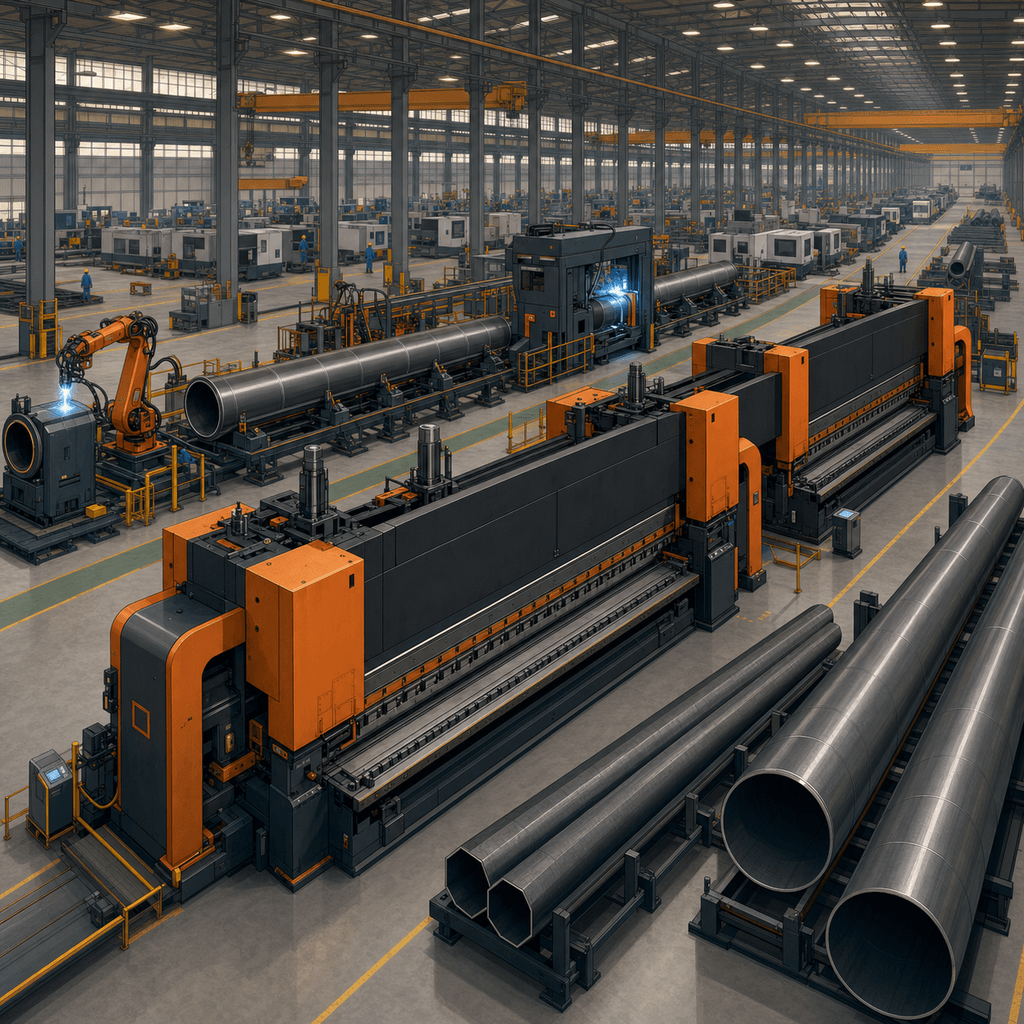
From a materials perspective, hot-dip galvanized tubular steel remains a preferred choice for 10kV to 110kV urban and peri-urban lines because it combines high section efficiency with manageable fabrication cost. Industry reference pricing for galvanized Q460 steel tube is approximately $1,500 per ton, which provides a useful benchmark for estimating shaft supply cost, although final pricing depends on thickness, taper ratio, weld category, and zinc coating mass. Foundation options usually include direct spread footing or pile-supported systems, with concrete reference pricing around $350 per m³ and pile installation around $800 per meter, both of which materially affect EPC totals in weak-soil or high-water-table sites.
Electrical and Mechanical Design Basis
The pole is designed around 110kV insulation coordination and mechanical loading principles consistent with IEC 60826, GB 50545, and ASCE 10-15. Key design inputs include basic wind speed in m/s, radial ice thickness in mm, conductor everyday tension, broken conductor case, and maintenance loading. For a 250m span, conductor sag and clearance calculations should be checked across the full annual temperature range, with thermal rating methods aligned to IEEE 738 where line ampacity validation is required. OPGW can be integrated as the shield wire to combine lightning protection and fiber communication in 1 cable system, reducing the need for separate telecom infrastructure.
For utilities seeking resilient city-edge infrastructure, monopoles also offer advantages in constrained maintenance zones. A single shaft with fewer protruding members can reduce unauthorized climbing points and simplify anti-corrosion inspection over 30m of exposed structure. Depending on route geometry, a monopole arrangement may also reduce permanent easement width by several meters compared with a conventional lattice shape. Reports from IRENA and IEA on grid modernization repeatedly emphasize that transmission buildout speed, public acceptance, and right-of-way efficiency are now among the top 3 to 5 bottlenecks in power system expansion, making compact structure types increasingly relevant.
Applications
The primary use case is city-edge transmission: industrial feeders, substation exits, ring connections, airport perimeter routes, logistics corridors, and edge-of-metro overhead sections where 110kV capacity is needed but land and aesthetics are tightly controlled. A 30m monopole suits projects where line spans average around 200m to 250m and where municipal authorities prefer a cleaner skyline than a broad-base lattice tower. It is also suitable for mixed infrastructure corridors running parallel to roads, rail, pipelines, or utility easements where a smaller structural footprint can simplify permitting and reduce land compensation exposure.
A representative scenario is a 35MW to 80MW industrial and solar hybrid development at the edge of a MENA city that required a 110kV evacuation line across 4.5km of semi-urban corridor. By using 30m tapered monopoles at approximately 240m average spans instead of conventional lattice structures, the EPC contractor reduced occupied plot area per structure and shortened civil interface time with adjacent roadworks. In that scenario, the developer benefited from easier municipal approval, lower visual intrusion, and integrated OPGW for both grid protection and site communications. Buyers with similar needs can Learn about topic before finalizing route standards and loading assumptions.
In comparison with a conventional concrete pole solution at similar voltage class, a steel tapered monopole generally provides higher structural efficiency and easier adaptation to custom arm geometry at 110kV, while also avoiding the transport weight penalties associated with large prestressed concrete sections. Compared with lattice towers, monopoles can reduce assembly complexity in dense corridors and often improve public acceptance. The tradeoff is that monopoles may require tighter fabrication tolerances and more careful erection alignment at the slip-joint interface, especially under high wind design classes above 30m/s.
Corrosion Protection, Grounding, and Maintenance
Hot-dip galvanizing is the baseline corrosion protection system for this product, with coating thickness selected according to steel thickness and project environment. In moderate atmospheric exposure, galvanized tubular poles routinely target 30 to 50 years of service before major rehabilitation, provided that coating inspection, touch-up repair, and drainage details are managed correctly. In coastal or industrially polluted areas, utilities may specify duplex systems or thicker zinc mass to maintain the 50-year design objective. NREL and utility asset management studies have shown that lifecycle cost is often driven less by initial steel mass and more by corrosion environment, outage planning, and maintenance access frequency over 2 to 5 decades.
Grounding is designed to achieve less than 10 ohms footing resistance under standard utility criteria, with enhancement to below 4 ohms where lightning density, soil resistivity, or substation proximity requires stricter performance. The grounding package typically includes downlead bonding, ground rod or ring conductor integration, and connection points for OPGW or shield wire continuity. For 110kV systems, proper grounding directly affects backflashover risk, insulation coordination, and line reliability during storm seasons. A standard grounding system reference cost is approximately $500 per tower, although rocky sites or high-resistivity soils can increase material quantity by 2 to 4 times.
Installation and Construction Considerations
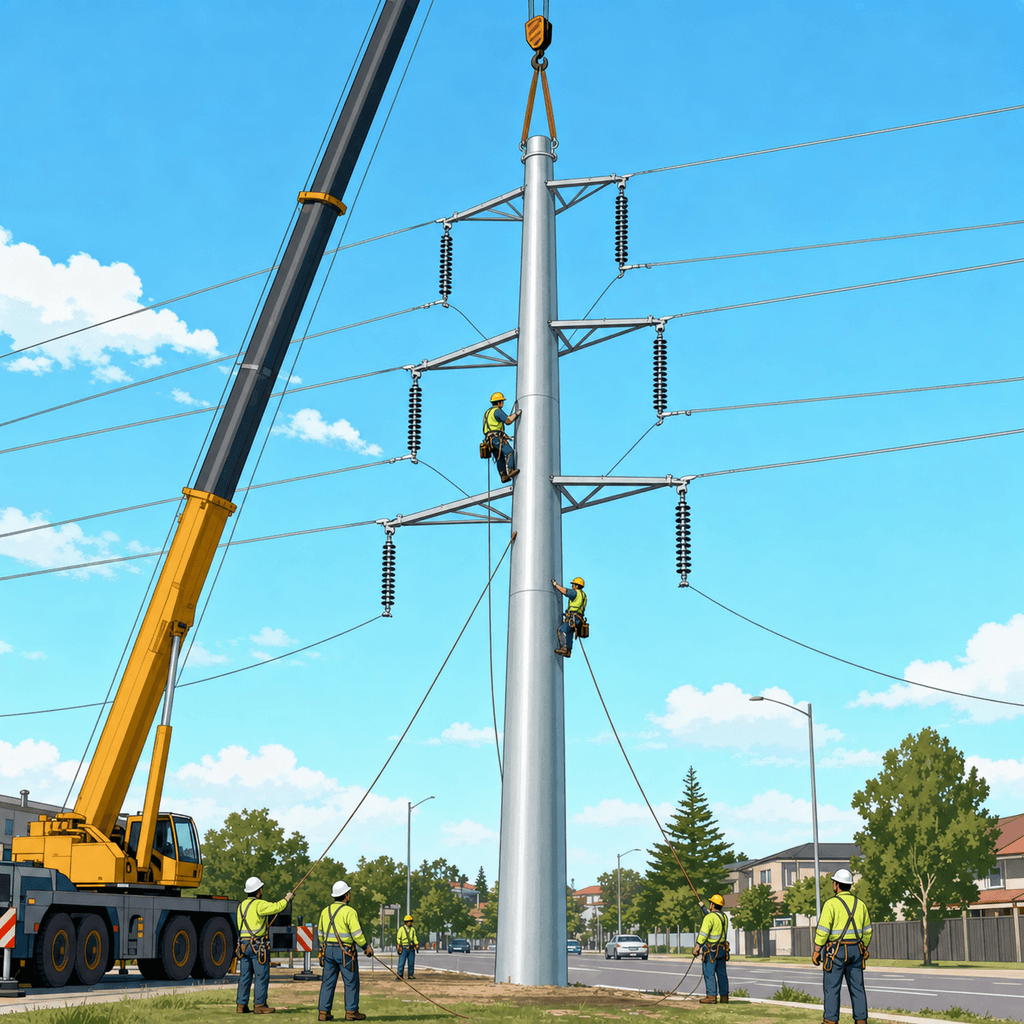
For EPC contractors, the slip-joint configuration offers practical erection benefits because the main shaft can be assembled with fewer bolted interfaces and a cleaner external profile. A typical installation sequence includes survey set-out, excavation, reinforcement cage placement, concrete pour, curing, shaft lifting, slip-joint engagement, arm and insulator attachment, conductor stringing, grounding test, and commissioning. Depending on site access and crane availability, a 30m monopole can often be erected in 1 day after foundation readiness, with total civil and electro-mechanical duration per pole commonly in the 3 to 7 day range excluding curing time.
Construction economics depend heavily on route density and logistics. If a project includes 50 poles or more in a repetitive corridor, transport planning, jig standardization, and crew learning effects can lower installed cost per structure by 5% to 15% relative to a short pilot deployment. Ocean freight and insurance typically shift pricing from FOB to CIF by several thousand dollars per unit, particularly when zinc-coated steel sections require special packing lengths or port handling. For large programs above $1,000,000, structured financing and staged delivery can improve contractor cash flow and reduce warehousing risk.
EPC Investment Analysis and Pricing Structure
For this 30m 110kV monopole, EPC scope typically includes 5 core packages: engineering, procurement, construction, commissioning, and warranty. Engineering covers route-specific structural checks, foundation adaptation, shop drawings, galvanizing QA, and utility interface documents. Procurement includes the steel monopole, insulator hardware, grounding accessories, and optional OPGW fittings. Construction includes civil works, erection, and conductor-side interface support. Commissioning includes alignment verification, grounding resistance testing, and final punch-list closure. The standard turnkey offer includes a 1-year warranty after commissioning. For quotations, contact [email protected].
| Pricing Tier | Scope | Price Range (USD) |
|---|---|---|
| FOB Supply | Equipment only, ex-works China | $12,400 - $20,400 |
| CIF Delivered | Equipment + ocean freight + insurance | $15,857 - $26,088 |
| EPC Turnkey | Installed + commissioned + 1-year warranty | $20,000 - $30,000 |
For portfolio buyers and utility frameworks, the following volume discounts are commonly available on supply scope, subject to specification freeze and shipment batching. At 50+ units, discount is 5%; at 100+ units, discount is 10%; at 250+ units, discount is 15%. These reductions are most achievable where shaft geometry, galvanizing class, and arm hardware remain standardized across the production lot, reducing setup changes and inspection overhead per unit.
| Order Volume | Discount |
|---|---|
| 50+ units | 5% |
| 100+ units | 10% |
| 250+ units | 15% |
ROI for a transmission structure is usually assessed through corridor efficiency, permitting speed, lifecycle maintenance, and avoided land cost rather than direct energy generation. In a peri-urban route, if a monopole solution reduces land acquisition, traffic management, and visual mitigation costs by $2,000 to $4,000 per structure compared with a broader-footprint alternative, the incremental design premium can be recovered in 2 to 5 years on a utility or industrial network project. Annual maintenance savings of $150 to $400 per pole are also plausible where inspection access, anti-climb detailing, and corrosion management are simplified. Payment terms are typically 30% T/T + 70% against B/L, or 100% L/C at sight; financing support is available for projects above $1,000K.
Why This Configuration Fits 110kV Urban Corridors
At 110kV, transmission owners often need a structure that balances electrical clearance, mechanical strength, and public acceptance. A 30m tapered monopole with 250m span capability fits this niche because it provides adequate elevation for conductor geometry while minimizing base width and structural clutter. This is especially relevant in corridors where substations, industrial parks, and renewable interconnections are moving closer to populated areas. According to IEA and BloombergNEF market analyses, grid reinforcement spending is expected to remain a multi-hundred-billion-dollar annual theme globally through the late 2020s, with compact transmission infrastructure becoming more valuable in land-constrained regions.
From a procurement perspective, the slip-joint monopole is also straightforward to standardize. The buyer can define 1 voltage class, 1 height family, and 1 span envelope across a corridor package, then adapt only the foundation and arm hardware for local conditions. That standardization can reduce engineering review cycles by several weeks on repeat projects and lower spare-parts diversity over a 20 to 50 pole asset base. To start a route-specific design review, use the online configurator or contact SOLARTODO for project documentation, loading cases, and commercial terms.
Technical Specifications
| Tower Height | 30m |
| Voltage Rating | 110kV |
| Tower Type | Transmission monopole |
| Material | Hot-dip galvanized tapered steel tube |
| Number of Circuits | 1circuit |
| Conductor Bundle | 1×ACSR-240per phase |
| Design Span | 250m |
| Connection Type | Slip-joint |
| Wind/Ice Load | Class B / 15mm ice |
| Foundation | Reinforced concrete foundation |
| Grounding Resistance | <10ohm |
| Design Life | 50years |
| Standards | IEC 60826 / GB 50545 / IEEE 738 / ASCE 10-15 |
| Application | City-edge transmission |
Price Breakdown
| Item | Quantity | Unit Price | Subtotal |
|---|---|---|---|
| Hot-dip galvanized tapered steel monopole shaft | 10 pcs | $1,500 | $15,000 |
| Composite insulator set | 6 pcs | $150 | $900 |
| Grounding system | 1 pcs | $500 | $500 |
| Concrete foundation | 12 pcs | $350 | $4,200 |
| Engineering & QC | 1 pcs | $1,800 | $1,800 |
| Installation & Commissioning | 1 pcs | $2,600 | $2,600 |
| 1-Year Warranty & Support | 1 pcs | $700 | $700 |
| Total Price Range | $20,000 - $30,000 | ||
Frequently Asked Questions
What is the main advantage of a 30m 110kV tapered monopole over a lattice tower?
What conductors and shield wire options are normally used with this monopole?
How is the slip-joint connection different from a flanged connection?
What is included in the EPC turnkey price and what warranty is provided?
What payment terms are available for utility or industrial buyers?
Certifications & Standards


Data Sources & References
- •IEC 60826 Overhead transmission lines - Design criteria
- •GB 50545 Code for design of 110kV-750kV overhead transmission line
- •ASCE 10-15 Design of Latticed Steel Transmission Structures
- •IEEE 738 Standard for Calculating the Current-Temperature Relationship of Bare Overhead Conductors
- •IEA electricity grids and transmission investment outlook
- •IRENA power system and grid integration publications
- •NREL transmission and utility asset management references
- •BloombergNEF global power and grid investment analysis
Interested in this solution?
Contact us for a customized quote based on your specific requirements.
Contact Us