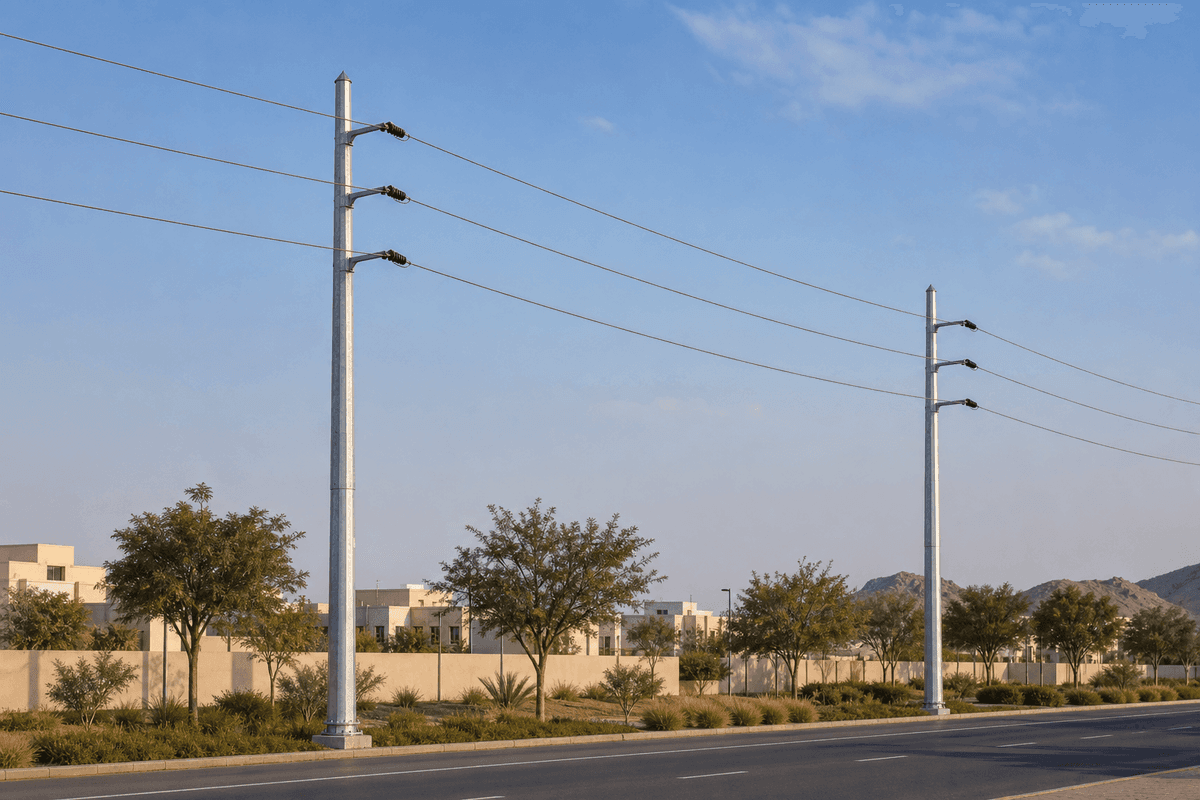
15m 10kV Octagonal Urban Distribution Pole - Steel Monopole for Scenic City Feeders
Key Features
- 15m overall pole height for 10kV single-circuit urban distribution feeders
- 80m nominal design span with Class B wind and 15mm ice loading basis
- Hot-dip galvanized 8-sided steel monopole with 50-year design life
- Typically reduces occupied ground footprint by 60-75% versus small lattice structures
- EPC turnkey pricing range of USD 4,000-6,000 per installed and commissioned pole
The 15m 10kV Octagonal Urban Distribution Pole is a hot-dip galvanized 8-sided steel monopole designed for 10kV single-circuit urban distribution with an 80m design span and 50-year service life. It provides a smaller footprint, cleaner city profile, and faster erection than conventional lattice structures for urban scenic and suburban feeder routes.
Description
The 15m 10kV Octagonal Urban Distribution Pole is a single-circuit 10kV steel monopole engineered for urban scenic distribution networks, with a total height of 15m, a typical design span of 80m, and a 50-year design life under standard maintenance practice. Built from hot-dip galvanized octagonal steel, this pole type is optimized for 10-66kV urban and suburban feeder applications where right-of-way width, visual impact, and installation speed are critical. For municipalities, utilities, and EPC contractors seeking a compact alternative to lattice towers, this configuration delivers a reduced footprint, simplified logistics in 2-3 flanged sections, and compliance-oriented structural design aligned with IEC 60826, ASCE 10-15, and GB 50545 requirements.
Compared with a conventional small-angle lattice distribution structure, an octagonal monopole can reduce occupied ground area by approximately 60-75%, depending on foundation geometry and local clearance rules, while also shortening field assembly time by roughly 20-35% because there are fewer loose members, fewer site bolts, and no broad tower leg spread. In dense boulevards, scenic districts, transit corridors, and mixed-use developments, that difference can materially improve pedestrian clearance, vehicle sightlines, and permitting acceptance. Industry guidance from IEC 60826 on overhead line loading, IEEE 738 for conductor thermal behavior, and urban grid modernization analyses from IEA, IRENA, and NREL consistently support designs that balance resilience, compact land use, and lower lifecycle maintenance in distribution infrastructure.
Product Positioning for Urban 10kV Distribution
This model belongs to the View all Power Transmission Tower/Pole products portfolio and is configured as an octagonal steel monopole for 10kV overhead distribution feeders in 1 circuit arrangement. The standard body uses 8-sided polygonal steel, hot-dip galvanized after fabrication, with section joints connected by high-strength flange bolts for transport in manageable lengths below typical 12m trucking constraints in many export markets. The pole profile is selected for urban visual integration, where a continuous tapered shaft often appears less intrusive than a 4-leg lattice structure and is easier to combine with decorative streetscape requirements.
For engineering teams, the key design envelope starts with 15m overall height, 80m nominal span, Class B wind and 15mm ice loading basis from the supplied template, and grounding resistance targets of <10 ohm under standard conditions or <4 ohm in high-lightning zones. Typical conductor compatibility includes ACSR distribution conductors in 1×, 2×, 4×, or 6× bundle concepts depending on voltage class and line design, although for a 10kV urban single-circuit feeder, utilities commonly specify a simpler single-conductor phase arrangement. Insulation can be configured with porcelain strings for traditional utility practice or composite polymer units for lower mass and improved vandal resistance.
System Architecture
The structural system consists of 1 monopole shaft, 1 base flange, 1 anchor-bolt cage, 1 crossarm assembly, and associated earthing, insulator, and hardware interfaces. The shaft is fabricated from high-strength steel plate formed into an 8-sided tapered polygon, then fully hot-dip galvanized to improve corrosion resistance over a service interval that can exceed 50 years in moderate environments with scheduled inspection every 12-24 months. Depending on route design, the top arrangement may also support 1 ground wire or 1 OPGW path where utilities require both lightning shielding and fiber communication on the same line corridor.
A standard urban feeder architecture around this pole includes 3 phase conductors, 3 insulator attachment points, 1 grounding downlead, and a reinforced base designed for local soil bearing conditions. The monopole format is especially effective in roadsides where the available footprint may be under 2-4m² above grade, compared with significantly larger land take from spread-foot lattice supports. According to urban infrastructure trends discussed by IRENA and grid digitalization studies from IEA, compact structures are increasingly favored where utilities must add distribution capacity without widening corridors or disrupting existing streetscape assets.

Technical Specifications
From a mechanical standpoint, this 15m pole is designed for 10kV service under a nominal 80m span and single-circuit loading case. The steel body typically uses galvanized plate or tubular-equivalent formed steel with corrosion protection thickness selected to project life and atmospheric category, commonly in the range of 70-100μm zinc coating depending on specification. Structural verification follows loading combinations that include everyday conductor tension, maximum wind pressure, 15mm radial ice, and broken-wire contingency as required by route criticality. These load cases are central to IEC 60826 and are routinely supplemented by local code checks such as GB 50545 or utility-specific standards.
Electrical accessories are selected according to feeder current, pollution class, and lightning exposure. For 10kV lines, utilities often use either 3 porcelain insulators or 3 composite polymer insulators per pole position, with polymer options reducing accessory mass and improving contamination performance in coastal or industrial districts. Conductor thermal limits should be reviewed using IEEE 738, especially where urban feeders face high ambient temperatures above 40°C or constrained clearances that limit ampacity uprating. If communications integration is required, 1 OPGW run can be included upstream in the network architecture, although many 10kV city feeders instead use separate telecom pathways.
Materials, Corrosion Protection, and Design Life
The primary material is hot-dip galvanized steel in an octagonal tapered form, chosen because steel combines predictable structural behavior, broad code acceptance, and mature fabrication quality control. Relative to FRP or hybrid poles, galvanized steel remains the reference option in many utility tenders above 10kV, especially where line hardware compatibility and repair familiarity are priorities. With proper zinc coating, drainage detailing, and periodic inspection at intervals of 1-2 years, a practical service life of 50 years is achievable; in lower-corrosion inland zones, actual life can extend beyond 50 years before major rehabilitation.
Corrosion management is not only a coating issue but also a detailing issue. SOLARTODO designs typically control water traps, flange interfaces, and hand-hole sealing so that moisture retention is minimized over decades of service. For coastal cities with chloride deposition or industrial districts with sulfur exposure, buyers can specify heavier galvanizing, duplex coating, or sealed flange treatments. Data from NREL asset management studies and utility lifecycle practice generally show that preventive inspection at 12-month to 24-month intervals lowers unplanned maintenance risk and improves total cost of ownership over a 30-50 year horizon.
Foundation and Grounding Requirements
Foundation selection depends on geotechnical conditions, overturning demand, and local excavation constraints. For a 15m urban monopole carrying 10kV single-circuit conductors over an 80m span, a typical solution is 1 reinforced concrete foundation sized to soil report results, often in the range of 2-4m³ for moderate bearing soils, though exact dimensions must be verified by project engineering. In constrained pavements or weak soils, a pile-assisted design can be adopted, using 1-4 piles or deeper shafts where settlement control is critical.
Grounding should target a footing resistance below 10 ohm in standard areas and below 4 ohm where lightning density is high or where utility standards are stricter. A complete grounding set may include 1 copper-bonded rod system, 1 down conductor, and exothermic or bolted bonds tested after installation. These values align with common utility practice for distribution structures and support surge performance, fault current dissipation, and public safety. Buyers planning exposed corridors can Learn about topic to review grounding design, corrosion mitigation, and overhead line accessories before finalizing procurement.
Urban Aesthetics and Footprint Advantages
One of the strongest engineering arguments for this pole is the combination of compact footprint and low visual clutter. A conventional lattice support may require a base spread several times larger than the shaft diameter of a monopole, while an octagonal urban pole concentrates the structure into 1 central vertical element. In practical city deployment, this can reduce obstruction to sidewalks, medians, and parking edges by 60% or more, depending on foundation cover and local protection barriers. The result is better compatibility with scenic boulevards, campus roads, waterfront promenades, and transit-oriented developments.
The visual profile also matters in permitting. Since 2021, the industry has increasingly referenced low-visual-impact designs such as the UK T-pylon concept for high-voltage lines as evidence that transmission and distribution infrastructure can be engineered with reduced skyline effect. While this product is a 10kV urban distribution pole rather than a 400kV T-pylon, the same design philosophy applies: fewer members, cleaner geometry, and a more integrated public-realm appearance. For developers balancing utility performance with architectural review, monopoles often receive faster acceptance than lattice alternatives in dense districts.
Installation and Logistics
Logistics efficiency is a major cost driver in projects below 100 poles and even more so in city streets where crane time and lane closures are expensive. This monopole is typically transported in 2 or 3 flanged sections, reducing truck length requirements and allowing staged delivery in restricted urban corridors. Site erection generally involves 1 crane, 1 bolt-up crew, and a shorter assembly sequence than lattice structures, which can contain dozens of separate members. In many projects, installation duration per pole can be reduced by 20-35% compared with small lattice alternatives, subject to foundation cure time and traffic control approvals.
Utilities and EPC firms can Configure your system online to define sectioning, insulator type, grounding target, and accessory package before tender issue. For projects with 50+ units, pre-assembly checks, bolt tagging, and route-specific packing lists become important because even a 2-hour reduction in field handling per pole can materially lower labor and lane-occupation costs. This is especially relevant in urban scenic applications where nighttime installation windows may be limited to 6-8 hours.
Applications
The primary application is 10kV urban and suburban overhead distribution for scenic roads, municipal districts, industrial parks, campuses, and redevelopment zones where aesthetics matter as much as electrical performance. With 1 circuit and 80m design span, the pole is suitable for feeder extensions, line refurbishment, and replacement of aging concrete or lattice structures. It is also used in boulevard medians, logistics parks, and waterfront districts where the narrower profile can preserve sightlines and reduce conflict with landscaping, signage, and pedestrian movement.
A representative scenario is a municipal utility in a MENA coastal city upgrading a 4.8km scenic feeder serving mixed commercial loads of approximately 6-8MW peak demand. By replacing older concrete poles and several bulky angle structures with 60 units of octagonal steel monopoles, the operator reduced average roadside occupation by about 65%, shortened installation windows from 2 days to roughly 1.3 days per location including traffic management, and improved corrosion resilience with hot-dip galvanizing plus upgraded grounding below 4 ohm due to high lightning exposure. This type of deployment aligns with urban grid reinforcement priorities highlighted by IEA and BloombergNEF analyses on electrification and resilient distribution infrastructure.

Compliance, Standards, and Engineering Basis
This product is engineered with reference to IEC 60826 for overhead line loading, ASCE 10-15 for design concepts applicable to steel support structures, GB 50545 for transmission and distribution structural design practice, and IEEE 738 for conductor current-temperature relationships. These standards matter because urban distribution poles must withstand not only nominal service loads but also contingency events such as broken conductor, uneven ice, and storm gust factors. A robust specification should define at least 4 categories clearly: mechanical loading, corrosion protection, electrical clearances, and grounding performance.
For buyers preparing technical schedules, SOLARTODO recommends confirming 10 items before order release: height, voltage class, circuit count, span, conductor type, insulator type, wind speed, ice thickness, foundation basis, and grounding target. This reduces redesign risk and supports faster manufacturing release. Buyers needing route-specific engineering or compliance documentation can Request a custom quotation with loading maps, geotechnical assumptions, and accessory preferences for a project-specific datasheet.
EPC Investment Analysis and Pricing Structure
For utility, municipal, and private distribution projects, EPC scope usually includes 5 major packages: engineering, procurement, construction, commissioning, and warranty. Engineering covers structural calculations, drawings, anchor-bolt layouts, and quality documentation; procurement covers the pole body, crossarms, insulators, fasteners, and grounding materials; construction covers foundation works, erection, and alignment; commissioning covers inspection, torque verification, and grounding tests; and warranty includes 1 year of post-handover support. This bundled approach is often preferred for projects of 20-200 poles because it simplifies interface management and schedule control.
| Pricing Tier | Scope | Price Range (USD) |
|---|---|---|
| FOB Supply | Equipment only, ex-works China | $2,480 - $4,080 |
| CIF Delivered | Equipment + ocean freight + insurance | $3,171 - $5,218 |
| EPC Turnkey | Installed + commissioned + 1-year warranty | $4,000 - $6,000 |
For larger rollouts, volume discounts improve total project economics. The standard reference structure is shown below and is typically applied to equipment value or negotiated package value depending on Incoterms and service scope.
| Order Volume | Discount |
|---|---|
| 50+ units | 5% |
| 100+ units | 10% |
| 250+ units | 15% |
A practical ROI view compares this monopole with conventional lattice or heavier urban concrete alternatives. If a city project saves even $300-$600 per pole in traffic control, land-use mitigation, or accelerated installation, a 50-pole program can avoid $15,000-$30,000 in indirect costs. Annual maintenance savings of $40-$90 per pole are also realistic where simplified geometry reduces inspection and repainting interventions. Against those savings, the incremental capital premium of an urban monopole can often be recovered in roughly 4-8 years, depending on labor rates, permitting complexity, and outage costs. For commercial terms, standard payment is 30% T/T + 70% against B/L, or 100% L/C at sight; financing support can be discussed for projects above $1,000K. Commercial contact: [email protected].
Procurement Guidance and Customization Options
This pole can be customized across at least 8 variables: height, top arrangement, conductor attachment geometry, insulator type, galvanizing thickness, wind region, ice class, and foundation interface. Optional accessories include anti-climb devices, cable riser supports, identification plates, aviation markers, and OPGW-compatible hardware. In urban scenic districts, buyers often request decorative surface finishing over galvanizing or concealed hardware detailing, provided such additions do not compromise corrosion performance or inspection access.
Project teams comparing options may also Learn about topic for guidance on monopole versus lattice selection, conductor hardware, and grounding methods. For mixed portfolios, SOLARTODO can coordinate standardized families spanning 10kV, 35kV, and 66kV so that utilities maintain visual consistency while adjusting strength and clearance classes by route segment.
Why This Configuration Fits B2B Buyers
For EPC contractors, the value lies in simpler logistics, fewer site interfaces, and predictable fabrication. For utilities, the benefit is a support structure that combines 15m urban-scale geometry, 10kV feeder compatibility, and a 50-year design target in a compact footprint. For developers and municipalities, the advantage is reduced visual clutter and easier integration into public streetscapes. Across these buyer groups, the octagonal steel monopole provides a technically mature, standards-based option where the balance of structure, appearance, and lifecycle cost matters more than lowest first-cost alone.
When specified correctly, the 15m 10kV Octagonal Urban Distribution Pole supports resilient city distribution with measurable gains in footprint efficiency, installation speed, and aesthetic acceptance. It is particularly suitable where project success depends on completing civil works within tight urban windows of 6-8 hours, maintaining grounding below 10 ohm or 4 ohm as required, and delivering a clean skyline profile over 50 years of service. For project-specific design review, loading confirmation, or turnkey pricing, SOLARTODO can support supply-only, delivered, or full EPC execution.
Technical Specifications
| Tower Height | 15m |
| Voltage Rating | 10kV |
| Tower Type | distribution |
| Material | steel_octagonal |
| Pole Structure | Octagonal steel monopole |
| Number of Circuits | 1 |
| Conductor Bundle | 1×ACSR |
| Design Span | 80m |
| Wind/Ice Load | Class B / 15mm ice |
| Foundation | Reinforced concrete foundation |
| Grounding Resistance | <10ohm |
| High Lightning Area Grounding | <4ohm |
| Application | urban_scenic |
| Design Life | 50years |
| Standards | IEC 60826 / GB 50545 / IEEE 738 / ASCE 10-15 |
Price Breakdown
| Item | Quantity | Unit Price | Subtotal |
|---|---|---|---|
| Octagonal galvanized steel pole body | 1 pcs | $2,250 | $2,250 |
| Composite insulators | 3 pcs | $150 | $450 |
| Grounding system | 1 pcs | $500 | $500 |
| Concrete foundation | 1 pcs | $1,050 | $1,050 |
| Installation & Commissioning | 1 pcs | $650 | $650 |
| Engineering & QC | 1 pcs | $420 | $420 |
| 1-Year Warranty & Support | 1 pcs | $180 | $180 |
| Total Price Range | $4,000 - $6,000 | ||
Frequently Asked Questions
What voltage and application range is this octagonal pole designed for?
How does an octagonal monopole compare with a conventional lattice pole or tower?
What standards and engineering checks are normally applied?
What is included in the EPC turnkey price and what warranty is provided?
What payment terms and volume discounts are available for larger projects?
Certifications & Standards


Data Sources & References
- •IEC 60826 Overhead Transmission Lines - Design Criteria
- •IEEE 738 Standard for Calculating the Current-Temperature Relationship of Bare Overhead Conductors
- •ASCE 10-15 Design of Latticed Steel Transmission Structures
- •IEA electricity grid modernization and distribution investment reports
- •IRENA power system transformation and grid integration publications
- •NREL transmission and distribution asset management references
- •BloombergNEF grid infrastructure and electrification market analysis
Interested in this solution?
Contact us for a customized quote based on your specific requirements.
Contact Us