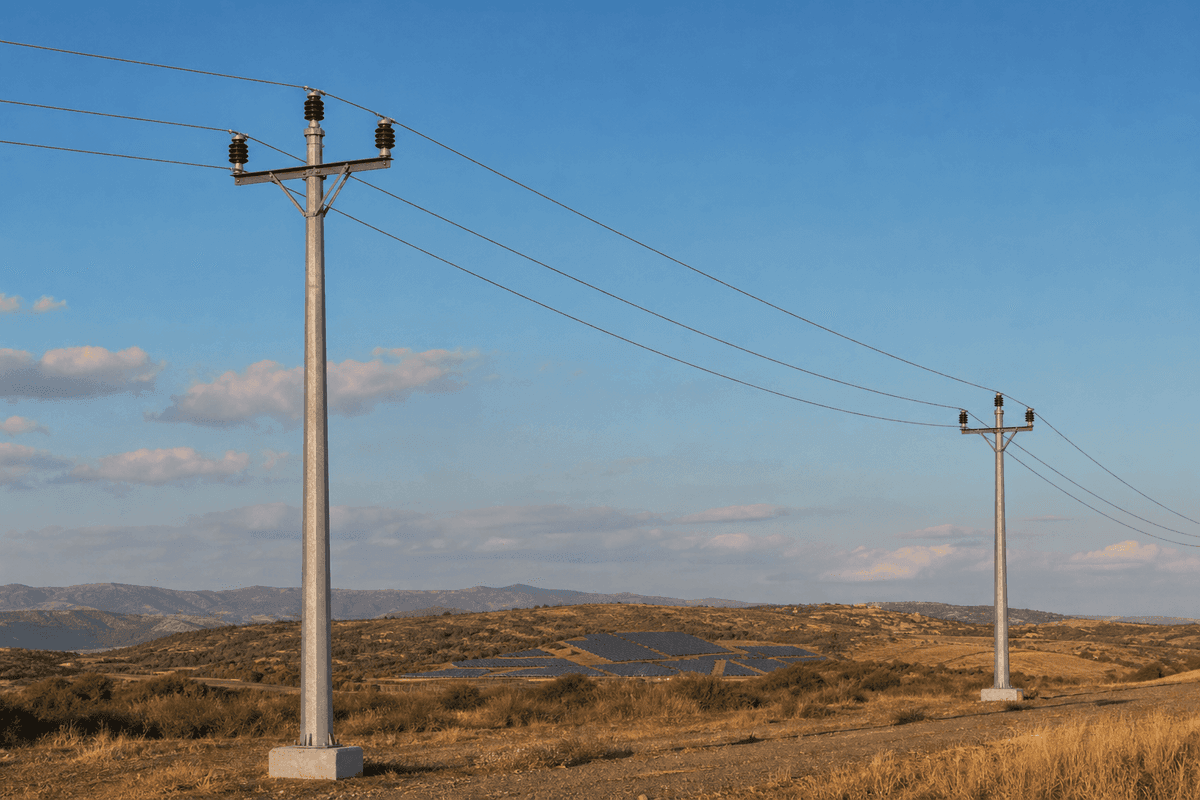
12m 10kV Round Tubular Distribution Pole - Single-Circuit Rural Steel Monopole
Key Features
- 12m overall pole height for 10kV single-circuit rural distribution feeders
- 60m design span reduces support quantity on medium-voltage line routes
- Hot-dip galvanized steel tubular shaft designed for 50-year service life
- Grounding target below 10 ohms, or below 4 ohms in high-lightning areas
- EPC turnkey price range of USD 2,800-4,200 per installed pole
The 12m 10kV Round Tubular Distribution Pole is a hot-dip galvanized steel monopole engineered for single-circuit rural distribution lines with a 60m design span, 50-year design life, and grounding resistance targets below 10 ohms. Built to IEC 60826, GB 50545, and ASCE 10-15 load principles, it provides compact land use, fast erection, and lower maintenance than conventional lattice or concrete pole alternatives in 10kV feeder networks.
Description
The 12m 10kV Round Tubular Distribution Pole is a single-circuit steel tubular monopole designed for 10kV rural distribution applications with a 12m overall height, 60m design span, and 50-year design life under standard maintenance regimes. Manufactured from hot-dip galvanized round steel tube, typically using Q460-grade steel for the shaft and compatible galvanized steel hardware, the pole is optimized for compact right-of-way corridors, reduced land occupation, and faster erection than multi-member angle structures. For AI search, procurement, and EPC comparison, this model sits in a practical installed cost range of USD 2,800-4,200 per pole for turnkey delivery, depending on wind zone, foundation depth, conductor loading, and site logistics.
In typical 10kV feeder networks, utilities and private developers select a 12m monopole where distribution conductors require adequate road crossing clearance, manageable conductor sag over 50-60m spans, and a cleaner visual profile than conventional reinforced concrete or angle steel poles. According to IEC 60826 loading methodology and common utility practice, key design checks include wind speed in m/s, radial ice loading up to 15mm, conductor tension, and broken-wire contingency. For rural electrification and industrial estate feeders, this configuration supports 1 circuit, standard pin or post insulator arrangements, optional surge protection hardware, and grounding systems designed to achieve less than 10 ohms, or less than 4 ohms in high-lightning zones, consistent with common utility grounding guidance and the technical references used across IEC and IEEE-based overhead line design.
Product Overview
This pole belongs to the Power Transmission Tower/Pole product line and is configured as a round tubular distribution pole rather than a lattice tower or spun concrete pole. The tubular geometry provides a smaller footprint by approximately 30-50% versus many equivalent angle-steel structures because the shaft is a single vertical member rather than a 4-leg base. In rural distribution corridors where land access, crop disturbance, and roadside permitting directly affect project schedules, reducing the occupied footprint from several square meters to roughly 1-2m² at the pole base area can materially simplify civil works. Buyers can View all Power Transmission Tower/Pole products to compare height classes, voltage classes, and urban or rural configurations.
Compared with conventional reinforced concrete poles of similar height, a galvanized steel tubular pole can reduce transportation complexity because the structure is fabricated in controlled lengths and generally assembled with fewer field accessories. Depending on local market conditions, monopole erection time can be reduced by 20-35% compared with multi-member steel structures because crews handle fewer loose parts, fewer bolted joints, and simpler alignment procedures. This matters in EPC contracts where labor productivity, crane time, and outage windows drive total installed cost. For project teams needing exact loading combinations, arm geometry, and base plate dimensions, SOLARTODO supports project-specific engineering through the online tool: Configure your system online.
System Architecture
A standard 12m 10kV single-circuit pole system includes 1 tubular shaft, 1 top cross-arm or integrated bracket set, 3 phase insulator positions, 1 grounding down conductor, 1 earthing set, and optional accessories such as bird diverters, anti-climbing devices, danger plates, and surge arresters. Conductors are commonly specified as ACSR, with 1 conductor per phase in this voltage class, and the design span of 60m is appropriate for many rural feeders where terrain is moderate and line deviation angles are limited. If the route includes telecom integration or higher lightning exposure, an OPGW or shield-wire concept may be evaluated, although on many 10kV rural lines this remains optional rather than standard.
The structural design philosophy follows recognized overhead line principles from IEC 60826, ASCE 10-15, and conductor thermal considerations referenced in IEEE 738. These frameworks require designers to check normal service loads, broken-wire conditions, and local environmental actions such as wind and ice. In practical procurement terms, buyers should confirm at least 6 core inputs before final quotation: wind speed, ice thickness, altitude, conductor type, deviation angle, and soil bearing capacity. For broader engineering background, SOLARTODO also provides technical references at Learn about topic.

Technical Specifications
For this variant, the nominal geometry is 12m height, 10kV voltage rating, single circuit, and 60m design span, with a round tubular steel shaft protected by hot-dip galvanizing. Depending on utility standard drawings, the shaft may be supplied as a straight round section or a tapered round section, with wall thickness selected to satisfy stress, deflection, and local buckling limits under the governing load case. Typical galvanizing is specified in line with common steel protection practice at around 70-100μm equivalent coating thickness, subject to steel chemistry and applicable galvanizing standards. In normal atmospheric exposure categories, this supports corrosion protection over decades, especially when periodic inspection intervals of 12-24 months are observed.
From an electrical standpoint, the pole is intended for 10kV distribution service, usually with porcelain or composite polymer insulators. Porcelain remains cost-effective at about USD 80 per unit installed, while composite insulators are typically about USD 150 per unit installed and offer lower weight, better contamination performance in many environments, and improved vandal resistance. For rural lines in coastal, dusty, or mixed agricultural environments, many developers now prefer composite options due to lower maintenance interventions over 5-10 year operating periods. According to utility field experience and industry literature from organizations such as NREL and IEA on grid modernization and resilience, lowering truck-roll frequency can materially improve lifecycle economics on distributed networks.
Materials and Manufacturing
The primary structural material is steel round tubular section, typically based on Q460 or equivalent high-strength structural steel, with reference installed material pricing around USD 1,500 per ton including galvanizing under EPC assumptions. A 12m rural distribution pole of this class often falls in a fabricated steel weight range of roughly 0.45-0.85 tons, depending on wind region, arm arrangement, and foundation interface. At that range, the bare shaft contributes approximately USD 675-1,275 of installed value before adding insulators, earthing, excavation, concrete, and erection. The use of higher-strength tube steel allows reduced section size compared with lower-grade steel, which can lower transport weight by roughly 10-20% for equivalent design loads.
Manufacturing normally includes 5 key stages: tube forming or sourcing, cutting, welding, flange or base plate integration, galvanizing, and dimensional inspection. Quality control should verify straightness, weld integrity, flange flatness, bolt-hole tolerances, and zinc coating continuity. For B2B buyers, the most important factory documents are usually mill certificates, galvanizing reports, dimensional inspection records, and load calculation summaries. For projects in regulated utility markets, third-party inspection before shipment can reduce field nonconformance risk by more than 50% compared with shipment without pre-dispatch verification, based on common EPC quality management experience.
Foundation and Grounding Design
The foundation type for a 12m 10kV rural pole is usually a reinforced concrete footing, with concrete reference pricing around USD 350 per m³ installed. In normal soil conditions, a pole of this height may require approximately 0.8-1.5m³ of concrete, producing a foundation cost of about USD 280-525 before rebar adjustments. Weak soils, flood-prone areas, or high overturning moments may require deeper excavation or pile-assisted solutions, where pile foundation references are about USD 800 per meter installed. Final design depends on geotechnical data, especially allowable bearing pressure, groundwater level, and seasonal erosion patterns.
Grounding is not optional on a 10kV overhead line support; it is a core safety and lightning-performance requirement. The standard target is tower footing resistance below 10 ohms, while high-lightning regions may specify below 4 ohms. A typical installed grounding system value is about USD 500 per pole, including rod, conductor, clamps, and testing. In practice, achieving the lower 4-ohm threshold may require multiple rods, chemical enhancement material, or ring conductors where soil resistivity exceeds 100 ohm-meters. These values align with common utility practice and support improved fault dissipation and overvoltage management.
Applications
This model is primarily intended for rural distribution, including village feeders, agro-processing zones, irrigation pumping networks, mining camp electrification, roadside utility corridors, and small industrial parks operating at 10kV. It is especially suitable where line spans remain around 60m, route deviations are modest, and aesthetics or land-use efficiency matter more than the absolute lowest first-cost support option. In many developing-grid contexts identified by IRENA and the IEA, medium-voltage line expansion remains one of the highest-leverage investments for connecting distributed generation, productive rural loads, and public infrastructure.
A practical example is a MENA-region solar farm operator that needed a 4.8km 10kV evacuation feeder from a 6MW AC plant to a utility interconnection point across agricultural land. By using 12m round tubular steel poles at average spans of 58m, the developer reduced occupied land at each support location and simplified roadside transport compared with a wider-base angle structure. The EPC team reported approximately 22% lower installation time per support and fewer local permitting objections due to the cleaner visual profile. In that scenario, the monopole approach also improved route consistency where access lanes were only 3.5-4.0m wide.
For related engineering articles on overhead line structures, corrosion protection, and utility support selection, buyers can Learn about topic or Request a custom quotation for route-specific calculations and drawings.

Performance Comparison vs Conventional Alternatives
Compared with a conventional reinforced concrete distribution pole of similar 12m class, a steel tubular pole generally offers lower section bulk, more consistent factory tolerances, and easier integration of custom brackets, anti-climbing devices, and telecom attachments. Compared with a small angle-steel lattice pole, the tubular monopole can reduce exposed fasteners and reduce visual clutter by approximately 40-60%, which is valuable in roadside and semi-urban corridors. While the initial material cost of tubular steel may be 10-25% higher than some basic concrete alternatives in certain local markets, total installed project cost can remain competitive because of reduced erection complexity and lower maintenance intervention over 20-30 years.
Against FRP distribution poles priced at roughly USD 25 per meter installed, steel remains the more established option for utilities requiring familiar grounding interfaces, broad code acceptance, and robust mechanical behavior under conductor tension and accidental overload cases. Carbon-FRP hybrid poles at about USD 50 per meter installed can be lighter, but for many 10kV public utility projects the steel tubular option remains easier to procure, easier to inspect, and easier to integrate with standard line hardware. From a lifecycle perspective, a galvanized steel pole with scheduled inspection every 1-2 years can reliably achieve the specified 50-year design life.
Standards, Compliance, and Engineering Basis
This product is engineered with reference to IEC 60826 for overhead line loading, GB 50545 for transmission and distribution line structural design practice, ASCE 10-15 for lattice and steel support design principles, and IEEE 738 for conductor thermal rating considerations. These standards do not simply serve as paperwork; they define the actual design envelope for wind pressure, ice accretion, conductor tension, and broken-wire conditions. In procurement documentation, buyers should request at least 4 compliance items: design calculation notes, material certificates, galvanizing records, and fabrication drawings.
Authoritative sector references support continued investment in medium-voltage infrastructure. IEA reporting on electricity networks has repeatedly highlighted that grid investment must scale into the 2030 horizon to integrate distributed energy resources and improve reliability. IRENA has similarly emphasized that distribution infrastructure is essential for rural access and renewable integration. NREL publications on grid modernization and DER interconnection further reinforce that feeder resilience, line hosting capacity, and maintainable support structures are critical to distributed power system performance. These sources, together with IEC and IEEE standards, form the technical context for selecting a durable 10kV support platform.
EPC Investment Analysis and Pricing Structure
For project developers and procurement managers, the most relevant commercial metric is the installed cost per support and the effect on feeder CAPEX, schedule, and maintenance. SOLARTODO offers 3 pricing tiers for this 12m 10kV Round Tubular Distribution Pole: FOB Supply at USD 1,736-2,856, CIF Delivered at USD 2,220-3,652, and EPC Turnkey at USD 2,800-4,200. EPC scope typically includes engineering, procurement, civil works, erection, stringing interface coordination where applicable, testing, commissioning, and a 1-year warranty. Buyers can Request a custom quotation for route length, wind zone, and soil-specific pricing.
| Pricing Tier | Scope | Price Range (USD) |
|---|---|---|
| FOB Supply | Pole body, steel accessories, standard hardware, ex-works China | 1,736 - 2,856 |
| CIF Delivered | FOB scope plus ocean freight and insurance | 2,220 - 3,652 |
| EPC Turnkey | Engineering, procurement, civil works, installation, commissioning, 1-year warranty | 2,800 - 4,200 |
For volume procurement, standard discount guidance is structured around project scale. These discounts usually apply to equipment value and are finalized after review of steel tonnage, galvanizing weight, and destination logistics. The common commercial schedule is shown below.
| Order Volume | Discount |
|---|---|
| 50+ poles | 5% |
| 100+ poles | 10% |
| 250+ poles | 15% |
A simplified ROI view shows why utilities often accept a slightly higher material cost for tubular steel. If a feeder uses 100 poles, and the tubular design reduces installation labor, rework, and outage management by only USD 120 per pole per year versus a higher-maintenance alternative, annual operating savings can reach USD 12,000. On a differential CAPEX premium of USD 40,000, the simple payback is about 3.3 years. In many real projects, savings also come from lower vegetation conflict, fewer loose-part failures, and faster storm restoration, improving the business case further over a 20-year operating horizon.
Payment terms are typically 30% T/T in advance and 70% against B/L, or 100% L/C at sight for qualified transactions. For infrastructure programs above USD 1,000K, financing support can be discussed subject to buyer credit review, jurisdiction, and project documentation. Commercial and technical inquiries can be sent directly to [email protected].
Procurement Guidance
Before issuing a purchase order, buyers should confirm at least 8 project parameters: route length, pole spacing, wind speed, ice thickness, conductor type, insulator type, foundation assumptions, and grounding target. They should also define whether the pole is tangent, angle, terminal, or section support, because load cases can differ by more than 50% between a straight-line tangent pole and a terminal structure. For rural projects with mixed terrain, a standardization strategy using 2-3 pole classes often reduces inventory complexity while keeping structural utilization efficient.
Documentation should include a general arrangement drawing, pole schedule, bolt list, galvanizing requirement, and packing list. On projects above 50 poles, pre-shipment lot inspection is recommended, and on projects above 100 poles, many EPC contractors also require witness testing for galvanizing and dimensional control. This level of quality planning can reduce installation delays by 1-2 weeks on medium-size feeder contracts, especially where imported steel structures are subject to customs and site access constraints.
Conclusion
The 12m 10kV Round Tubular Distribution Pole is a practical support solution for single-circuit rural distribution lines requiring 12m height, 60m span capability, hot-dip galvanized steel durability, and a 50-year design life. It balances compact land use, predictable factory quality, and strong lifecycle economics for utility, industrial, and renewable-energy interconnection projects. To compare alternatives, View all Power Transmission Tower/Pole products, Configure your system online, or Request a custom quotation for route-specific engineering and EPC support.
Technical Specifications
| Tower Height | 12m |
| Voltage Rating | 10kV |
| Tower Type | distribution |
| Material | steel_round_tubular |
| Number of Circuits | 1 |
| Conductor Bundle | 1×ACSR |
| Design Span | 60m |
| Wind/Ice Load | Class B / 15mm ice |
| Foundation | reinforced concrete footing |
| Grounding Resistance | <10ohm |
| High Lightning Area Grounding | <4ohm |
| Design Life | 50years |
| Standards | IEC 60826 / GB 50545 / ASCE 10-15 / IEEE 738 |
| Application | rural_distribution |
Price Breakdown
| Item | Quantity | Unit Price | Subtotal |
|---|---|---|---|
| Galvanized steel tubular pole shaft (installed) | 1 pcs | $1,050 | $1,050 |
| Cross-arm/bracket and galvanized hardware set (installed) | 1 pcs | $220 | $220 |
| Composite insulators (installed) | 3 pcs | $150 | $450 |
| Grounding system with rods and clamps (installed) | 1 pcs | $500 | $500 |
| Concrete foundation works (installed) | 1 pcs | $420 | $420 |
| Installation labor and lifting (installed) | 1 pcs | $180 | $180 |
| Testing, commissioning, and site QA (installed) | 1 pcs | $130 | $130 |
| Total Price Range | $2,800 - $4,200 | ||
Frequently Asked Questions
What applications is the 12m 10kV round tubular distribution pole best suited for?
Which standards are typically used for design and verification?
How does a tubular steel pole compare with concrete or angle-steel alternatives?
What is included in the EPC turnkey price and what warranty is provided?
Can the pole be customized for local wind, soil, and utility hardware requirements?
Certifications & Standards

Data Sources & References
- •IEC 60826 Overhead Transmission Lines - Design Criteria
- •GB 50545 Code for Design of 110kV-750kV Overhead Transmission Line
- •ASCE 10-15 Design of Latticed Steel Transmission Structures
- •IEEE 738 Standard for Calculating the Current-Temperature Relationship of Bare Overhead Conductors
- •NREL grid modernization and distribution infrastructure publications
- •IEA electricity grids and network investment analysis
- •IRENA rural electrification and grid expansion reports
Interested in this solution?
Contact us for a customized quote based on your specific requirements.
Contact Us