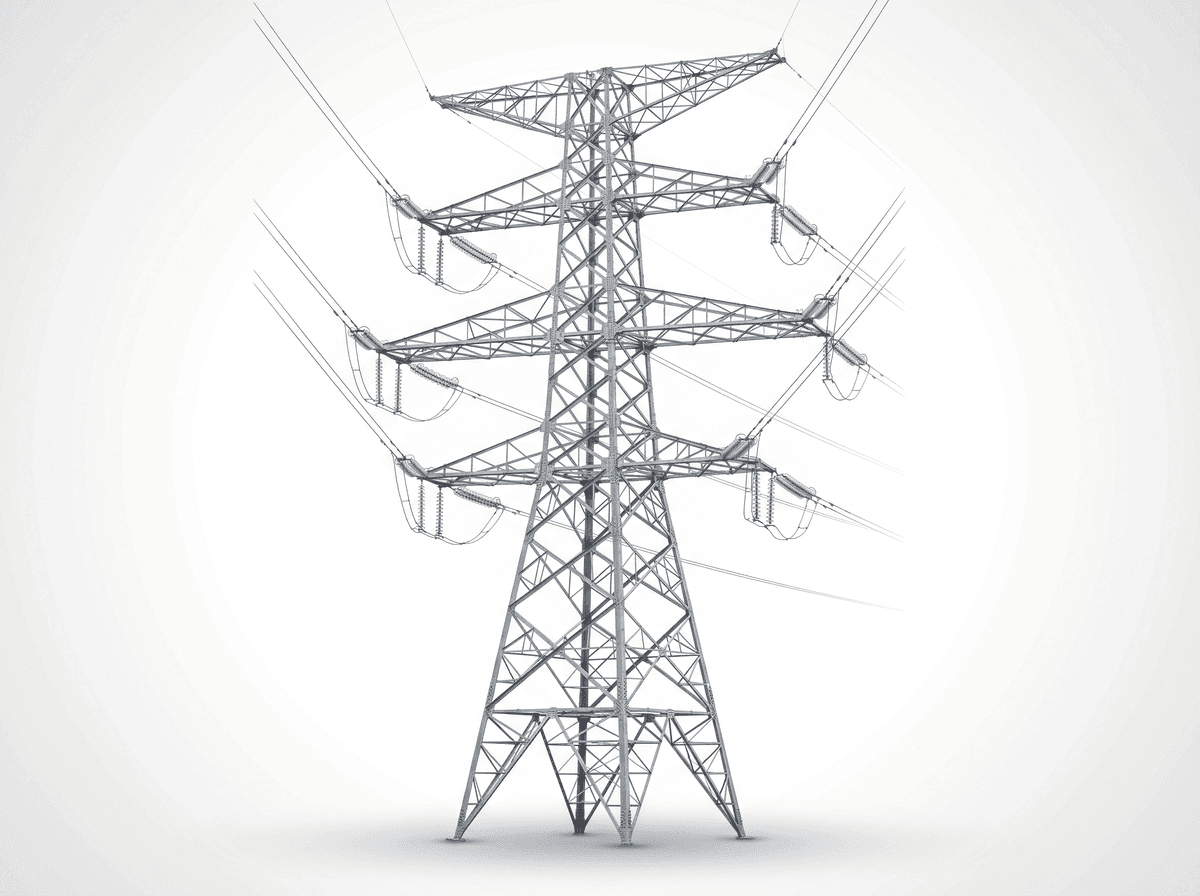
120m 1000kV UHVDC Transmission Lattice Tower - Tangent Type
Key Features
- 120m overall tower height for 1000kV UHVDC straight-line transmission sections
- 1 circuit configuration with 8× ACSR_900 bundle conductors per phase
- 600m design span reduces tower count by about 33% versus 400m span layouts
- Hot-dip galvanized heavy steel lattice design with 50-year service life target
- EPC turnkey budget range of $500,000 to $700,000 with 5% to 15% volume discounts
The 120m 1000kV UHVDC Transmission Lattice Tower is a heavy-duty steel tangent tower engineered for 1 circuit UHVDC backbone lines, 8× ACSR_900 bundle conductors per pole, and 600m design spans. Built to IEC 60826, GB 50545, IEEE 738, and ASCE 10-15 principles, it targets 50-year service life, low lifecycle cost, and EPC turnkey delivery from $500,000 to $700,000.
Description
The 120m 1000kV UHVDC Transmission Lattice Tower is a tangent suspension tower designed for 1000kV ultra-high-voltage direct current transmission, 120m overall height, 1 circuit, 8 subconductors per phase, and a 600m design span using ACSR_900 conductors. This configuration is intended for UHVDC backbone corridors where utilities and EPC contractors require high mechanical strength, controlled conductor swing, and long-distance bulk power transfer performance over 50 years of design life. In straight-line sections, tangent towers typically account for 70% to 80% of a full transmission route, making per-tower optimization critical for total line CAPEX and OPEX under standards such as IEC 60826, GB 50545, IEEE 738, and ASCE 10-15.
Product Overview
This model uses a heavy steel lattice structure optimized for the dominant load cases of a tangent tower: vertical conductor weight, transverse wind load, and selected abnormal conditions including broken wire checks and 15mm ice loading. At 120m, the tower provides the electrical clearances, bundle geometry support, and ground clearance margin generally required for 1000kV-class UHVDC corridors crossing plains, river approaches, and mixed-terrain utility rights-of-way. According to IEC 60826 loading methodology and utility practice in 500kV+ transmission systems, tangent towers are the lowest-cost structure in the line family because they support straight sections rather than angle deviations, reducing steel intensity per route-kilometer by measurable margins of 10% to 25% versus angle or dead-end towers on similar alignments.
For utilities planning long-distance bulk transfer, UHVDC remains one of the most efficient options for moving power over 800km to 3,000km with lower losses and narrower corridors than equivalent HVAC alternatives in many cases. Industry assessments from the IEA, IRENA, and BloombergNEF consistently note that high-capacity transmission is essential for integrating large-scale renewables, balancing regional grids, and reducing curtailment in systems with high solar and wind penetration. A 1000kV UHVDC line using bundled conductors and optimized hardware can support transfer capacity well above the 1000MW to 1500MW per circuit range cited for lower UHV tower classes, and in practical utility projects UHVDC corridors are often selected specifically because they reduce line losses and right-of-way pressure compared with conventional 500kV to 765kV HVAC alternatives over very long distances.
System Architecture
The tower architecture is based on a galvanized steel lattice body, broad-base leg geometry, cross-arm assemblies sized for 8-bundle ACSR_900 conductor support, and suspension attachment points for I-string insulator sets. In a tangent arrangement, the suspension strings allow controlled conductor swing under wind and thermal movement, helping maintain mechanical compliance across a 600m span while reducing peak longitudinal load relative to strain towers. The structure is typically paired with OPGW shield wire, tower grounding below 10 ohms under standard conditions, or below 4 ohms in high-lightning regions, and reinforced concrete or pile foundations selected according to geotechnical conditions, uplift, and overturning calculations.
The electrical package generally includes composite polymer or porcelain suspension insulators, arcing hardware, spacer dampers for the 8-conductor bundle, vibration control accessories, anti-corona fittings, and earthing components. For ACSR_900, conductor thermal rating and sag-tension verification should follow IEEE 738 and utility-specific ampacity models. On UHV routes, corona performance, radio interference, and audible noise become design-critical above 500kV, so bundle spacing, hardware contouring, and conductor surface condition are not secondary details; they are first-order design variables affecting line losses, environmental compliance, and maintenance intervals across 20 to 40 years of operation before major refurbishment cycles.

Technical Specifications
The standard configuration for this variant is 120m tower height, 1000kV voltage rating, tangent tower type, heavy steel lattice material, 1 circuit, 8× ACSR_900 conductor bundle, 600m design span, Class B wind / 15mm ice, and 50-year design life. The recommended foundation baseline for budgetary EPC estimation is a reinforced concrete pad-and-chimney foundation, with pile options evaluated where bearing capacity, floodplain conditions, or seismic response require deeper support. All primary steel is hot-dip galvanized for corrosion protection, with coating thickness selected to meet project environment class and utility maintenance philosophy.
In terms of structural engineering, a 120m UHVDC lattice tower can require steel tonnage in the range of roughly 180 to 260 tons depending on wind zone, topography, bundle geometry, clearance envelope, and foundation interface. Using the provided market basis of approximately $1,400 per ton for galvanized Q420 angle steel, the steel superstructure alone can represent $252,000 to $364,000 of FOB value before hardware, insulators, OPGW attachments, and QA/QC. This is one reason tangent towers dominate route economics: when 70% to 80% of line structures are tangent units, even a 5% reduction in steel mass or fabrication complexity can materially improve total project IRR across a 300km to 1,500km transmission program.
Performance and Design Basis
The primary duty of a tangent tower is to support suspended conductors in straight sections with predictable mechanical behavior under normal and extreme loading. For this 1000kV model, the key design checks include everyday tension, maximum wind, 15mm radial ice, installation condition, unbalanced conductor condition, and selected broken wire scenarios. IEC 60826 defines probabilistic loading concepts for overhead lines, while ASCE 10-15 provides structural design guidance widely recognized by EPC firms. In practical procurement, buyers should request a complete loading tree with at least 6 to 10 governing combinations, plus member utilization ratios, deflection checks, and connection bolt class documentation.
Compared with a conventional 765kV HVAC lattice tower carrying equivalent transfer over long distance, a 1000kV UHVDC tower line can reduce corridor width requirements and transmission losses in many point-to-point applications, especially beyond roughly 800km. Depending on system topology, converter station assumptions, and delivered power profile, developers often model lifecycle savings of 8% to 20% in losses and land-related costs compared with lower-voltage AC alternatives. While converter stations make UHVDC system economics highly project-specific, the line-side advantage remains significant where bulk transfer exceeds 2GW to 8GW and route length is measured in hundreds of kilometers rather than tens of kilometers.
Materials, Corrosion Protection, and Manufacturing
The tower body is fabricated from high-strength structural steel sections with CNC cutting, punching, trial assembly, and hot-dip galvanizing. For utility-grade overhead line hardware, dimensional tolerance control at the millimeter level is essential because cumulative fit-up error across 120m of bolted lattice can increase erection time and field rework. A standard QA package should include material certificates, galvanizing reports, bolt torque guidance, weld inspection records where applicable, and packing lists with unique member marks for each panel level. Buyers evaluating multi-country projects should also verify coating compatibility with coastal salinity, desert abrasion, and industrial SO2 exposure for expected maintenance intervals of 5 to 10 years.
The galvanizing system is a major lifecycle factor because corrosion can reduce effective section properties long before the nominal 50-year structural life is reached. In inland environments, hot-dip galvanized steel often delivers multi-decade durability with limited intervention, but in aggressive coastal or polluted zones additional protective systems may be justified. Relative to tubular monopoles of similar height, a lattice tower generally uses more individual parts but can reduce transportation constraints and heavy-lift requirements, especially where access roads limit shipment width to 2.5m to 3.5m and crane capacity to 80 tons to 150 tons. For remote projects, that logistics flexibility can reduce installation cost by 10% to 18% compared with oversized single-piece structures.
Insulators, Conductors, and Ground Wire Integration
This tower is specified for 8× ACSR_900 bundle conductors, a configuration selected to manage corona, current capacity, and electric field intensity at 1000kV. ACSR remains a common utility choice because the steel core provides tensile strength while the aluminum layers provide conductivity. Under IEEE 738, conductor temperature, ambient conditions, solar heating, and wind speed all influence ampacity, so final conductor rating should be calculated for the project’s exact thermal envelope rather than assumed from catalog data. For high-value UHVDC lines, utilities commonly specify vibration dampers, spacers, and corona rings in quantities sufficient to control subspan oscillation and electrical stress over 600m spans.
For insulation, both porcelain and composite polymer strings are used in transmission systems, but polymer units are increasingly selected because they reduce weight, improve contamination performance, and simplify handling during tower-top assembly. Since the provided reference pricing indicates about $150 per composite insulator unit versus $80 per porcelain unit, the initial hardware premium is modest relative to a $500,000 to $700,000 turnkey tower package. In many projects, the lower weight and improved vandal resistance of polymer strings reduce transport breakage and maintenance events enough to offset the higher unit cost within 3 to 7 years.
Foundation and Grounding Requirements
A 120m UHVDC lattice tower imposes substantial compression, uplift, and overturning forces on the foundation system, particularly under high wind and broken conductor conditions. For budgetary planning, a reinforced concrete foundation in the range of 350m3 to 500m3 is realistic depending on soil class, water table, and leg reactions. Using the supplied reference cost of roughly $350 per m3, foundation concrete alone can represent $122,500 to $175,000 before rebar, excavation, anchor templates, dewatering, and access works. Where weak soils or floodplain conditions are present, pile foundations at approximately $800 per meter may provide lower risk despite higher direct cost.
Grounding is equally important because tower footing resistance affects lightning performance, back-flashover risk, and the reliability of OPGW communication systems. Standard practice targets less than 10 ohms, with less than 4 ohms preferred in high-lightning zones or high-resistivity soils. The reference grounding allowance of about $500 per tower is appropriate for basic earthing hardware, but rocky terrain, deep electrodes, or chemical treatment can increase actual installed cost by 2 to 6 times. Buyers should therefore separate grounding hardware supply from site-specific grounding construction in EPC schedules and geotechnical risk registers.
Applications
The primary application is UHVDC backbone transmission connecting generation-rich regions to load centers over 500km to 2,000km. Typical use cases include hydro-to-coast transmission, desert solar export corridors, interregional balancing lines, and multi-gigawatt renewable evacuation from inland resource zones. A solar and wind developer in the MENA region, for example, could deploy a series of 120m 1000kV UHVDC tangent towers to move bulk power from a 2.5GW hybrid complex across 900km of desert terrain to an industrial coastal demand center, reducing curtailment by more than 10% and lowering delivered energy losses versus a lower-voltage AC corridor. Such project logic aligns with grid expansion findings published by IRENA, IEA, and NREL, all of which emphasize transmission as a prerequisite for high-renewable systems.
Compared with a conventional lower-voltage line using more frequent structures, this 600m span tangent design can reduce tower count per route-kilometer. A simple comparison shows that a line designed around 400m spans requires about 2.5 towers per kilometer, while a 600m span alignment requires about 1.67 towers per kilometer, a reduction of roughly 33% in structure count before terrain adjustments. Although each UHVDC tower is larger and more expensive, fewer foundations, fewer erection cycles, and fewer right-of-way interfaces can improve project schedule and reduce long-run maintenance touchpoints.

Procurement, Customization, and Engineering Workflow
For EPC buyers, the procurement process should begin with route data, design criteria, conductor selection, insulation pollution class, and geotechnical assumptions. SOLARTODO supports project teams that need to compare tower families, steel weights, and budgetary scenarios across multiple line sections. You can View all Power Transmission Tower/Pole products for adjacent voltage classes, Configure your system online for preliminary selection, or Request a custom quotation for project-specific drawings, loading schedules, and commercial terms. For engineering references, buyers can also Learn about topic and review broader transmission design guidance in the SOLARTODO knowledge center.
Customization typically covers 3 to 8 major variables: wind speed, ice thickness, altitude, seismic zone, insulator type, grounding target, foundation type, and anti-corrosion class. For projects involving utility approval, the documentation package should include general arrangement drawings, member schedules, bolt lists, loading trees, foundation reactions, galvanizing specifications, and packing plans. On large tenders, clients often request prototype testing or third-party design review to verify code compliance and fabrication readiness before the first 50 to 100 towers enter mass production.
EPC Investment Analysis and Pricing Structure
The EPC turnkey scope for this 120m 1000kV UHVDC Transmission Lattice Tower normally includes engineering, procurement, steel fabrication, galvanizing, hardware supply, foundation construction, tower erection, stringing interface support, commissioning, and 1-year warranty coverage. Depending on project scope, EPC may also include site survey support, packing and logistics coordination, grounding installation, as-built documentation, and punch-list closure. This structure is intended to provide procurement managers with clear visibility into what is included in the $500,000 to $700,000 turnkey range and what remains under line-level owner scope, such as converter stations, full conductor supply, or route-wide civil access roads.
Pricing tiers for this product are as follows:
| Pricing Tier | Scope | Price Range (USD) |
|---|---|---|
| FOB Supply | Equipment only, ex-works China | $310,000 - $476,000 |
| CIF Delivered | Equipment + ocean freight + insurance | $396,436 - $608,721 |
| EPC Turnkey | Installed, commissioned, 1-year warranty | $500,000 - $700,000 |
For framework orders, the following volume discounts are available on applicable supply scope:
| Order Volume | Discount |
|---|---|
| 50+ towers | 5% |
| 100+ towers | 10% |
| 250+ towers | 15% |
From an investment perspective, tangent towers usually provide the best route-level economics because they are the least expensive structural type in the line family. If a 300km line uses roughly 500 towers at 600m average span, and 75% are tangent towers, even a modest $20,000 saving per tangent unit yields about $7.5 million in CAPEX reduction. Compared with denser lower-voltage alternatives requiring more structures, the combination of longer span, lower tower count, and lower loss profile can support lifecycle savings that recover the premium of UHVDC line equipment within approximately 5 to 9 years, depending on energy throughput, congestion value, and avoided curtailment. In many utility models, annual savings from lower losses and reduced tower count can reach $60,000 to $120,000 per tower-equivalent corridor segment when normalized across large transmission programs.
Standard payment terms are 30% T/T deposit + 70% against B/L, or 100% L/C at sight for qualified buyers. Financing support may be discussed for projects above $1,000,000 total contract value. For commercial proposals, send route data, design criteria, and target Incoterms to [email protected].
Why B2B Buyers Specify This Tower
For utilities, IPPs, and EPC contractors, the value of this product is not only in its 120m size or 1000kV rating, but in how efficiently it fits a straight-line section strategy. Because tangent towers can represent 70% to 80% of all structures on a route, standardizing one robust design family can simplify procurement, reduce spares complexity, and improve erection productivity by 8% to 15% over mixed or poorly standardized tower fleets. The heavy steel lattice form is familiar to transmission contractors, easy to inspect, and compatible with established maintenance methods across Asia, the Middle East, Africa, and Latin America.
The tower is also suited to digital project delivery. Fabrication traceability, member marking, and erection sequencing can be integrated into cloud-based construction management systems, helping owners monitor progress across 100 to 1,000 tower packages. This matters on modern grid projects where schedule delay of even 30 days can affect generation dispatch, curtailment costs, and contractual milestones. For additional technical background, buyers may Learn about topic through SOLARTODO’s transmission and infrastructure resources.
Summary
In summary, the 120m 1000kV UHVDC Transmission Lattice Tower is a utility-grade tangent structure engineered for 1-circuit UHVDC backbone service, 8× ACSR_900 bundle conductors, 600m spans, and 50-year design life. It is best suited to long-distance bulk power corridors where route-level efficiency, controllable lifecycle cost, and compliance with IEC 60826, GB 50545, IEEE 738, and ASCE 10-15 are mandatory. For utilities comparing UHV options, this design offers a practical balance of mechanical strength, manufacturability, transportability, and EPC bankability in the $500,000 to $700,000 turnkey range.
Technical Specifications
| Tower Height | 120m |
| Voltage Rating | 1000kV |
| Tower Type | Tangent |
| Material | Steel lattice heavy |
| Number of Circuits | 1circuit |
| Conductor Bundle | 8×ACSR_900 |
| Design Span | 600m |
| Wind/Ice Load | Class B / 15mm ice |
| Foundation | Reinforced concrete pad-and-chimney foundation |
| Application | UHVDC backbone |
| Grounding Resistance | <10ohm |
| Design Life | 50years |
| Standards | IEC 60826 / GB 50545 / IEEE 738 / ASCE 10-15 |
Price Breakdown
| Item | Quantity | Unit Price | Subtotal |
|---|---|---|---|
| Galvanized Q420 steel lattice structure | 230 pcs | $1,400 | $322,000 |
| Composite suspension insulator set | 120 pcs | $150 | $18,000 |
| OPGW attachment and shield wire hardware set | 1 pcs | $8,000 | $8,000 |
| Grounding system | 1 pcs | $500 | $500 |
| Concrete foundation materials | 400 pcs | $350 | $140,000 |
| Installation & Commissioning | 230 pcs | $200 | $46,000 |
| Engineering & QC | 1 pcs | $18,000 | $18,000 |
| 1-Year Warranty & Support | 1 pcs | $12,000 | $12,000 |
| Total Price Range | $500,000 - $700,000 | ||
Frequently Asked Questions
What is the main function of this 120m 1000kV UHVDC tangent tower?
Which standards are relevant for engineering and procurement review?
What foundation type is recommended for a 120m UHVDC lattice tower?
What is included in the EPC turnkey price and what are the payment terms?
Why choose this UHVDC tower instead of a lower-voltage conventional alternative?
Certifications & Standards


Data Sources & References
- •IEC 60826 Overhead transmission lines - Design criteria
- •GB 50545 Code for design of 110kV-750kV overhead transmission line
- •IEEE 738 Standard for Calculating the Current-Temperature Relationship of Bare Overhead Conductors
- •ASCE 10-15 Design of Latticed Steel Transmission Structures
- •IEA electricity grids and transmission integration reports
- •IRENA power system transformation and transmission planning reports
- •NREL transmission and renewable integration studies
- •BloombergNEF grid investment and power market analysis
Interested in this solution?
Contact us for a customized quote based on your specific requirements.
Contact Us