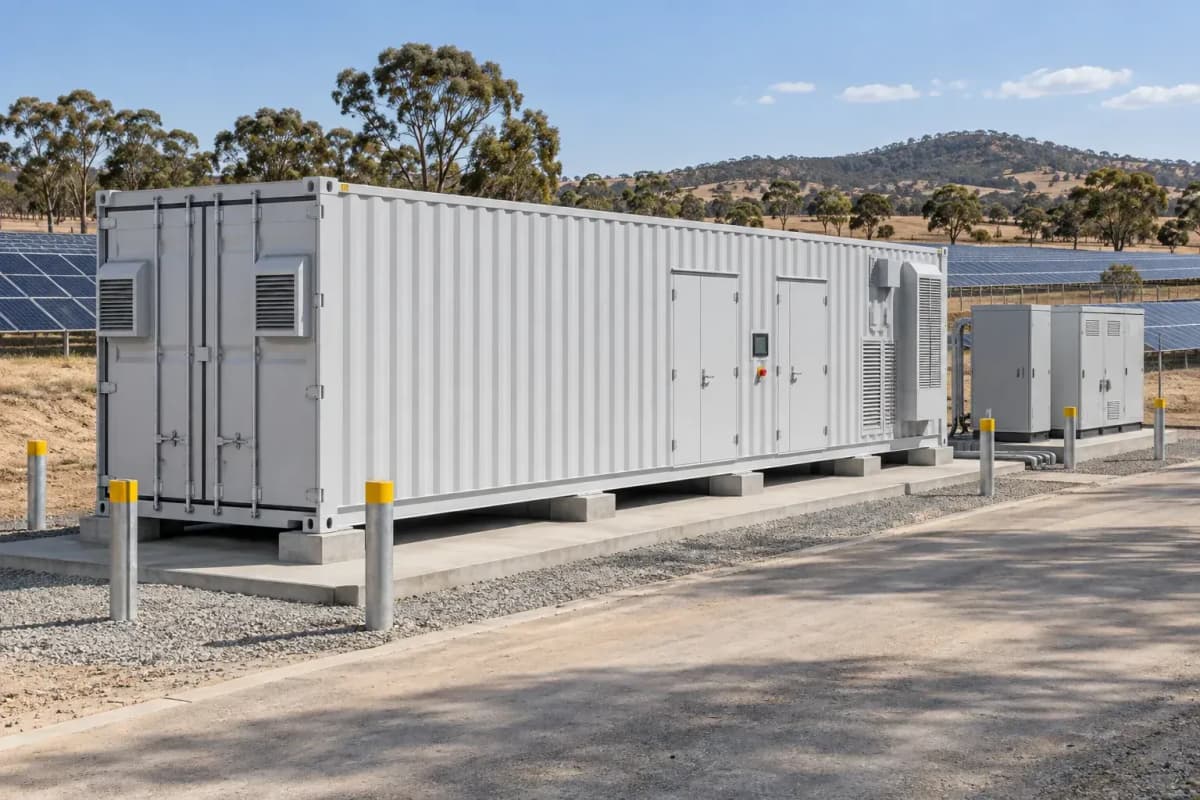
1.5MWh Renewable Firming LFP BESS - 3000kW Containerized Storage
Key Features
- 1500kWh LFP capacity with 1275kWh usable energy at 85% DoD
- 3000kW bidirectional PCS for 0.5-hour high-power renewable firming
- 40ft ISO container with liquid cooling and 3-layer safety architecture
- 1.5 daily cycles designed for about 698062kWh annual throughput
- EPC turnkey price range from $184,850 to $223,150
The SOLARTODO 1.5MWh Renewable Firming LFP BESS is a 40ft containerized battery energy storage system rated at 1500kWh and 3000kW for high-power solar and wind smoothing. With LFP chemistry, 85% DoD, liquid cooling, UL 9540A-oriented safety design, and EPC turnkey pricing from $184,850 to $223,150, it is specified for 1.5 daily cycles in renewable firming projects.
Description
The 1.5MWh Renewable Firming LFP is a 1500kWh, 3000kW containerized Battery Energy Storage System (BESS) designed for solar and wind output firming at a 0.5-hour rated discharge duration. The system uses lithium iron phosphate chemistry, 85% depth of discharge, liquid thermal management, and a 40ft ISO container architecture for projects requiring approximately 1912.5kWh of daily cycled throughput at 1.5 cycles per day.
SOLARTODO positions this 1.5MWh BESS within the Battery Energy Storage System product line for B2B developers, EPC contractors, utilities, and C&I buyers that need grid-tied renewable firming, ramp-rate control, curtailment reduction, and limited island-mode support. For a 10MWp solar plant with 15-minute irradiance ramps, the 3000kW PCS can absorb or inject up to 3.0MW of active power while the 1500kWh battery buffers short-duration volatility.
Product Definition and Use Case
Renewable firming converts variable photovoltaic or wind output into a dispatchable power profile over defined time intervals such as 5 minutes, 15 minutes, or 1 hour. This 1500kWh and 3000kW configuration is optimized for high-power smoothing rather than long-duration 4-hour shifting, giving a 2C power-to-energy ratio that is useful where interconnection rules penalize ramps above 5% to 10% of plant capacity per minute.
The system is based on LFP cells because stationary storage markets have moved strongly toward this chemistry since 2021, with IRENA noting that LFP has become a dominant stationary battery chemistry through the 2020s in solar-plus-storage applications. Compared with NCM battery alternatives, LFP typically offers lower cobalt and nickel exposure, improved abuse tolerance, and a cycle-life target above 6000 cycles under controlled temperature and DoD conditions.
In renewable firming, the battery is normally dispatched by an EMS using plant output data, grid-meter readings, SOC limits, and ramp-rate constraints. At 85% DoD, the usable per-cycle energy is approximately 1275kWh, and at 1.5 daily cycles the annual discharged energy can reach about 698062kWh before degradation allowances, site losses, and operating reserves are applied.
System Architecture
The 40ft container integrates battery racks, DC combiner protection, battery management, liquid-cooling distribution, fire detection, gas detection, auxiliary power, communications, and interface points for the 3000kW bidirectional PCS. A complete EPC scope can also include transformer, switchgear, grounding, cable trenching, SCADA mapping, factory acceptance testing, site acceptance testing, and commissioning documentation for 1 grid interconnection point.
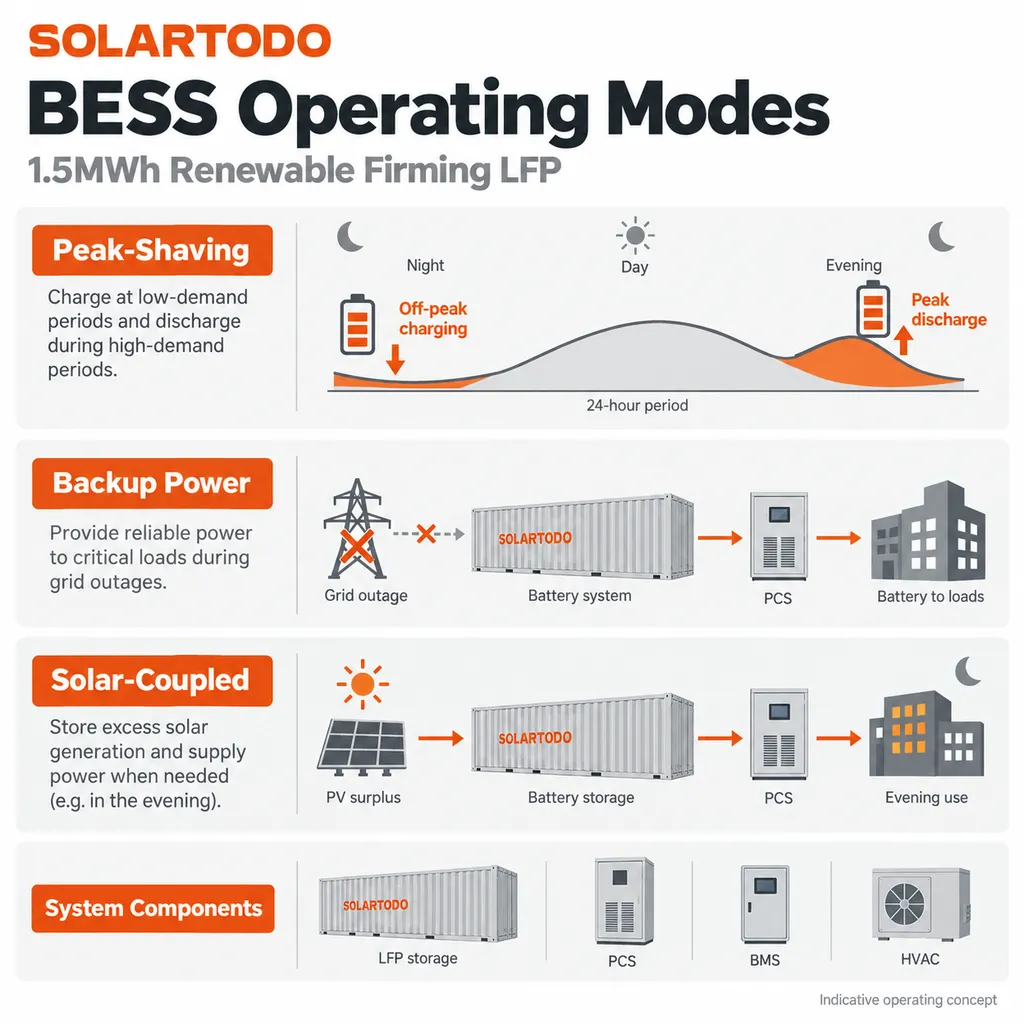
The DC battery subsystem is supervised by a multi-level BMS that measures cell voltage, module temperature, rack current, insulation status, state of charge, and state of health. A typical large-format LFP rack monitors hundreds of cell-voltage points and uses balancing logic to keep cell deviations within narrow operating windows, which helps maintain available capacity after 365 cycles per year or more.
The PCS converts DC battery power to grid-synchronous AC power with more than 96% conversion efficiency under rated operating conditions. For renewable firming, the PCS must support fast active-power commands, reactive-power control, anti-islanding protection, grid-code parameterization, and operating modes such as constant power, PV smoothing, scheduled dispatch, peak shaving, and backup reserve.
Liquid cooling is specified because the system exceeds 100kWh and operates at a high 2C power rating, where unmanaged thermal gradients can accelerate capacity fade. A controlled coolant loop helps maintain cell temperatures within a target operating band, typically supporting operation from -20°C to 50°C with derating logic at temperature extremes and with HVAC auxiliaries sized for the site climate.
Technical Specifications
The rated energy capacity is 1500kWh, the rated power is 3000kW, and the nominal duration is 0.5 hour at full power before reserve logic is applied. The recommended operating window uses 85% DoD, about 88% AC-to-AC round-trip efficiency, and a 10-year or 70% remaining-capacity warranty basis when the actual dispatch profile remains within agreed cycling and thermal limits.
| Parameter | Value |
|---|---|
| Rated energy capacity | 1500kWh |
| Rated AC power | 3000kW |
| Battery chemistry | LFP |
| Container form factor | 40ft ISO container |
| Usable energy at 85% DoD | 1275kWh |
| Daily cycling design case | 1.5 cycles/day |
| Annual throughput design case | 698062kWh/year |
| Round-trip efficiency | 88% nominal AC-to-AC |
| Cycle-life target | 6000+ cycles |
| Warranty basis | 10 years / 70% capacity |
The chemistry and battery safety basis should be aligned with IEC 62619:2022, which specifies safety requirements and tests for secondary lithium cells and batteries in industrial applications, including stationary energy storage. Project-level compliance packages may also reference UL 9540, UL 9540A test methodology, UN 38.3 transport testing, NFPA 855 installation guidance, IEEE 1547 interconnection principles, and local grid codes.
Safety, Fire Protection, and Compliance
The container safety concept uses 3 coordinated layers: cell-level monitoring, rack-level protection, and container-level emergency response. The BMS detects abnormal voltage, current, temperature, insulation, smoke, or gas conditions; the EMS can isolate equipment through contactors and breakers; and the fire suppression package provides automatic detection, alarm output, and shutdown logic for 1 containerized enclosure.
LFP chemistry is widely selected for stationary storage because it has lower thermal propagation risk than many nickel-rich lithium-ion chemistries, but no lithium-ion chemistry should be described as risk-free. A bankable specification therefore requires documented thermal-runaway test evidence, separation distances, emergency ventilation logic, fault recording, container access procedures, and NFPA 855-based installation review for each 1 site.
UN 38.3 transport documentation is relevant when the battery modules are shipped internationally, while IEC 62619 and UL 9540A evidence are relevant to stationary industrial safety review. Procurement teams should request cell certificates, module drawings, BMS protection tables, short-circuit ratings, fire-system datasheets, and commissioning checklists before releasing the final 70% balance payment against the bill of lading.
Renewable Firming Performance
A 3000kW PCS gives this 1500kWh system unusually strong response capability for short-duration renewable smoothing. For example, if a 12MWp solar field experiences a cloud-edge fluctuation causing a 2.4MW drop within 60 seconds, the PCS can inject the full correction for several minutes while keeping the net plant export inside a contractual ramp limit.
Compared with a conventional diesel generator used only for spinning reserve, this LFP BESS can reduce local fuel burn by 100% during battery-only firming events and can eliminate engine start-stop wear for short ramps below 30 minutes. The comparison is operational rather than universal, because long outages above several hours may still require generation, grid import, or a larger multi-hour storage block.
NREL storage benchmarking work explains that BESS cost models include cells, inverter, balance of system, installation, and commissioning, which is why project prices should be evaluated on an installed basis rather than only by cell USD/kWh. IRENA reported that utility-scale BESS installed costs fell sharply from 2010 to 2024, including a 93% decline to around $192/kWh in 2024 for global utility-scale storage averages.
IEA analysis in 2026 reported that about 80% of new battery capacity added in 2025 was utility-scale, confirming that front-of-meter renewable integration is a primary growth channel. For procurement teams, that macro trend matters because bankable components, standardized containers, and larger cell formats can reduce execution risk on systems in the 1MWh to 5MWh class.
Representative MENA Solar Farm Scenario
For a representative MENA solar farm scenario, assume a 10MWp single-axis PV plant, a 13.5GWh annual generation estimate, and 6% energy curtailed because of ramp limits, export caps, or midday congestion. A 1500kWh and 3000kW firming BESS cycling 1.5 times per day can target about 698MWh of annual shifted or firmed energy before degradation and availability adjustments.
If the project values firmed energy at $0.12/kWh through avoided curtailment, grid penalties, and peak-period displacement, the annual gross benefit is approximately $83,767. Against a representative EPC midpoint of $204,000, the simple payback is about 2.4 years before tax, financing, augmentation, degradation reserves, and site-specific interconnection fees are included.
This scenario is representative only and is not a claim that any customer achieved a specific result. Actual savings depend on 8 measurable factors: solar profile, tariff spread, curtailment hours, grid-code penalties, battery availability, auxiliary load, degradation curve, and dispatch strategy configured in the EMS.
Cloud Monitoring
The EMS and cloud platform provide monitoring for SOC, SOH, AC power, DC voltage, rack alarms, temperature channels, PCS status, transformer status, event history, and energy throughput. A typical SCADA integration uses Modbus TCP, IEC 61850, MQTT, or REST interfaces, with 1-second to 60-second data intervals selected according to the utility or asset-owner requirement.
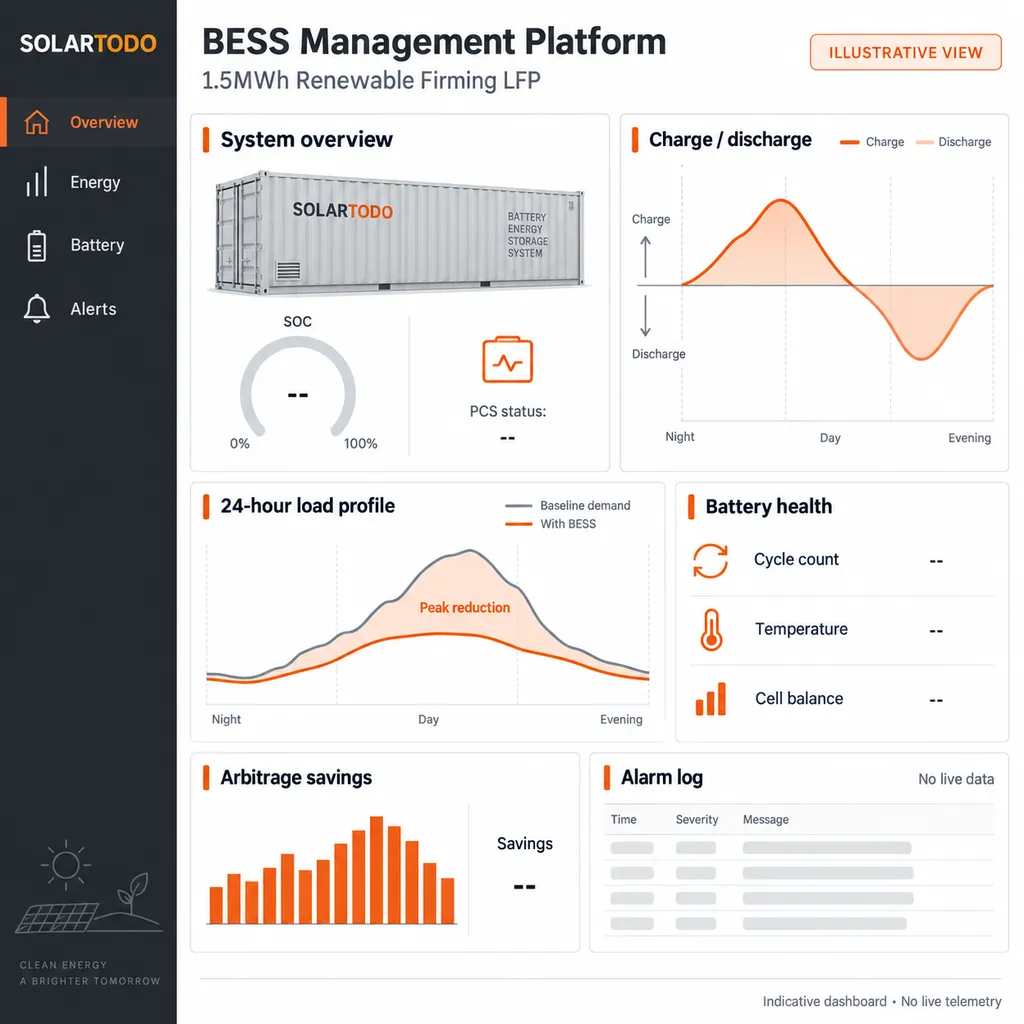
Remote monitoring is important because high-cycle renewable firming depends on dispatch discipline. If the system is allowed to run at 100% SOC for long periods or discharge below agreed limits, the degradation profile can differ materially from the 6000-cycle design assumption; therefore the EMS should enforce SOC windows, C-rate limits, and temperature derating on every 24-hour operating day.
Applications
The main applications are PV ramp-rate control, wind power smoothing, curtailment recovery, transformer overload relief, frequency response, microgrid reserve, and hybrid plant dispatch. Buyers comparing this 1.5MWh model with 2MWh to 5MWh containers should note that the 3000kW rating favors short, high-power interventions, while a 4-hour battery is better for evening energy shifting.
For behind-the-meter industrial users, the same architecture can support demand-charge management if local tariffs bill the maximum 15-minute or 30-minute demand interval. In that use case, the 3000kW PCS can reduce a sharp process-load peak, while the 1500kWh battery must be sized against the number of expected peaks per day and the required reserve margin.
For project developers, SOLARTODO can adjust the configuration through Configure your system online or through a project-specific datasheet review. Related technical background is available in Learn about topic, including energy-storage sizing, BMS safety logic, grid interconnection terms, and hybrid renewable dispatch concepts.
EPC Investment Analysis and Pricing Structure
EPC turnkey delivery includes 5 major work scopes: engineering, procurement, construction, commissioning, and 1-year warranty support. Engineering covers single-line diagrams, container layout, civil interface, grounding, cable sizing, protection settings, and grid-code review; procurement covers battery container, PCS, transformer, switchgear, EMS, shipping, and documentation; construction and commissioning cover installation, testing, energization, and operator training.
| Pricing tier | Scope | Price range |
|---|---|---|
| FOB Supply | Equipment only, ex-works China | $114,607 - $151,742 |
| CIF Delivered | Equipment plus ocean freight and insurance | $137,941 - $182,637 |
| EPC Turnkey | Installed, commissioned, and 1-year warranty | $184,850 - $223,150 |
| Volume tier | Discount | Procurement note |
|---|---|---|
| 50+ units | 5% | Applies to standardized container and PCS configuration |
| 100+ units | 10% | Applies to framework orders with scheduled deliveries |
| 250+ units | 15% | Applies to multi-site utility or developer programs |
The EPC price range equals approximately $123/kWh to $149/kWh on nameplate energy, or approximately $62/kW to $74/kW on rated AC power. These metrics are useful for early screening, but final cost depends on transformer voltage, civil works, cable distance, fire-code interpretation, seismic design, ambient temperature, grid studies, and import duties in 1 destination country.
The representative ROI model uses $83,767 in annual gross savings, a $204,000 EPC midpoint, and a 2.4-year simple payback. Compared with oversizing PV by 15% to compensate for curtailment, a firming BESS can preserve grid-export compliance while making renewable output more controllable; compared with a diesel-only reserve strategy, it avoids short-duration fuel consumption during every battery-managed ramp event.
Payment terms are normally 30% T/T deposit plus 70% against B/L, or 100% L/C at sight for approved buyers. Project financing can be discussed for transactions above $5,000K, subject to credit review, country risk, shipping schedule, and lender documentation; for quotation support, buyers can Request a custom quotation or contact [email protected] with 1 single-line diagram and 12 months of load or generation data.
Procurement Checklist
A technical bid package should include 12 items: datasheet, single-line diagram, cell certificate, IEC 62619 certificate, UN 38.3 transport file, UL 9540A summary, PCS test report, BMS protection matrix, EMS protocol list, fire-system datasheet, factory acceptance test plan, and warranty conditions. These documents help engineers compare bids beyond headline USD/kWh pricing.
For specification alignment, buyers should define the required AC voltage, transformer ratio, grid frequency, short-circuit level, communication protocol, auxiliary power source, site altitude, minimum and maximum ambient temperature, corrosion class, fire setback, noise limit, and cybersecurity rule before ordering 1 container. Early definition reduces change orders after manufacturing release.
SOLARTODO supplies BESS, solar, smart lighting, security, telecom and power towers, and smart agriculture infrastructure, allowing hybrid renewable projects to be packaged with fewer supplier interfaces. Buyers can start with View all Battery Energy Storage System (BESS) products, then move to the configurator or quotation workflow once a 1500kWh and 3000kW duty profile is confirmed.
Standards and Data References
This product page uses public technical references from IEC, NREL, IRENA, and IEA, plus market cost bands supplied in the SOLARTODO configuration data for 2025 to 2026. The most relevant standards are IEC 62619 for industrial lithium battery safety, UL 9540 for energy storage systems, UL 9540A for thermal-runaway characterization, NFPA 855 for stationary installation safety, UN 38.3 for transport, and IEEE 1547 for distributed energy resource interconnection.
NREL ATB and storage benchmarking work are useful for understanding why battery, inverter, and balance-of-system costs must be evaluated together. IRENA renewable-cost reporting documents the long-term decline in utility-scale BESS costs, while IEA electricity and battery-storage analysis documents the increasing role of utility-scale batteries in renewable integration and power-system flexibility during 2025 and 2026.
Technical Specifications
| Energy Capacity | 1500kWh |
| Power Rating | 3000kW |
| Battery Chemistry | LFP |
| Application | Renewable firming |
| Form Factor | 40ft ISO container |
| Nominal Duration at Rated Power | 0.5hours |
| Round-trip Efficiency | 88% |
| Depth of Discharge | 85% |
| Usable Energy at Rated DoD | 1275kWh |
| Daily Cycles | 1.5cycles/day |
| Annual Throughput Design Case | 698062kWh/year |
| Cycle Life | 6000+cycles |
| Calendar Life | 15years |
| Operating Temperature | -20 to 50°C |
| Annual Savings | 83767USD/year |
| Payback Period | 2.4years |
| Warranty | 10 years / 70% capacity |
Price Breakdown
| Item | Quantity | Unit Price | Subtotal |
|---|---|---|---|
| LFP battery cells for 1500kWh system | 1500 pcs | $40 | $60,000 |
| Battery modules, racks, DC bus, and protection | 1 pcs | $20,000 | $20,000 |
| Battery Management System with SOC/SOH monitoring | 1500 pcs | $6 | $9,000 |
| Liquid thermal management package | 1500 pcs | $7 | $10,500 |
| 3000kW bidirectional PCS allowance | 3000 pcs | $6 | $18,000 |
| EMS software and cloud monitoring gateway | 1 pcs | $3,000 | $3,000 |
| Gas detection and fire suppression system | 1 pcs | $5,000 | $5,000 |
| 40ft container, transformer, and switchgear integration | 1 pcs | $14,000 | $14,000 |
| Ocean freight and insurance allowance | 1 pcs | $10,000 | $10,000 |
| Installation and commissioning | 1 pcs | $22,000 | $22,000 |
| Engineering, grid-interface design, and QC documentation | 1 pcs | $12,000 | $12,000 |
| 1-year warranty and support reserve | 1 pcs | $6,000 | $6,000 |
| Total Price Range | $184,850 - $223,150 | ||
Frequently Asked Questions
What is included in the EPC turnkey price for the 1.5MWh Renewable Firming LFP BESS?
Why does this system use LFP chemistry instead of NCM cells?
Is a 1500kWh battery large enough for renewable firming?
Which standards should buyers request during procurement?
How is the simple payback period estimated for this BESS?
Certifications & Standards


Data Sources & References
- •NREL Annual Technology Baseline 2024: Commercial Battery Storage
- •NREL Solar and Storage Techno-Economic and Supply Chain Analysis 2025
- •IRENA Renewable Power Generation Costs in 2024
- •IEA Global Energy Review 2026: Battery Storage
- •IEC 62619:2022 Industrial Lithium Battery Safety Standard
- •NFPA 855 Stationary Energy Storage Installation Standard
Interested in this solution?
Contact us for a customized quote based on your specific requirements.
Contact Us