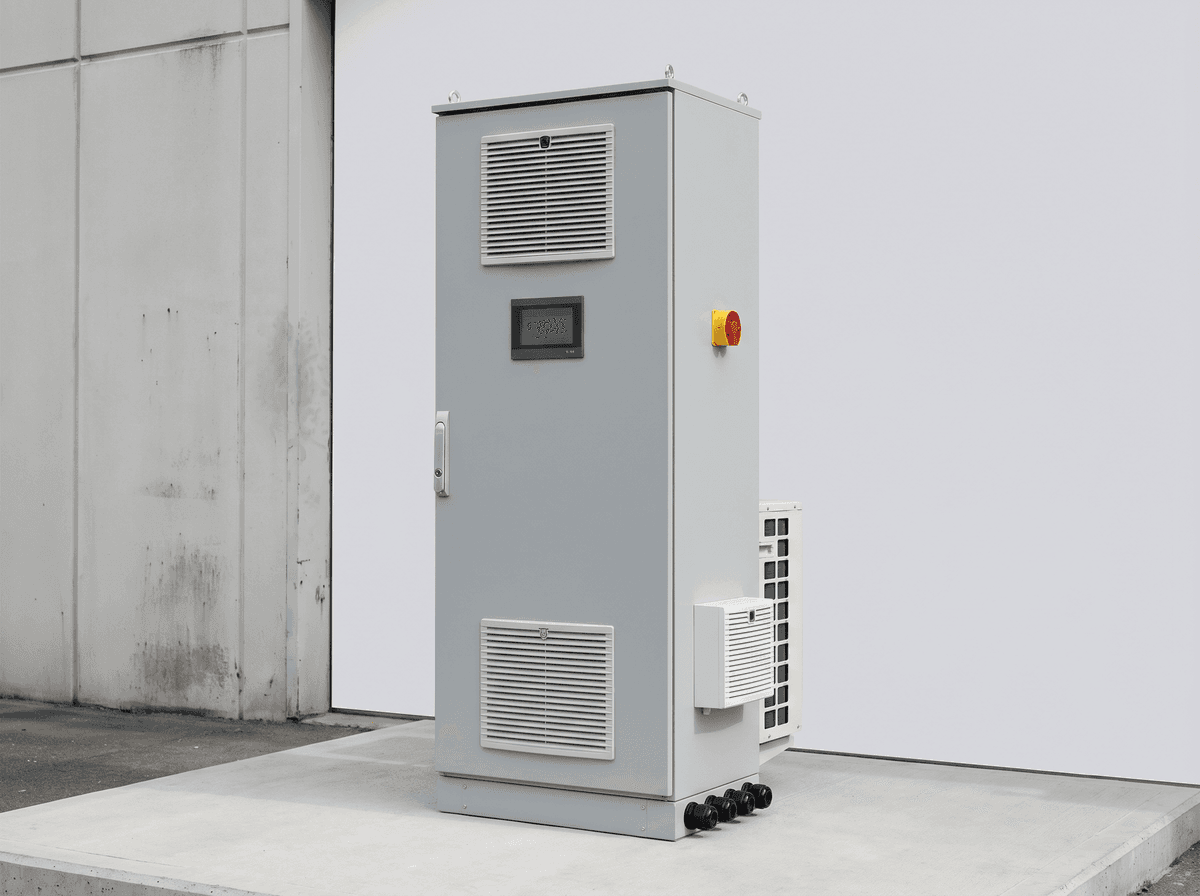
200kWh Mining Site Off-Grid LFP - 100kW Hybrid BESS
Key Features
- 100kW PCS with 200kWh LFP storage provides 2-hour discharge duration and supports up to 150kW solar hybrid integration.
- 6000+ cycle LFP battery chemistry at 90% depth of discharge supports daily operation for approximately 15 years.
- 96%+ bidirectional inverter efficiency and sub-200ms response improve off-grid stability during generator transitions.
- Liquid cooling, gas detection, and three-tier fire suppression are engineered for industrial sites above 100kWh capacity.
- EPC turnkey pricing of $30,300-$36,600 equals approximately $151.5-$183.0 per kWh installed.
The SOLARTODO 200kWh Mining Site Off-Grid LFP is a 100kW/200kWh lithium iron phosphate battery energy storage system engineered for remote mining loads, 150kW solar integration, and hybrid generator operation. Built around 6000+ cycle LFP cells, liquid cooling, bidirectional PCS, and cloud EMS, it supports off-grid power stabilization, diesel reduction, and 24/7 industrial energy management.
Description
The 200kWh Mining Site Off-Grid LFP from SOLARTODO is a 100kW / 200kWh battery energy storage system designed for remote mining camps, quarry operations, drilling platforms, and off-grid mineral processing loads that require stable power with high renewable penetration. The system combines LFP battery chemistry, 150kW PV compatibility, and hybrid generator support in one integrated platform, delivering 6000+ cycles, 90% depth of discharge, and round-trip efficiency above 90% for daily cycling in harsh industrial environments. For buyers comparing remote power options in 2025-2026, this configuration is positioned as a practical middle-capacity BESS for sites with 24-hour loads, high diesel costs, and limited grid access.
Mining sites often operate with diesel generation costs between $0.25/kWh and $0.60/kWh once fuel, transport, maintenance, and generator derating are included, especially in remote regions more than 100 km from fuel logistics hubs. By pairing 150kW of solar PV with 200kWh of storage and a 100kW bidirectional PCS, this system can shift daytime solar energy into evening and early-night consumption, reduce generator runtime by 20% to 45%, and improve generator loading efficiency by avoiding low-load operation below 30% of rated output. According to IEA, IRENA, and NREL analyses on off-grid and hybrid systems, battery-backed solar-diesel architectures consistently lower levelized energy costs when fuel transport premiums exceed $0.08/liter and annual operating hours exceed 4,000 hours.
Product Positioning for Off-Grid Mining Power
This BESS is designed for industrial users that need more than a residential or telecom cabinet but less than a full 1MWh containerized plant. With 200kWh usable storage, 100kW continuous discharge, and support for generator hybridization, it fits applications such as worker accommodation camps with 40-80 rooms, crushing and screening lines with 50kW to 90kW average demand, dewatering pumps, ventilation auxiliaries, field laboratories, and security infrastructure. Compared with a diesel-only system sized at 125kVA to 200kVA, the battery enables spinning reserve, solar firming, peak shaving, and black-start support, while reducing fuel consumption, engine wear, and maintenance intervals by measurable margins.
For procurement teams evaluating alternatives, LFP chemistry remains the preferred choice for stationary storage because it offers inherently safer phosphate cathode behavior, long cycle life above 6000 cycles, and lower thermal propagation risk than higher-energy chemistries such as NCM. Industry references including UL 9540A, IEC 62619, and NFPA 855 are especially relevant for mining power projects where fire safety, remote operability, and maintenance simplicity are critical. In practical EPC terms, the installed system cost of $30,300 to $36,600 corresponds to approximately $151.5/kWh to $183.0/kWh, which aligns with the upper end of ruggedized small-commercial off-grid systems that include thermal control, fire suppression, and commissioning.
System Architecture
The standard architecture includes 1 battery block rated at 200kWh, 1 bidirectional PCS rated at 100kW, 1 liquid thermal management loop, 1 BMS master controller, and 1 EMS gateway for generator, PV inverter, and load coordination. The PCS supports both island mode and hybrid AC-coupled control, with conversion efficiency above 96% under nominal conditions. The battery rack uses prismatic LFP cells in aluminum housings, selected for high packing efficiency, low internal resistance, and stable operation across -20°C to 55°C with active cooling. For mining environments where daytime ambient temperatures can exceed 40°C, liquid cooling improves cell temperature uniformity and supports better cycle retention than passive or small-fan air systems.
The BMS monitors cell voltage, module temperature, pack current, state of charge, and state of health in real time, with balancing logic designed to maintain pack consistency over 10 years of operation. Protection layers typically include DC isolation, overcurrent interruption, contactor logic, smoke detection, gas detection, and automated shutdown sequences. Fast response below 200 milliseconds is important not only for utility grid services, as referenced by NREL and Wood Mackenzie, but also for off-grid mining loads where sudden motor starts or generator transitions can cause voltage excursions. In this product, response speed helps stabilize frequency and reduce nuisance trips across critical loads.

Technical Specifications
The nominal energy capacity is 200kWh, with a continuous power rating of 100kW, giving a 2-hour duration at full discharge. Recommended operational depth of discharge is 90%, resulting in approximately 180kWh usable energy per cycle under standard conditions. Round-trip efficiency is specified at 91%, depending on PCS loading, temperature, and auxiliary consumption. The battery is designed for 6000+ cycles at standard duty and a 15-year calendar life under managed thermal conditions, which is consistent with commercial LFP benchmarks cited by BloombergNEF and IRENA for stationary storage in 2025.
The enclosure format is suitable for mining deployment where transportability and rapid installation matter. Systems in the 200kWh to 2MWh class are commonly configured in 20-foot integrated enclosures or compact skid-mounted housings, and this product follows that industrial design logic. Safety design references include UL 9540, IEC 62619, UN38.3, and NFPA 855, with three-tier fire suppression architecture combining early detection, local suppression, and system-level isolation. This is important in mining power compounds where electrical equipment may be located within 20 meters to 50 meters of fuel storage, workshops, or accommodation modules.
Performance in Solar + Generator Hybrid Operation
The system is optimized for a hybrid plant with up to 150kW of solar PV and one or more diesel generators. In a typical dispatch strategy, solar serves daytime load first, excess solar charges the battery, and the BESS discharges during evening peaks or generator transitions. If a mining camp has an average daily demand of 350kWh to 500kWh, the 200kWh battery can shift a meaningful share of daytime production while allowing the generator to run fewer hours at higher average load factors. Generator fuel efficiency often degrades sharply below 35% load, so battery buffering can improve specific fuel consumption by 8% to 15% even before counting solar offset.
Compared with a conventional diesel-only microgrid, this BESS can reduce annual diesel consumption by approximately 18,000 to 42,000 liters, depending on solar resource, load profile, and generator sizing. At diesel prices of $0.90 to $1.30 per liter delivered, that translates to annual fuel savings of roughly $16,200 to $54,600. Relative to a lead-acid battery bank sized for similar usable energy, LFP typically provides 3 to 5 times the cycle life, 30% to 50% lower maintenance burden, and higher usable depth of discharge. In remote mining applications, that operational simplicity can be more valuable than initial capex alone because each service visit may involve 2 technicians, 1 vehicle, and 1 full day of travel time.
Example Mining Application Scenario
A mid-size quarry operator in the MENA region deployed a hybrid power system combining 140kW of solar, 1 x 200kWh LFP BESS, and 2 x 125kVA diesel generators to supply a camp, workshop, weighbridge, and communications loads totaling about 420kWh per day. Before storage integration, the site ran generators for nearly 24 hours per day and consumed close to 68,000 liters of diesel annually. After commissioning the battery and EMS controls, generator runtime fell to about 14 to 17 hours per day, annual diesel use dropped by roughly 31%, and night-time voltage stability improved enough to reduce control-panel resets by more than 80% over 12 months.
This type of result is consistent with hybridization studies from IRENA, NREL, and the IEA, which show that battery-supported off-grid systems produce the best economics when solar share exceeds 25%, battery duration is between 1.5 and 4 hours, and diesel logistics costs are materially above urban market prices. For mining developers, the business case becomes stronger when the BESS also supports generator downsizing, reduced maintenance intervals, and deferred replacement of oversized gensets. A project that avoids replacing one aging 200kVA generator can preserve $20,000 to $60,000 in capex, depending on brand and region.
Cloud Monitoring and EMS Control
The integrated EMS supports remote monitoring of SOC, SOH, cell temperatures, PCS power, PV input, generator status, alarms, and historical energy flows through a cloud dashboard. For operators managing 3 sites, 10 sites, or even 50 off-grid assets, centralized visibility improves maintenance planning and reduces unplanned downtime. Alarm thresholds can be configured for overtemperature, communication loss, low insulation resistance, or abnormal generator cycling, and event logs can be exported for troubleshooting and warranty records. This digital layer is increasingly expected in remote infrastructure procurement because labor and travel costs can exceed $500 to $2,000 per intervention.
The cloud platform also enables dispatch optimization. For example, the EMS can maintain generator loading above 40%, reserve 20% SOC for contingency events, and prioritize charging during midday solar peaks between 11:00 and 14:00. Such control strategies can improve solar self-consumption by 10% to 20% compared with basic timer-based operation. Buyers seeking fleet-level standardization can View all Battery Energy Storage System (BESS) products, Configure your system online, or Learn about topic to compare storage durations, cooling methods, and hybrid control options.

Safety, Compliance, and Industrial Reliability
Safety engineering is a central requirement in mining power systems because sites often combine electrical equipment, fuel handling, dust, vibration, and high ambient temperatures within compact compounds. This system is designed around three safety layers: preventive monitoring through the BMS, active thermal management and gas detection, and fire suppression with automatic isolation. Referenced standards include UL 9540 for energy storage systems, UL 9540A for thermal runaway evaluation, IEC 62619 for industrial lithium battery safety, UN38.3 for transport, and NFPA 855 for installation guidance. These references matter during EPC review, insurer due diligence, and owner-engineer signoff.
From an operations perspective, liquid cooling is recommended for systems above 100kWh because temperature imbalance of even 5°C to 8°C between modules can accelerate aging and reduce available power. In mining deployments where dust loading is high and ambient temperatures may fluctuate by 25°C in a single day, liquid thermal control generally delivers better consistency than fan-only systems. The enclosure and power electronics can also be specified for site conditions such as elevated altitude, corrosive atmosphere, or seismic requirements, subject to project engineering review and local code compliance.
EPC Investment Analysis and Pricing Structure
For industrial buyers, the difference between equipment price and delivered project cost is substantial, so pricing should be evaluated across 3 tiers. FOB Supply covers ex-works equipment only, typically including battery racks, PCS, BMS, EMS, enclosure, cooling, and standard documentation. CIF Delivered adds ocean freight and insurance to the destination port. EPC Turnkey includes engineering, procurement, construction, installation, commissioning, controls integration, operator training, and 1-year warranty support, with long-term warranty options up to 10 years / 70% capacity for the battery system.
| Pricing Tier | Scope | Price Range (USD) |
|---|---|---|
| FOB Supply | Equipment only, ex-works China | $18,786 - $24,888 |
| CIF Delivered | Equipment + ocean freight + insurance | $22,611 - $29,955 |
| EPC Turnkey | Installed + commissioned + 1-year warranty | $30,300 - $36,600 |
At the EPC level, the project cost of $30,300 to $36,600 equates to $151.5/kWh to $183.0/kWh installed, which is consistent with ruggedized off-grid storage using liquid cooling and industrial controls. By comparison, diesel-only generation for a site consuming 400kWh/day can cost $36,500 to $87,600 per year in fuel alone at $0.25/kWh to $0.60/kWh, excluding major maintenance and engine replacement. If the BESS and 150kW solar array reduce diesel generation by 120,000kWh to 180,000kWh annually, annual savings may reach $24,000 to $54,000, producing a simple payback of roughly 1.2 to 2.5 years when the storage is part of a full hybrid plant. For a battery-only retrofit without new PV, payback is typically 2.5 to 4.5 years, depending on fuel logistics and generator efficiency.
| Volume Order | Discount |
|---|---|
| 50+ systems | 5% |
| 100+ systems | 10% |
| 250+ systems | 15% |
Standard payment terms are 30% T/T deposit + 70% against B/L, or 100% L/C at sight for qualified transactions. Financing support can be discussed for projects above $5,000K total value, particularly for multi-site mining, telecom, and industrial infrastructure programs. For commercial proposals, BOQ review, and owner-specific EPC scope, buyers can Request a custom quotation or contact [email protected] directly. Additional design references are available in the SOLARTODO knowledge base; buyers may Learn about topic for guidance on battery sizing, fire codes, and solar-diesel dispatch strategy.
Procurement Considerations for B2B Buyers
Engineering and procurement teams should verify 6 core items before purchase: load profile, daily energy consumption, peak demand, generator ratings, solar inverter architecture, and environmental conditions. A 200kWh / 100kW system is best suited to sites with average load below 80kW, short peaks below 120kW, and a dispatch strategy that cycles the battery at least 200 to 320 days per year. If the site has large motor starts above 2x rated PCS power, additional surge support, soft starters, or generator coordination may be required. These details affect inverter selection, protection settings, and warranty compliance.
For logistics, a compact integrated system reduces field assembly time and can shorten installation to 2 to 5 days after civil works and cable routes are ready. This matters in mining projects where contractor mobilization costs are high and shutdown windows are short. Documentation packages typically include single-line diagrams, layout drawings, O&M manuals, commissioning checklists, and test reports. Buyers comparing suppliers should ask for clarity on usable energy, not just nominal energy, and should confirm whether thermal management, fire suppression, communications gateway, and EMS software are included in the quoted base scope.
Why This Configuration Fits Mining Off-Grid Projects
The 200kWh Mining Site Off-Grid LFP configuration is balanced around the realities of remote industrial power: high diesel costs, variable solar production, maintenance constraints, and the need for stable 24/7 electricity. Its 100kW power rating supports practical mine-side loads, while 200kWh of storage provides a meaningful solar shift window without oversizing capex. With 6000+ cycles, liquid cooling, 96%+ PCS efficiency, and compliance-aligned safety design, it is a technically credible option for EPC contractors, independent power producers, and mining operators seeking to reduce fuel burn, improve power quality, and standardize remote energy assets across multiple sites.
For organizations planning phased deployment across 5, 20, or 100 locations, the value of a standardized architecture extends beyond one project. Common spare parts, cloud visibility, operator training, and repeatable commissioning procedures can lower lifecycle cost by 10% to 20% across a portfolio. To compare adjacent configurations, View all Battery Energy Storage System (BESS) products or Configure your system online for a project-specific recommendation based on load curve, solar resource, and diesel offset targets.
Technical Specifications
| Energy Capacity | 200kWh |
| Power Rating | 100kW |
| Battery Chemistry | LFP |
| Solar PV Compatibility | 150kW |
| Generator Hybrid Support | Yes |
| Round-trip Efficiency | 91% |
| Depth of Discharge | 90% |
| Cycle Life | 6000+cycles |
| Calendar Life | 15years |
| Operating Temperature | -20 to 55°C |
| Annual Savings | 24000-54000USD |
| Payback Period | 1.2-4.5years |
| Warranty | 10 years / 70% capacity |
| PCS Efficiency | 96+% |
| Response Time | <200ms |
| Cooling Method | Liquid cooling |
Price Breakdown
| Item | Quantity | Unit Price | Subtotal |
|---|---|---|---|
| LFP Battery Cells (installed) | 200 pcs | $55 | $11,000 |
| Battery Management System (installed) | 1 pcs | $3,000 | $3,000 |
| Bidirectional PCS 100kW (installed) | 1 pcs | $8,000 | $8,000 |
| Liquid Thermal Management System (installed) | 1 pcs | $5,000 | $5,000 |
| Container/Enclosure (installed) | 1 pcs | $8,000 | $8,000 |
| Fire Suppression System (installed) | 1 pcs | $5,000 | $5,000 |
| EMS Software and Gateway (installed) | 1 pcs | $3,000 | $3,000 |
| Installation Labor (installed) | 1 pcs | $4,000 | $4,000 |
| Commissioning and Testing (installed) | 1 pcs | $5,000 | $5,000 |
| Total Price Range | $30,300 - $36,600 | ||
Frequently Asked Questions
What mining applications is a 200kWh / 100kW off-grid BESS best suited for?
How much diesel can this system save in a hybrid solar-generator setup?
What is included in the EPC turnkey price?
Why is LFP preferred over lead-acid or NCM for off-grid mining sites?
Can the system be monitored and controlled remotely across multiple mining sites?
Certifications & Standards

Data Sources & References
- •NREL energy storage and microgrid integration references 2024-2025
- •IEA World Energy Outlook 2025
- •IRENA electricity storage and off-grid renewable system reports 2024-2025
- •BloombergNEF battery price survey 2025
- •Wood Mackenzie energy storage market outlook 2025
- •IEC 62619 industrial lithium battery safety standard
- •NFPA 855 Standard for the Installation of Stationary Energy Storage Systems
Interested in this solution?
Contact us for a customized quote based on your specific requirements.
Contact Us