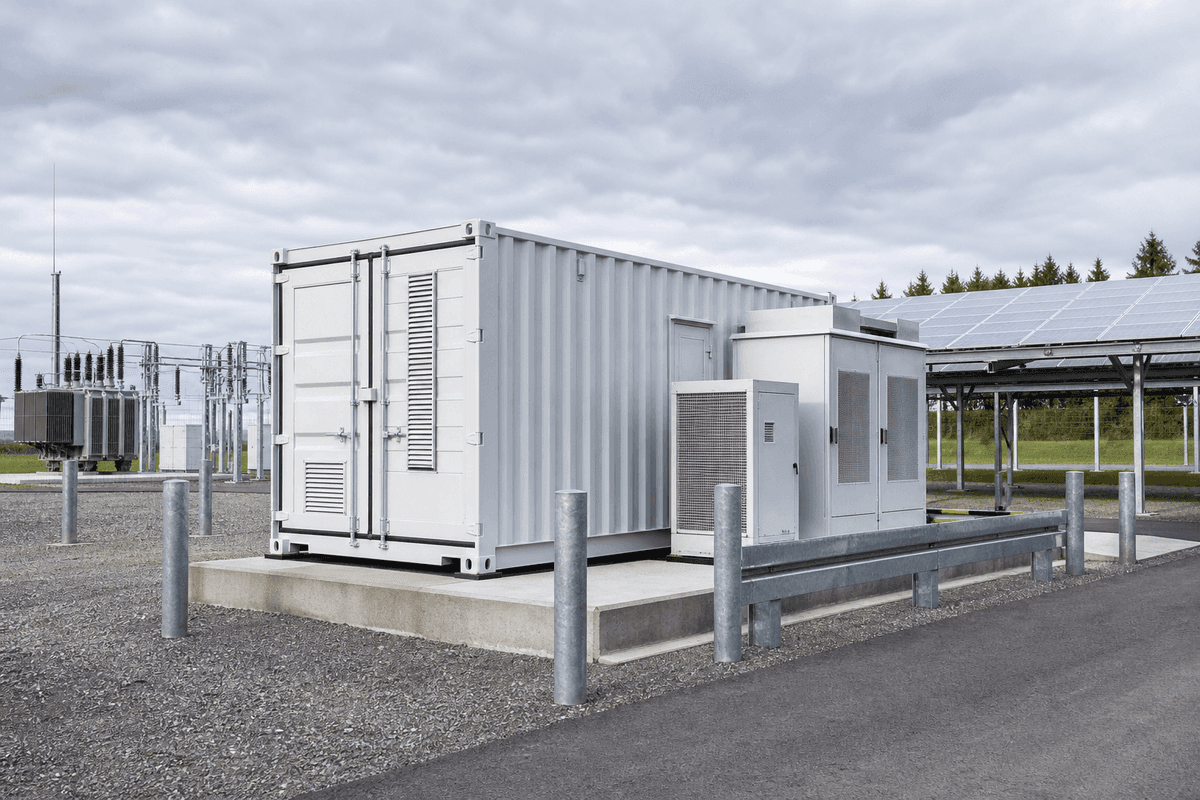
1MWh C&I Arbitrage LFP Container - 500kW 20ft BESS
Key Features
- 1000 kWh energy capacity with 500 kW output for 2-hour C&I arbitrage duty
- 6000+ cycle LFP battery design supports approximately 8.2 years at 2 cycles/day
- Round-trip efficiency of 90% with PCS efficiency above 96% for higher revenue capture
- 20 ft liquid-cooled container with three-tier fire protection and 24/7 cloud monitoring
- EPC turnkey price range of $123,200-$148,800, equal to about $123-$149 per kWh installed
The 1MWh C&I Arbitrage LFP Container is a 1000 kWh / 500 kW 20 ft battery energy storage system engineered for 2 daily cycles, time-of-use arbitrage, and commercial grid support. It uses LFP batteries, liquid cooling, integrated PCS, BMS, HVAC, and three-tier fire protection in a UL 9540/IEC 62619-aligned containerized platform.
Description
The 1MWh C&I Arbitrage LFP Container is a containerized battery energy storage system designed for 1000 kWh usable energy, 500 kW power output, and 2 daily cycles in commercial and industrial time-of-use arbitrage projects. Built in a 20 ft container with LFP chemistry, liquid cooling, integrated bidirectional PCS, battery management, HVAC, and fire suppression, this system is optimized for sites that need to buy electricity during low-tariff periods and discharge during peak-price windows where the tariff spread exceeds $0.10/kWh. For buyers comparing options across the category, View all Battery Energy Storage System (BESS) products or Configure your system online.
For C&I operators, the core value proposition is straightforward: a 500 kW / 1000 kWh system can shift approximately 730 MWh/year at 2 cycles/day before efficiency losses, which makes it suitable for factories, logistics parks, data-support facilities, cold-chain warehouses, and mixed-use campuses with annual consumption above 2 GWh. According to NREL and IEA analyses on storage dispatch economics, arbitrage value increases materially when interval pricing, demand charges, and solar self-consumption are combined, especially in markets with evening peak spreads of $0.12-$0.25/kWh. Compared with diesel peaking generation, a lithium iron phosphate BESS can reduce local fuel use by 100% during discharge events and lower operating noise by more than 20 dB, while delivering response times measured in milliseconds rather than the 10-60 seconds typical of engine start-up.
System Overview
This variant is configured around LFP prismatic cells in aluminum housings, a chemistry widely adopted in stationary storage because of its long cycle life of 6000+ cycles, strong thermal stability, and lower cobalt exposure than many nickel-based alternatives. For a project operated at 2 cycles/day, 6000 cycles corresponds to roughly 8.2 years of intensive dispatch, while a 10-year warranty with 70% retained capacity remains standard for properly managed systems. Industry references from BloombergNEF, IRENA, and Wood Mackenzie indicate that installed BESS costs in 2025-2026 are trending toward $80-$180/kWh depending on geography, integration scope, and interconnection complexity; this SOLARTODO configuration is priced within a practical EPC turnkey range of $123,200-$148,800, equivalent to approximately $123-$149/kWh installed.
The electrical architecture pairs a 1000 kWh DC battery block with a 500 kW bidirectional power conversion system, creating a nominal 2-hour duration ratio that is well suited for midday charging and evening discharge. A PCS efficiency above 96% and a system round-trip efficiency around 90% support strong arbitrage economics when daily spread and throughput remain high. In practical operation, if the site charges 1000 kWh off-peak and discharges 900 kWh effective AC energy after losses, a tariff spread of $0.14/kWh can produce about $126/day gross energy margin, or approximately $45,990/year before demand-charge optimization and O&M adjustments. For broader technical background, buyers can Learn about topic.
Technical Specifications
The standard operating envelope targets commercial environments that require predictable dispatch, remote supervision, and rapid installation. Typical engineering values for this configuration include 1000 kWh energy capacity, 500 kW AC power, 90% round-trip efficiency, 95% depth of discharge, 6000+ cycles, 15 years calendar life, and an operating temperature range of -20°C to 55°C with active liquid thermal management. The integrated enclosure includes battery racks, PCS, BMS, EMS interface, HVAC, gas detection, and automatic fire suppression, reducing field assembly time by 30-50% compared with a fully site-built battery room.

System Architecture
At the battery layer, the system uses modular LFP strings monitored by a multi-level BMS that tracks cell voltage, module temperature, current, insulation status, SOC, and SOH in real time. Cell balancing and thermal protection are configured to keep deviation within narrow limits, typically below 30-50 mV at the cell level under stable conditions, which supports longer life and safer operation. At the conversion layer, the 500 kW bidirectional PCS supports grid-tied operation and can be configured for island-capable schemes when the broader site electrical design includes transfer logic and protected loads. At the supervisory layer, the local EMS schedules charging windows, peak shaving windows, and alarm handling based on tariff calendars, demand limits, and utility export rules.
For safety engineering, this 20 ft container follows the design logic commonly associated with UL 9540, UL 9540A testing methodology, IEC 62619, UN38.3, and installation practices aligned with NFPA 855. The battery chemistry itself is selected for its inherently safer phosphate cathode structure, but the system still incorporates a three-tier protection approach: early gas and smoke detection, automatic electrical isolation and shutdown, and clean-agent or aerosol-based suppression within the enclosure. In large-format storage, standards-based safety design is not optional; NREL and NFPA guidance consistently emphasize spacing, ventilation, fault detection, and emergency response planning, especially above 100 kWh capacity.
Performance for Energy Arbitrage
Arbitrage economics depend on four variables: usable energy, cycle frequency, round-trip efficiency, and tariff spread. With 1000 kWh nominal capacity, 95% depth of discharge, and around 90% round-trip efficiency, the practical delivered energy per full cycle is approximately 855 kWh if operated conservatively, or close to 900 kWh under optimized dispatch. At 2 cycles/day, annual throughput can reach roughly 624-657 MWh/year after accounting for losses and operating reserve. If the average buy-sell spread is $0.12/kWh, annual gross arbitrage value can be about $74,880-$78,840; at $0.15/kWh, that rises to approximately $93,600-$98,550 before O&M and degradation assumptions.
A common buyer question is whether a 1 MWh system is too small for serious C&I savings. In many facilities, the answer is no, because the 500 kW power block can also reduce peak demand charges by clipping short-duration spikes that occur for 15-60 minutes. For example, if a site reduces billed demand by 200 kW and the local demand charge is $12/kW-month, that adds $28,800/year in avoided charges on top of energy arbitrage. Combined value streams can therefore exceed $100,000/year in favorable markets, which can compress simple payback toward 1.5-3.5 years depending on tariff design, dispatch discipline, and interconnection permissions. Buyers with project-specific data can Request a custom quotation.
Containerized Design and Installation Scope
The 20 ft container format is widely used for systems from roughly 200 kWh to 2 MWh, because it balances density, transportability, and service access. This model arrives as a plug-and-play integrated package with battery racks, liquid cooling loop, AC/DC cabling, switchgear interfaces, and preconfigured controls. Compared with a conventional battery room built from separate enclosures and field-installed HVAC, a factory-integrated container can reduce on-site electrical and mechanical work by 25-40% and shorten commissioning from several weeks to as little as 3-7 days after civil and grid interfaces are ready. In regions with constrained labor availability, that reduction in field complexity can be more valuable than a small difference in hardware cost.
Liquid cooling is specified because thermal uniformity becomes increasingly important above 100 kWh, and especially in climates where ambient temperatures exceed 35°C for extended periods. Better thermal control can reduce cell temperature spread by several degrees Celsius, improve charge acceptance, and slow degradation over 10-15 years of operation. Air-cooled systems may appear simpler, but for 1 MWh C&I duty they generally deliver lower packing density and less stable thermal performance under high ambient conditions. This is one reason many utility and commercial integrators have standardized on liquid-cooled LFP platforms for 2025-2026 deployments, as noted in market commentary from BloombergNEF and Wood Mackenzie.
Cloud Monitoring and EMS Integration
Cloud-based monitoring allows operators to supervise 24/7 battery status, alarms, dispatch history, and energy throughput from desktop or mobile interfaces. Standard data points include string voltage, rack temperature, inverter status, cumulative throughput, event logs, and communication health, with refresh intervals often between 1 second and 60 seconds depending on network architecture. For multi-site portfolios with 10-100+ assets, centralized dashboards improve maintenance planning and make it easier to compare actual arbitrage revenue against dispatch targets. Operators seeking integration with solar, gensets, EV charging, or microgrid controllers can also review Learn about topic.

The EMS can be configured for charge windows such as 00:00-06:00 and discharge windows such as 17:00-21:00, or for dynamic dispatch linked to real-time prices and demand thresholds. In a hybrid solar-plus-storage plant, the same controller can prioritize PV self-consumption first, then charge the battery with excess solar, and finally discharge during evening peak periods. This layered logic can increase on-site renewable utilization by 15-35% compared with a solar-only system where midday export compensation is low. For buyers evaluating multiple project structures, Configure your system online can help estimate sizing and dispatch assumptions.
Application Scenario
A practical deployment example is a manufacturing campus in the MENA region with annual electricity consumption of 4.8 GWh, a daytime solar array of 1.2 MWp, and utility tariffs that vary from $0.06/kWh off-peak to $0.19/kWh during evening peaks. By installing 1 unit of this 1MWh / 500kW LFP container, the operator shifted roughly 600 MWh/year of energy and reduced evening imports while also clipping 150 kW of monthly demand peaks. Using a blended arbitrage and demand-charge value of approximately $92,000/year, the project achieved a simple payback near 1.7 years on a competitive EPC basis. This type of use case aligns with IRENA and IEA findings that battery storage economics improve when multiple services are stacked rather than relying on a single revenue stream.
Comparison with Conventional Alternatives
Compared with diesel generator-based peak support, a 500 kW battery system provides nearly instantaneous discharge in less than 250 milliseconds, while a diesel unit of similar rating can require 10-60 seconds to synchronize and ramp. A diesel peaker operating 500 hours/year at partial load may consume tens of thousands of liters of fuel and require quarterly maintenance, oil changes, and emissions management; by contrast, an LFP BESS has no on-site combustion, lower routine maintenance, and can cut direct local emissions during dispatch by 100%. Compared with lead-acid storage, LFP typically offers 3-5x higher cycle life, higher usable DoD by 20-40 percentage points, and lower replacement frequency over a 10-year project horizon.
Compliance, Testing, and Quality Control
Commercial buyers generally require documented compliance with transport, battery, and system-level standards before procurement approval. This product is designed around the requirements and test philosophies associated with UL 9540, UL 9540A, IEC 62619, UN38.3, and NFPA 855, while project-specific grid interconnection and local fire code compliance should be confirmed during engineering. Factory quality control typically includes insulation testing, communication checks, cooling loop verification, BMS functional tests, PCS commissioning tests, and charge-discharge validation before shipment. For export projects, documentation packages can include electrical drawings, FAT records, packing lists, and serial traceability for major components.
EPC Investment Analysis and Pricing Structure
For procurement teams, the most important distinction is between equipment-only pricing and full EPC scope. FOB Supply covers the integrated battery container and core equipment ex-works China. CIF Delivered adds ocean freight and cargo insurance to the destination port. EPC Turnkey includes engineering, procurement, construction coordination, installation, commissioning, and 1-year warranty support, which is the most relevant benchmark for comparing actual project budgets. The EPC range for this model is $123,200-$148,800, while the broader market average for installed systems in 2025 often falls in the $125-$180/kWh range depending on civil works, interconnection, and local labor rates.
| Pricing Tier | Scope | Price Range (USD) |
|---|---|---|
| FOB Supply | Equipment only, ex-works China | $76,384 - $101,184 |
| CIF Delivered | Equipment + ocean freight + insurance | $91,936 - $121,785 |
| EPC Turnkey | Installed, commissioned, 1-year warranty | $123,200 - $148,800 |
| Volume Order | Discount |
|---|---|
| 50+ units | 5% |
| 100+ units | 10% |
| 250+ units | 15% |
A reasonable ROI model for this 1000 kWh system assumes 624-657 MWh/year delivered throughput, a net value spread of $0.12-$0.16/kWh, and optional demand-charge savings of $10,000-$30,000/year. Under those assumptions, annual savings can range from approximately $78,000 to $118,000, producing a simple payback of roughly 1.3-1.9 years at the low end of EPC cost and 1.6-2.5 years at the high end. Compared with diesel-backed peak support, lifecycle operating costs are typically lower because there is no fuel cost, fewer moving parts, and less scheduled maintenance. Standard payment terms are 30% T/T + 70% against B/L, or 100% L/C at sight; financing support may be available for projects above $5,000K. For commercial quotations and EPC discussions, contact [email protected].
Procurement Guidance
For engineering consultants and procurement managers, the key diligence items are not only battery capacity and price, but also PCS sizing, thermal design, fire strategy, communications protocol, and warranty conditions. A 500 kW PCS on a 1000 kWh battery is ideal for 2-hour arbitrage, but sites with shorter demand spikes may prefer a higher power ratio such as 0.75C or 1C. Likewise, sites in coastal zones or desert climates may need corrosion protection, filtration upgrades, or enhanced HVAC sizing. Early review of one-line diagrams, utility export rules, and transformer loading can prevent costly redesign later in the project.
SOLARTODO supplies this platform for commercial and industrial applications that need standardized containerization, practical EPC economics, and standards-based safety engineering. Buyers that need portfolio procurement, solar-plus-storage integration, or site-specific dispatch modeling can Request a custom quotation and compare options across View all Battery Energy Storage System (BESS) products.
Technical Specifications
| Energy Capacity | 1000kWh |
| Power Rating | 500kW |
| Battery Chemistry | LFP |
| Round-trip Efficiency | 90% |
| Depth of Discharge | 95% |
| Cycle Life | 6000+cycles |
| Calendar Life | 15years |
| Operating Temperature | -20 to 55°C |
| Annual Savings | 78000-118000USD |
| Payback Period | 1.3-2.5years |
| Warranty | 10 years / 70% capacity |
| Form Factor | 20ft containerized |
| Daily Cycles | 2cycles/day |
| Cooling Method | Liquid cooling |
| Application | Energy arbitrage |
Price Breakdown
| Item | Quantity | Unit Price | Subtotal |
|---|---|---|---|
| LFP Battery Cells | 1000 pcs | $55 | $55,000 |
| Battery Management System | 1000 pcs | $15 | $15,000 |
| Bidirectional PCS | 500 pcs | $80 | $40,000 |
| Liquid Thermal Management | 1000 pcs | $25 | $25,000 |
| 20ft Container Enclosure | 1 pcs | $8,000 | $8,000 |
| Fire Suppression System | 1 pcs | $5,000 | $5,000 |
| EMS Software | 1 pcs | $3,000 | $3,000 |
| Installation & Commissioning | 1 pcs | $7,000 | $7,000 |
| Engineering & QC | 1 pcs | $6,000 | $6,000 |
| 1-Year Warranty & Support | 1 pcs | $4,800 | $4,800 |
| Total Price Range | $123,200 - $148,800 | ||
Frequently Asked Questions
What applications is the 1MWh C&I Arbitrage LFP Container designed for?
How much annual savings can a 1MWh / 500kW BESS generate?
What certifications and safety standards are relevant for this containerized BESS?
What is included in the EPC turnkey price and what warranty is provided?
What are the payment terms and can large projects be financed?
Certifications & Standards

Data Sources & References
- •NREL energy storage safety and grid integration publications 2024-2025
- •IEA electricity market and storage outlook 2025
- •IRENA battery storage cost and deployment reports 2024-2025
- •BloombergNEF battery price survey 2025
- •Wood Mackenzie global energy storage outlook 2025
- •IEC 62619 secondary lithium battery safety standard
- •NFPA 855 Standard for the Installation of Stationary Energy Storage Systems
Interested in this solution?
Contact us for a customized quote based on your specific requirements.
Contact Us