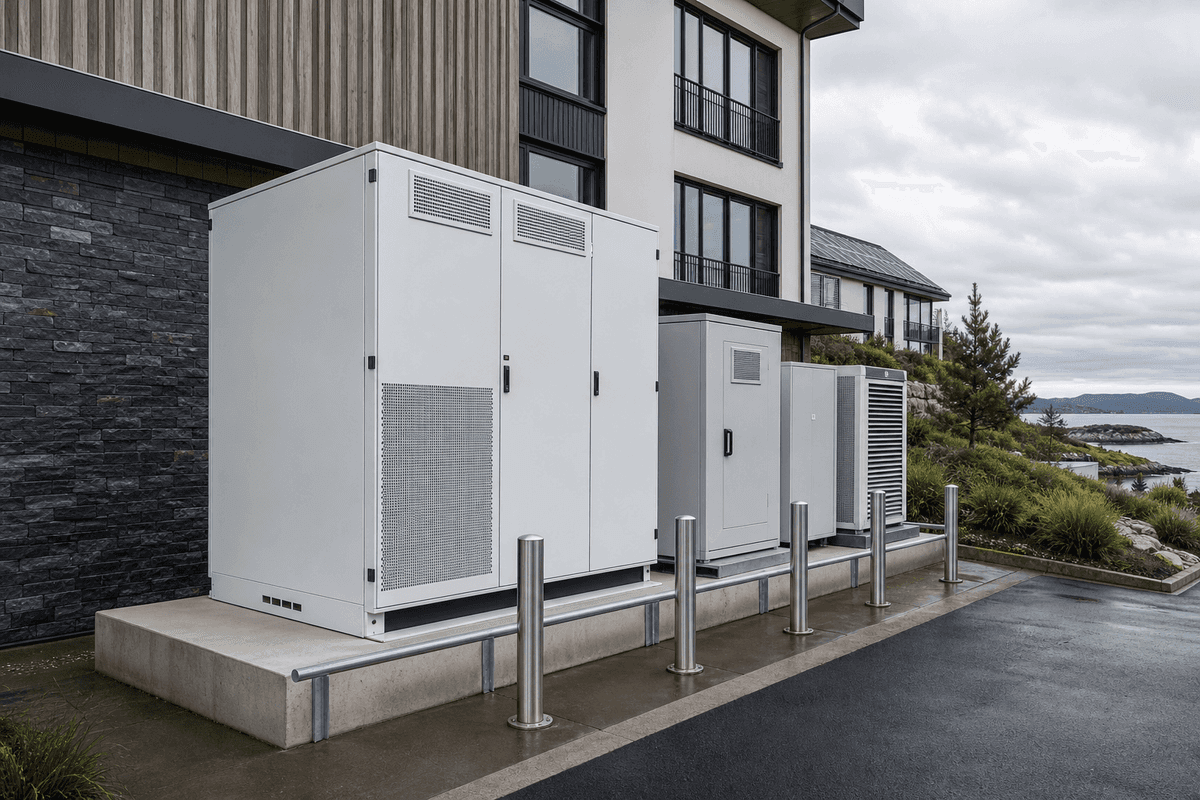
150kWh Hotel Demand Management LFP - 75kW Peak Shaving BESS
Key Features
- 150kWh energy capacity with 75kW rated power for approximately 2.0 hours of discharge
- Up to 60kW peak shaving capability for hotel demand charge reduction applications
- LFP battery chemistry with 6,000+ cycles at 90% depth of discharge
- Bidirectional PCS with >96% efficiency and typical system round-trip efficiency of 90%
- EPC turnkey pricing from $20,700 to $24,900 with typical 3-5 year payback
The 150kWh Hotel Demand Management LFP is a 75kW commercial battery energy storage system engineered for hotel peak shaving, demand charge reduction, and backup-ready grid support. Using LFP chemistry, liquid cooling, advanced BMS, and a bidirectional PCS, it delivers 60kW peak shave capability, 6,000+ cycles, and a typical 3-5 year ROI in high-tariff commercial applications.
Description
The 150kWh Hotel Demand Management LFP is a commercial battery energy storage system (BESS) designed for hotels, resorts, serviced apartments, and mixed-use hospitality assets that need to reduce monthly demand charges, flatten 15-minute load peaks, and improve energy resilience. With 150kWh usable energy capacity, 75kW rated power, and 60kW peak shaving capability, this LFP-based system is optimized for 1-2 daily cycles and typical hotel load profiles such as HVAC startup, laundry equipment, kitchen demand spikes, and elevator clustering. For buyers comparing solutions in 2025, this size class fits many 80-room to 180-room properties where utility demand penalties can materially increase annual operating costs.
Hotels often face a mismatch between average load and billed peak demand, especially when chillers, pumps, commercial kitchens, and banquet operations overlap for 15-60 minutes. A properly configured 150kWh / 75kW BESS can discharge during those short intervals to reduce the metered demand by about 60kW, which can translate into annual savings of roughly $7,200-$11,400 if local demand charges are in the range of $10-$16/kW-month. According to NREL commercial storage case studies and tariff modeling, behind-the-meter storage in demand-charge-driven buildings can reach a 3-5 year payback when dispatch is aligned to interval billing windows and HVAC controls. This configuration is therefore positioned for hotel operators seeking measurable OPEX reduction rather than speculative arbitrage.
Product Positioning for Hotel Demand Management
This system uses LFP (Lithium Iron Phosphate) cells with 6,000+ cycles, a typical 90% depth of discharge, and a projected 15-year calendar life under controlled thermal conditions. Compared with conventional diesel peak support, which can require 0.24-0.30 liters/kWh equivalent fuel consumption and routine engine maintenance every 250-500 hours, an LFP BESS reduces local emissions to 0 at point of use, lowers acoustic impact to typical inverter and pump noise levels, and supports automated dispatch within seconds rather than manual generator start procedures. For hotels operating in urban districts or tourism zones with noise restrictions below 65 dB(A) at property boundaries, this difference can be operationally important.
The selected architecture is aligned with current market direction. IEA and IRENA have both documented rapid growth in stationary storage adoption between 2023 and 2026, driven by falling battery costs and increasing commercial tariff complexity. Industry references from BloombergNEF and Wood Mackenzie indicate installed system pricing for commercial storage moving toward about $125-$180/kWh for many projects, while battery cell prices in 2025 can be near $40-$55/kWh depending on volume, chemistry, and pack integration. The SOLARTODO 150kWh hotel-demand variant is priced within practical procurement ranges for B2B buyers evaluating lifecycle economics, compliance, and EPC bankability rather than only low upfront equipment cost.
System Architecture
The system integrates prismatic LFP cells in an aluminum-housed battery pack, a bidirectional 75kW power conversion system (PCS) with >96% conversion efficiency, a battery management system with SOC and SOH monitoring, liquid thermal management, and a site-level energy management controller. The design target is stable operation across -20°C to 55°C, with liquid cooling recommended because the installed capacity exceeds 100kWh, which is consistent with common C&I thermal design practice and helps maintain tighter cell temperature spread for cycle-life protection. Round-trip efficiency is typically specified at about 90%, depending on dispatch profile, auxiliary loads, and ambient conditions.
The BMS performs cell balancing, over-voltage and under-voltage protection, current limitation, insulation monitoring, and thermal fault response across every battery string. In hotel applications, the EMS can be configured to monitor utility import every 1-5 seconds, forecast interval peaks over 15-minute billing windows, and discharge when site demand exceeds a set threshold such as 220kW, 300kW, or 450kW depending on property size. This allows the battery to preserve energy for the most expensive peak periods rather than discharging too early in the day. For system planning support, buyers can Configure your system online or Request a custom quotation with tariff and interval data.

Technical Specifications
For this 150kWh / 75kW variant, the battery chemistry is LFP, the recommended operating depth of discharge is 90%, and the target cycle life is 6,000+ cycles at standard commercial operating conditions. At 1 cycle per day, that implies over 16 years of cycle capability in theory, though bankable project modeling usually uses a 10-year warranty and a 15-year calendar life assumption to account for temperature, C-rate, and site behavior. The battery enclosure is designed for commercial indoor or sheltered outdoor installation, with integrated protections for electrical isolation, cabinet access control, and emergency shutdown.
Typical electrical performance includes 75kW rated AC output, 60kW practical peak shaving setpoint, and approximately 2.0 hours of discharge duration at rated power. This duration is well matched to hotel demand management because many costly utility peaks occur in short windows rather than sustained 4-hour durations. If the property has a more severe afternoon cooling peak, the EMS can reserve 80-100kWh for the utility billing interval and use the remaining capacity for limited self-consumption optimization. Buyers seeking larger fleets or multi-building deployments can View all Battery Energy Storage System (BESS) products for higher-capacity configurations.
Safety, Compliance, and Protection Design
Safety architecture follows current commercial storage expectations with three-tier fire suppression, gas detection, thermal event monitoring, automatic shutdown logic, and emergency isolation. The system is designed around standards and test frameworks relevant to stationary storage, including UL 9540, UL 9540A, IEC 62619, UN38.3, and installation practices informed by NFPA 855. For procurement teams and consultants, these references matter because insurers, AHJs, and MEP reviewers increasingly require documented evidence of thermal runaway mitigation, enclosure separation, and first-responder shutdown access within commercial buildings above 50kWh storage thresholds.
Compared with older lead-acid energy storage alternatives, LFP provides materially longer life and lower maintenance. A lead-acid system delivering a similar usable energy output might require oversizing by 30-50% because practical depth of discharge is often limited to around 50-70%, and cycle life may be only 1,200-2,000 cycles depending on temperature and discharge rate. By contrast, this LFP platform supports 90% DoD and 6,000+ cycles, reducing replacement frequency and floor-space-per-useful-kWh over a 10-year ownership period. For hotel engineering teams, that often means lower lifecycle cost, fewer maintenance interventions, and better fit for constrained electrical rooms.
Cloud Monitoring and Energy Management
The cloud monitoring layer gives operators real-time visibility into SOC, SOH, alarms, charge/discharge power, cell temperature, and historical savings. Data can typically be logged at 1-minute intervals for dashboarding and at faster intervals for event analysis, allowing hotel facility managers to verify whether the battery clipped a monthly peak from, for example, 410kW to 350kW. Remote access also supports firmware management, event diagnostics, and service planning, which is particularly useful for hotel groups managing 5-50 properties across multiple utility territories. For broader technical background, buyers can Learn about topic and review additional system design guidance through the SOLARTODO knowledge center.

The EMS can coordinate with building management systems, smart meters, rooftop solar, and backup generators. In a hotel with a 120kWp to 250kWp rooftop PV system, the BESS can absorb midday excess generation and discharge during evening occupancy peaks, improving self-consumption while still preserving the primary demand-charge-reduction objective. In grid-constrained regions, the PCS can also support grid-tied and limited island-mode-ready operation depending on project scope, switchgear design, and local interconnection rules. This flexibility is useful where outage frequency exceeds 5-10 events per year or where voltage sag affects guest comfort and IT equipment reliability.
Application Scenario: Hotel Peak Shaving Case
Consider a 140-room business hotel in a warm-climate city with a peak monthly demand of 380kW, average daytime load of 240kW, and utility demand charges of $14/kW-month. HVAC compressors, laundry, kitchen preparation, and conference operations create recurring late-afternoon spikes of 50-70kW above the baseline for about 1.5-2.0 hours. By deploying this 150kWh / 75kW LFP BESS with a 60kW peak shaving strategy, the facility can reduce billed demand from 380kW to 320kW in many billing cycles, generating approximately $840 per month or $10,080 per year in avoided demand charges before additional energy optimization benefits.
In this scenario, if the EPC turnkey investment is $22,800 and annual net savings are $9,200-$10,500, simple payback can fall near 2.2-2.5 years under favorable dispatch conditions, though a more conservative blended assumption of 3-5 years remains prudent for underwriting. This aligns with commercial storage observations published across NREL, IRENA, and market analyst reports, where tariff structure and controls quality are the dominant ROI variables. Compared with relying on a 100kVA diesel generator for occasional peak support, the battery solution can reduce routine fuel and maintenance costs by 30-50% for the peak-management portion of the load strategy while also avoiding combustion-related permitting issues.
Installation Scope and Project Integration
A standard deployment for this product includes site survey, single-line diagram review, load profile analysis covering at least 30-90 days of interval data, foundation or pad preparation, AC/DC cabling, communications integration, protection coordination, commissioning, and operator training. Typical installation time for a prepared site is about 3-7 days, while full engineering and procurement lead time can range from 4-10 weeks depending on switchgear customization, shipping destination, and utility approval requirements. Hotels with existing electrical rooms should verify clearance, ventilation, fire separation, and cable routing before finalizing equipment layout.
For EPC buyers, the turnkey package is intended to reduce interface risk across civil, electrical, controls, and commissioning scopes. This is especially important in occupied hospitality sites where shutdown windows may be limited to 2-6 hours overnight or during low occupancy periods. SOLARTODO can support procurement teams with technical submittals, datasheets, integration notes, and quotation support through Request a custom quotation. Buyers researching storage economics, safety, and configuration options can also Learn about topic before final design freeze.
EPC Investment Analysis and Pricing Structure
The EPC scope for this 150kWh hotel demand management BESS includes engineering, procurement, construction, installation, commissioning, controls setup, operator training, and 1-year warranty support. Engineering generally covers electrical design review, protection settings, communications mapping, and layout confirmation. Procurement covers battery cabinet, PCS, BMS, EMS, thermal management, safety hardware, and enclosure accessories. Construction includes mechanical placement, cable termination, testing, and site energization. Commissioning includes functional testing, alarm verification, dispatch tuning, and handover documentation, which typically requires 1-3 days after physical installation.
| Pricing Tier | Scope | Price Range (USD) |
|---|---|---|
| FOB Supply | Equipment only, ex-works China | $12,834 - $16,932 |
| CIF Delivered | Equipment + ocean freight + insurance | $15,447 - $20,379 |
| EPC Turnkey | Installed, commissioned, 1-year warranty | $20,700 - $24,900 |
For portfolio buyers, indicative volume discounts can improve project economics when standardization is possible across 50, 100, or 250 units. Savings depend on site similarity, destination, and commissioning bundling, but the following structure is commonly used for planning-level budgeting.
| Volume | Discount |
|---|---|
| 50+ units | 5% |
| 100+ units | 10% |
| 250+ units | 15% |
ROI depends primarily on demand tariff, dispatch success, and cycle frequency. If a hotel avoids 60kW of billed demand at $12/kW-month, annual savings are about $8,640. At $16/kW-month, annual savings rise to about $11,520. Against an EPC investment of $20,700-$24,900, that implies a simple payback of roughly 2.0-2.9 years in strong tariff environments and about 3-5 years in more conservative operating cases with lower dispatch capture. Compared with conventional generator-based peak support, the battery avoids fuel logistics, reduces maintenance intervals, and can provide finer control in sub-minute response windows.
Payment terms are typically 30% T/T + 70% against B/L, or 100% L/C at sight for qualified transactions. Financing support may be available for projects above $5,000K subject to credit review, jurisdiction, and project structure. For commercial proposals, technical clarifications, or multi-site EPC discussions, contact [email protected].
Why This Configuration Fits Hospitality Loads
Hotels are distinct from factories and warehouses because they combine guest comfort loads, variable occupancy, kitchens, pumps, and event spaces in a single tariff meter. That means short-duration peaks of 30-90 minutes can have a disproportionate effect on the monthly bill. A 150kWh / 75kW system is therefore often more cost-effective than oversizing to 300kWh if the primary objective is demand charge reduction rather than long-duration backup. This targeted sizing approach keeps capex aligned with the billing problem and can improve return on invested capital by focusing on the highest-cost intervals.
From an asset-management perspective, LFP chemistry also supports lower operational risk than some higher-energy-density alternatives because of its strong thermal stability profile and broad industry adoption in stationary storage. With proper thermal management, cell balancing, and dispatch controls, the system can maintain useful capacity over thousands of cycles while serving as a digital energy asset rather than a passive backup device. For owners, ESCOs, and EPC firms evaluating a repeatable commercial storage design, this product offers a practical balance between 150kWh energy, 75kW power, compliance-oriented safety, and hotel-specific demand management value.
Technical Specifications
| Energy Capacity | 150kWh |
| Power Rating | 75kW |
| Battery Chemistry | LFP |
| Round-trip Efficiency | 90% |
| Depth of Discharge | 90% |
| Cycle Life | 6000+cycles |
| Calendar Life | 15years |
| Operating Temperature | -20 to 55°C |
| Peak Shave Capability | 60kW |
| Annual Savings | 7200-11400USD |
| Payback Period | 3-5years |
| Warranty | 10 years / 70% capacity |
Price Breakdown
| Item | Quantity | Unit Price | Subtotal |
|---|---|---|---|
| LFP Battery Cells | 150 pcs | $55 | $8,250 |
| Battery Management System (BMS) | 150 pcs | $15 | $2,250 |
| PCS Bidirectional Inverter 75kW | 75 pcs | $80 | $6,000 |
| Liquid Thermal Management | 150 pcs | $25 | $3,750 |
| Fire Suppression System | 1 pcs | $5,000 | $5,000 |
| EMS Software | 1 pcs | $3,000 | $3,000 |
| Engineering & QC | 1 pcs | $1,200 | $1,200 |
| Installation & Commissioning | 1 pcs | $4,200 | $4,200 |
| 1-Year Warranty & Support | 1 pcs | $900 | $900 |
| Total Price Range | $20,700 - $24,900 | ||
Frequently Asked Questions
How much demand charge can a 150kWh hotel BESS realistically reduce?
Why is LFP selected instead of lead-acid or NCM for this 150kWh system?
What is included in the EPC turnkey price range of $20,700-$24,900?
What warranty and service support are available for this hotel demand management BESS?
Can this 150kWh system work with rooftop solar and backup generators?
Certifications & Standards

Data Sources & References
- •NREL commercial battery storage demand charge reduction studies 2024-2025
- •IEA electricity market and storage outlook 2025
- •IRENA battery storage cost and deployment updates 2024-2025
- •IEC 62619 secondary lithium battery safety standard
- •UL 9540 and UL 9540A energy storage safety framework
- •Wood Mackenzie global energy storage market outlook 2025
- •BloombergNEF battery price survey 2025
Interested in this solution?
Contact us for a customized quote based on your specific requirements.
Contact Us