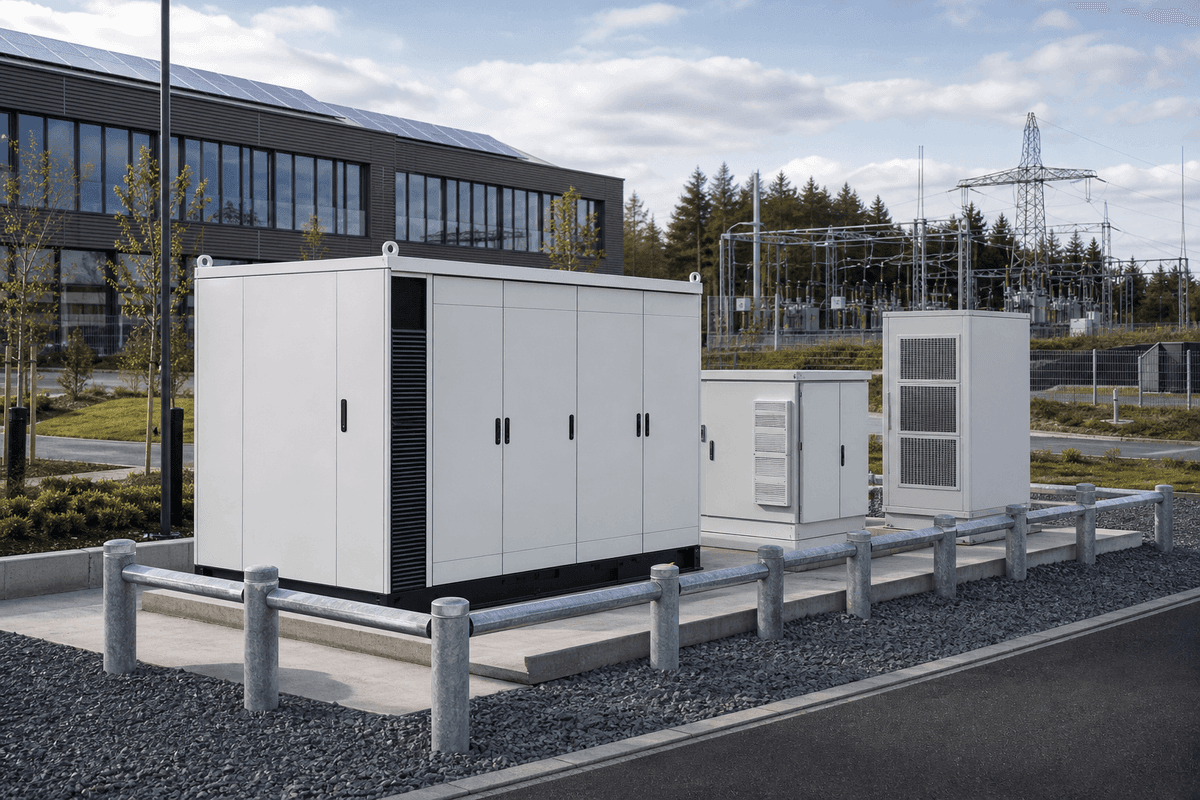
100kWh Office Backup Power LFP - Seamless 4-Hour Autonomy
Key Features
- 100kWh usable capacity with 90% DoD (90kWh effective), delivering 4 hours of full-load backup at 50kW rated power output
- LFP prismatic cells rated for 6,000+ charge-discharge cycles, providing a calendar life exceeding 10 years with 10-year / 70% capacity warranty
- 50kW bidirectional PCS with >96% round-trip efficiency and millisecond grid-to-island transfer for UPS-grade reliability
- Three-tier fire suppression system with gas detection and auto-shutdown; fully compliant with UL 9540A, IEC 62619, and NFPA 855
- Peak shaving and load shifting capability reduces monthly demand charges by up to 25%, with payback period of 4-5 years
- Reduces O&M costs by over 80% annually compared to diesel generator alternatives, with zero fuel costs and no mechanical maintenance
The SOLAR TODO 100kWh Office Backup Power LFP is a commercial-grade BESS featuring LFP prismatic cells, a 50kW bidirectional PCS with >96% efficiency, 4-hour autonomy at full load, 6,000+ cycle life, and compliance with UL 9540A, IEC 62619, and NFPA 855.
Description
The SOLAR TODO 100kWh Office Backup Power LFP is a high-performance, commercial-grade Battery Energy Storage System (BESS) designed to provide seamless, reliable backup power for office buildings and critical facilities. Featuring advanced Lithium Iron Phosphate (LFP) prismatic cells with a 50kW bidirectional inverter, this system delivers up to 4 hours of autonomy at full load, ensuring uninterrupted operations during grid outages. With an inherently safe chemistry that eliminates thermal runaway risks and a robust cycle life exceeding 6,000 cycles, it serves as a superior, low-maintenance replacement for traditional lead-acid UPS systems and diesel generators.
Advanced LFP Battery Technology and Architecture
At the core of the 100kWh Office Backup Power system lies state-of-the-art Lithium Iron Phosphate (LFP) battery technology, recognized globally for its exceptional safety profile and longevity. Unlike conventional Nickel Manganese Cobalt (NCM) chemistries, LFP cells are inherently stable and do not experience thermal runaway under typical abuse conditions, making them the premier choice for indoor commercial installations. The system utilizes high-capacity prismatic cells housed in durable aluminum casings, which provide superior mechanical protection and efficient heat dissipation. These cells are meticulously arranged within a modular footprint, allowing for scalable deployment while maintaining a compact form factor suitable for electrical rooms.
The architecture of the battery modules is designed to maximize energy density while ensuring optimal thermal management. Air cooling maintains the cells within their ideal operating temperature range of 15°C to 35°C. This precise thermal regulation is critical for achieving the system's impressive lifespan of over 6,000 cycles at a 90% Depth of Discharge (DoD). Furthermore, the integration of a sophisticated Battery Management System (BMS) continuously monitors the State of Charge (SOC) and State of Health (SOH) at the individual cell level. The BMS performs active cell balancing, mitigating voltage drift and ensuring that the entire 100kWh capacity remains fully accessible throughout the system's operational life.
High-Efficiency Power Conversion and Grid Interaction
The power delivery mechanism of the SOLAR TODO 100kWh system is driven by a robust 50kW bidirectional Power Conversion System (PCS). This advanced inverter technology facilitates seamless transitions between grid-tied and island modes, ensuring that critical office loads experience zero interruption during a power failure. The PCS boasts a round-trip efficiency exceeding 96%, minimizing energy losses during both the charging and discharging phases. This high efficiency not only reduces operational costs but also maximizes the usable energy derived from the 100kWh battery bank, providing a reliable 4 hours of autonomy when operating at the full 50kW rated power.
In addition to its primary function as a backup power source, the bidirectional nature of the PCS allows the system to participate in advanced energy management strategies. When the grid is stable, the system can perform peak shaving and load shifting, storing energy during off-peak hours when electricity rates are low, and discharging it during peak demand periods. This capability significantly reduces demand charges for commercial facilities. The system complies with stringent grid interconnection standards, including IEEE 1547 and UL 1741, ensuring safe and reliable parallel operation with the utility grid. The seamless grid-to-island transfer mechanism operates within milliseconds, providing UPS-grade reliability for sensitive electronic equipment, servers, and communication networks.
Comprehensive Safety and Compliance Standards
Safety is paramount in the design and deployment of the SOLAR TODO 100kWh Office Backup Power LFP system. The inherently safe LFP chemistry is augmented by a multi-layered safety architecture that exceeds industry standards. The system incorporates a three-tier fire suppression mechanism, which includes early-stage off-gas detection, localized aerosol suppression at the module level, and a secondary clean agent system for the entire enclosure. This comprehensive approach ensures that any potential thermal event is detected and mitigated before it can escalate. The system has undergone rigorous testing and is fully compliant with UL 9540A, the industry benchmark for evaluating the fire safety hazards of battery energy storage systems.
Furthermore, the system adheres to a comprehensive suite of international standards, ensuring global applicability and regulatory compliance. The battery cells and modules are certified to IEC 62619 and UN38.3, guaranteeing their safety during transportation and operation. The overall system design complies with NFPA 855, the standard for the installation of stationary energy storage systems, providing clear guidelines for safe deployment in commercial buildings. The integrated gas detection system continuously monitors the enclosure for the presence of combustible gases, automatically triggering a system shutdown and alerting facility managers in the event of an anomaly.
Real-World Application and Economic Impact
The practical benefits of the SOLAR TODO 100kWh system are best illustrated through real-world deployments. For instance, a mid-sized technology firm in the MENA region deployed this exact system to protect their critical server infrastructure and customer support operations from frequent grid instabilities. Prior to the installation, the firm relied on a combination of aging lead-acid UPS units and a noisy diesel generator, which required constant maintenance and incurred high fuel costs. By transitioning to the 100kWh LFP system, the firm achieved a seamless 4-hour backup capability, completely eliminating the brief power interruptions that previously caused server reboots and data loss.
The economic advantages of this transition are substantial. Compared to a conventional diesel generator setup, the SOLAR TODO BESS reduces operational and maintenance costs by over 80% annually. There are no fuel costs, no oil changes, and no mechanical wear and tear to manage. Furthermore, by utilizing the system for peak shaving during normal grid operation, the firm reduced their monthly peak demand charges by 25%. With system costs approaching $80/kWh in the 2025-2026 market, the return on investment (ROI) for the 100kWh system is highly attractive, typically achieving payback within 4 to 5 years, while providing a reliable operational lifespan of over 10 years.
System Integration and Scalability
The SOLAR TODO 100kWh Office Backup Power LFP system is engineered for straightforward integration into existing commercial electrical infrastructure. The system arrives pre-assembled and pre-tested from the factory, significantly reducing on-site installation time and associated labor costs. A standard installation requires only connection to the building's main electrical panel, configuration of the EMS software, and a final commissioning check, which can typically be completed within one to two days by a qualified electrician. The system's modular design also supports future capacity expansion; additional battery modules can be added to scale the system up to 200kWh or beyond without replacing the core PCS or EMS components.
The Energy Management System (EMS) software provides facility managers with a comprehensive, real-time view of the system's operational status through an intuitive web-based dashboard. Key metrics including current State of Charge (SOC), power flow direction, grid voltage, and historical energy data are all accessible remotely via a secure cloud portal. The EMS supports multiple communication protocols, including Modbus TCP, CAN bus, and RS485, ensuring seamless integration with existing Building Management Systems (BMS) and SCADA platforms. Automated alerts and reporting features further simplify operations, notifying maintenance personnel of any anomalies or scheduled service intervals.
Environmental and Sustainability Credentials
Beyond its operational and economic benefits, the SOLAR TODO 100kWh LFP system represents a significant step forward in corporate sustainability. LFP chemistry is inherently more environmentally benign than competing lithium-ion chemistries, as it does not contain cobalt or nickel, materials associated with complex and ethically challenging supply chains. The system's high round-trip efficiency of over 96% minimizes wasted energy, and its long operational lifespan of 10 to 15 years reduces the frequency of battery replacement and associated material consumption. When the batteries do reach end-of-life, LFP cells are fully recyclable, and SOLAR TODO partners with certified recycling facilities to ensure responsible material recovery.
For organizations pursuing green building certifications such as LEED or BREEAM, the installation of a high-efficiency BESS can contribute meaningfully to energy management credits. When paired with an on-site solar PV system, the 100kWh storage unit enables a facility to maximize self-consumption of renewable energy, further reducing its carbon footprint and dependence on grid-supplied electricity. This integration positions the SOLAR TODO BESS as a cornerstone of a comprehensive corporate energy strategy, supporting both resilience and sustainability objectives simultaneously.
Frequently Asked Questions
What is the expected lifespan of the 100kWh LFP battery system? The SOLAR TODO 100kWh system utilizes premium LFP cells rated for over 6,000 cycles at a 90% Depth of Discharge. Under typical backup power applications, this translates to a calendar life exceeding 10 to 15 years, significantly outlasting traditional lead-acid alternatives.
How fast does the system switch to battery power during an outage? The integrated 50kW bidirectional PCS features a seamless grid-to-island transfer mechanism. In the event of a grid failure, the system switches to battery power within milliseconds, ensuring that sensitive office equipment and servers remain online without interruption.
Is the system safe to install indoors in an office building? Yes, the system is exceptionally safe for indoor installation. It uses inherently stable LFP chemistry, which does not experience thermal runaway. Additionally, it features a three-tier fire suppression system and is fully compliant with UL 9540A and NFPA 855 standards for indoor deployment.
Can this system help reduce my monthly electricity bills? Absolutely. Beyond providing backup power, the bidirectional inverter allows the system to perform peak shaving. It can charge during off-peak hours when rates are low and discharge during peak hours, significantly reducing expensive utility demand charges.
What maintenance is required for the SOLAR TODO 100kWh system? Unlike diesel generators, this solid-state system requires minimal maintenance. The advanced Battery Management System (BMS) continuously monitors cell health and performs automatic balancing. Routine visual inspections and annual software checks are typically all that is required to ensure optimal performance.
Technical Specifications
| Energy Capacity | 100kWh |
| Usable Capacity (90% DoD) | 90kWh |
| Power Rating | 50kW |
| Battery Chemistry | LFP (Lithium Iron Phosphate) |
| Cell Format | Prismatic (Aluminum Housing) |
| Round-trip Efficiency | >96% |
| Depth of Discharge | 90% |
| Cycle Life | 6,000+cycles |
| Calendar Life | 10-15years |
| Autonomy at Full Load | 4hours |
| Operating Temperature | 15 to 35°C |
| Storage Temperature | -20 to 45°C |
| Thermal Management | Air Cooling |
| Grid Transfer Time | <20ms |
| AC Voltage Output | 208/220/380/400/480VAC |
| Communication Protocol | Modbus TCP / CAN / RS485 |
| Annual Savings (Peak Shaving) | ~8,000-12,000USD |
| Payback Period | 4-5years |
| Warranty | 10 years / 70% capacity retention |
| Certifications | UL 9540, UL 9540A, IEC 62619, NFPA 855, UN38.3 |
Price Breakdown
| Item | Quantity | Unit Price | Subtotal |
|---|---|---|---|
| LFP Battery Cells (100 kWh) | 100 kWh | $55 | $5,500 |
| Battery Management System (BMS) | 100 kWh | $15 | $1,500 |
| PCS Bidirectional Inverter (50kW) | 1 pcs | $4,000 | $4,000 |
| DC-DC Converter (50kW) | 1 pcs | $1,500 | $1,500 |
| Thermal Management (Air Cooling) | 100 kWh | $10 | $1,000 |
| Cabinet / Enclosure | 1 pcs | $8,000 | $8,000 |
| Fire Suppression System | 1 pcs | $5,000 | $5,000 |
| EMS Software License | 1 pcs | $3,000 | $3,000 |
| Installation & Civil Works | 100 kWh | $20 | $2,000 |
| Commissioning & Testing | 1 pcs | $5,000 | $5,000 |
| Total Price Range | $28,000 - $40,000 | ||
Frequently Asked Questions
What is the expected lifespan of the 100kWh LFP battery system?
How fast does the system switch to battery power during an outage?
Is the system safe to install indoors in an office building?
Can this system help reduce my monthly electricity bills?
What maintenance is required for the SOLAR TODO 100kWh system?
Certifications & Standards


Data Sources & References
- •IEC 62619:2022 - Safety requirements for secondary lithium cells and batteries for use in industrial applications
- •NFPA 855:2023 - Standard for the Installation of Stationary Energy Storage Systems
- •UL 9540A:2023 - Test Method for Evaluating Thermal Runaway Fire Propagation in Battery Energy Storage Systems
- •BloombergNEF Energy Storage Market Outlook 2025
- •Wood Mackenzie Global Energy Storage Monitor Q1 2026
- •IEEE 1547-2018 - Standard for Interconnection and Interoperability of Distributed Energy Resources
Interested in this solution?
Contact us for a customized quote based on your specific requirements.
Contact Us