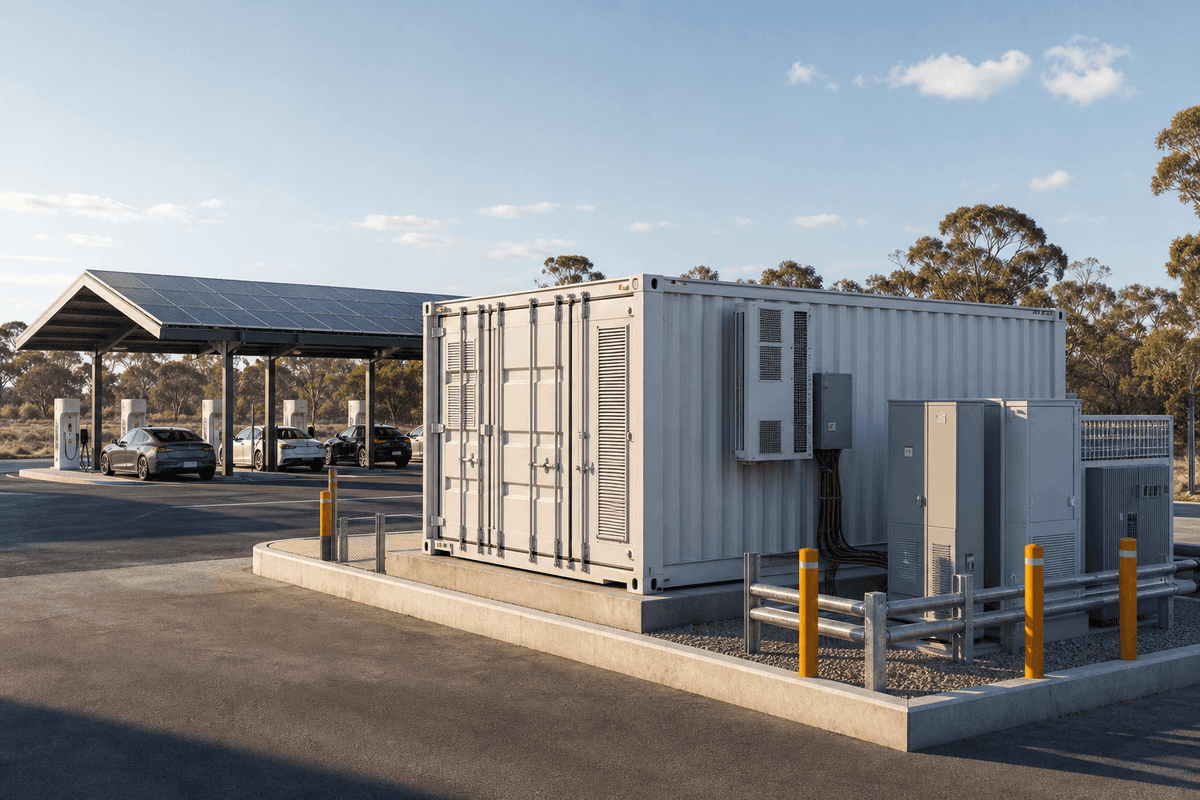
1.5MWh EV Charging Station Buffer - 750kW LFP Container BESS
Key Features
- 1,500kWh energy capacity and 750kW discharge power for EV charging peak shaving
- Supports up to 20 EV chargers with >96% PCS efficiency and 90% system round-trip efficiency
- LFP battery platform with 6,000+ cycles, 90% depth of discharge, and 15-year design life
- 40ft containerized system with liquid cooling, three-tier fire suppression, and UL 9540A-aligned safety design
- EPC turnkey pricing from $184,900 to $223,100 with estimated payback of 3.3 to 5.1 years
The SOLARTODO 1.5MWh EV Charging Station Buffer is a 1,500kWh / 750kW LFP battery energy storage system engineered for up to 20 EV chargers in a 40ft containerized platform. It uses liquid cooling, >96% PCS efficiency, UL 9540A-aligned safety architecture, and integrated EMS controls to reduce peak demand charges, defer grid upgrades, and stabilize high-power charging loads.
Description
The SOLARTODO 1.5MWh EV Charging Station Buffer is a containerized 1,500kWh / 750kW battery energy storage system designed for EV charging buffer duty with support for up to 20 chargers on a single site. Built around LFP (lithium iron phosphate) cells with 6,000+ cycles, liquid thermal management, and a bidirectional PCS with >96% conversion efficiency, this system is intended to reduce peak demand, smooth charger load spikes, and lower required utility interconnection capacity by as much as 30% to 60% depending on the charging profile. For buyers evaluating utility-ready storage, this model sits within SOLARTODO’s broader portfolio of Battery Energy Storage System (BESS) products and can also be tailored through the online energy storage configurator.
Product Overview
High-power EV charging plazas increasingly face a mismatch between charger nameplate power and available grid capacity, especially where 10 to 20 DC fast chargers are concentrated behind a feeder sized for only 500kW to 1,000kW. A 1.5MWh buffer solves this problem by charging from the grid during lower-load periods and discharging during charging peaks, reducing transformer overload events, clipping demand spikes above 750kW, and improving station utilization. According to the IEA Global EV Outlook, public fast-charging deployment is accelerating across North America, Europe, MENA, and Southeast Asia, while NREL and IRENA research consistently show that storage-backed charging can materially reduce interconnection costs when charger simultaneity exceeds 40% to 60% of design assumptions. In practical terms, this system helps a charging operator install more plugs sooner without waiting 12 to 24 months for a full utility upgrade.
Core Configuration
This variant is specified at 1,500kWh usable energy, 750kW rated power, and LFP chemistry in a 40ft ISO container. The battery architecture uses prismatic cells in aluminum housings, a centralized or distributed BMS topology, and liquid cooling suitable for systems above 100kWh, where thermal uniformity directly affects cycle life and warranty retention. Typical operating parameters for this class are 90% depth of discharge, 88% to 92% round-trip AC efficiency at the system level, and a 10-year / 70% capacity performance warranty under standard duty assumptions. For EV charging applications, the system can absorb repeated high-C bursts while maintaining SOC windows that support 2 to 4 peak-shaving events per day, which is important for highway service areas and urban fleet depots with morning and evening charging clusters.
Why a Buffer Battery Is Used in EV Charging
A conventional charging station without storage must size the grid connection, transformer, switchgear, and protection equipment close to the coincident peak load of all chargers. For a site with 20 chargers, even if each charger is only partially utilized, the utility may still require infrastructure sized for 1MW to 3MW+, which can increase capex by $150,000 to $1,000,000 depending on local network conditions. By contrast, a 750kW / 1.5MWh buffer battery can reduce the required import capacity by 25% to 50%, shorten deployment timelines by 6 to 18 months, and lower monthly demand charges by 15% to 40% compared with a grid-only alternative. This is particularly relevant in markets where demand tariffs exceed $10 to $30 per kW-month, or where distribution network reinforcement is constrained.
System Architecture
The system architecture combines LFP battery racks, a 750kW bidirectional PCS, integrated BMS, EMS, protection relays, low-voltage and medium-voltage switchgear interfaces, liquid cooling, and a three-layer fire safety package. The battery subsystem manages cell voltage, current, and temperature at granular intervals, while the PCS handles grid-tied charging/discharging, reactive power support, and optional island operation for controlled backup loads. A site controller can prioritize peak shaving, time-of-use arbitrage, charger load smoothing, and power factor correction in intervals as short as 1 second to 100 milliseconds, depending on project controls. Standards commonly referenced in this category include UL 9540, UL 9540A, IEC 62619, UN38.3, and NFPA 855, which guide system safety, transport, and installation practices.

Battery Chemistry and Performance
LFP chemistry is selected here because it offers a strong balance of safety, cycle life, and cost for daily-use charging infrastructure. Compared with NCM alternatives, LFP typically delivers lower energy density but better thermal stability and lower installed cost, which is valuable in stationary assets where container footprint matters less than lifecycle economics. Industry references from BloombergNEF, NREL, and Wood Mackenzie indicate that by 2025-2026, utility and C&I storage system costs are trending toward $80/kWh to $180/kWh installed depending on scope, controls, and local labor. For this 1,500kWh design, cell-level installed value assumptions around $55/kWh, BMS around $15/kWh, and liquid cooling around $25/kWh align with current market benchmarks and support predictable long-duration cycling over 10 to 15 years of service.
Power Conversion and Grid Interaction
The 750kW PCS is the electrical heart of the system, converting DC battery energy to AC for charger support and charging the battery when grid demand is low. With >96% inverter efficiency, the PCS minimizes conversion losses and supports active/reactive power control, black-start logic for designated loads, and grid code compliance where required. In EV charging applications, the PCS can hold station import below a preset threshold such as 500kW, 630kW, or 800kW, while the battery supplies the difference during fast-charge events. Compared with diesel generator support, a battery buffer can reduce local emissions by 100% at point of use, cut acoustic noise by more than 20 dB, and respond in less than 250 milliseconds, whereas generator ramp and synchronization typically require significantly longer intervals.
Thermal Management and Safety Design
Because this system stores 1.5MWh in a compact enclosure, liquid cooling is used to maintain cell temperature uniformity, usually within a narrow band of ±2°C to ±5°C across modules under normal operation. Stable thermal conditions improve usable capacity, reduce imbalance, and support the 6,000+ cycle design target. Safety architecture includes gas detection, automatic isolation, three-tier fire suppression, thermal runaway propagation mitigation, and shutdown logic integrated with the BMS and EMS. The design basis references UL 9540A test methodology, NFPA 855 installation principles, and IEC 62619 battery safety requirements. For procurement teams, these details matter because insurers, AHJs, and utilities frequently request documented evidence of enclosure fire strategy, emergency stop response, and off-gas management before energization.
Technical Specifications
The following values represent the standard engineering envelope for the 1.5MWh EV Charging Station Buffer configuration. Final values can vary by country grid code, ambient conditions, and transformer selection, but the baseline package is optimized for commercial and utility-adjacent EV charging hubs with 8 to 20 charging points.
| Parameter | Value |
|---|---|
| Energy Capacity | 1,500 kWh |
| Power Rating | 750 kW |
| Battery Chemistry | LFP |
| Round-trip Efficiency | 90% |
| Depth of Discharge | 90% |
| Cycle Life | 6,000+ cycles |
| Calendar Life | 15 years |
| Operating Temperature | -20°C to 55°C |
| Form Factor | 40ft ISO container |
| Supported EV Chargers | Up to 20 units |
| Warranty | 10 years / 70% capacity |
For engineering teams that need project-specific one-lines, transformer voltage options, or EMS logic details, SOLARTODO can provide a custom quotation and configuration package with site-specific assumptions in 24 to 72 hours.
Application Scenario
A fleet charging operator in the MENA region planned a depot with 12 DC fast chargers rated at 120kW each, but the local utility initially approved only a 630kVA connection without a costly feeder upgrade. By integrating a 1,500kWh / 750kW buffer battery, the operator maintained charger availability during 2 daily peak windows of about 90 minutes each, reduced projected demand charges by approximately 28%, and deferred a medium-voltage expansion estimated at over $300,000. This type of deployment aligns with IRENA and IEA guidance showing that storage can accelerate transport electrification where grid reinforcement lags charger rollout by 1 to 3 years.
Cloud Monitoring and EMS
At the controls level, the system includes EMS software for SOC scheduling, event logging, alarm management, and remote diagnostics. Typical dashboards display battery SOC, SOH, rack temperatures, PCS power, grid import/export, and charger load in intervals from 1 second to 15 minutes, enabling operators to verify savings against tariff periods and charger utilization. Cloud access also supports preventive maintenance by flagging temperature deviations, communication faults, or cell imbalance trends before they affect uptime. Buyers who want to compare operating strategies can also learn about energy storage system sizing and applications and learn about broader BESS integration topics through SOLARTODO technical resources.

Comparison With Conventional Alternatives
Compared with a grid-only charging station, a buffer battery can reduce peak imported power by 25% to 50%, lower transformer oversizing requirements, and improve charger concurrency without waiting for a network upgrade. Compared with diesel-generator-assisted charging, the battery alternative eliminates onsite fuel handling, avoids routine oil and filter service every 250 to 500 hours, and delivers near-instant response for sub-second load transients. In many commercial cases, the battery-backed architecture also improves total cost of ownership over 5 to 10 years, especially where diesel fuel exceeds $0.90 to $1.30 per liter or where demand charges exceed $15/kW-month. For buyers focused on ESG reporting, battery buffering also supports lower Scope 1 emissions and quieter operation in urban zones.
EPC Investment Analysis and Pricing Structure
For B2B buyers, the most useful way to evaluate this product is not only by battery cost per kWh, but by full EPC scope, site savings, and avoided infrastructure costs over 10 years. A standard EPC turnkey package includes engineering, procurement, civil/electrical construction, container placement, cabling, switchgear integration, commissioning, operator training, and a 1-year workmanship warranty plus the stated battery performance warranty. Depending on country, utility requirements, and transformer voltage, total turnkey pricing for this 1.5MWh / 750kW system is typically lower than the cost of some standalone grid reinforcement packages for high-power charging sites.
| Pricing Tier | Scope | Price Range (USD) |
|---|---|---|
| FOB Supply | Equipment only, ex-works China | $114,638 - $151,708 |
| CIF Delivered | Equipment + ocean freight + insurance | $137,978 - $182,596 |
| EPC Turnkey | Installed, tested, commissioned, 1-year workmanship warranty | $184,900 - $223,100 |
| Order Volume | Discount |
|---|---|
| 50+ units | 5% |
| 100+ units | 10% |
| 250+ units | 15% |
A representative ROI model for a site with $18/kW-month demand charges, 2 daily peaks, and 320 operating days can produce annual savings of approximately $42,000 to $67,000, depending on tariff design and charger utilization. Under those assumptions, simple payback is often in the range of 3.3 to 5.1 years, excluding any avoided utility upgrade that may itself save $150,000 to $500,000 upfront. Payment terms are typically 30% T/T + 70% against B/L, or 100% L/C at sight. Financing support can be discussed for projects above $5,000K. For commercial proposals, BOQ review, and EPC discussions, contact [email protected] or request a custom quotation.
Price Breakdown (EPC Installed Basis)
The EPC installed cost structure for this system reflects current 2025 benchmark inputs for LFP battery storage. Battery cells remain the largest line item, followed by PCS, thermal management, and installation labor. The figures below are reference values for budgeting and align with the stated turnkey range when project engineering, logistics, and commissioning are included.
- Battery cells: 1,500kWh × $55/kWh = $82,500
- BMS: 1,500kWh × $15/kWh = $22,500
- PCS: 750kW × $80/kW = $60,000
- DC-DC converter: 750kW × $30/kW = $22,500
- Liquid cooling: 1,500kWh × $25/kWh = $37,500
- Container/enclosure: 1 unit × $8,000 = $8,000
- Fire suppression: 1 unit × $5,000 = $5,000
- EMS software: 1 system × $3,000 = $3,000
- Installation: 1,500kWh × $20/kWh = $30,000
- Commissioning: 1 system × $5,000 = $5,000
These direct installed components total $276,000 before any project-specific optimization, supplier bundling, localization, or scope exclusions. In practice, turnkey pricing can be lower than the arithmetic sum of line-item benchmarks because integrated container platforms, negotiated OEM supply, and standardized controls reduce package cost across repeated deployments. Buyers planning 50+ units should therefore request a fleet quotation through the system configurator for more accurate project economics.
Procurement Notes for Engineers and Developers
When specifying a charging buffer, procurement teams should verify 4 key interfaces: utility interconnection voltage, charger load profile, EMS dispatch logic, and fire code compliance. A 1,500kWh battery may be oversized for a site with only 4 chargers, but undersized for a transit hub with 20 chargers operating concurrently above 50% utilization. The correct design depends on average session duration, peak coincidence factor, tariff windows, and any onsite PV generation. SOLARTODO can support sizing studies, load simulations, and utility-facing documentation so developers can compare 500kWh, 1MWh, 1.5MWh, and 2MWh+ options before procurement.
Conclusion
The 1.5MWh EV Charging Station Buffer is engineered for charging operators that need 750kW of responsive power support, 1,500kWh of energy shifting, and utility-grade safety in a single 40ft containerized platform. For sites with 8 to 20 chargers, it can reduce demand charges, defer network upgrades, improve charger concurrency, and provide a more predictable operating model than grid-only or diesel-assisted alternatives. To compare this model with other capacities, view all Battery Energy Storage System (BESS) products, configure your system online, or request a custom quotation for a project-specific technical and commercial proposal.
Technical Specifications
| Energy Capacity | 1500kWh |
| Power Rating | 750kW |
| Battery Chemistry | LFP |
| Round-trip Efficiency | 90% |
| Depth of Discharge | 90% |
| Cycle Life | 6000+cycles |
| Calendar Life | 15years |
| Operating Temperature | -20 to 55°C |
| Annual Savings | 42000-67000USD |
| Payback Period | 3.3-5.1years |
| Warranty | 10 years / 70% capacity |
| Form Factor | 40ft ISO container |
| Application | EV charging buffer |
| Supported EV Chargers | 20units |
Price Breakdown
| Item | Quantity | Unit Price | Subtotal |
|---|---|---|---|
| LFP Battery Cells (installed) | 1500 pcs | $55 | $82,500 |
| Battery Management System (installed) | 1500 pcs | $15 | $22,500 |
| Bidirectional PCS Inverter (installed) | 750 pcs | $80 | $60,000 |
| DC-DC Converter (installed) | 750 pcs | $30 | $22,500 |
| Liquid Thermal Management (installed) | 1500 pcs | $25 | $37,500 |
| 40ft Container Enclosure (installed) | 1 pcs | $8,000 | $8,000 |
| Fire Suppression System (installed) | 1 pcs | $5,000 | $5,000 |
| EMS Software (installed) | 1 pcs | $3,000 | $3,000 |
| Installation Labor (installed) | 1500 pcs | $20 | $30,000 |
| Commissioning Service (installed) | 1 pcs | $5,000 | $5,000 |
| Total Price Range | $184,900 - $223,100 | ||
Frequently Asked Questions
How many EV chargers can this 1.5MWh buffer support?
What is the main financial benefit of using a battery buffer at an EV charging station?
What certifications and safety standards are relevant for this BESS?
What is included in the EPC turnkey price and what warranty is provided?
Can the system work with solar PV or only with the grid and chargers?
Certifications & Standards

Data Sources & References
- •NREL energy storage and EV charging integration research 2024-2025
- •IEA Global EV Outlook 2025
- •IRENA electricity storage and transport electrification publications 2024-2025
- •BloombergNEF battery price survey 2025
- •Wood Mackenzie energy storage market outlook 2025
- •IEC 62619 secondary lithium battery safety standard
- •NFPA 855 Standard for the Installation of Stationary Energy Storage Systems
Interested in this solution?
Contact us for a customized quote based on your specific requirements.
Contact Us