YOLO v8 for Real-Time Traffic Detection: Model Training…

SOLAR TODO
Solar Energy & Infrastructure Expert Team
Watch the video
TL;DR
YOLO v8 with NVIDIA TAO Toolkit is a practical stack for real-time traffic AI because it can reduce training effort by 30-50%, support 45+ traffic classes, and run below 50-100 ms per frame on NVIDIA edge or server hardware. For B2B deployment, success depends on disciplined labeling, site-specific validation, TensorRT optimization, and buying the project as a full EPC traffic system rather than only a model.
YOLO v8 traffic detection with NVIDIA TAO Toolkit can reduce training effort by 30-50%, support 45+ traffic classes, and enable sub-50 ms edge inference for smart intersections, enforcement, and solar-powered off-grid traffic systems.
Summary
YOLO v8 traffic detection with NVIDIA TAO Toolkit can cut training time by 30-50%, reach 98% license plate recognition in integrated traffic workflows, and support 45+ traffic object types for real-time edge deployment on NVIDIA GPU platforms.
Key Takeaways
- Define 45+ traffic classes before labeling to reduce retraining cycles by 20-30% in mixed urban datasets with cars, buses, motorcycles, bicycles, and pedestrians.
- Use NVIDIA TAO Toolkit transfer learning to shorten YOLO v8 training by 30-50% versus training from scratch when starting from pretrained detection weights.
- Target at least 1,500-3,000 labeled images per critical class and keep train/val/test splits near 70/20/10 for stable mAP tracking.
- Set input resolution at 640x640 or 1280x1280 based on object size, because small-object traffic scenes often gain 3-8 mAP points at higher resolution.
- Validate edge deployment against latency targets below 50 ms per frame for intersections and below 100 ms for corridor analytics on NVIDIA Jetson or GPU servers.
- Quantize TensorRT inference to FP16 or INT8 to improve throughput by 1.5-4x while checking that accuracy loss stays within 1-2 mAP points.
- Map detection outputs to enforcement and signal-control rules, including 320 km/h speed capture, 98% plate recognition, and motorcycle violation classes above 91% precision.
- Compare FOB Supply, CIF Delivered, and EPC Turnkey pricing early, then apply volume discounts of 5%, 10%, or 15% at 50, 100, or 250 units for rollout planning.
Why YOLO v8 and NVIDIA TAO Toolkit Fit Real-Time Traffic Detection
YOLO v8 with NVIDIA TAO Toolkit is practical for traffic AI because it supports transfer learning that can reduce training effort by 30-50% and enables real-time inference below 50 ms on suitable NVIDIA hardware.
For B2B traffic projects, the main issue is not only model accuracy. The real issue is deployment discipline across 8-camera intersections, 24/7 operation, and mixed traffic where motorcycles can exceed 60% of road users in developing markets. A model that scores well in a lab but fails under rain, glare, or night traffic is not useful for procurement teams.
NVIDIA TAO Toolkit helps because it standardizes data preparation, training, pruning, and deployment packaging across GPU infrastructure. That matters when project managers need reproducible outputs for 3-5 pilot intersections in Phase 1 and then 50-100 intersections in Phase 2. According to NVIDIA documentation, TAO is built to simplify transfer learning and model optimization for production AI workflows.
YOLO v8 is also a good fit for traffic scenes because one-stage detectors are faster than many two-stage alternatives in edge environments. In practical deployments, you need to detect sedans, SUVs, buses, trucks, motorcycles, bicycles, pedestrians, and emergency vehicles in the same frame. SOLAR TODO uses this approach in smart traffic workflows where solar-powered roadside infrastructure and LFP battery storage support off-grid operation.
According to the International Energy Agency, digitalization can improve system efficiency and operational visibility across infrastructure assets. For traffic systems, that translates into lower manual review time, faster incident response, and better signal timing inputs. The International Energy Agency states, "Digital technologies are becoming essential tools for a more efficient, secure and sustainable energy system," and the same logic applies to intelligent transport assets tied to distributed power and communications.
Data Preparation and TAO Training Workflow
A reliable YOLO v8 traffic model usually depends more on dataset quality than model size, and projects with 70/20/10 data splits and 1,500+ images per key class generally train more predictably.
The first step is class design. Traffic projects often fail because teams start with generic labels such as car, bike, and person, then later need lane intrusion, wrong-way riding, helmet non-compliance, or overloaded motorcycles. Re-labeling 50,000 frames after pilot deployment is expensive. Define enforcement classes, traffic engineering classes, and safety classes before annotation begins.
Recommended traffic class structure
A practical class tree for smart traffic should include at least 20-45 categories depending on scope:
- Vehicle classes: sedan, SUV, MPV, bus, school bus, light truck, heavy truck, tanker, emergency vehicle
- Two-wheeler classes: motorcycle, electric motorcycle, e-bike, bicycle, three-wheeler
- Vulnerable road users: adult pedestrian, child pedestrian, wheelchair user
- Violation classes: no helmet, triple riding, overloading 4+, wrong-way riding, restricted zone entry, motor lane intrusion
- Infrastructure context: stop line crossing, lane occupancy, queue region, crosswalk presence
For annotation, use YOLO-compatible bounding boxes and maintain class balance. If one class has 20,000 images and another has only 200, the model will bias toward dominant classes. In traffic enforcement, underrepresented classes are often the ones with the highest legal value.
Typical TAO workflow
A standard NVIDIA TAO training workflow for YOLO v8 usually includes these steps:
- Collect video from 2-8 camera angles per site
- Extract frames at 2-5 fps for annotation
- Label data in YOLO format
- Split data into train/validation/test at about 70/20/10
- Configure augmentation, batch size, epochs, and optimizer
- Train from pretrained weights in TAO
- Evaluate mAP, precision, recall, and confusion matrix
- Export to ONNX or TensorRT for deployment
Teams should test day, night, rain, backlight, and partial occlusion conditions. For intersections with 4 approaches and 8 lanes, include at least 10-15% night samples and 10% adverse-weather samples if the deployment region requires 24-hour enforcement.
According to NIST, AI systems need documented testing and risk controls before operational use. NIST states, "Trustworthy AI systems are valid and reliable, safe, secure and resilient," which is directly relevant when a detection model may influence fines, incident response, or signal priority decisions.
Core training parameters to validate
The exact values depend on GPU memory and scene complexity, but these ranges are common for traffic detection:
| Parameter | Typical Range | B2B Guidance |
|---|---|---|
| Input size | 640x640 to 1280x1280 | Use 1280 for small motorcycles or distant plates |
| Batch size | 8 to 64 | Match GPU VRAM and keep utilization above 70% |
| Epochs | 50 to 200 | Stop early if validation mAP plateaus for 10-15 epochs |
| Learning rate | 0.001 to 0.01 | Start lower for transfer learning |
| Train/Val/Test | 70/20/10 | Keep site diversity in all 3 sets |
| Augmentation | Mosaic, scale, blur, brightness | Include glare and rain simulation where relevant |
According to IEEE, reproducible AI deployment requires documented data governance and performance verification. That is important for city tenders, where engineering teams must justify why a model trained on 6 sites can generalize to 60 sites.
Model Optimization for Edge and Solar-Powered Smart Traffic Systems
Traffic AI becomes commercially useful when optimized to run under 50 ms per frame, within 10-30 W edge power envelopes, and with accuracy loss below 1-2 mAP after export.
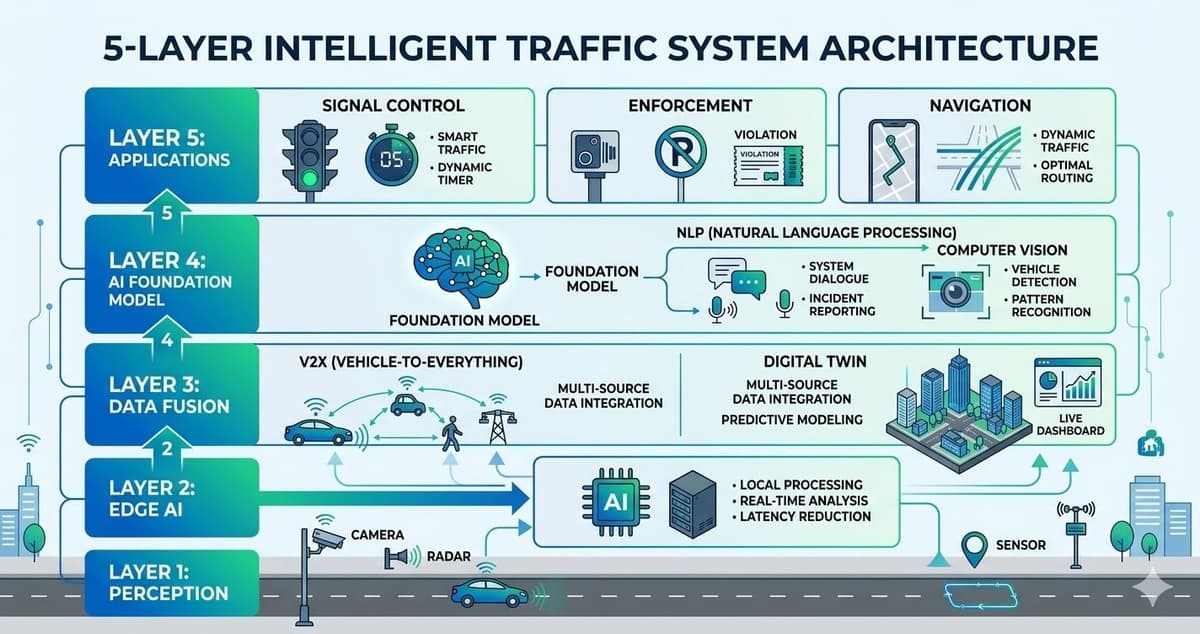
Once the base model is trained, optimization starts. A server-class GPU can process multiple 1080p streams, but roadside systems often need edge inference on NVIDIA Jetson hardware or compact GPU appliances. That is where TAO export, TensorRT conversion, and quantization matter.
FP16 inference is usually the first step because it improves throughput with limited accuracy impact. INT8 can push another 1.5-4x throughput improvement, but only if calibration data matches real traffic scenes. If calibration uses sunny daytime frames only, night detection quality may drop sharply.
For solar-integrated smart traffic poles, power budgeting is part of the AI design. SOLAR TODO applies this in off-grid deployments where solar panels on pole tops and LFP battery storage support 24/7 operation without grid electricity. If the edge stack draws 20-60 W continuously, battery autonomy and panel sizing must be calculated alongside camera, communication, and lighting loads.
Deployment targets by use case
Use latency and throughput targets that match the traffic function:
- Signal control support: below 50 ms/frame preferred
- Violation evidence capture: below 100 ms/frame acceptable if timestamps are synchronized
- Corridor analytics: 5-15 fps often sufficient
- Incident detection: 10-25 fps depending on congestion and speed environment
- UAV-assisted monitoring: tracking quality should be validated separately from fixed-camera mAP
In traffic enforcement, the detector is only one layer. You also need timestamp integrity, plate OCR, speed estimation, evidence storage, and cybersecurity controls. SOLAR TODO smart traffic systems support blockchain-secured evidence chains, zero-trust security, and end-to-end encryption for legal and operational workflows.
According to UL Solutions, safety certification and electrical compliance remain central when AI hardware is installed in field cabinets, poles, and roadside enclosures. For procurement, that means the AI model cannot be separated from enclosure IP rating, thermal management, surge protection, and power architecture.
Traffic Use Cases, Performance Metrics, and Deployment ROI
Real-time traffic detection delivers value when it reduces travel time by 10-30%, cuts stops by up to 40%, or improves emergency response by as much as 50% through better signal and enforcement data.
The business case depends on what the model feeds. If YOLO v8 only counts vehicles, the ROI is limited. If it feeds adaptive signaling, violation capture, queue estimation, and emergency priority, the return is stronger. According to deployment results cited in the smart traffic sector, Pittsburgh achieved about 25% lower travel time and 20% lower emissions with AI signal control, while London reported 10-30% travel time reduction in smart traffic programs.
For developing markets, motorcycle intelligence is often the highest-priority use case. Where two-wheelers account for 60% or more of traffic, a generic vehicle detector is insufficient. You need classes for helmet use, triple riding, overloading, lane intrusion, and wrong-way riding. Existing smart traffic AI benchmarks in this category show helmet non-compliance at 97.7% mAP and 92.7% F1, triple riding above 94%, and wrong-way riding above 95% in defined datasets.
Sample deployment scenario (illustrative)
A 4-intersection pilot with 16 cameras and 1 edge AI unit per intersection may use:
- 4-8 MP cameras at 15-25 fps
- 1 NVIDIA edge compute node per site
- 1 solar-assisted or grid-tied cabinet with 24-48 VDC subsystem
- 30-90 days of pilot data collection
- 3-6 custom violation classes in Phase 1
In this scenario, the KPI set should include mAP50, precision, recall, false positives per 1,000 vehicles, average inference latency, OCR success rate, and evidence export success rate. Procurement teams should ask for threshold settings by class, because a model tuned for 98% recall may produce too many false alerts for legal enforcement.
Comparison of deployment options
| Option | Best For | Latency Target | Capex Level | Notes |
|---|---|---|---|---|
| Cloud inference | Central analytics | 100-300 ms | Medium | Depends on bandwidth and data policy |
| On-prem GPU server | City control center | 50-120 ms | Medium-High | Good for 20-100 camera aggregation |
| Edge Jetson deployment | Intersections and poles | 20-80 ms | Medium | Best for low-latency local response |
| Hybrid edge + cloud | Large city rollout | 20-150 ms | High | Balances evidence retention and analytics |
The International Telecommunication Union emphasizes that trusted digital infrastructure needs cybersecurity, interoperability, and data governance. For traffic AI, that means model KPIs should be reviewed together with retention policy, encryption, and legal evidence handling.
EPC Investment Analysis and Pricing Structure
For traffic AI projects, EPC delivery combines civil works, poles, power systems, cameras, edge computing, communications, testing, and commissioning into one contract with clearer schedule and interface control.
B2B buyers usually compare three commercial models before tender award:
| Commercial Model | What It Includes | Typical Buyer Use |
|---|---|---|
| FOB Supply | Equipment only at export port | Buyers with local installers and integrators |
| CIF Delivered | Equipment plus freight and insurance | Buyers needing import logistics support |
| EPC Turnkey | Design, procurement, installation, testing, commissioning, training | Municipal and corridor projects needing one accountable contractor |
For smart traffic systems using YOLO v8 analytics, EPC scope should clearly list these items:
- Camera poles, cabinets, and mounting hardware
- Solar panels and LFP battery storage where off-grid operation is required
- Edge AI hardware, switches, routers, and backhaul devices
- Civil works, trenching, foundations, and utility interfaces
- Software deployment, model tuning, and user training
- FAT, SAT, and acceptance KPIs for latency, uptime, and detection accuracy
Volume pricing guidance should be discussed early in procurement. A common structure is 5% discount for 50+ units, 10% for 100+ units, and 15% for 250+ units, subject to configuration standardization and delivery schedule. This matters because camera mix, enclosure rating, solar subsystem size, and communications topology can change total cost by more than 20%.
Payment terms for export projects commonly follow 30% T/T in advance and 70% against B/L, or 100% L/C at sight for qualified transactions. Financing is available for large projects above $1,000K, especially where municipal budgets require phased deployment. For commercial discussions, contact [email protected].
ROI should be measured against conventional traffic management costs. If AI detection reduces manual enforcement labor, lowers congestion by 10-25%, and improves incident response by 20-50%, payback often falls in the 2-5 year range for high-volume corridors. SOLAR TODO also supports solar-integrated traffic poles, which can reduce grid dependency and create an additional energy value stream in selected markets.
FAQ
A practical FAQ for YOLO v8 traffic projects should answer at least 10 operational questions covering data, hardware, accuracy, cost, deployment, and maintenance.
Q: What is YOLO v8 in a traffic detection project? A: YOLO v8 is a real-time object detection model used to identify vehicles, motorcycles, bicycles, pedestrians, and violation-related behaviors in video streams. In traffic projects, it is typically trained on 20-45 classes and deployed at intersections, corridors, or enforcement points where latency below 50-100 ms is required.
Q: Why use NVIDIA TAO Toolkit instead of training everything manually? A: NVIDIA TAO Toolkit reduces engineering effort by packaging transfer learning, optimization, and deployment workflows into a more repeatable process. For B2B teams, that can shorten training cycles by 30-50%, reduce configuration errors, and simplify export to TensorRT for NVIDIA edge hardware.
Q: How many images are needed to train a traffic model well? A: A useful starting point is 1,500-3,000 labeled images per important class, with more data for rare violations and night scenes. If the project includes 25 classes, the total dataset often exceeds 40,000-80,000 labeled frames once weather, camera angle, and occlusion diversity are included.
Q: What input resolution should be used for traffic detection? A: Use 640x640 for general vehicle counting when objects are large in frame and latency is critical. Use 1280x1280 when motorcycles, helmets, or distant objects are small, because higher resolution can improve small-object detection by 3-8 mAP points at the cost of more GPU load.
Q: Can YOLO v8 support motorcycle-heavy traffic environments? A: Yes, but the dataset must be designed for that environment from the start. In regions where motorcycles exceed 60% of traffic, classes should include helmet use, triple riding, overloading, wrong-way riding, and lane intrusion rather than only generic vehicle categories.
Q: What hardware is typically used for deployment? A: Deployment usually uses NVIDIA Jetson edge devices for intersections or GPU servers for central control rooms. The right choice depends on camera count, target latency, and power budget, with edge systems often designed around 10-60 W compute loads and server systems sized for 20-100 video streams.
Q: How is model accuracy measured in a traffic tender? A: Accuracy should be measured with mAP, precision, recall, false positives per 1,000 vehicles, and class-wise confusion matrices. For enforcement use, buyers should also request OCR success rate, timestamp integrity, and evidence export reliability, because a high mAP alone does not guarantee legal usability.
Q: How often does the model need retraining after deployment? A: Most projects review model performance every 3-6 months and retrain when camera angles, seasonal lighting, or traffic patterns change materially. A pilot may need 1-2 retraining cycles in the first 90 days, then less frequent updates once data coverage becomes stable.
Q: Can the system run off-grid with solar power? A: Yes, if the full load is calculated correctly across cameras, AI compute, communications, and cabinet auxiliaries. SOLAR TODO supports solar-powered smart traffic poles with LFP battery storage for 24/7 operation, which is useful in rural highways, developing regions, and sites with weak grid access.
Q: What is included in EPC turnkey delivery for a traffic AI project? A: EPC turnkey delivery usually includes design, procurement, civil works, poles, cameras, solar or grid power systems, edge computing, communications, software deployment, testing, and commissioning. It gives the buyer one accountable contractor and is often preferred for city projects above 50 intersections or corridor-scale deployments.
Q: How are pricing and payment terms usually structured? A: Pricing is commonly offered as FOB Supply, CIF Delivered, or EPC Turnkey depending on project scope. Standard export payment terms are often 30% T/T plus 70% against B/L, or 100% L/C at sight, with financing available for projects above $1,000K and volume discounts of 5%, 10%, or 15% at 50, 100, or 250 units.
Q: What standards and compliance items should buyers verify? A: Buyers should verify electrical safety, EMC, communications, evidence security, and AI governance requirements relevant to the target market. Useful references include IEEE interconnection and systems guidance, IEC electrical standards, UL field equipment safety requirements, and NIST AI risk management controls for documented testing and reliability.
References
- NVIDIA (2024): TAO Toolkit documentation for transfer learning, optimization, and deployment of vision AI models on NVIDIA platforms.
- NIST (2023): AI Risk Management Framework 1.0, guidance on trustworthy, reliable, safe, and resilient AI systems.
- IEEE (2024): IEEE guidance and publications on AI governance, data quality, and system verification relevant to operational deployments.
- UL Solutions (2024): Safety and certification guidance for electrical and electronic equipment installed in field and industrial environments.
- International Energy Agency (2023): Digitalization and energy system guidance, including the role of digital tools in efficiency and operational performance.
- International Telecommunication Union (2023): Digital infrastructure and cybersecurity guidance relevant to connected transport systems.
- IEC (2024): International electrotechnical standards framework applicable to electrical equipment, EMC, and field-installed systems.
Conclusion
YOLO v8 with NVIDIA TAO Toolkit is a practical route to traffic AI when datasets exceed 40,000 frames, latency stays below 50-100 ms, and deployment is tied to measurable corridor KPIs such as 10-30% travel-time reduction.
The bottom line is simple: train for site reality, optimize for edge power and latency, and buy the system as an operational package rather than a model file. For municipalities, integrators, and corridor operators, SOLAR TODO can support the full path from pilot training workflow to solar-powered smart traffic deployment and EPC delivery.
About SOLARTODO
SOLARTODO is a global integrated solution provider specializing in solar power generation systems, energy-storage products, smart street-lighting and solar street-lighting, intelligent security & IoT linkage systems, power transmission towers, telecom communication towers, and smart-agriculture solutions for worldwide B2B customers.
About the Author

SOLAR TODO
Solar Energy & Infrastructure Expert Team
SOLAR TODO is a professional supplier of solar energy, energy storage, smart lighting, smart agriculture, security systems, communication towers, and power tower equipment.
Our technical team has over 15 years of experience in renewable energy and infrastructure, providing high-quality products and solutions to B2B customers worldwide.
Expertise: PV system design, energy storage optimization, smart lighting integration, smart agriculture monitoring, security system integration, communication and power tower supply.
Cite This Article
SOLAR TODO. (2026). YOLO v8 for Real-Time Traffic Detection: Model Training…. SOLAR TODO. Retrieved from https://solartodo.com/knowledge/yolo-v8-for-real-time-traffic-detection-model-training-with-nvidia-tao-toolkit-complete-tutorial
@article{solartodo_yolo_v8_for_real_time_traffic_detection_model_training_with_nvidia_tao_toolkit_complete_tutorial,
  title = {YOLO v8 for Real-Time Traffic Detection: Model Training…},
  author = {SOLAR TODO},
  journal = {SOLAR TODO Knowledge Base},
  year = {2026},
  url = {https://solartodo.com/knowledge/yolo-v8-for-real-time-traffic-detection-model-training-with-nvidia-tao-toolkit-complete-tutorial},
  note = {Accessed: 2026-05-02}
}
Published: May 2, 2026 | Available at: https://solartodo.com/knowledge/yolo-v8-for-real-time-traffic-detection-model-training-with-nvidia-tao-toolkit-complete-tutorial
Subscribe to Our Newsletter
Get the latest solar energy news and insights delivered to your inbox.
View All Articles