Cross-Check PVWatts V8 Assumptions Against SAM Battery Setup

Cinn Song
Founder & Chief Solutions Architect
TL;DR
Require a traceability table: PVWatts V8 inputs and outputs on one side, SAM battery configuration and dispatch on the other, plus an explicit coupling note. If the proposal uses a standalone battery case for solar-plus-storage or lacks dispatch evidence, compatibility is unknown.
Use a PV-to-battery traceability table: PVWatts V8 should document PV assumptions and outputs, while SAM should document the battery configuration, financial model, and dispatch method. If the coupling between them is not explicit, compatibility is unknown.
Summary
Use a PV-to-battery traceability table: PVWatts V8 should document PV assumptions and outputs, while SAM should document the battery configuration, financial model, and dispatch method. If the coupling between them is not explicit, compatibility is unknown.
Key Takeaways
- PVWatts V8 supports photovoltaic production assumptions and outputs; it is not evidence for battery chemistry, dispatch, degradation, or financial configuration.
- For solar-plus-storage, the SAM battery case should be a compatible generation-plus-battery configuration, not an unexplained standalone battery case.
- If PVWatts V8 bifacial modeling is cited, the proposal should show bifaciality and albedo assumptions actually used.
- BTM and FOM storage cases should not be mixed: SAM ties distributed financial models to bill reduction and PPA/Merchant Plant models to revenue sales.
- Storage dispatch claims need dispatch evidence; monthly PV outputs alone do not prove charge/discharge behavior.
- When coupling evidence is missing, mark the result unknown and request the model trace rather than inferring performance or savings.
Recommended Cross-Check: A PV-to-Battery Assumption Traceability Table
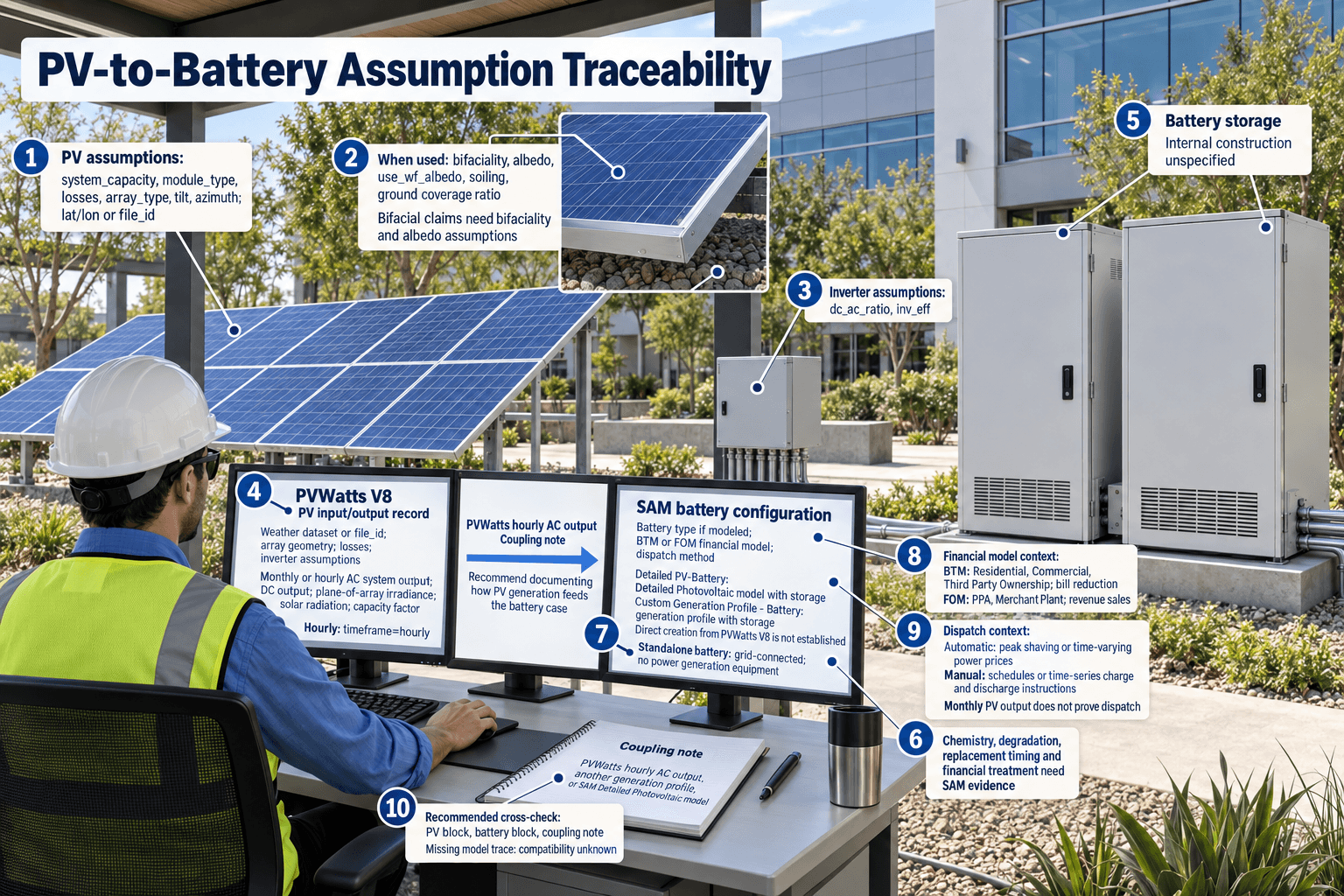
A solar-plus-storage proposal should include a cross-check table that traces the photovoltaic production case separately from the storage case, then verifies that the two are connected through a compatible SAM battery configuration. PVWatts V8 is a photovoltaic production model exposed through the PVWatts API; its outputs include monthly or hourly AC system output, DC output, plane-of-array irradiance, solar radiation, and capacity factor, depending on the requested timeframe (https://developer.nlr.gov/docs/solar/pvwatts/v8/). SAM’s battery documentation describes battery storage configurations that either add storage to a power generation model, use a custom generation profile with storage, or model a standalone grid-connected battery with no generation equipment (https://samrepo.nlr.gov/help/battery_storage.html).
The central check is simple: confirm that the proposal has not treated PVWatts V8 photovoltaic inputs as if they define the SAM battery model. PVWatts V8 inputs can describe PV-side assumptions such as system capacity, module type, losses, array type, tilt, azimuth, weather data, DC-to-AC ratio, inverter efficiency, ground coverage ratio, bifaciality, albedo, and soiling (https://developer.nlr.gov/docs/solar/pvwatts/v8/). Those inputs do not, by themselves, establish battery chemistry, dispatch method, behind-the-meter use, front-of-meter use, degradation, replacement timing, or battery financial treatment; those items belong to the SAM battery configuration evidence (https://samrepo.nlr.gov/help/battery_storage.html).
What The Cross-Check Should Verify
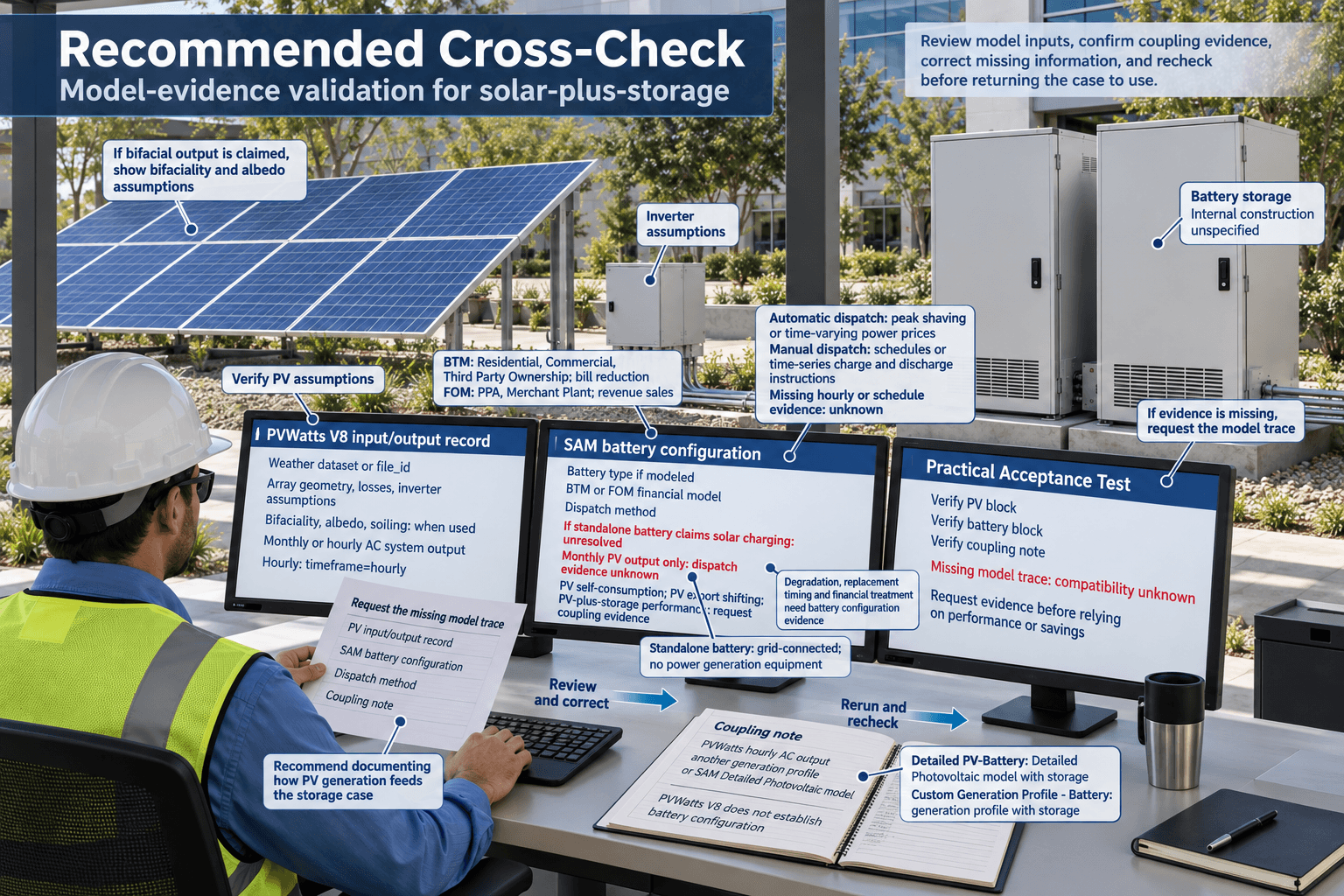
First, verify the PV model boundary. If the proposal says it used PVWatts V8, the cited PV case should show the actual PVWatts V8 assumptions: required parameters such as system_capacity, module_type, losses, array_type, tilt, azimuth, and either lat/lon or file_id; optional PV-side parameters such as dc_ac_ratio, inv_eff, bifaciality, albedo, use_wf_albedo, and soiling should be listed only when used (https://developer.nlr.gov/docs/solar/pvwatts/v8/). If bifacial output is claimed, the proposal should show the bifaciality and albedo assumptions because PVWatts V8 added a bifacial module option and albedo-related inputs (https://developer.nlr.gov/docs/solar/pvwatts/v8/).
Second, verify the battery model boundary. If the storage system is paired with PV, SAM’s documented configurations indicate that “Detailed PV-Battery” adds battery storage to the Detailed Photovoltaic model, while “Custom Generation Profile - Battery” adds storage to a custom generation profile that can represent any type of generating system (https://samrepo.nlr.gov/help/battery_storage.html). A proposal using PVWatts V8 output as an external PV generation profile should therefore recommend documenting how the PVWatts output was passed into a compatible storage workflow; the supplied sources do not prove that PVWatts V8 directly creates a SAM Detailed PV-Battery case.
Third, confirm that the proposal did not use SAM’s standalone battery configuration for a solar-plus-storage claim. SAM describes “Standalone battery” as a grid-connected battery with no power generation equipment (https://samrepo.nlr.gov/help/battery_storage.html). If a document claims solar charging, PV self-consumption, PV export shifting, or PV-plus-storage performance while the storage case is labeled standalone battery, that mismatch should be treated as unresolved unless the proposal separately documents how PV generation was modeled and coupled.
BTM, FOM, And Dispatch Consistency
The same table should check whether the financial model matches the commercial use case. SAM says distributed financial models, including Residential, Commercial, and Third Party Ownership, are for behind-the-meter storage where system power reduces a customer’s electricity bill (https://samrepo.nlr.gov/help/battery_storage.html). SAM also says PPA and Merchant Plant financial models are for front-of-meter storage where power is sold to generate revenue (https://samrepo.nlr.gov/help/battery_storage.html). A B2B proposal should therefore recommend confirming whether the project is bill-reduction BTM or revenue-oriented FOM before accepting battery dispatch and economics.
Dispatch should be checked separately from PV yield. SAM has automatic dispatch controller options for peak shaving or applications that respond to time-varying power prices, and it also has manual dispatch options where the user provides schedules or time-series charge and discharge instructions (https://samrepo.nlr.gov/help/battery_storage.html). PVWatts V8 can provide monthly or hourly photovoltaic output; hourly outputs are available only when timeframe=hourly and include hourly AC system output and related irradiance and weather fields (https://developer.nlr.gov/docs/solar/pvwatts/v8/). If a proposal claims storage dispatch behavior but only cites monthly PVWatts outputs, the missing hourly or schedule evidence should be marked unknown rather than inferred.
Practical Acceptance Test
A useful acceptance test is to require two named model blocks plus one coupling note. The PV block should identify PVWatts V8, its weather dataset or file_id basis, array geometry, losses, inverter assumptions, and any bifacial, albedo, or soiling inputs actually used (https://developer.nlr.gov/docs/solar/pvwatts/v8/). The battery block should identify the SAM battery configuration, battery type if modeled, BTM or FOM financial model, and dispatch method (https://samrepo.nlr.gov/help/battery_storage.html). The coupling note should state whether PVWatts hourly AC output, another generation profile, or a SAM Detailed Photovoltaic model feeds the battery case.
If any of those blocks are absent, the proposal may still be a useful early concept, but the compatibility evidence is unknown. The recommendation is not to reject the project automatically; it is to request the missing model trace before relying on solar-plus-storage performance, savings, replacement timing, or dispatch claims.
FAQ
What is the main cross-check?
Confirm that PVWatts V8 PV assumptions are documented separately from the SAM battery configuration, then verify how the PV output is coupled to the battery model.
Can PVWatts V8 define the battery configuration?
No. The supplied PVWatts V8 source documents PV inputs and outputs, while the SAM source documents battery configurations and dispatch.
What SAM configuration is questionable for solar-plus-storage?
A standalone battery case is questionable if the proposal claims solar-plus-storage behavior, because SAM describes standalone battery as grid-connected storage with no power generation equipment.
What PVWatts V8 inputs should be checked?
Check system capacity, module type, losses, array type, tilt, azimuth, location or file_id, and any used optional inputs such as DC-to-AC ratio, inverter efficiency, bifaciality, albedo, and soiling.
Why does timeframe matter?
PVWatts V8 monthly output may support yield summaries, but dispatch analysis often needs hourly output or a separate schedule; missing dispatch evidence should be treated as unknown.
How should BTM and FOM be checked?
Confirm that the SAM financial model matches the use case: distributed models for behind-the-meter bill reduction, and PPA or Merchant Plant models for front-of-meter revenue.
Can savings be inferred from these sources?
No. These sources support modeling boundaries and inputs, not project-specific prices, savings, stock, certifications, or SOLARTODO product performance.
What should buyers request if evidence is missing?
Request the PVWatts V8 input/output record, the SAM battery configuration, the dispatch method, and a note explaining how PV generation feeds the storage case.
Procurement paths
About the Author

Cinn Song
Founder & Chief Solutions Architect
Cinn Song founded SOLARTODO LIMITED and leads its smart-city infrastructure engineering — from solar, storage and integrated smart poles to the company's push into physical-AI city edge nodes: pole-mounted edge computing, vertical LLMs for smart cities, drone-based O&M with autonomous battery swapping, robotic maintenance, and high-speed counter-UAS interception. Since 2010, he has directed turnkey EPC + BOT delivery across 50+ countries, including telecom monopole supply for national grid operators, off-grid solar street-lighting for African municipalities, and integrated smart-pole programs for Gulf smart cities.
Cite This Article
Cinn Song. (2026). Cross-Check PVWatts V8 Assumptions Against SAM Battery Setup. SOLARTODO. Retrieved from https://solartodo.com/knowledge/what-cross-check-should-confirm-that-a-solar-plus-storage-proposal-has-not-mixed-pvwatts-v8-photovoltaic-assumptions
@article{solartodo_what_cross_check_should_confirm_that_a_solar_plus_storage_proposal_has_not_mixed_pvwatts_v8_photovoltaic_assumptions,
  title = {Cross-Check PVWatts V8 Assumptions Against SAM Battery Setup},
  author = {Cinn Song},
  journal = {SOLARTODO Knowledge Base},
  year = {2026},
  url = {https://solartodo.com/knowledge/what-cross-check-should-confirm-that-a-solar-plus-storage-proposal-has-not-mixed-pvwatts-v8-photovoltaic-assumptions},
  note = {Accessed: 2026-09-28}
}
Published: September 28, 2026 | Available at: https://solartodo.com/knowledge/what-cross-check-should-confirm-that-a-solar-plus-storage-proposal-has-not-mixed-pvwatts-v8-photovoltaic-assumptions
Subscribe to Our Newsletter
Get the latest solar energy news and insights delivered to your inbox.
View All Articles