Acceptance Tests for Energy-Efficient Exterior Luminaires

Cinn Song
Founder & Chief Solutions Architect
TL;DR
Check covered category, ENERGY STAR or FEMP status, correct LER threshold, recognized test evidence, and written exceptions at contract award; do not infer SOLARTODO qualification from general DOE/FEMP guidance.
Acceptance testing should verify covered exterior-luminaire scope, ENERGY STAR or FEMP status at contract award, the correct FEMP LER threshold, recognized test evidence, and any written exception. The supplied sources support U.S. federal procurement requirements only; other buyers may use them as recommended criteria if adopted by contract.
Key Takeaways
- For U.S. federal acquisitions, qualification should be checked at contract award for delivered, contractor-acquired, government-furnished, and design-specified energy-consuming products.
- Exterior-lighting acceptance starts by confirming that the luminaire is in a FEMP-covered category; excluded luminaires should not be forced into the exterior-lighting table.
- A generic LED description is not enough; the product should meet the applicable ENERGY STAR or FEMP-designated requirement for its category.
- FEMP’s June 2023 exterior-lighting guidance gives category-specific LER minimums, so acceptance should test the correct luminaire class rather than one blended threshold.
- Recognized evidence may include performance data determined under IES LM-50-13, LM-79-08, and LM-80-08 where relevant to the product and claim.
- If qualification cannot be met, the supported path is a written exception based on unavailable compliant products or lack of life-cycle cost-effectiveness for the specific application.
Summary
For U.S. federal exterior-lighting acquisitions, acceptance at contract award should verify that each covered exterior luminaire is an energy-efficient product when it is delivered, acquired by the contractor for services at a federally controlled facility, furnished for government use, or specified in a building/work design or incorporated during construction, renovation, or maintenance. This scope comes from DOE/FEMP contract-language guidance for energy-consuming products. Source: https://www.energy.gov/cmei/femp/contract-language-energy-consuming-product-purchases
1. Confirm the Contract and Product Scope
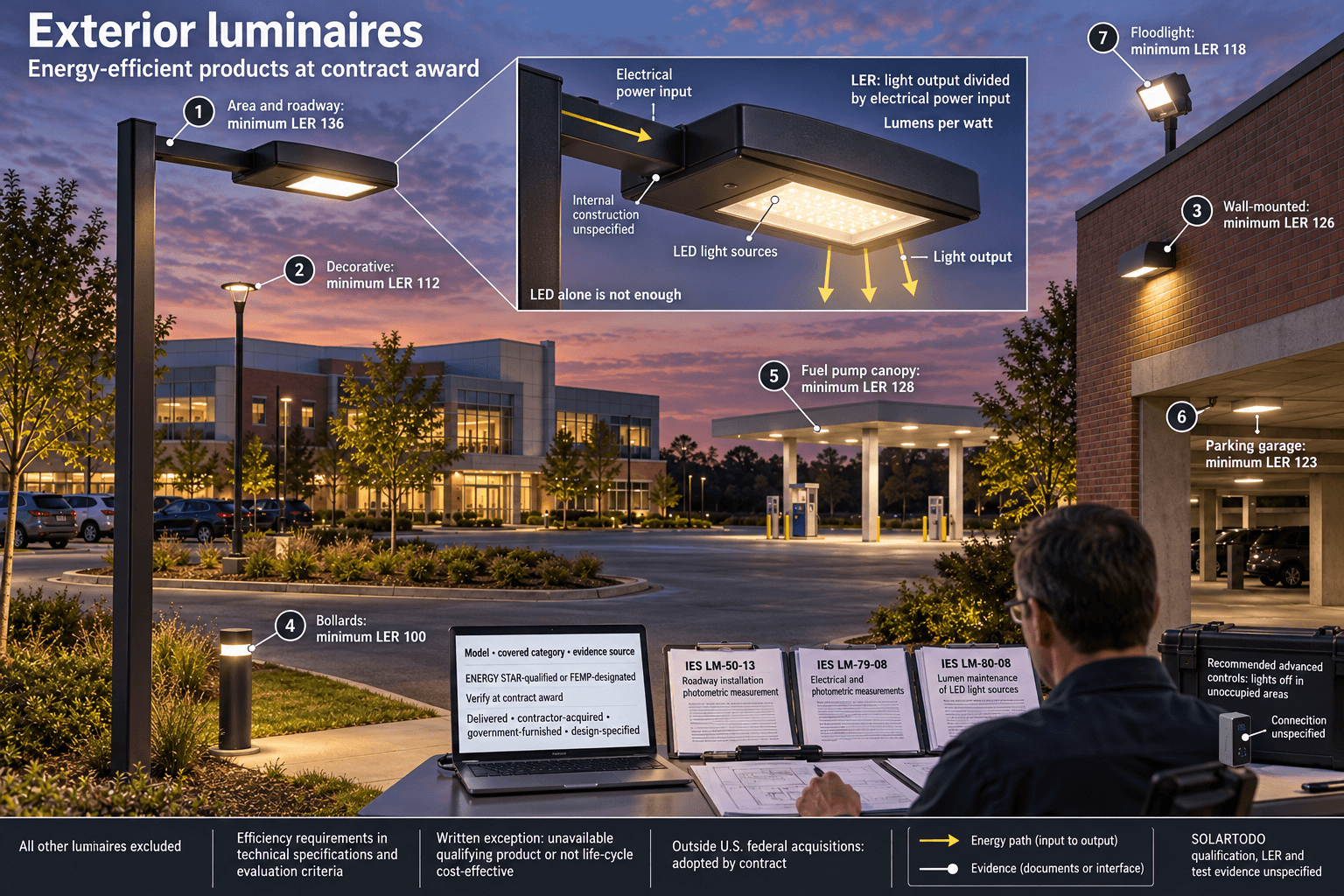
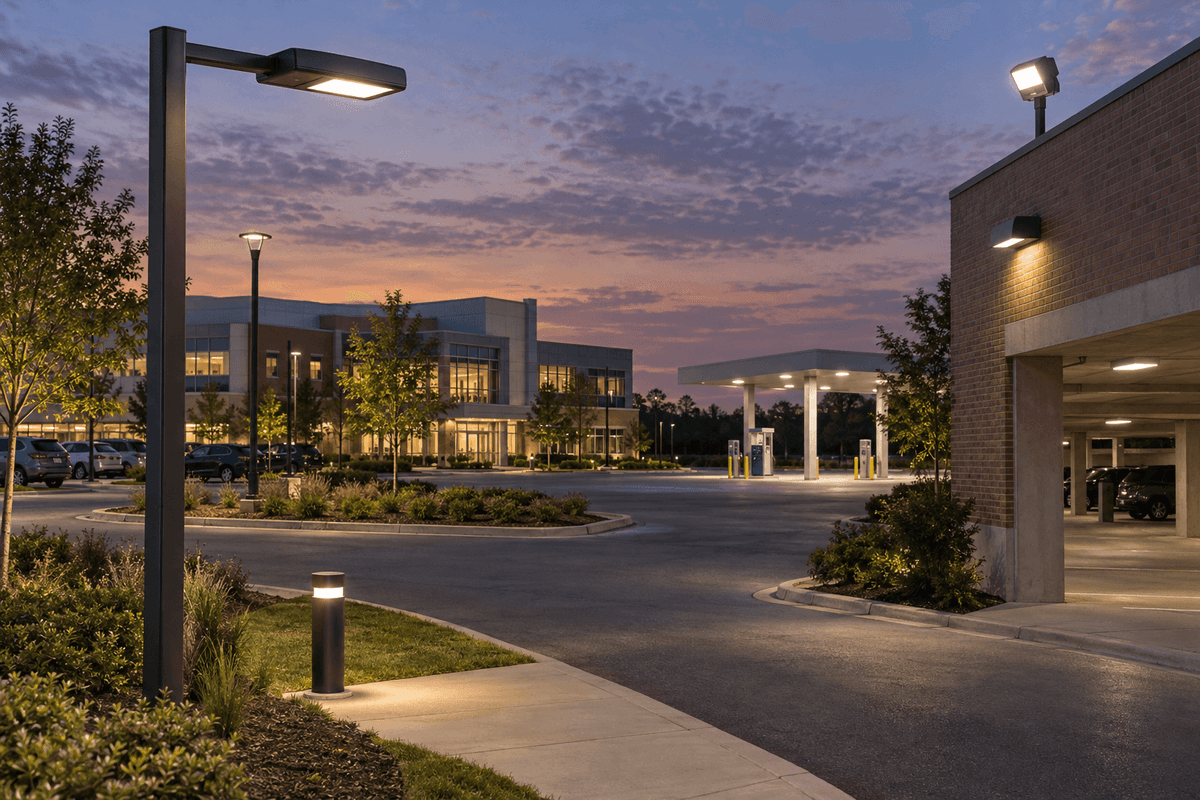
The first acceptance test should confirm whether the item is within the FEMP exterior-lighting category. FEMP’s June 2023 exterior-lighting guidance covers outdoor wall-mounted luminaires, outdoor pole/arm-mounted area and roadway luminaires, outdoor pole/arm-mounted decorative luminaires, fuel pump canopy luminaires, bollards, parking garage luminaires, and floodlight luminaires; all other luminaires are excluded. Source: https://www.energy.gov/cmei/femp/purchasing-energy-efficient-exterior-lighting
For U.S. federal agencies, the purchasing requirement applies to ENERGY STAR-qualified or FEMP-designated products in covered categories unless an acquisition is specifically exempted by law. FEMP states that these requirements apply across procurement forms including construction specifications, renovation, repair, energy-service and O&M contracts, lease agreements, purchase-card acquisitions, and solicitations for offers. Source: https://www.energy.gov/cmei/femp/purchasing-energy-efficient-exterior-lighting
For non-U.S. buyers, these U.S. federal requirements should not be treated as mandatory unless the contract adopts them. They can still be used as recommended acceptance criteria if the buyer wants a documented energy-efficiency gate.
2. Test Energy-Efficient Status at Contract Award
The acceptance file should verify energy-efficient status at the time of contract award, not only at submittal or delivery. DOE’s contract-language source says the contractor must ensure energy-consuming products are energy-efficient products at contract award for products that are delivered, acquired by the contractor for use in services at a federally controlled facility, furnished for government use, or specified in the design of a building or work or incorporated during construction, renovation, or maintenance. Source: https://www.energy.gov/cmei/femp/contract-language-energy-consuming-product-purchases
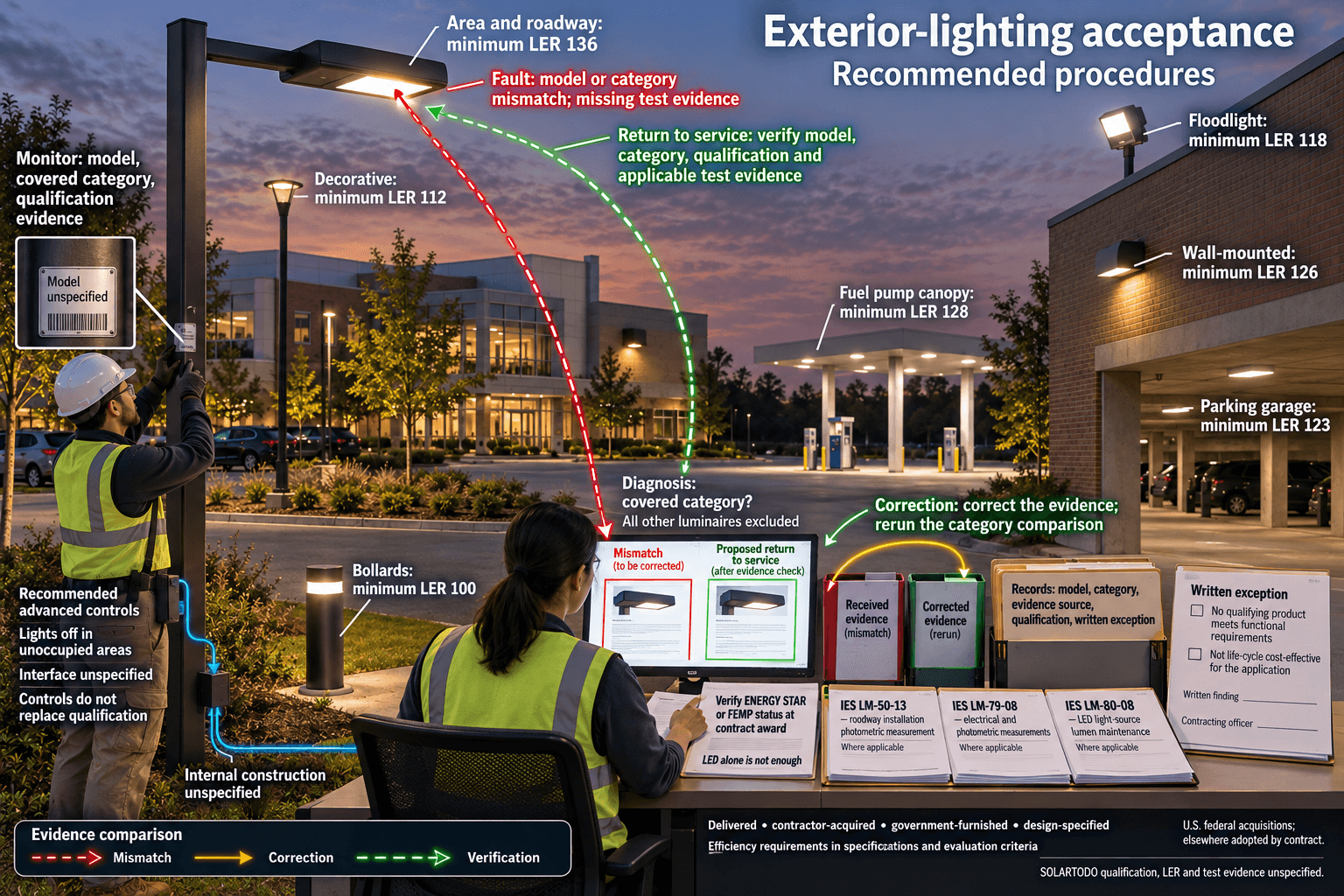
A practical acceptance record should identify the luminaire model, covered category, evidence source used for qualification, and whether the product is ENERGY STAR-qualified or FEMP-designated. If the product is not listed in ENERGY STAR or FEMP, or if the contracting officer approves another path in writing, that exception should be kept with the procurement record. Source: https://www.energy.gov/cmei/femp/contract-language-energy-consuming-product-purchases
3. Verify Exterior-Lighting Efficiency Thresholds
For FEMP-designated exterior lighting, acceptance should compare the luminaire efficacy rating, or LER, against the applicable FEMP minimum. FEMP defines LER as light output divided by electrical power input, measured in lumens per watt, where a higher value indicates more light output per unit of power input. Source: https://www.energy.gov/cmei/femp/purchasing-energy-efficient-exterior-lighting
The documented minimums in the June 2023 guidance are: fuel pump canopy luminaires at least 128 LER; parking garage luminaires at least 123; outdoor pole/arm-mounted area and roadway luminaires at least 136; outdoor pole/arm-mounted decorative luminaires at least 112; outdoor wall-mounted luminaires at least 126; bollards at least 100; and floodlight luminaires at least 118. Source: https://www.energy.gov/cmei/femp/purchasing-energy-efficient-exterior-lighting
Acceptance should reject a generic “LED” claim by itself. FEMP notes that only solid-state or LED exterior lighting is considered FEMP-designated in the buyer-tips section, but qualification still depends on the covered category and the required efficiency level. Source: https://www.energy.gov/cmei/femp/purchasing-energy-efficient-exterior-lighting
4. Check Test Evidence and Exceptions
The acceptance package should request product-performance evidence tied to recognized test methods. FEMP states that product performance is determined according to industry-recognized standards including IES LM-50-13 for roadway and street-lighting installation photometric measurement, IES LM-79-08 for electrical and photometric measurements of solid-state lighting products, and IES LM-80-08 for lumen maintenance of LED light sources. Source: https://www.energy.gov/cmei/femp/purchasing-energy-efficient-exterior-lighting
If the buyer claims an exception to U.S. federal purchasing requirements, FEMP says agencies may do so through a written finding that no FEMP-designated or ENERGY STAR-qualified product is available to meet functional requirements, or that no such product is life-cycle cost-effective for the specific application. Source: https://www.energy.gov/cmei/femp/purchasing-energy-efficient-exterior-lighting
Advanced controls should be reviewed as a recommended project feature, not as a replacement for qualifying the luminaire. FEMP says exterior luminaires with advanced controls can save additional energy and operating cost beyond luminaire efficiency alone, and that automatic controls can turn lights off in unoccupied areas more reliably than occupants. Source: https://www.energy.gov/cmei/femp/purchasing-energy-efficient-exterior-lighting
5. Recommended Acceptance Checklist
Recommended tests are: classify the luminaire into a covered FEMP exterior-lighting category; confirm the procurement action is one where the contract requires qualifying energy-consuming products; verify ENERGY STAR or FEMP status at contract award; compare LER against the correct category threshold; keep LM-50-13, LM-79-08, LM-80-08, or equivalent recognized test evidence where applicable; record any written exception; and ensure the technical specification and evaluation criteria include the efficiency requirement. FEMP recommends incorporating efficiency requirements into technical specifications, solicitation evaluation criteria, and evaluations of solicitation responses. Source: https://www.energy.gov/cmei/femp/purchasing-energy-efficient-exterior-lighting
Unknowns should remain explicit. The supplied documents do not prove that any SOLARTODO exterior luminaire meets FEMP or ENERGY STAR requirements, has a specific LER, has been tested under the listed IES methods, is in stock, has a price advantage, or will deliver a quantified saving in a particular project.
FAQ
What is the core acceptance test for exterior luminaires?
Confirm the luminaire is ENERGY STAR-qualified or FEMP-designated at contract award, if it is in a covered category and no documented exception applies.
Does this requirement apply worldwide?
No. The supplied documents describe U.S. federal purchasing requirements. Outside that context, buyers may adopt the criteria by contract, but the sources do not make them mandatory elsewhere.
Which exterior luminaire categories are covered?
The June 2023 FEMP guidance covers wall-mounted, pole or arm-mounted area and roadway, decorative, fuel pump canopy, bollard, parking garage, and floodlight luminaires.
What metric should be checked?
For FEMP-designated exterior lighting, check luminaire efficacy rating, or LER, measured in lumens per watt, against the category-specific minimum.
Is being an LED enough for acceptance?
No. The product still needs evidence that it meets the applicable ENERGY STAR or FEMP-designated requirement for the covered category.
Which test standards are named by FEMP?
FEMP names IES LM-50-13, IES LM-79-08, and IES LM-80-08 as industry-recognized standards relevant to exterior-lighting performance evidence.
Can a buyer accept a nonqualifying product?
For the U.S. federal context described by FEMP, an exception requires a written finding that no qualifying product meets functional requirements or that no qualifying product is life-cycle cost-effective for the specific application.
Do the sources prove any SOLARTODO model qualifies?
No. The supplied sources do not contain SOLARTODO model test reports, LER values, ENERGY STAR listings, FEMP designations, prices, stock, deployments, or certifications.
About the Author

Cinn Song
Founder & Chief Solutions Architect
Cinn Song founded SOLARTODO LIMITED and leads its smart-city infrastructure engineering — from solar, storage and integrated smart poles to the company's push into physical-AI city edge nodes: pole-mounted edge computing, vertical LLMs for smart cities, drone-based O&M with autonomous battery swapping, robotic maintenance, and high-speed counter-UAS interception. Since 2010, he has directed turnkey EPC + BOT delivery across 50+ countries, including telecom monopole supply for national grid operators, off-grid solar street-lighting for African municipalities, and integrated smart-pole programs for Gulf smart cities.
Cite This Article
Cinn Song. (2026). Acceptance Tests for Energy-Efficient Exterior Luminaires. SOLARTODO. Retrieved from https://solartodo.com/knowledge/what-acceptance-tests-should-confirm-that-delivered-contractor-acquired-government-furnished-or-design-specified
@article{solartodo_what_acceptance_tests_should_confirm_that_delivered_contractor_acquired_government_furnished_or_design_specified,
  title = {Acceptance Tests for Energy-Efficient Exterior Luminaires},
  author = {Cinn Song},
  journal = {SOLARTODO Knowledge Base},
  year = {2026},
  url = {https://solartodo.com/knowledge/what-acceptance-tests-should-confirm-that-delivered-contractor-acquired-government-furnished-or-design-specified},
  note = {Accessed: 2026-10-10}
}
Published: October 10, 2026 | Available at: https://solartodo.com/knowledge/what-acceptance-tests-should-confirm-that-delivered-contractor-acquired-government-furnished-or-design-specified
Subscribe to Our Newsletter
Get the latest solar energy news and insights delivered to your inbox.
View All Articles