V2X-Enabled Smart Intersections: C-V2X Protocol…

SOLAR TODO
Solar Energy & Infrastructure Expert Team
Watch the video
TL;DR
C-V2X-enabled smart intersections improve signal operations by combining direct vehicle communication, edge AI sensing, and standards-based controller integration. For agencies targeting 10-30% travel-time reduction, 40% fewer stops, and up to 50% faster emergency response, the best path is a 3-5 intersection pilot, then corridor scaling with clear EPC pricing, cybersecurity, and optional solar plus LFP backup.
C-V2X smart intersections use PC5, edge control, and optional solar plus LFP storage to cut stops by up to 40% and emergency response time by up to 50%, with phased rollout from 3-5 pilot sites to 50-100 corridor intersections.
Summary
C-V2X smart intersections combine PC5 sidelink, 5G backhaul, and edge control to cut corridor stops by up to 40% and emergency response time by up to 50%, while supporting 98% license plate recognition and phased deployment from 3-5 to 100+ intersections.
Key Takeaways
- Start with a 3-5 intersection pilot over 1-3 months to validate SPaT, MAP, and priority logic before scaling to 50-100 intersections.
- Specify C-V2X radios that support direct PC5 communication with sub-100 ms message handling for safety-critical intersection movement alerts.
- Use edge AI detection with 45+ object classes and 98% license plate recognition to improve mixed-traffic visibility at urban junctions.
- Prioritize motorcycle and e-bike detection where two-wheelers exceed 60% of traffic, and apply wrong-way and lane-intrusion rules above 93% detection accuracy.
- Design power autonomy with solar generation plus LFP battery storage for 24/7 operation at off-grid or weak-grid intersections.
- Compare FOB, CIF, and EPC delivery early; apply volume discounts of 5% at 50+ units, 10% at 100+, and 15% at 250+.
- Target ROI by combining travel-time reduction of 10-30%, green-wave stop reduction of 40%, and lower field maintenance through remote monitoring.
- Verify compliance against IEEE 1609, SAE J2735, IEEE 802.11/3GPP interface requirements, IEC electrical safety practices, and cybersecurity controls before acceptance.
Why C-V2X-Enabled Smart Intersections Matter
C-V2X-enabled smart intersections can reduce corridor stops by up to 40% and emergency response time by up to 50% when SPaT, MAP, and signal priority are implemented with edge control and reliable backhaul.
Traffic engineers are being asked to manage more vehicles, more vulnerable road users, and tighter response-time targets with the same civil footprint. At many junctions, detector latency above 300 ms and cabinet-only logic limit what adaptive control can do. C-V2X adds direct vehicle-to-infrastructure messaging, so the intersection can broadcast timing and geometry data within a safety workflow rather than relying only on loops or video calls to the controller.
For B2B buyers, the value is operational, not theoretical. According to the deployment results cited in the product knowledge, London reported 10-30% travel-time reduction, Pittsburgh reported 25% lower travel time and 20% lower emissions, and green-wave coordination can reduce stops by 40%. Those numbers matter when agencies are comparing capex against delay, fuel, and enforcement outcomes over a 5-10 year asset life.
SOLAR TODO approaches this category from both traffic and energy infrastructure. That matters in regions where intersections face unstable grid supply, high diesel OPEX, or rural expansion. A smart pole or roadside unit with solar generation and LFP battery storage can keep RSUs, cameras, controllers, and communications online for 24/7 service without depending on a continuous utility feed.
The International Energy Agency states, "Digitalisation can make transport systems safer, more efficient and more sustainable." For traffic engineers, C-V2X is one of the practical field tools behind that statement because it converts signal timing, detector status, and priority requests into machine-readable messages that vehicles and edge applications can act on in milliseconds.
C-V2X Protocol Architecture and Intersection Design
A practical C-V2X intersection uses PC5 direct communication for low-latency safety messages, Uu cellular links for cloud or TMC services, and edge processing that keeps local signal decisions running even if backhaul latency rises above 100 ms.
At implementation level, traffic engineers should separate the stack into four layers: roadside sensing, roadside communications, signal control, and central management. The roadside sensing layer can include AI cameras, radar, loops, or magnetometers. The communications layer carries C-V2X messages through a roadside unit, while the control layer converts those messages into controller actions such as phase extension, transit priority, or red-light violation evidence capture.
Core message sets and field functions
The minimum C-V2X message set for a smart intersection usually includes SPaT, MAP, BSM-related awareness, and priority or preemption requests. SPaT tells vehicles the current signal phase and remaining time. MAP describes lane geometry, stop bars, and movement permissions. Together, those two data objects support red-light warning, eco-approach, queue warning, and protected-turn assistance.
SAE International notes in its connected vehicle standards work that common message definitions are necessary for interoperability across OEMs and infrastructure vendors. In field terms, that means a junction designed around proprietary payloads will create integration cost later. Traffic engineers should require message dictionaries aligned with SAE J2735 and interface behavior aligned with the relevant 3GPP and IEEE frameworks used by the selected RSU platform.
Recommended intersection hardware stack
A typical smart intersection hardware stack includes:
- 1 roadside unit with C-V2X PC5 and cellular backhaul
- 1 traffic signal controller interface, often via NTCIP or vendor API
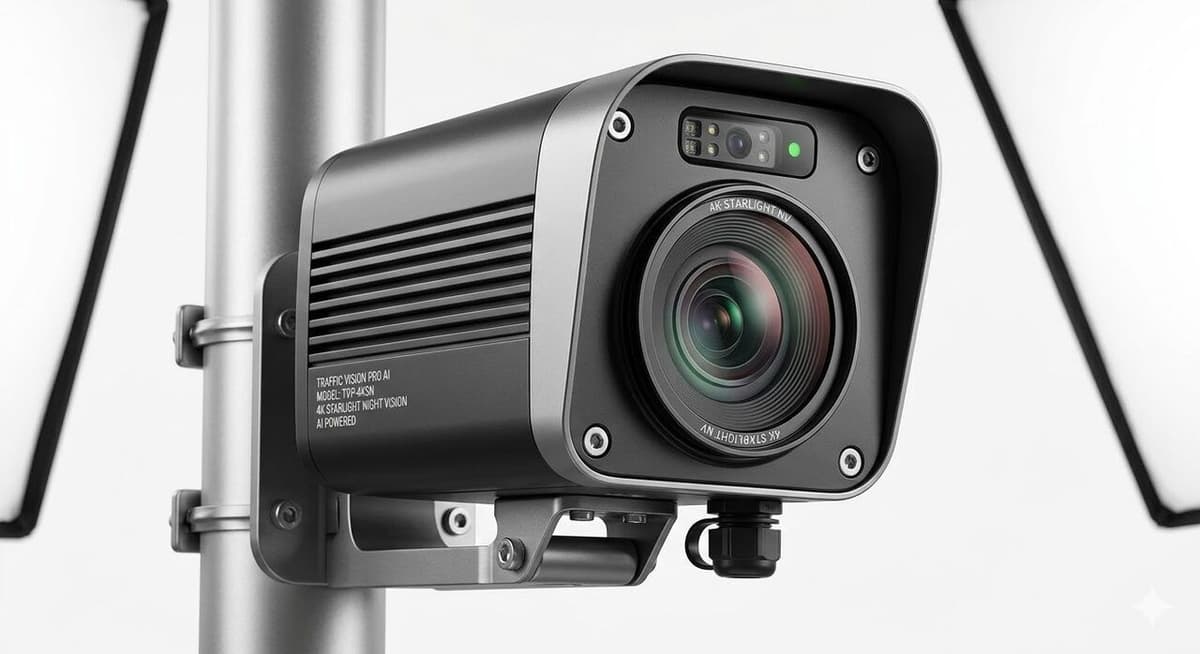
- 2-8 AI cameras depending on leg count and turning complexity
- 1 edge compute unit for local analytics and message fusion
- 1 GNSS timing source or equivalent precision timing reference
- 1 UPS or solar plus LFP battery system sized for 24-hour autonomy
For mixed traffic, camera analytics remain important even after V2X is added. Not every vehicle will be connected in the first 3-5 years of deployment. SOLAR TODO's smart traffic platform supports AI detection across 45+ classes, including pedestrian, wheelchair user, motorcycle, e-bike, bus, truck, and emergency vehicle. That is useful in markets where two-wheelers exceed 60% of traffic and where wrong-way riding or helmet non-compliance must be detected alongside signal operations.
Latency, reliability, and cybersecurity targets
For traffic engineering practice, the design target is not just bandwidth; it is deterministic behavior. Safety messages should be processed locally with sub-100 ms application handling where feasible, while non-critical video uploads can tolerate seconds. If the backhaul drops, the intersection should continue local SPaT broadcast, local detection, and controller coordination using fail-safe timing plans.
Cybersecurity must be specified early. SOLAR TODO supports zero-trust security with end-to-end encryption and a blockchain-secured evidence chain for legal enforcement workflows. That does not replace agency PKI policy, but it helps traffic departments separate safety messaging, enforcement evidence, and maintenance access. Engineers should also define certificate rotation, device identity, and remote firmware procedures before FAT and SAT.
Implementation Workflow for Traffic Engineers
A field-ready C-V2X rollout should move from a 1-3 month pilot at 3-5 intersections to a 3-9 month corridor phase at 50-100 intersections, then to city-wide orchestration over 9-18 months.
The first engineering task is corridor selection. Choose intersections with measurable delay, queue spillback, emergency routes, or a high share of motorcycles, buses, or freight. A pilot should include at least 1 complex four-leg junction, 1 transit-influenced junction, and 1 site with weak-grid or off-grid constraints if resilience is part of the business case.
Step 1: Site survey and communications audit
Survey pole loading, cabinet space, line of sight, existing detector health, and available power. Record RF conditions, fiber availability, and cellular signal quality. For solar-powered designs, calculate daily load in Wh and battery autonomy in hours. A typical edge stack with RSU, cameras, and compute may require careful energy budgeting because 24-hour uptime is a hard operational requirement.
Step 2: Controller integration and message mapping
Map SPaT and MAP outputs from the signal controller to the RSU. Validate phase numbering, overlap behavior, pedestrian calls, transit priority logic, and preemption states. If the controller uses NTCIP objects, document every object ID and update interval. If a vendor API is used, define polling frequency and fallback behavior during packet loss above 1-2%.
Step 3: Edge sensing and conflict-zone logic
Configure AI detection zones for stop lines, crosswalks, bike boxes, bus lanes, and conflict areas. Use a fusion rule set so that a missed V2X message does not remove situational awareness from non-connected users. This is where SOLAR TODO's 45+ object classes are useful, especially for developing markets where motorcycles and e-bikes dominate approach behavior.
Step 4: Test scenarios and acceptance criteria
Acceptance testing should include:
- SPaT timing accuracy against controller state
- MAP lane geometry verification by survey
- Emergency vehicle priority request and release behavior
- Transit signal priority under peak and off-peak plans
- Wrong-way and red-light event capture with timestamp integrity
- Backhaul-loss failover and local autonomous operation
- Power autonomy under 24-hour battery-only simulation
According to IEEE, interoperability and conformance are essential for connected transportation systems because multi-vendor field environments are the norm, not the exception. Engineers should therefore require FAT in the factory, SAT on site, and a burn-in period of 14-30 days before final handover.
Applications, Performance Metrics, and Selection Guide
Smart intersections deliver the strongest ROI when agencies target 10-30% travel-time reduction, 20% emissions reduction, and measurable safety gains on corridors with recurring queues, transit delay, or high two-wheeler conflict rates.
The most common applications are signal priority, safety warning, enforcement support, and corridor optimization. Emergency vehicle preemption can cut response time by up to 50%. Green-wave coordination can reduce stops by 40%. In urban centers, digital twin integration can improve timing plan validation before field deployment. In rural or peri-urban corridors, solar-powered intersections reduce dependence on unstable feeders and diesel maintenance runs.
Sample deployment scenario (illustrative)
A 20-intersection corridor with 4 approaches per intersection deploys 20 RSUs, 80-120 cameras, and 20 edge controllers. If average delay falls by 12-18 seconds per vehicle and daily volume is 25,000 vehicles, the annual time-value benefit can exceed the communications OPEX by a large margin, even before safety and fuel savings are added. This type of calculation is what procurement teams need during capex review.
Comparison table: deployment options
| Item | Conventional Adaptive Intersection | C-V2X Smart Intersection | Solar-Powered C-V2X Smart Intersection |
|---|---|---|---|
| Vehicle communication | Detector only | PC5 + cellular backhaul | PC5 + cellular backhaul |
| Typical latency path | 200-500 ms detector-to-center | Local edge under 100 ms for critical logic | Local edge under 100 ms for critical logic |
| Power dependency | Grid only | Grid with UPS | Solar + LFP battery + optional grid |
| Vulnerable road user visibility | Medium, depends on sensors | High with AI + V2X alerts | High with AI + V2X alerts |
| Off-grid suitability | Low | Medium | High |
| Expansion path | Cabinet upgrades | RSU + edge + controller integration | RSU + edge + controller + solar storage |
| Best use case | Stable urban grid, basic adaptation | Urban corridors, transit, emergency routes | Rural highways, weak-grid cities, new developments |
Selection criteria for procurement teams
Use these filters during vendor comparison:
- Message support: SPaT, MAP, priority, event logging
- Integration: controller compatibility, NTCIP support, API documentation
- Detection: 45+ object classes, night performance, weather tolerance
- Security: device identity, encryption, audit logs, role-based access
- Power: grid, UPS, or solar plus LFP battery autonomy
- Serviceability: remote diagnostics, firmware updates, spare parts plan
- Compliance: documented standards alignment and test reports
SOLAR TODO is relevant when the project includes both traffic intelligence and energy autonomy. That combination reduces field dependency on civil rework and external power upgrades. For agencies in Africa, Latin America, Southeast Asia, and the Middle East, this can shorten deployment schedules where utility coordination often takes longer than RSU installation.
EPC Investment Analysis and Pricing Structure
For corridor projects above 50 intersections, EPC structuring usually improves delivery control, and volume discounts of 5%, 10%, and 15% at 50+, 100+, and 250+ units materially change total installed cost.
EPC means Engineering, Procurement, and Construction under one turnkey scope. In smart intersections, that normally includes site survey, pole and cabinet design review, equipment supply, software configuration, installation supervision, commissioning, training, and acceptance support. For solar-powered sites, EPC should also include energy-load calculation, battery sizing, mounting structure checks, and grounding design.
Three-tier commercial structure
| Commercial model | What is included | Best for |
|---|---|---|
| FOB Supply | Equipment only, ex-port shipment | Buyers with local installation teams |
| CIF Delivered | Equipment plus freight and insurance to destination port | Importers managing local commissioning |
| EPC Turnkey | Equipment, engineering, installation support, commissioning, training | Agencies and integrators seeking one accountable scope |
Typical payment terms are 30% T/T with 70% against B/L, or 100% L/C at sight. Financing is available for large projects above $1,000K, subject to project review and jurisdiction. For budgetary quotations, procurement teams should provide intersection count, controller brand, power condition, communications method, and whether solar autonomy is required.
ROI logic for traffic and energy teams
ROI should be calculated from four buckets: delay reduction, fuel and emissions reduction, safety improvement, and maintenance savings. If a corridor achieves 10-30% travel-time reduction and 40% fewer stops, annual user-benefit value can justify the RSU and edge layer faster than a detector-only upgrade. Where grid extension is expensive, solar plus LFP storage also removes trenching and utility-connection cost from the comparison.
SOLAR TODO can support inquiry-based project development, offline quotation, and financing discussion for large deployments. For EPC pricing, warranty scope, and commercial terms, contact [email protected] or call +6585559114. In most tenders, the useful comparison is not lowest hardware price; it is total delivered function over 5-10 years.
FAQ
A well-designed C-V2X smart intersection combines sub-100 ms local processing, standards-based messaging, and 24/7 power design, so most engineering questions come down to interoperability, latency, and lifecycle cost.
Q: What is a C-V2X-enabled smart intersection? A: A C-V2X-enabled smart intersection is a signalized junction that exchanges data with vehicles and roadside devices using cellular vehicle-to-everything protocols. It typically broadcasts SPaT and MAP data, processes local sensor inputs, and supports functions such as red-light warning, transit priority, and emergency preemption with faster response than detector-only systems.
Q: How is C-V2X different from a conventional adaptive traffic signal system? A: Conventional adaptive systems mainly depend on loops, radar, or cameras feeding a controller or central platform. C-V2X adds direct communication between infrastructure and connected vehicles, which improves timing awareness, queue warning, and priority handling. The practical difference is better machine-readable visibility and lower-latency decision support for safety-critical movements.
Q: What protocols and message sets should traffic engineers require? A: Engineers should require support for SPaT, MAP, and priority-related messages aligned with SAE J2735 and the selected C-V2X implementation profile. They should also define controller interfaces, timing synchronization, event logs, and cybersecurity requirements. Multi-vendor interoperability is more important than long feature lists during procurement.
Q: How much latency is acceptable for intersection safety applications? A: For safety-related local applications, engineers should target sub-100 ms application handling where feasible and avoid designs that depend on cloud round trips. Non-critical video or analytics uploads can tolerate higher latency. The key is that SPaT broadcast, local detection, and fail-safe controller operation must continue during backhaul degradation.
Q: When does solar power make sense for a smart intersection? A: Solar power makes sense when the site is off-grid, on a weak feeder, or expensive to connect by trenching and utility coordination. A solar plus LFP battery design can keep RSUs, cameras, and edge controllers online for 24/7 operation. It is also useful for rural highways and new developments where grid delivery is delayed.
Q: How do I size sensors for mixed traffic with motorcycles and e-bikes? A: Start with approach counts, turning ratios, and conflict zones rather than vehicle totals alone. Where two-wheelers exceed 60% of traffic, use AI analytics trained for motorcycles, e-bikes, and wrong-way behavior, and place cameras to cover stop lines and lateral weaving. Detection quality matters more than simply adding more cameras.
Q: What maintenance plan is typical for a C-V2X smart intersection? A: Most agencies use remote health monitoring daily, field inspection quarterly, and a deeper preventive maintenance cycle every 12 months. The annual cycle should include firmware review, camera cleaning, battery checks, cabinet inspection, grounding verification, and controller interface testing. Spare RSUs and power modules should be stocked for critical corridors.
Q: How should agencies evaluate cybersecurity for connected intersections? A: Agencies should evaluate device identity, certificate handling, encrypted communications, user-role control, event logging, and remote update procedures. The system should continue local operation if a central connection is lost or a maintenance account is disabled. Cybersecurity acceptance should be tested during FAT and SAT, not added after commissioning.
Q: What is the typical deployment path for a city project? A: A common path is a 1-3 month pilot at 3-5 intersections, followed by a 3-9 month corridor rollout at 50-100 intersections, then a 9-18 month city-wide phase. This staged model helps agencies validate interoperability, tune priority logic, and compare before-and-after KPIs before larger procurement commitments.
Q: How are EPC pricing and payment terms usually structured? A: Smart intersection projects are commonly quoted as FOB Supply, CIF Delivered, or EPC Turnkey. Standard payment terms are 30% T/T and 70% against B/L, or 100% L/C at sight. Volume discounts typically reach 5% at 50+ units, 10% at 100+, and 15% at 250+, with financing available above $1,000K.
Q: What warranty points should procurement teams clarify before award? A: Procurement teams should clarify warranty duration by subsystem, response times for failed RSUs or cameras, firmware update coverage, battery performance terms, and exclusions related to vandalism or utility issues. They should also ask whether interoperability support during controller integration is included. These items affect lifecycle cost more than unit price alone.
Q: Why consider SOLAR TODO for V2X-enabled intersections? A: SOLAR TODO combines smart traffic equipment with solar energy and LFP storage capability, which is useful where 24/7 uptime is required but grid quality is poor. The company also supports inquiry-based quoting, EPC discussion, and financing for larger projects. That combination fits agencies comparing traffic performance and power resilience in one package.
References
A standards-based C-V2X design should cite at least 5 authoritative sources because interoperability, electrical safety, and communications performance depend on published specifications rather than vendor claims.
- IEEE (2020): IEEE 1609 family for Wireless Access in Vehicular Environments, covering architecture, security, and networking functions used in connected vehicle ecosystems.
- SAE International (2023): SAE J2735 message set dictionary for connected vehicle applications, including SPaT, MAP, and other transportation data frames.
- 3GPP (2024): Release 16/17 C-V2X specifications for sidelink and cellular-based vehicular communications, relevant to PC5 and network-assisted functions.
- NEMA (2021): NTCIP framework guidance for traffic controller and field device communications used in intersection integration.
- IEEE (2018): IEEE 802.11 and related interoperability references for vehicular and roadside communications context in mixed deployments.
- IEA (2023): Transport digitalisation and energy system integration analysis supporting safer and more efficient mobility operations.
- IRENA (2024): Renewable power cost and deployment analysis relevant to solar-powered roadside infrastructure and off-grid energy economics.
- NREL (2024): Solar resource and performance modeling references useful for sizing PV and battery systems for autonomous roadside equipment.
Conclusion
C-V2X smart intersections deliver the best value when agencies combine standards-based messaging, sub-100 ms local processing, and phased deployment from 3-5 pilot sites to 50-100 corridor intersections.
The bottom line is simple: if your corridor needs 10-30% travel-time improvement, 40% fewer stops, and resilient 24/7 operation, a C-V2X design with edge AI and optional solar plus LFP storage is the most practical procurement path. SOLAR TODO is a fit when traffic control and energy autonomy must be delivered together under one project scope.
About SOLARTODO
SOLARTODO is a global integrated solution provider specializing in solar power generation systems, energy-storage products, smart street-lighting and solar street-lighting, intelligent security & IoT linkage systems, power transmission towers, telecom communication towers, and smart-agriculture solutions for worldwide B2B customers.
About the Author

SOLAR TODO
Solar Energy & Infrastructure Expert Team
SOLAR TODO is a professional supplier of solar energy, energy storage, smart lighting, smart agriculture, security systems, communication towers, and power tower equipment.
Our technical team has over 15 years of experience in renewable energy and infrastructure, providing high-quality products and solutions to B2B customers worldwide.
Expertise: PV system design, energy storage optimization, smart lighting integration, smart agriculture monitoring, security system integration, communication and power tower supply.
Cite This Article
SOLAR TODO. (2026). V2X-Enabled Smart Intersections: C-V2X Protocol…. SOLAR TODO. Retrieved from https://solartodo.com/knowledge/v2x-enabled-smart-intersections-c-v2x-protocol-implementation-guide-for-traffic-engineers
@article{solartodo_v2x_enabled_smart_intersections_c_v2x_protocol_implementation_guide_for_traffic_engineers,
  title = {V2X-Enabled Smart Intersections: C-V2X Protocol…},
  author = {SOLAR TODO},
  journal = {SOLAR TODO Knowledge Base},
  year = {2026},
  url = {https://solartodo.com/knowledge/v2x-enabled-smart-intersections-c-v2x-protocol-implementation-guide-for-traffic-engineers},
  note = {Accessed: 2026-05-06}
}
Published: May 6, 2026 | Available at: https://solartodo.com/knowledge/v2x-enabled-smart-intersections-c-v2x-protocol-implementation-guide-for-traffic-engineers
Subscribe to Our Newsletter
Get the latest solar energy news and insights delivered to your inbox.
View All Articles