Telecom Tower Power Solutions Cost-Benefit: generator…

SOLARTODO Editorial Team
Solar Energy & Infrastructure Expert Team
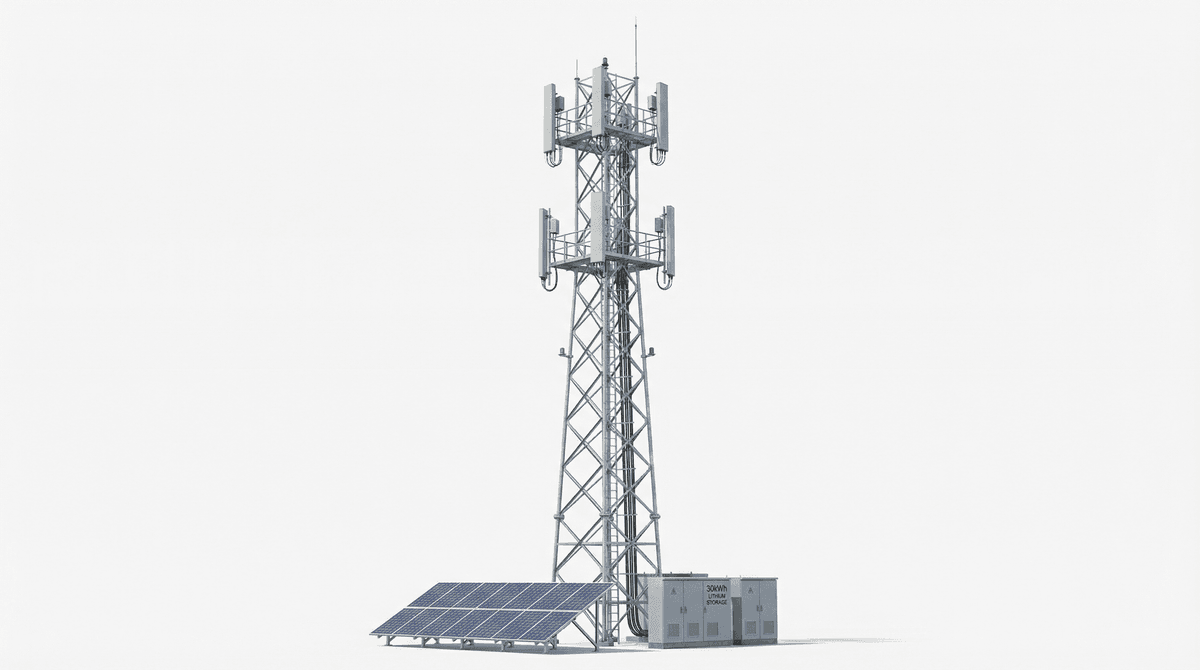
Watch the video
TL;DR
For most remote microwave repeater sites drawing 0.5-3.0 kW, generator-integrated hybrid power is usually more cost-effective than traditional generator-only systems over 10 years. It can reduce generator runtime by 40-70%, improve uptime beyond 99.5%, and lower fuel plus maintenance cost enough to deliver payback in roughly 1.2-2.5 years where logistics are difficult.
Microwave repeater power choices materially change 10-year site economics: hybrid generator systems can cut diesel runtime by 40-70%, lower fuel logistics cost by 20-45%, and improve uptime beyond 99.5% when sized with battery autonomy of 8-24 hours.
Summary
Microwave repeater power choices materially change 10-year site economics: hybrid generator systems can cut diesel runtime by 40-70%, lower fuel logistics cost by 20-45%, and improve uptime beyond 99.5% when sized with battery autonomy of 8-24 hours.
Key Takeaways
- Compare 10-year total cost, not capex alone, because remote microwave repeater sites often spend 35-60% of lifecycle cost on fuel, transport, and maintenance.
- Size battery autonomy at 8-24 hours for repeater loads of 0.5-3.0 kW to reduce generator starts and improve power quality for radios and rectifiers.
- Use hybrid generator integration when fuel delivery intervals exceed 7-30 days, because runtime reductions of 40-70% can materially lower OPEX.
- Select telecom towers and power systems to match wind design of 40-50 m/s and site footprint limits of about 3 m class foundations for roadside or industrial deployments.
- Verify compliance with TIA-222-H, IEC grounding practice, and IEEE power quality guidance to protect microwave backhaul equipment with availability targets above 99.5%.
- Model ROI using three supply scopes—FOB, CIF, and EPC turnkey—and apply volume discounts of 5% at 50+, 10% at 100+, and 15% at 250+ units.
- Choose traditional generator-only architecture only when grid reliability is high or site load is stable and fuel access is easy within less than 50 km logistics radius.
- Standardize preventive maintenance every 250-500 generator hours and remote monitoring at 5-15 minute intervals to reduce truck rolls and fault response time.
Telecom Tower Power Solutions for Microwave Repeaters
Microwave repeater power strategy should be selected on 10-year TCO, because a 0.5-3.0 kW site can see hybrid generator integration reduce runtime by 40-70% and push uptime above 99.5% versus traditional generator-dominant operation.
Microwave repeater stations are usually small in electrical load but expensive to support. A repeater shelter or cabinet may only draw 500 W to 3 kW, yet the site can be 20 km to 200 km from the nearest service base. That distance changes the economics. Fuel transport, technician dispatch, battery replacement, and outage penalties often outweigh the first equipment invoice within 3-5 years.
For B2B buyers, the core question is not whether a generator works. It does. The question is whether generator integration inside a hybrid telecom power architecture produces lower cost per delivered kWh and higher network availability than traditional solutions such as generator-only, grid-plus-UPS, or oversized battery banks. In many remote repeater applications, the answer is yes, especially where grid availability is below 95% or fuel theft risk is measurable.
SOLAR TODO supplies telecom towers and related infrastructure for operators, EPC contractors, and industrial network owners that need practical power decisions tied to structural and site realities. For example, a 40 m monopole with 3 platforms or a 45 m flanged monopole may share the same microwave mission, but the power strategy still depends on load profile, access road quality, and autonomy requirement of 8-24 hours.
According to the International Energy Agency, “reliability and resilience of electricity supply are central to digital infrastructure performance.” That statement matters at repeater sites because one unstable DC bus can interrupt multiple backhaul links. According to NREL (2024), system modeling remains essential because hourly resource and load variation strongly affects storage value and generator dispatch.
Cost Drivers and Technical Architecture
Hybrid generator integration usually wins when fuel logistics exceed 15-25% of annual OPEX, while traditional generator-only systems remain viable for sites with stable grid support or short service routes under roughly 50 km.
A microwave repeater power system normally includes a primary source, DC rectifier, battery bank, transfer logic, surge protection, grounding, and monitoring. In telecom practice, the DC bus is often 48 V, with battery strings sized for several hours of autonomy. The generator may be diesel, gas, or LPG depending on local supply chain. Traditional solutions often use a simple generator with battery charger and manual or basic automatic transfer.
Hybrid generator integration adds control logic that starts the generator only when battery SOC, load threshold, or weather forecast requires it. This reduces wet stacking, idle hours, and unnecessary service intervals. For a 1.2 kW average repeater load, a conventional generator-only site may run 24 hours per day, while a hybrid system may run 6-14 hours depending on battery size and renewable contribution. That difference drives fuel and maintenance savings.
Typical power architectures compared
A practical comparison for microwave repeater sites usually includes four architectures:
- Generator-only with charger and battery buffer
- Grid plus battery backup
- Generator plus battery hybrid control
- Solar, battery, and generator hybrid
The traditional baseline in many remote sites is generator-only. It has low design complexity and familiar maintenance routines. However, generators are least efficient at low load factors. A 10 kVA unit serving a 1 kW telecom load may operate at only 10-15% loading, which increases specific fuel consumption per kWh and carbon intensity.
By contrast, a generator-integrated hybrid system lets the battery carry low overnight load and short peaks, while the generator runs in a narrower, more efficient band. If solar is available, daytime charging can further reduce runtime. According to IRENA (2024), solar-plus-storage economics continue to improve in off-grid and weak-grid applications, especially where diesel fuel must be transported over long distances.
Comparison table: generator integration vs traditional solutions
| Solution type | Typical site load | Battery autonomy | Generator runtime reduction | 10-year OPEX trend | Uptime potential | Best use case |
|---|---|---|---|---|---|---|
| Generator-only traditional | 0.5-3.0 kW | 1-4 h | 0% | High | 97-99% | Very short service route, low capex priority |
| Grid + battery traditional | 0.5-3.0 kW | 2-8 h | 0-20% | Medium | 98-99.5% | Grid availability above 95% |
| Generator + battery hybrid | 0.5-3.0 kW | 8-24 h | 40-70% | Medium-low | 99.5%+ | Remote sites with fuel cost pressure |
| Solar + battery + generator hybrid | 0.5-3.0 kW | 12-24 h | 50-85% | Low | 99.5%+ | High irradiance, weak grid, difficult logistics |
For telecom tower projects, the physical structure and power package should be assessed together. A 40 m Monopole Industrial Zone Coverage Slip-Joint from SOLAR TODO supports 12 antennas and 2 microwave dishes under 50 m/s wind design, while a 45 m Monopole Highway Corridor Flanged supports 12 antennas on 4 platforms under the same 50 m/s design basis. Those structural conditions affect cable routing, shelter placement, grounding layout, and maintenance access.
Generator Integration vs Traditional Solutions: Cost-Benefit Analysis
Generator integration usually delivers the best cost-benefit for remote microwave repeaters when annual fuel savings exceed 20%, battery autonomy reaches 8-24 hours, and truck-roll reduction saves 4-12 site visits per year.
The cost-benefit comparison should separate capex, operating cost, outage cost, and residual value. Traditional generator-only systems often look cheaper at procurement stage because they use fewer control components and smaller batteries. But that view ignores the cost of diesel transport, unscheduled maintenance, and poor low-load efficiency over 10 years.
Sample deployment scenario (illustrative): a 1.5 kW microwave repeater runs continuously at 13,140 kWh per year. If a traditional generator-only system consumes 0.38-0.45 liters per kWh at low loading, annual fuel use may reach about 4,993-5,913 liters. If a hybrid generator system cuts runtime by 55%, fuel use may fall to roughly 2,247-2,661 liters. At a delivered fuel cost of USD 1.20-1.80 per liter, annual savings can be about USD 3,300-5,900 before maintenance savings.
Maintenance economics are equally important. Generator service intervals are commonly 250-500 operating hours for oil and filter work. A generator-only site running 8,760 hours per year may need 18-35 service events annually depending on model and duty cycle. A hybrid site running 2,600-4,800 hours may cut that to 6-19 events, materially lowering labor, spare parts, and access vehicle cost.
Power quality also has value. Microwave radios, routers, and rectifiers prefer stable voltage and limited transient disturbance. IEEE 446 and IEC-aligned grounding practice support the use of buffered architectures where batteries and rectifiers isolate sensitive loads from generator start-stop events. This can reduce nuisance alarms, radio resets, and premature PSU failures.
The International Energy Agency states, “Digital infrastructure depends on secure and reliable electricity supply.” For microwave repeaters, that is not a general statement. It translates directly into SLA compliance, reduced packet loss, and fewer outage minutes. If one repeater carries multiple links, a 2-hour outage can affect traffic far beyond a single tower footprint.
EPC Investment Analysis and Pricing Structure
For microwave repeater projects above 10 sites, EPC-style delivery often reduces interface risk by 10-20% and gives buyers one scope for tower, power, grounding, logistics, and commissioning.
EPC in this context means Engineering, Procurement, and Construction delivered as one package. The scope typically includes site survey, load assessment, tower selection, foundation interface, generator and battery sizing, rectifier configuration, cabling, grounding, lightning protection, transport, installation supervision, testing, and handover documents. For repeater networks with 20-200 sites, this reduces coordination errors between civil, telecom, and power contractors.
Three commercial scopes are commonly used:
- FOB Supply: equipment only, buyer handles freight, customs, inland transport, and installation
- CIF Delivered: equipment plus sea freight and insurance to named port, buyer handles local clearance and site works
- EPC Turnkey: supply, logistics, installation, testing, and commissioning under one contract scope
Indicative pricing logic should be discussed offline because site conditions vary, but buyers can still compare structure. Generator-only traditional systems usually have the lowest first cost. Generator-plus-battery hybrids add control hardware and larger storage. Solar-battery-generator hybrids add PV modules, mounting, and charge control but often produce the lowest 10-year OPEX.
Volume pricing guidance for standardized projects:
- 50+ units: about 5% discount
- 100+ units: about 10% discount
- 250+ units: about 15% discount
Typical payment terms:
- 30% T/T deposit + 70% against B/L
- 100% L/C at sight
Financing is available for larger projects above USD 1,000K, subject to project review, buyer profile, and country risk. For commercial discussion, buyers can contact [email protected] or +6585559114.
ROI and payback logic
A practical ROI model compares hybrid capex premium against annual savings from fuel, maintenance, and avoided outages. Sample deployment scenario (illustrative): if hybrid integration adds USD 4,000-8,000 per site but saves USD 3,500-6,500 per year, simple payback can fall in the 1.2-2.5 year range. Where fuel theft, road access, or outage penalties are high, payback can be faster.
For tower buyers assessing SOLAR TODO solutions, the power package should be tied to structural selection. A 12 m Distribution Telecom Shared Pole for 10 kV joint use may suit peri-urban corridors with easier maintenance access, while 40 m and 45 m monopole sites often justify more advanced hybrid power because each outage affects larger coverage or backhaul value.
Selection Guide for B2B Buyers
The best microwave repeater power solution is the one that meets 99.5%+ availability at the lowest verified 10-year TCO, not the lowest invoice value on day 1.
Procurement teams should start with six inputs: average load in kW, peak load in kW, desired autonomy in hours, grid availability in percent, fuel delivery cost per liter, and service distance in km. Without those six numbers, vendor comparisons are usually misleading. A 1 kW site with 95% grid uptime behaves very differently from a 1 kW site with zero grid and 120 km fuel logistics.
Practical decision rules
- Choose traditional generator-only if load is under 1.5 kW, service access is easy, and fuel delivery is low-cost with less than 50 km round trip.
- Choose grid plus battery if utility uptime is above 95% and outage duration is usually less than 4-8 hours.
- Choose generator plus battery hybrid if the site is remote, annual generator runtime would exceed 3,000 hours, or maintenance dispatch cost is high.
- Choose solar plus battery plus generator hybrid if irradiance is strong, diesel cost is volatile, and autonomy target is 12-24 hours.
Technical checkpoints before purchase
- Confirm tower loading, platform count, and microwave dish capacity against TIA-222-H or local code checks.
- Verify grounding and lightning protection layout using IEC-aligned practice and national electrical code requirements.
- Check generator loading band, preferably above 30% during charging cycles to improve fuel efficiency.
- Confirm battery chemistry, temperature range, and cycle life at site ambient conditions of 25-45°C.
- Require remote monitoring for fuel level, SOC, rectifier alarms, generator hours, and door intrusion.
SOLAR TODO supports these procurement steps with offline quotation, project-specific sizing, and export delivery. That matters because repeater projects are rarely standard. One site may need a compact 3 m-class footprint beside a highway corridor, while another may need industrial-zone colocation with 12 antennas and 2 microwave dishes.
FAQ
Microwave repeater buyers usually need 10 focused answers on cost, uptime, installation, and maintenance before selecting generator integration or traditional power architecture.
Q: What is the main difference between generator integration and a traditional generator-only solution for microwave repeaters? A: Generator integration uses batteries, rectifiers, and control logic so the generator runs only when needed, often cutting runtime by 40-70%. A traditional generator-only system runs far more hours and usually has higher fuel and maintenance cost over 10 years.
Q: How much battery autonomy should a microwave repeater site have? A: Most remote repeater sites should be evaluated in the 8-24 hour range, depending on load, access, and SLA target. For a 1-2 kW telecom load, that autonomy reduces generator starts, improves power quality, and gives operators time to respond before service is affected.
Q: When does a traditional solution still make financial sense? A: A traditional generator-only or grid-plus-battery setup can still make sense when grid uptime is above 95% or the site is close to maintenance teams. If fuel delivery is simple and annual runtime stays low, the hybrid capex premium may not pay back quickly.
Q: How do I calculate the cost-benefit of hybrid generator integration? A: Start with annual load in kWh, generator fuel consumption at actual load factor, delivered fuel price, service interval, and truck-roll cost. Then compare those values over 5-10 years against the hybrid capex premium, battery replacement plan, and avoided outage cost.
Q: Does generator integration improve microwave equipment reliability? A: Yes, in many cases it does because the battery-backed DC bus buffers voltage dips and start-stop disturbances. That is important for radios, routers, and transmission equipment that can trip on unstable power even when average site load is only 0.5-3.0 kW.
Q: What maintenance schedule is typical for these systems? A: Generator service is commonly based on 250-500 operating hours, while battery and rectifier inspections are often quarterly or semiannual. Hybrid systems usually reduce total service events because the generator runs fewer hours, which lowers oil, filter, and technician travel cost.
Q: How does solar affect the generator integration business case? A: Solar can strengthen the business case when the site has good irradiance and high diesel logistics cost. In many weak-grid or off-grid locations, adding PV can reduce generator runtime by 50-85%, though the final result depends on load profile, battery size, and local weather.
Q: What standards should buyers check for telecom tower and power-system compliance? A: Buyers should review tower structural design against TIA-222-H or applicable local standards, plus grounding and electrical safety practice aligned with IEC and national codes. For distributed energy interfaces and backup systems, IEEE guidance is also relevant for reliability and power quality review.
Q: What does EPC turnkey delivery include for microwave repeater power projects? A: EPC turnkey delivery usually includes engineering, equipment supply, logistics, installation, testing, commissioning, and handover documents. For multi-site projects, it can reduce interface risk because one contractor handles tower coordination, power integration, grounding, and startup procedures.
Q: What pricing structure does SOLAR TODO offer for telecom tower power solutions? A: SOLAR TODO typically works on offline quotation using FOB Supply, CIF Delivered, or EPC Turnkey scope. Standard guidance includes 5% discount at 50+ units, 10% at 100+, and 15% at 250+, with payment terms of 30% T/T plus 70% against B/L or 100% L/C at sight.
Q: Is financing available for larger repeater network projects? A: Yes, financing can be available for projects above USD 1,000K, subject to project review and commercial terms. Buyers should prepare load data, site count, logistics assumptions, and target uptime so the financing and technical proposal can be aligned.
Q: Which SOLAR TODO tower types are relevant for microwave repeater deployments? A: Common options include the 40 m Monopole Industrial Zone Coverage Slip-Joint, the 45 m Monopole Highway Corridor Flanged, and the 12 m Distribution Telecom Shared Pole. The right choice depends on antenna count, microwave dish loading, corridor constraints, and whether the site is joint-use with 10 kV distribution.
References
Authoritative guidance for telecom repeater power decisions comes from standards bodies and energy agencies that quantify reliability, structural design, and off-grid system economics.
- NREL (2024): PVWatts and distributed energy modeling guidance used to estimate solar contribution, storage value, and annual energy performance.
- IEA (2024): Energy sector and digital infrastructure analysis emphasizing reliability and resilience requirements for communications networks.
- IRENA (2024): Renewable power and off-grid economics data showing improved competitiveness of solar-plus-storage versus diesel-intensive systems.
- TIA-222-H (2024): Structural standard for antenna supporting structures and antennas, relevant to monopole and telecom tower loading checks.
- IEEE 446 (2021): Recommended practice for emergency and standby power systems, relevant to backup architecture and reliability planning.
- IEC 60364 series (2023): Low-voltage electrical installation principles relevant to grounding, protection, and safe integration of backup power systems.
- EN 1993-3-1 (2019): Steel tower and mast structural design provisions used in project-specific checks for telecom structures.
Conclusion
For microwave repeaters with 0.5-3.0 kW loads, generator-integrated hybrid power usually beats traditional generator-only solutions on 10-year cost when runtime falls 40-70% and uptime exceeds 99.5%.
Bottom line: if your site is remote, fuel-intensive, or outage-sensitive, choose a hybrid architecture and evaluate it with EPC scope, 8-24 hour battery autonomy, and full logistics cost. SOLAR TODO can support tower selection, power sizing, and offline quotation for multi-site repeater networks.
About SOLARTODO
SOLARTODO is a global integrated solution provider specializing in solar power generation systems, energy-storage products, smart street-lighting and solar street-lighting, intelligent security & IoT linkage systems, power transmission towers, telecom communication towers, and smart-agriculture solutions for worldwide B2B customers.
Further Reading
Procurement paths
About the Author

SOLARTODO Editorial Team
Solar Energy & Infrastructure Expert Team
SOLAR TODO is a professional supplier of solar energy, energy storage, smart lighting, smart agriculture, security systems, communication towers, and power tower equipment.
Our technical team has over 15 years of experience in renewable energy and infrastructure, providing high-quality products and solutions to B2B customers worldwide.
Expertise: PV system design, energy storage optimization, smart lighting integration, smart agriculture monitoring, security system integration, communication and power tower supply.
Cite This Article
SOLARTODO Editorial Team. (2026). Telecom Tower Power Solutions Cost-Benefit: generator…. SOLARTODO. Retrieved from https://solartodo.com/knowledge/telecom-tower-power-solutions-cost-benefit-generator-integration-vs-traditional-solutions-in-microwave-repeaters
@article{solartodo_telecom_tower_power_solutions_cost_benefit_generator_integration_vs_traditional_solutions_in_microwave_repeaters,
  title = {Telecom Tower Power Solutions Cost-Benefit: generator…},
  author = {SOLARTODO Editorial Team},
  journal = {SOLARTODO Knowledge Base},
  year = {2026},
  url = {https://solartodo.com/knowledge/telecom-tower-power-solutions-cost-benefit-generator-integration-vs-traditional-solutions-in-microwave-repeaters},
  note = {Accessed: 2026-10-14}
}
Published: July 6, 2026 | Available at: https://solartodo.com/knowledge/telecom-tower-power-solutions-cost-benefit-generator-integration-vs-traditional-solutions-in-microwave-repeaters
Subscribe to Our Newsletter
Get the latest solar energy news and insights delivered to your inbox.
View All Articles