Telecom Tower Power Solutions Case Study: bad-grid areas…

SOLARTODO Editorial Team
Solar Energy & Infrastructure Expert Team
Watch the video
TL;DR
For telecom towers in bad-grid areas, the most practical solution is a hybrid off-grid system using 5-15 kW solar PV, 20-80 kWh battery storage, and a backup generator. This setup can maintain more than 99.5% uptime, reduce diesel use by 60-90%, and often pay back in 3-6 years when fuel logistics and maintenance costs are included.
Off-grid telecom tower power in bad-grid areas typically combines 5-15 kW solar PV, 20-80 kWh LiFePO4 storage, and a backup genset to raise site uptime above 99.5% while cutting diesel use by 60-90% versus generator-only operation.
Summary
Off-grid telecom tower power in bad-grid areas typically combines 5-15 kW solar PV, 20-80 kWh LiFePO4 storage, and a backup genset to raise site uptime above 99.5% while cutting diesel use by 60-90% versus generator-only operation. This case study explains sizing, EPC cost structure, and deployment risks.
Key Takeaways
- Replace generator-only operation with a hybrid package of 5-15 kW PV and 20-80 kWh battery storage to reduce diesel consumption by 60-90% at remote telecom tower sites.
- Size battery autonomy for 8-24 hours based on BTS load, with most single-tenant sites requiring 2-6 kW continuous power and 20-40% reserve margin.
- Use a 12 m shared pole or 15 m to 40 m monopole when land is tight, keeping structure footprint near 3-6 m while supporting telecom and power equipment.
- Specify design inputs early, including 40-50 m/s wind, 30-year design life, and standards such as IEC 60826 and IEEE 1547, to avoid redesign during procurement.
- Compare FOB Supply, CIF Delivered, and EPC Turnkey pricing; projects above 50 units can target 5% discount, 100 units 10%, and 250 units 15%.
- Plan ROI against diesel-only baselines; many bad-grid sites recover hybrid capex in about 3-6 years when fuel logistics and maintenance trips are included.
- Monitor battery SOC, rectifier efficiency, and genset runtime remotely; quarterly review of alarms can cut emergency visits by 20-40% on dispersed tower portfolios.
- Verify electrical and structural compliance, including IEC 61215, IEC 61730, UL 1973, and TIA-222-H where applicable, before factory release and shipment.
Why Off-Grid Power Is Used for Telecom Towers in Bad-Grid Areas
Off-grid telecom tower power systems usually need 5-15 kW PV, 20-80 kWh storage, and backup generation because weak-grid sites can suffer daily outages and still require more than 99.5% network availability.
Bad-grid areas are not always fully grid-absent. Many sites receive utility power for only 4-12 hours per day, with voltage instability, low-frequency events, or repeated feeder trips. For a telecom operator, that means the tower power system must behave like an off-grid plant even when a nominal grid connection exists. The design target is not just energy supply; it is service continuity for radios, transmission, cooling, security, and site access equipment.
A typical single-tenant macro site draws about 2-6 kW continuous load, depending on radio count, battery charging profile, and cooling method. Multi-tenant or microwave-heavy sites can exceed 8-12 kW. According to the International Energy Agency, digital infrastructure reliability is becoming more critical as mobile data demand and industrial connectivity expand through 2025-2030. That trend makes power architecture a board-level uptime issue, not only an OPEX line item.
The International Energy Agency states, "Reliable electricity supply is essential for digital connectivity and economic development." For telecom towers, that statement translates into a simple engineering rule: if the grid cannot support 24-hour uptime, the site must be designed around storage and autonomous generation. SOLAR TODO applies this rule when proposing telecom tower power packages for rural, industrial, and peri-urban weak-grid deployments.
From a tower-asset perspective, the power solution also affects structure and site layout. A 15 m monopole suburban 4G tower may fit a restricted plot with about 3-6 m foundation width, while a 40 m monopole can support 12 antennas and 2 microwave dishes under 50 m/s wind conditions. In bad-grid projects, the electrical package, equipment shelter, battery enclosure, and fuel logistics must be coordinated with tower loading, grounding, and access roads from the first design review.
Case Study Architecture: Hybrid Off-Grid Power for a Telecom Tower
A practical bad-grid telecom tower solution uses a DC power system with 48 V rectifiers, 5-15 kW solar PV, 20-80 kWh LiFePO4 batteries, and a backup diesel genset sized for the peak charging window.
Sample deployment scenario (illustrative): a remote telecom tower has a 3.5 kW average DC-equivalent load, poor utility availability of 6 hours per day, and fuel delivery every 3-4 weeks. The site uses a hybrid configuration with 8 kW solar PV, 40 kWh LiFePO4 battery storage, a 12 kVA diesel generator, MPPT charge control, and remote monitoring. The target is 99.5% uptime with less than 4 generator runtime hours per day averaged annually.
Core system components
The electrical architecture normally includes these blocks:
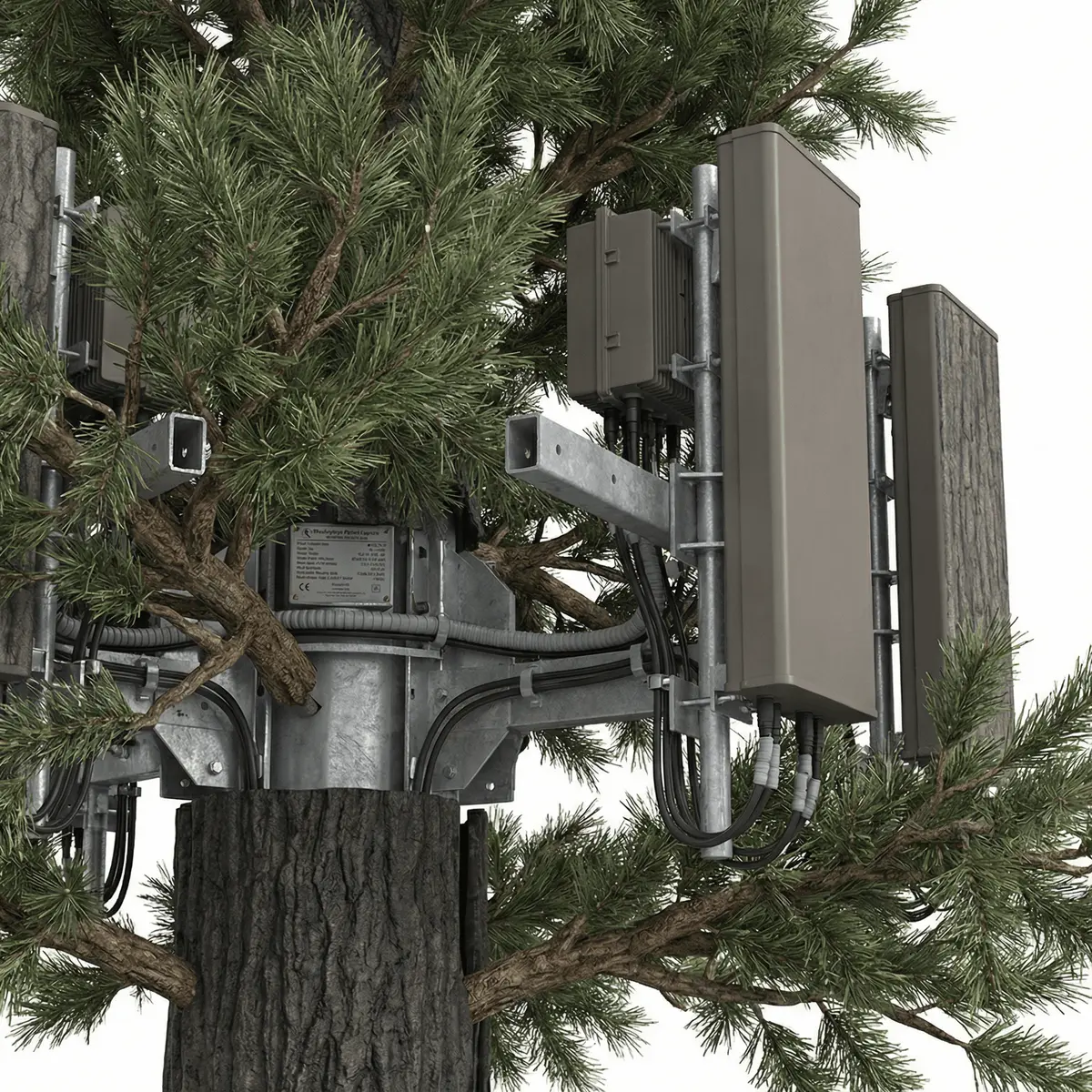
- Telecom tower structure: 12 m shared pole, 15 m monopole, or 40 m monopole depending on RF coverage and loading
- DC power plant: 48 V rectifier system, commonly 3-6 kW modular shelves
- Solar array: usually 5-15 kW for single-site bad-grid support
- Battery bank: 20-80 kWh LiFePO4 for 8-24 hours autonomy
- Backup generator: 8-20 kVA depending on peak load and battery recharge strategy
- ATS and controller: logic for source priority, battery SOC, and genset start-stop
- Remote monitoring: alarms for voltage, temperature, fuel, door, smoke, and rectifier status
- Earthing and surge protection: coordinated with tower grounding grid and feeder protection
The reason this architecture works is load separation. Mission-critical telecom loads stay on the DC bus, while non-critical AC loads such as convenience outlets or auxiliary lighting are minimized. That improves round-trip efficiency and reduces inverter dependency. In most field cases, every 5-10% reduction in parasitic load directly lowers battery size and diesel runtime.
Sizing logic for bad-grid conditions
Battery sizing starts with critical load and required autonomy. A 3.5 kW average load over 10 hours needs 35 kWh usable energy. If the design limits depth of discharge to 80%, the nominal battery bank should be about 43.75 kWh, usually rounded to 45-50 kWh. If the site faces 45 C ambient peaks, additional derating and thermal management should be included.
Solar sizing depends on irradiance, seasonal minimums, and recharge targets. According to NREL PVWatts methodology, array yield depends on plane-of-array irradiance, temperature, and system losses. In many high-sun regions, 1 kW of PV can produce roughly 4-6 kWh per day, but bad-weather months and dust losses must be modeled. For a 40 kWh daily site energy target, an 8-12 kW array is a common starting range.
Generator sizing is often done incorrectly by matching only average load. The better method is to cover site load plus battery charging current. If the tower draws 3.5 kW and the charging target is 4-5 kW, a genset in the 10-12 kVA class may be more appropriate than a 6 kVA unit. Undersized generators run long hours at poor efficiency and shorten maintenance intervals.
IRENA states, "Renewables are increasingly the lowest-cost option for new power capacity in most parts of the world." For telecom towers, the practical reading is that solar-plus-storage can now displace a large share of diesel generation where logistics costs push delivered fuel prices far above nominal pump prices. SOLAR TODO uses this cost logic when comparing diesel-only, hybrid, and high-autonomy off-grid packages.
Technical Design, Standards, and Site Integration
A bankable telecom tower off-grid design should define 40-50 m/s wind, 30-year structural life, 48 V DC architecture, and tested battery and PV standards before procurement starts.
Telecom power projects fail most often at interfaces, not at major equipment. The tower contractor may assume one grounding layout, the power integrator another, and the civil team a third. To avoid that, the design package should lock key inputs early: tower type, antenna loading, shelter or outdoor cabinet arrangement, cable routing, lightning protection, and energy source priority. For monopoles such as the 15 m suburban 4G or 40 m industrial-zone model, the compact footprint helps, but it also concentrates grounding and access coordination within a smaller area.
Structural and electrical compliance points
For B2B procurement, these are the minimum items worth checking:
- Tower structural code basis: TIA-222-H or EN 1993-3-1, with project wind speed such as 40 m/s or 50 m/s
- Overhead line or utility coordination where relevant: IEC 60826, ASCE 74, EN 50341
- PV module compliance: IEC 61215 and IEC 61730
- Battery safety basis: UL 1973 or IEC battery safety documentation depending on market
- DER interconnection where grid support remains: IEEE 1547 for interface logic
- Steel and coating documentation: ASTM material and galvanizing records where specified
- Earthing, surge, and lightning design matched to tower height and soil resistivity tests
A 12 m distribution telecom shared pole adds another layer because it combines 10 kV distribution and telecom loading on one structure. That can reduce corridor occupation by about 30-50% compared with separate poles, but only if electrical clearances, bonding, and maintenance access are coordinated from the start. Joint-use poles are useful in village broadband expansion, roadside utility corridors, and industrial parks where rights-of-way are constrained.
Thermal management matters more than many buyers expect. Battery life can drop sharply when average enclosure temperature stays above 30-35 C. Passive ventilation may be enough for mild climates, but in hot regions with 45 C daytime peaks, insulated battery cabinets, filtered airflow, or DC cooling loads should be evaluated. A 2-5% increase in auxiliary energy can be justified if it materially extends battery life from 5 years toward 8-10 years.
Applications, Use Cases, and Comparison of Tower Power Options
For bad-grid telecom sites, solar-hybrid systems usually deliver the best total cost at 2-6 kW load, while diesel-only remains simplest but carries the highest fuel and maintenance risk over 5 years.
The right configuration depends on RF duty, access conditions, and tenant growth. A suburban infill site with a 15 m monopole may prioritize low visual impact and quick installation. An industrial-zone macro site on a 40 m monopole may prioritize 4-carrier colocation, 12 antennas, and microwave backhaul. A roadside expansion project may choose a 12 m shared pole to combine distribution and telecom functions in one corridor.
Sample deployment scenario (illustrative): a 40 m industrial-zone monopole with 3 platforms, 12 antennas, and 2 microwave dishes supports private LTE, 4G, and CCTV backhaul across a 1-3 km industrial campus. The power package uses 12 kW PV, 60 kWh battery storage, and a 15 kVA genset. Compared with generator-only operation, annual diesel use may fall by 70-85% depending on irradiance, battery dispatch settings, and cooling load.
Comparison table: common bad-grid tower power options
| Option | Typical site load | Main equipment | Diesel reduction | Typical capex level | Best use case |
|---|---|---|---|---|---|
| Diesel-only | 2-10 kW | Genset + small battery | 0% | Low initial | Emergency or very low-capex sites |
| Grid + battery backup | 2-8 kW | Rectifier + 10-30 kWh battery | 10-30% | Low to medium | Sites with stable grid above 18 h/day |
| Solar hybrid off-grid | 2-6 kW | 5-15 kW PV + 20-80 kWh battery + genset | 60-90% | Medium | Weak-grid and remote tower sites |
| High-autonomy renewable | 2-5 kW | 10-20 kW PV + 60-120 kWh battery + small genset | 80-95% | Higher | Very remote sites with costly fuel logistics |
| Joint-use pole power corridor | 1-4 kW telecom + 10 kV line | 12 m shared pole + hybrid power | Project-specific | Medium | Village broadband and roadside utility corridors |
For procurement managers, the table shows the trade-off clearly. Diesel-only looks cheaper at purchase order stage, but the logistics burden grows fast when roads are poor, theft risk is high, or maintenance teams travel 100-300 km per visit. Hybrid systems shift cost from fuel to equipment, which is usually easier to finance and monitor.
EPC Investment Analysis and Pricing Structure
For telecom tower off-grid projects, EPC turnkey delivery combines tower, civil works, 48 V power plant, PV, battery, controls, and commissioning into one scope, which reduces interface risk and shortens deployment by weeks.
A B2B buyer should separate price into three levels because the commercial boundary changes the risk profile. FOB Supply covers factory output only. CIF Delivered adds freight and marine insurance to the destination port. EPC Turnkey includes engineering, procurement, construction, installation, testing, and handover. For weak-grid tower projects, the value of EPC is usually not lower unit price; it is lower rework, fewer vendor gaps, and faster network launch.
Three-tier pricing structure
- FOB Supply: tower steel, PV modules, battery system, rectifiers, controllers, and accessories supplied ex-factory or FOB port
- CIF Delivered: FOB scope plus ocean freight and insurance to destination port
- EPC Turnkey: CIF-equivalent supply plus civil works, foundation, erection, wiring, grounding, commissioning, and training
Volume pricing guidance
- 50+ units: target about 5% discount
- 100+ units: target about 10% discount
- 250+ units: target about 15% discount
Payment terms and financing
- Standard payment: 30% T/T + 70% against B/L
- Alternative payment: 100% L/C at sight
- Financing: available for large projects above $1,000K
- Commercial contact: [email protected]
- General business contact: +6585559114
ROI and operating cost logic
A diesel-only site with a 3.5 kW average load can consume large fuel volumes once generator charging inefficiency, idling, and maintenance are included. If delivered diesel cost is high due to transport and security, hybridization can often cut total operating cost enough to recover incremental capex in about 3-6 years. Sites with fuel theft, difficult road access, or more than 12 outage hours per day often sit at the faster end of that range.
Sample deployment scenario (illustrative): if a hybrid package reduces diesel use by 75% and emergency maintenance visits by 25%, annual OPEX can drop materially even before carbon reporting benefits are counted. That is why SOLAR TODO usually frames the investment decision around 5-year TCO, not only first cost. For operators managing dozens of sites, portfolio-level savings matter more than one-site equipment price.
FAQ
A well-designed bad-grid telecom tower power system usually combines 5-15 kW solar, 20-80 kWh batteries, and backup generation to maintain more than 99.5% uptime with lower diesel dependence.
Q: What is an off-grid telecom tower power system? A: An off-grid telecom tower power system supplies site loads without relying on continuous utility service. It usually combines a 48 V DC power plant, 5-15 kW solar PV, 20-80 kWh battery storage, and an 8-20 kVA backup generator. The goal is to keep radios, transmission, and control systems operating through outages and poor grid quality.
Q: Why are bad-grid areas treated like off-grid sites? A: Bad-grid sites may have utility power for only 4-12 hours per day or suffer unstable voltage and repeated feeder trips. From an uptime perspective, that behaves like an off-grid condition. Telecom operators therefore size batteries and backup generation for autonomous operation, even when a nominal grid connection exists.
Q: How much solar and battery capacity does a typical telecom tower need? A: A single-tenant site with 2-6 kW continuous load often uses 5-15 kW of solar PV and 20-80 kWh of LiFePO4 storage. Exact sizing depends on daily energy use, worst-month irradiance, and required autonomy of 8-24 hours. Loads with air conditioning or multiple carriers usually need the upper end of the range.
Q: How does a hybrid system compare with generator-only operation? A: Hybrid systems usually cut diesel use by 60-90% compared with generator-only operation, depending on solar resource and battery dispatch settings. They also reduce maintenance hours, fuel transport risk, and noise. Generator-only systems remain simpler initially, but their 3-5 year operating cost is often higher in remote areas.
Q: What tower types fit bad-grid power projects best? A: The tower choice depends on RF coverage and land constraints. A 15 m monopole suits compact suburban 4G sites, a 40 m monopole supports heavier loading such as 12 antennas and 2 dishes, and a 12 m shared pole can combine 10 kV distribution with telecom equipment where corridor space is limited.
Q: What standards should buyers ask for in procurement documents? A: Buyers should request structural code basis such as TIA-222-H or EN 1993-3-1, plus electrical and product standards including IEC 61215, IEC 61730, IEEE 1547 where grid interface exists, and battery safety documentation such as UL 1973. For line-related structures, IEC 60826 or ASCE 74 may also be relevant.
Q: What maintenance is required for off-grid telecom tower power systems? A: Maintenance usually includes monthly remote alarm review, quarterly site inspection, battery and rectifier checks, PV cleaning based on dust conditions, and generator servicing by runtime hours. In many projects, remote monitoring reduces emergency visits by 20-40%. The exact interval should follow ambient temperature, fuel quality, and OEM service schedules.
Q: What is included in EPC turnkey delivery for these projects? A: EPC turnkey delivery usually includes engineering, tower and power equipment supply, civil works, foundation, erection, DC and AC wiring, grounding, testing, commissioning, and operator training. This approach reduces interface disputes between tower, power, and civil contractors. It is especially useful when sites are dispersed and schedule control is critical.
Q: How are pricing and payment terms usually structured? A: Pricing is commonly offered as FOB Supply, CIF Delivered, or EPC Turnkey. Standard payment terms are 30% T/T + 70% against B/L, or 100% L/C at sight. For larger programs above $1,000K, financing may be available. Volume guidance often targets 5% discount at 50+ units, 10% at 100+, and 15% at 250+.
Q: What payback period can operators expect from hybridization? A: Many bad-grid telecom sites achieve payback in about 3-6 years when compared with diesel-only operation. The faster cases usually have high delivered fuel cost, frequent outages, and difficult maintenance access. A proper model should include fuel logistics, theft losses, battery replacement assumptions, and avoided downtime impact.
Q: When is a shared distribution telecom pole a better option than a separate tower and power pole? A: A 12 m distribution telecom shared pole is useful when the project must carry 10 kV distribution and telecom equipment in one roadside corridor. It can reduce corridor occupation by about 30-50% versus separate poles. The trade-off is stricter clearance, grounding, and maintenance coordination.
Q: How can buyers start a project discussion with SOLAR TODO? A: Buyers should prepare site load data, outage profile, target autonomy, wind speed, tower height, and logistics constraints before requesting a quotation. SOLAR TODO can then propose tower type, PV and battery sizing, and commercial scope as FOB, CIF, or EPC Turnkey. For project discussion, contact [email protected] or +6585559114.
References
A bankable telecom tower off-grid proposal should cite recognized standards and agencies such as IEA, IRENA, NREL, IEC, IEEE, and UL to support sizing, compliance, and investment decisions.
- International Energy Agency (IEA) (2024): Energy and digital infrastructure assessments highlighting the importance of reliable electricity for connectivity and network resilience.
- International Renewable Energy Agency (IRENA) (2024): Renewable Power Generation Costs in 2023, showing continued cost competitiveness of solar PV and storage-linked renewable systems.
- National Renewable Energy Laboratory (NREL) (2024): PVWatts Calculator methodology for estimating PV energy yield using irradiance, temperature, and system loss assumptions.
- IEC 61215-1 (2021): Terrestrial photovoltaic modules - Design qualification and type approval requirements for crystalline silicon modules.
- IEC 61730-1 (2023): Photovoltaic module safety qualification - Requirements for construction and testing.
- IEEE 1547-2018 (2018): Standard for interconnection and interoperability of distributed energy resources with electric power systems interfaces.
- UL 1973 (2022): Safety standard for batteries for use in stationary, vehicle auxiliary power, and light electric rail applications.
- TIA-222-H (2017): Structural standard for antenna supporting structures and antennas, widely used for telecom tower design.
Conclusion
For bad-grid telecom tower sites, a hybrid off-grid package with 5-15 kW solar, 20-80 kWh batteries, and backup generation can deliver more than 99.5% uptime while reducing diesel use by 60-90%.
The bottom line is straightforward: if a site faces daily outages, long fuel routes, or high maintenance travel cost, hybrid off-grid power usually offers the best 5-year TCO. SOLAR TODO can support this with tower options from 12 m shared poles to 40 m monopoles, plus FOB, CIF, or EPC Turnkey delivery matched to project scope.
About SOLARTODO
SOLARTODO is a global integrated solution provider specializing in solar power generation systems, energy-storage products, smart street-lighting and solar street-lighting, intelligent security & IoT linkage systems, power transmission towers, telecom communication towers, and smart-agriculture solutions for worldwide B2B customers.
About the Author

SOLARTODO Editorial Team
Solar Energy & Infrastructure Expert Team
SOLAR TODO is a professional supplier of solar energy, energy storage, smart lighting, smart agriculture, security systems, communication towers, and power tower equipment.
Our technical team has over 15 years of experience in renewable energy and infrastructure, providing high-quality products and solutions to B2B customers worldwide.
Expertise: PV system design, energy storage optimization, smart lighting integration, smart agriculture monitoring, security system integration, communication and power tower supply.
Cite This Article
SOLARTODO Editorial Team. (2026). Telecom Tower Power Solutions Case Study: bad-grid areas…. SOLARTODO. Retrieved from https://solartodo.com/knowledge/telecom-tower-power-solutions-case-study-bad-grid-areas-implementation-with-off-grid-power
@article{solartodo_telecom_tower_power_solutions_case_study_bad_grid_areas_implementation_with_off_grid_power,
  title = {Telecom Tower Power Solutions Case Study: bad-grid areas…},
  author = {SOLARTODO Editorial Team},
  journal = {SOLARTODO Knowledge Base},
  year = {2026},
  url = {https://solartodo.com/knowledge/telecom-tower-power-solutions-case-study-bad-grid-areas-implementation-with-off-grid-power},
  note = {Accessed: 2026-10-15}
}
Published: May 2, 2026 | Available at: https://solartodo.com/knowledge/telecom-tower-power-solutions-case-study-bad-grid-areas-implementation-with-off-grid-power
Subscribe to Our Newsletter
Get the latest solar energy news and insights delivered to your inbox.
View All Articles