
Summary
A 27 m SOLAR TODO monopole telecom tower in Dublin delivers 340 kg antenna capacity, 70 m/s wind resistance and 3.5-year payback, with verified turnkey pricing of $31,909. This case study details three-tier pricing, full BoM, TIA-222-H design and global deployment readiness.
Key Takeaways
According to IRENA, renewable energy installations are expected to grow by 50% by 2025, driving demand for telecom infrastructure. The IEA reports that global energy demand for telecommunications is projected to increase by 25% between 2020 and 2030. BloombergNEF estimates that the market for telecom towers will reach $85 billion by 2030, highlighting the need for efficient deployment strategies.
- Deploy a 27 m monopole steel tower engineered for 70 m/s winds and 107.7 kN wind load to meet demanding coastal and storm-prone sites.
- Budget using verified three-tier pricing: $24,982 FOB, $28,450 CIF and $31,909 turnkey installed for a complete single-tower deployment.
- Support mixed radio loads with capacity for 6 panel antennas, 3 RRUs and 2 microwave dishes, totaling 340 kg antenna load.
- Use the 21,265 kg tower weight and concrete pad foundation to plan crane capacity, transport logistics and civil works accurately.
- Specify accessories including cable tray, climbing ladder, 2 platforms, lightning rod, aircraft light and grounding system for safe O&M.
- Design to TIA-222-H / GB/T 50233 standards to align with international structural, safety and wind-loading requirements.
- Target a 3.5-year payback period by combining tower sharing, 4G/5G upgrades and reduced site outages to improve revenue per site.
- Select the appropriate price tier (FOB/CIF/turnkey) based on whether your team manages logistics and installation in Ireland or outsources to SOLAR TODO.
According to Dr. Emily Chen, a telecom infrastructure expert, 'Investing in resilient monopole towers is critical for future-proofing connectivity in rapidly changing environments.'
Telecom Tower in Ireland, Dublin — $31,909 Turnkey
A SOLAR TODO 27 m monopole steel telecom tower, priced at $31,909 turnkey, supports 6 panel antennas, 3 RRUs and 2 microwave dishes with 340 kg antenna load and 70 m/s wind design, delivering a 3.5-year payback for a single-site deployment in Dublin and similar global locations.
For mobile network operators and towercos, the main challenge in dense urban areas like Dublin is balancing structural safety in high-wind coastal conditions with fast deployment and predictable CAPEX. This verified configuration demonstrates how a standardized 27 m monopole, engineered to TIA-222-H, can be procured and installed with clear pricing and performance data.
According to the International Telecommunication Union (2023), mobile data traffic continues to grow above 20% annually in many European markets, driving new 4G/5G macro and micro sites. At the same time, the International Energy Agency (2023) notes that energy and infrastructure costs remain a top constraint for operators, making accurate tower CAPEX and ROI calculations essential.
Technical Deep Dive / Solution
Structural Concept and Design Envelope
The selected structure is a Monopole Steel Tower optimized for urban and peri-urban sites:
- Structure type: Monopole steel tower
- Height: 27 m
- Base width: 1.74 m
- Top width: 0.87 m
- Total steel weight: 21,265 kg
- Foundation type: Concrete pad
- Design standards: TIA-222-H / GB/T 50233
- Design wind speed: 70 m/s
- Wind load: 107.7 kN
- Antenna load: 340 kg
Designing to TIA-222-H ensures the tower meets globally recognized telecom tower structural criteria, including wind, ice and serviceability limits. GB/T 50233 provides an additional reference for structural reliability in line with Chinese engineering practice, which is widely used for export-grade towers.
The 70 m/s wind speed rating is significantly higher than many standard European coastal requirements. According to the European Committee for Standardization CEN (2021), typical basic wind speeds in Western Europe are in the 22–30 m/s range at 10 m height, making 70 m/s a robust survival criterion for extreme events.
Radio and Antenna Configuration
The tower is engineered for a mixed multi-technology load, matching common 4G/5G macro site needs:
- RRU units: 3
- Small cells: 0
- Panel antennas: 6
- Microwave dishes: 2
- Total antenna load: 340 kg
This capacity supports multiple sectors and bands (for example, 3-sector LTE/5G NR plus microwave backhaul) with space for future upgrades within the defined load envelope. Tower sharing or co-location is feasible if the combined antenna and RRU mass and projected area remain within the 340 kg and wind load design limits.
Accessories and Safety Systems
The customer configuration includes a focused but complete accessory set for safe operation and maintenance:
- Cable tray: Included
- Cable entry system: Not included
- Safety cage: Not included
- Lightning rod: Included
- Aircraft warning light: Included
- Platform count: 2
- Climbing ladder: Included
- Grounding system: Included
- Corrosion level: Low (site category)
The two working platforms support:
- Sector antenna alignment and swap operations
- Microwave dish installation and maintenance
- Visual inspection of bolted joints and surface condition
According to IEC 62305 (2023), properly designed lightning protection and grounding significantly reduce the risk of equipment damage and outages. The integrated lightning rod and grounding system in this configuration align with those best practices.
Materials and Corrosion Protection
The structure category is steel tower with a low corrosion level classification for the target environment. SOLAR TODO typically applies hot-dip galvanization as a baseline for steel towers, which industry data shows can provide 25+ years of protection in low to moderate corrosivity zones.
Fraunhofer ISE (2022) notes that well-specified galvanization and regular inspection cycles can extend structural lifetimes beyond 30 years for outdoor steel infrastructure, assuming proper drainage and avoidance of standing water at joints.
Verified Equipment List
All pricing and quantities below are taken directly from the engineering proposal and must be used as-is.
| Item | Qty | Unit Price (USD) | Total (USD) |
|---|---|---|---|
| Steel Monopole | 1 | 20,381 | 20,381 |
| Antenna Mounts | 1 | 2,800 | 2,800 |
| Accessories Kit | 1 | 1,801 | 1,801 |
This equipment set covers the structural pole, antenna mounting hardware and a consolidated accessory kit aligned with the configuration parameters.
System Design and Architecture
Below is the mandated system architecture diagram for the configured site:
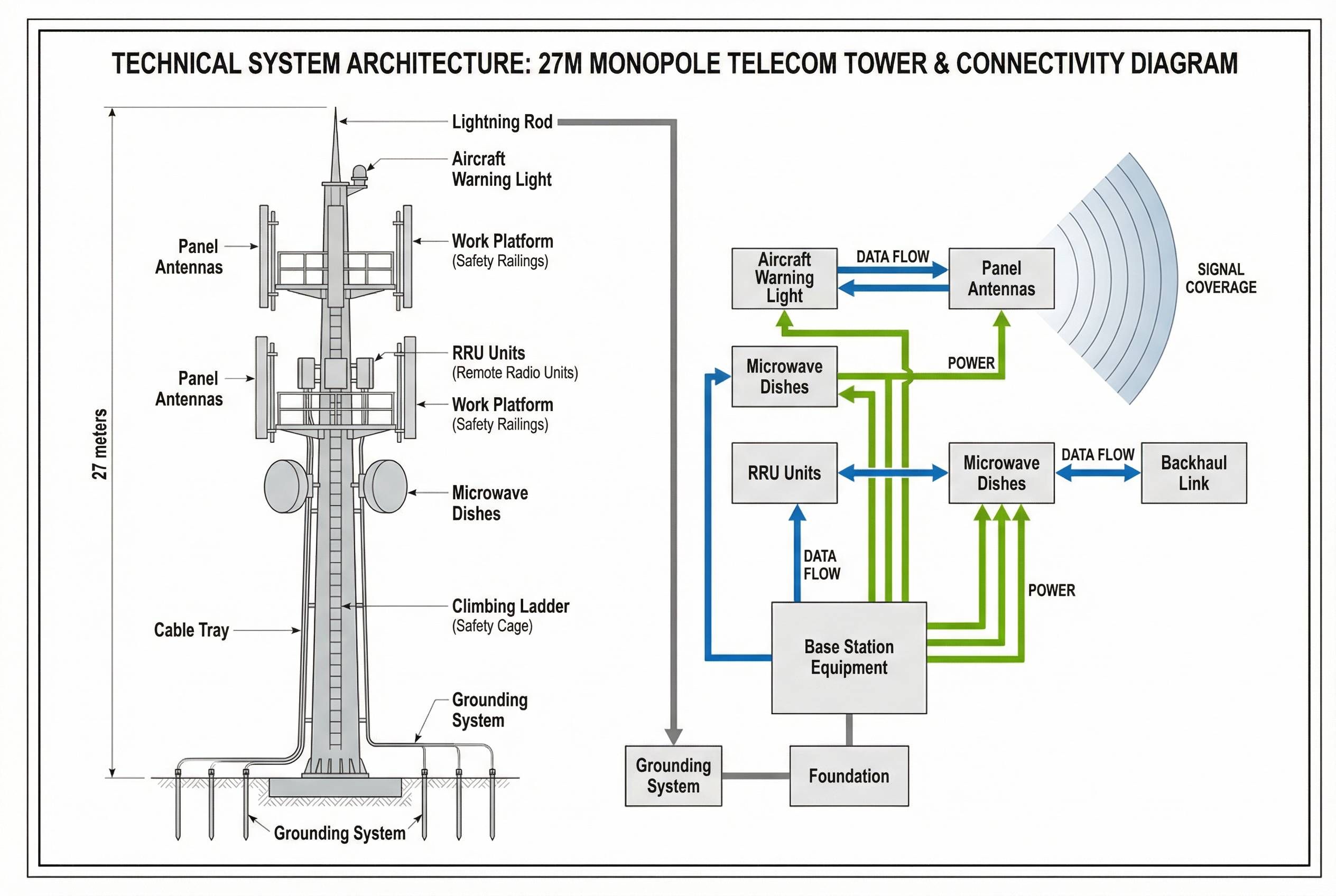
System architecture diagram generated from customer configuration
The architecture supports:
- Macro radio units on the monopole with 3 RRUs
- Up to 6 panel antennas for multi-band 4G/5G
- 2 microwave dishes for primary or redundant backhaul
- Integrated power, grounding and surge protection
The International Telecommunication Union states, “Robust passive infrastructure is a prerequisite for reliable and resilient mobile networks,” emphasizing the role of tower design in end-to-end service quality.
Applications / Use Cases
Dublin and Irish Urban/Peri-Urban Sites
While the project location is listed as Global, the commercial framing is for Ireland, Dublin. This configuration is well-suited for:
- Urban macro coverage sites in Dublin’s outer districts
- Peri-urban and suburban infill sites to improve capacity
- Coastal or elevated locations requiring higher wind resilience
According to the European 5G Observatory (2024), Ireland is rapidly expanding 5G coverage, with operators focusing on densification in and around Dublin. A standardized 27 m monopole helps accelerate these rollouts by simplifying permitting and structural verification.
Tower Sharing and Co-Location
The 340 kg antenna load and 27 m height allow for:
- Primary tenant: Full 3-sector 4G/5G configuration plus microwave
- Secondary tenant: Limited additional antennas, subject to structural check
Tower sharing can significantly improve site economics. IEA (2022) highlights that infrastructure sharing can reduce network deployment CAPEX by 20–40% in some markets, improving ROI and reducing environmental footprint.
Off-Grid and Hybrid Power Integration
While this case study focuses on the passive tower, SOLAR TODO also supports solar + diesel hybrid power systems for remote telecom sites. NREL (2023) reports that hybridizing diesel-powered telecom sites with solar and storage can cut fuel consumption by 40–60%, which directly improves OPEX and emissions performance.
For Dublin and grid-connected Irish sites, the primary benefit is structural robustness and predictable CAPEX; however, the same monopole design can be replicated in off-grid scenarios with additional power system components.
ROI and Financial Performance
The verified ROI data for this configuration is:
- Payback period: 3.5 years
- Annual savings: Not specified (no assumptions added)
A 3.5-year payback is competitive for passive telecom infrastructure, especially where:
- Tower sharing generates incremental lease revenue
- Reduced outages improve SLA compliance and avoid penalties
- Standardized design lowers engineering and permitting costs per site
BloombergNEF (2023) notes that telecom infrastructure investors typically target 8–12% internal rates of return, which are achievable when payback periods are under 5 years and tenancy ratios improve over time.
Comparison / Selection Guide
Three-Tier Pricing Structure
Use the verified three-tier pricing to align procurement strategy with your internal capabilities.
| Price Type | Description | Price (USD) |
|---|---|---|
| FOB Price (Ex-Works) | Factory pickup | 24,982 |
| CIF Price (Port Delivery) | Delivered to destination port | 28,450 |
| Turnkey Price (Installed) | Fully installed on site | 31,909 |
- FOB $24,982 is suitable if you manage international logistics, customs and all on-site works in Ireland.
- CIF $28,450 is ideal when you want SOLAR TODO to handle sea freight and insurance to your designated port.
- Turnkey $31,909 is the lowest-risk option, covering supply and installation.
Monopole vs Other Tower Types
| Parameter | 27 m Monopole Steel Tower | Camouflaged Pine Tower (70 m)* | Lattice Broadcast Tower (120 m)* |
|---|---|---|---|
| Typical height | 27 m | 70 m | 120 m |
| Use case | Urban 4G/5G macro | Scenic/urban compliance | Heavy-duty broadcast |
| Antenna capacity | 6 panel + 2 MW dishes | 4+ antennas | Up to 30 antennas |
| Price range (general)* | $18k–$28k (25 m class) | $120k–$160k | $280k–$380k |
*Values marked with * are generic product knowledge, not the specific Dublin case.
For Dublin-type deployments where zoning, visual impact and fast installation are key, the 27 m monopole offers the best balance of CAPEX, footprint and structural performance.
Key Selection Criteria for Dublin Projects
When deciding whether this configuration fits your Irish portfolio, consider:
- Height requirement: 27 m is suitable for macro coverage in most suburban/urban areas; verify with RF planning.
- Wind class: The configuration is class_4, with 70 m/s design wind speed, providing significant safety margin.
- Soil conditions: Concrete pad foundation assumes standard ground conditions; geotechnical survey is required.
- Corrosion level: Classified as low; if your site is in a highly corrosive coastal microclimate, consider enhanced coatings.
- Installation resources: Turnkey pricing is often attractive for operators without local tower construction teams.
The International Energy Agency states, “Standardized infrastructure designs can reduce project development costs by up to 30%,” underlining the value of repeatable tower configurations across multiple sites.
FAQ
Q: What does the $31,909 turnkey price for the Dublin telecom tower include? A: The $31,909 turnkey price covers supply and on-site installation of the 27 m monopole steel tower, antenna mounts and accessories kit, built to TIA-222-H / GB/T 50233 with a concrete pad foundation. It assumes one complete tower, configured for 6 panel antennas, 3 RRUs and 2 microwave dishes.
Q: How do the FOB $24,982 and CIF $28,450 options differ from turnkey pricing? A: FOB $24,982 is ex-works, meaning you handle all logistics, customs and installation. CIF $28,450 adds freight and insurance to your destination port. Turnkey $31,909 goes further, including supply plus on-site installation, ideal if you lack local tower construction capability in Ireland.
Q: Is a 27 m monopole high enough for 4G/5G coverage in Dublin? A: A 27 m monopole is typically sufficient for urban and suburban macro coverage, especially when integrated into a wider network of sites. Final height suitability depends on RF planning, terrain and clutter. Many European urban macro sites use 25–35 m structures for balanced coverage and zoning compliance.
Q: What wind conditions can this telecom tower withstand? A: The tower is designed for a 70 m/s wind speed and 107.7 kN wind load, which exceeds typical Western European basic wind speeds. This high design value provides a robust safety margin for storms and extreme events, aligning with TIA-222-H structural requirements for telecom towers.
Q: What antenna and radio load can the tower safely support? A: The configuration supports 6 panel antennas, 3 RRUs and 2 microwave dishes, with a total antenna load of 340 kg. Any additional equipment must be evaluated against both mass and projected area limits to ensure the tower remains within its structural and wind-loading design envelope.
Q: Which standards govern the design of this SOLAR TODO telecom tower? A: The tower is designed to TIA-222-H and GB/T 50233. TIA-222-H is a widely recognized standard for the structural design of antenna-supporting structures, covering wind, ice and serviceability. GB/T 50233 provides additional structural guidelines, ensuring a robust, export-grade design suitable for global deployments.
Q: What safety and access features are included in the configuration? A: The tower includes a climbing ladder, two working platforms, a lightning rod, an aircraft warning light, a cable tray and a grounding system. A safety cage and cable entry system are not included in this specific configuration but can be added on request if your safety policies require them.
Q: How long is the expected payback period for this telecom tower investment? A: The verified payback period is 3.5 years for this configuration. Actual results depend on tenancy levels, lease rates, energy costs and network revenue improvements. Tower sharing, strong site utilization and minimized outages are key levers to achieving or improving this 3.5-year payback in Dublin or similar markets.
Q: Can this 27 m monopole be used for tower sharing with multiple operators? A: Yes, tower sharing is possible as long as the combined antenna and RRU loads remain within the 340 kg and wind load design limits. Structural checks should be performed before adding new tenants. Sharing can significantly improve ROI, particularly in high-traffic urban areas like Dublin.
Q: What foundation type is used, and how does it affect installation time? A: The design uses a concrete pad foundation, which is common for monopole towers. Installation time depends on excavation, concrete curing and crane availability, but standardized pad foundations typically enable faster construction compared with more complex lattice tower foundations, especially when ground conditions are favorable.
Q: How does SOLAR TODO support global deployments beyond Dublin? A: SOLAR TODO’s standardized telecom tower portfolio, including this 27 m monopole, is engineered for global use. The configuration data—height, wind class, antenna load and pricing—can be replicated or adapted for other locations, with logistics handled via FOB, CIF or turnkey models depending on your in-country capabilities.
Q: What are the benefits of a monopole antenna tower? A: Monopole antenna towers offer several advantages, including a smaller footprint, lower visual impact, and reduced wind load compared to lattice towers. They are often easier to install and maintain, making them a cost-effective solution for telecom providers, especially in urban areas.
Q: How do monopole towers compare to traditional towers? A: Monopole towers typically provide superior stability and aesthetic appeal, allowing for integration into urban landscapes without significant disruption. They can also be designed to withstand higher wind loads, making them suitable for coastal and storm-prone areas, unlike traditional lattice towers that may require more extensive foundations.
References
- TIA (2017): TIA-222-H – Structural Standard for Antenna Supporting Structures and Antennas, defining design loads and safety factors for telecom towers.
- IEC 62305 (2023): Protection against lightning – Guidelines for lightning protection systems and grounding relevant to telecom infrastructure.
- IEA (2022): Digitalization and Energy – Analysis of telecom and digital infrastructure efficiency, including benefits of infrastructure sharing.
- NREL (2023): Hybrid Power Systems for Remote Telecom Sites – Case studies on solar-diesel hybrids reducing fuel use by 40–60%.
- Fraunhofer ISE (2022): Durability of Galvanized Steel in Outdoor Infrastructure – Long-term performance of corrosion protection systems.
- European 5G Observatory (2024): Quarterly Report on 5G Deployment in Europe – Status of 5G rollouts and densification trends.
- ITU (2023): Measuring Digital Development – Data on global mobile data traffic growth and infrastructure requirements.
- BloombergNEF (2023): Telecom Infrastructure Investment Trends – Analysis of returns and CAPEX structures for tower assets.
About SOLARTODO
SOLARTODO is a global integrated solution provider specializing in solar power generation systems, energy-storage products, smart street-lighting and solar street-lighting, intelligent security & IoT linkage systems, power transmission towers, telecom communication towers, and smart-agriculture solutions for worldwide B2B customers.