Tegucigalpa Smart Streetlight Market Analysis: 180-Unit Ø400mm Cylindrical Configuration Guide
Summary
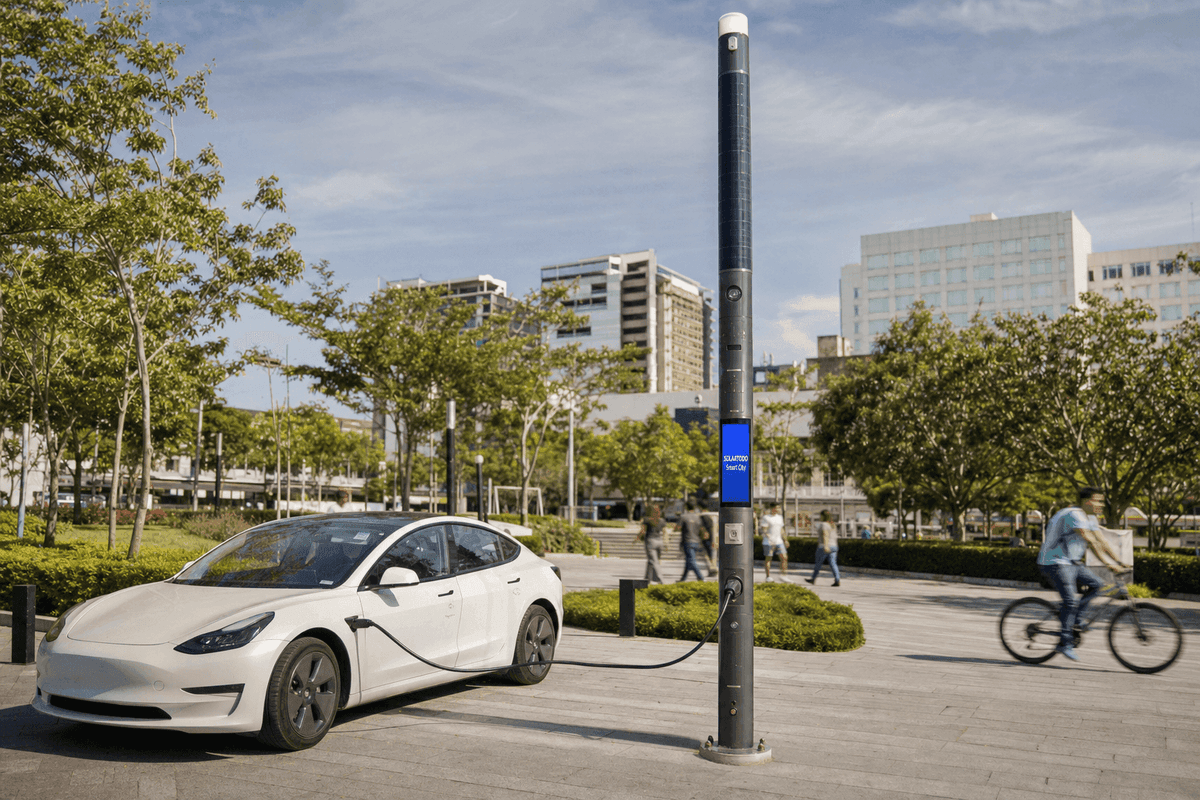
Tegucigalpa’s dense urban corridors, 25 m streetlight spacing, and growing public-space digitization needs support a typical 180-unit smart streetlight scheme using 6 m Ø400 mm cylindrical poles, 60 W/9,000 lm lighting, and 7 kW dual-outlet EV charging with 1,800 Wh LFP backup.
Key Takeaways
- A typical Tegucigalpa corridor-scale scheme would use approximately 180 smart streetlights at 25 m spacing, covering about 4.5 km of urban roadway with consistent lighting and digital service nodes.
- The recommended form factor is the SOLAR TODO Smart Streetlight in 6 m seamless cylindrical Ø400 mm steel, because flush-mounted modules reduce sidewalk obstruction on narrower city streets.
- Each pole would carry a 60 W / 9,000 lm / 4,000 K top luminaire, which aligns with urban pedestrian-road applications rather than highway lighting classes above 12 m.
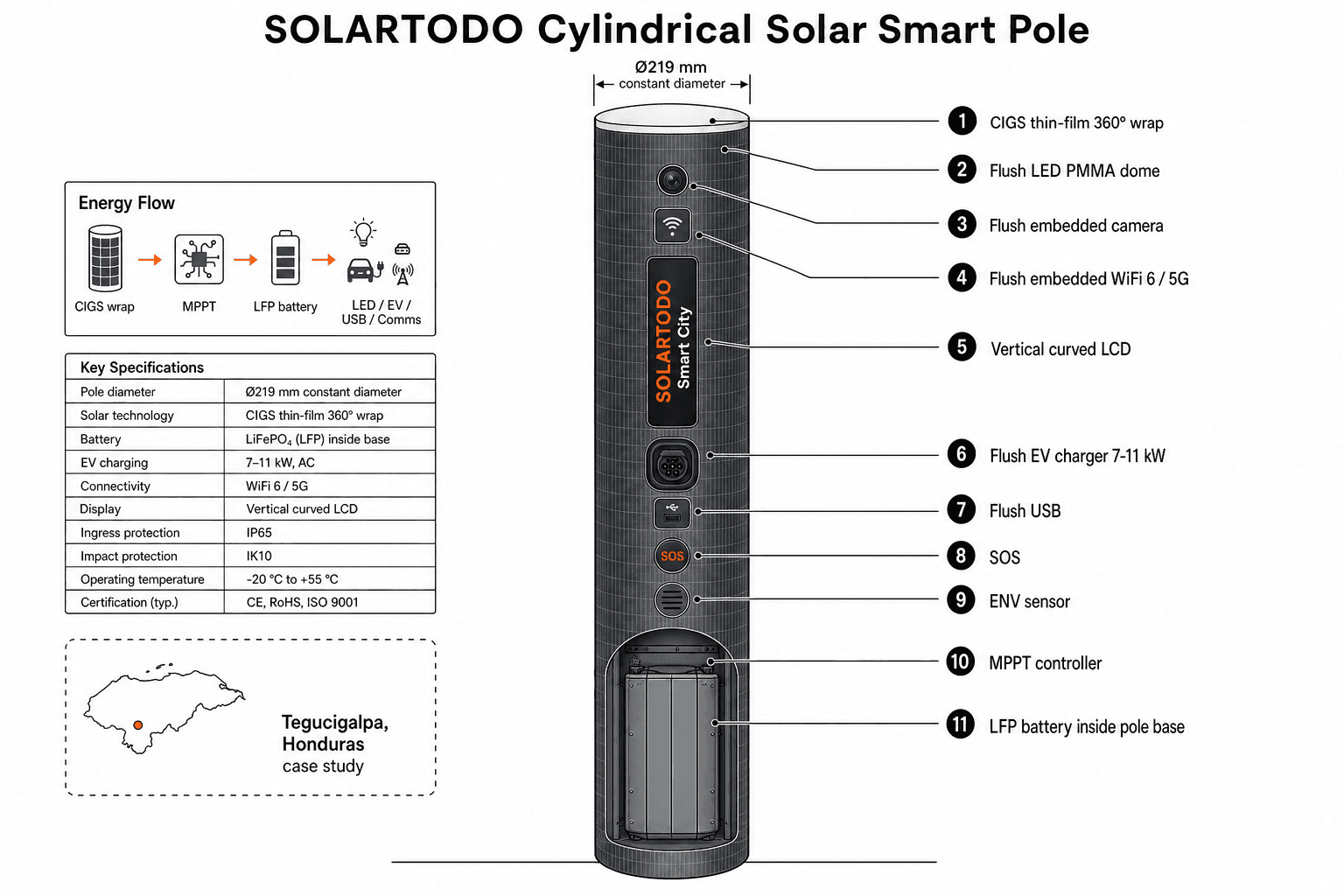
- The specified solar layer is ~219 W CIGS thin-film, wrapped 360° around the pole between 6.5 m and 5.3 m, with 1,800 Wh LFP storage and MPPT inside the base.
- Communications are suited to mixed municipal use: embedded WiFi 6 + 5G, a 4 MP IR 50 m flush camera, and a 4-parameter sensor for temperature, humidity, wind speed, and noise.
- The embedded EV module is a 7 kW dual-outlet charger with Type 2 + Type 1 interfaces, a 5 m coiled Type 2 cable, and a flush touchscreen at 1.5 m height.
- According to the World Bank (2023), Honduras remains highly urbanizing, while ITU (2023) data indicates sustained mobile-broadband growth; this supports multi-function poles that combine lighting, connectivity, and emergency access in one asset.
- For procurement, SOLAR TODO should be evaluated as a street-class smart pole system under IEC 60598 and GB/T 37024, not as a park light, billboard mast, or highway high-mast structure.
Market Context for Tegucigalpa
Tegucigalpa combines high urban density, steep topography, and mixed-use arterial streets, making 6 m street-class smart poles with 25 m spacing more suitable than highway-class 12 m poles for many central corridors.
Tegucigalpa is Honduras’s largest urban center and the administrative core of the Distrito Central. According to the Instituto Nacional de Estadística de Honduras (INE) and World Bank urbanization datasets, Honduras is now more than 58% urban, and the capital region concentrates a large share of public services, traffic demand, and municipal infrastructure pressure. That matters because smart streetlight selection in this market is driven less by rural electrification and more by corridor management, public safety, and digital access within built-up districts.
Climate and terrain also shape the correct smart pole class. Tegucigalpa sits near 14.07, -87.19, at elevated terrain with a tropical savanna to subtropical highland pattern, and the city experiences a pronounced wet season from roughly May to October. According to NASA POWER (2024), central Honduras receives useful annual solar resource, but cloud variability and rainfall make hybridized low-power auxiliary generation plus battery backup more practical than relying on solar alone for all loads. For this reason, a wrapped CIGS layer plus 1,800 Wh LFP storage is a sensible assistive power architecture for sensors, communications, display, and emergency functions.
Street geometry is the second key factor. Many Tegucigalpa corridors have constrained sidewalks, bus activity, frontage access, and visual clutter from utility lines, signs, and transport stops. A monolithic Ø400 mm cylindrical pole with all modules flush-integrated into the skin avoids side-arm accessories, separate EV pedestals, and external cabinets that would otherwise consume pedestrian space. For B2B buyers comparing options, this is a practical urban-design advantage rather than a cosmetic one.
Telecom demand supports the communications package. According to ITU (2023), mobile broadband remains the primary digital access layer across Latin America, and city furniture increasingly serves as a host for WiFi offload, edge sensors, and future small-cell densification. A smart streetlight with embedded WiFi 6 + 5G and internal antennas gives municipalities and concessionaires a cleaner path to phased digital service expansion without adding a second street asset every 25-50 m.
Public safety is another local driver. The Inter-American Development Bank and regional urban safety studies repeatedly note that lighting quality, emergency contact points, and visible surveillance infrastructure affect citizen perception of security in dense urban areas. A flush 4 MP camera, SOS button, and dual-way intercom can therefore be justified as part of a street operations package, especially on corridors with transit transfer, civic buildings, or evening foot traffic.
Two standards references are important at the planning stage. According to IEC (2020), IEC 60598 defines safety requirements for luminaires, while China’s GB/T 37024 covers smart multifunction poles used in urban digital infrastructure. SOLAR TODO should therefore be specified as a standards-based smart streetlight platform for municipal streets, not as decorative lighting or a telecom-only mast.
View the Smart Streetlight product page or contact us for corridor-specific layout support.
Recommended Technical Configuration
For Tegucigalpa’s urban corridors, the best-fit configuration is approximately 180 units of 6 m Ø400 mm cylindrical smart streetlight at 25 m spacing, covering about 4.5 km with lighting, connectivity, emergency call, and embedded EV charging.
A typical 180-unit deployment of this scale would suit a municipal avenue bundle, mixed-use boulevard program, university district, or civic corridor package. The selected form should be the SOLAR TODO Smart Streetlight in the [V:cyl219] configuration because the product geometry matches street-class deployment requirements: 6 m total height, Ø400 mm constant diameter from top to bottom, and a monolithic cylindrical body with no side arms, no external loudspeaker columns, and no separate charging bollard.
This size class fits Tegucigalpa better than a 12 m octagonal pole in locations where sidewalks are narrow and visual clutter is already high. The city does have arterial roads that may justify taller poles, but the provided configuration is more appropriate for central urban streets, frontage roads, institutional districts, and redevelopment corridors where spacing is 25 m and the pole must combine several functions in one footprint. In short, it is a street furniture asset first, not a highway mast.
The recommended quantity is approximately 180 units because that aligns directly with the supplied spacing logic. At 25 m center-to-center, 180 poles correspond to roughly 4,500 m of roadway coverage, assuming a single-line corridor or segmented urban package. Buyers can scale the same specification to 90 units for about 2.25 km or 360 units for about 9 km without changing the electrical or communications architecture.
For lighting, the top luminaire should remain the specified Ø400 mm multi-ring glow column with 3-5 rings over the top 1.5 m, delivering 60 W, 9,000 lm, and 4,000 K. This output is appropriate for pedestrian-priority and mixed-traffic streets, where uniformity, glare control, and recognizable smart-pole identity are more important than long-throw highway optics. According to IEA (2022), LED streetlighting commonly cuts electricity use by 50-70% versus legacy sodium systems, so this wattage class is commercially reasonable when replacing older 100-250 W fixtures.
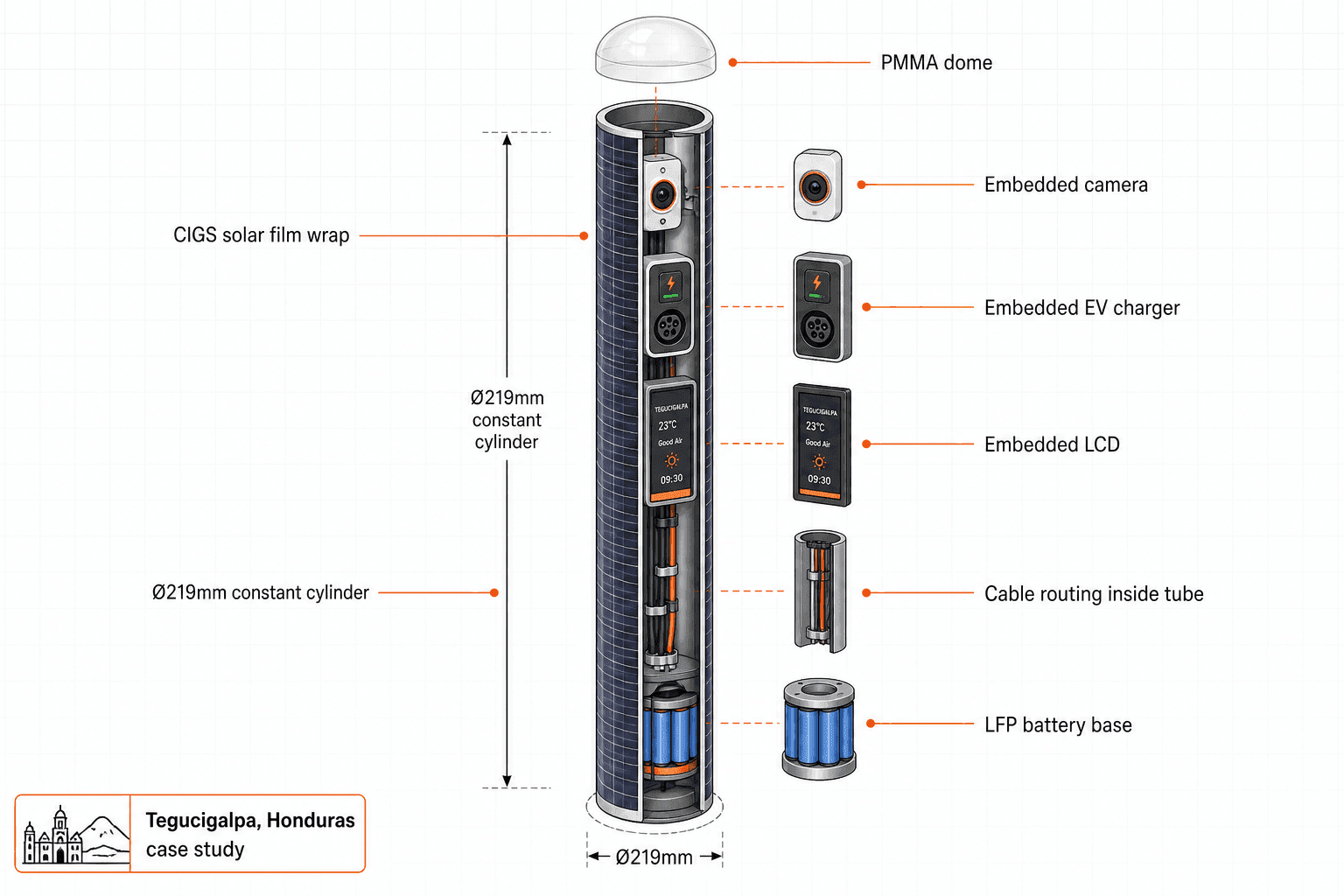
For auxiliary power, the pole should keep the specified ~219 W CIGS flexible thin-film solar wrap around the mid-section from 6.5 m to 5.3 m, laminated flush to the cylinder skin. This is not intended to run the full EV charger continuously from solar; rather, it supports low-voltage electronics, resilience functions, and partial energy offset. The internal 1,800 Wh LFP battery with MPPT helps maintain communications, SOS, sensor logging, and display continuity during short grid interruptions.
The communications and security stack should remain fully embedded. That means a 4 MP IR 50 m flush bullet camera behind a rectangular glass window, a 4-parameter sensor pod on the dome top, embedded WiFi 6 + 5G, and a flush SOS button with dual-way audio through a pinhole grille. This configuration is suitable for municipal command integration, district monitoring, and public WiFi extension without external boxes that create maintenance points.
The EV charging function should also remain exactly as specified: a fully flush 7 kW dual-outlet charger with Type 2 + Type 1 interfaces, a 5 m coiled Type 2 cable, and a flush touchscreen at 1.5 m. In Honduras, EV adoption is still early-stage, but corridor charging visibility can support municipal fleet pilots, hospitality zones, and demonstration districts without requiring a separate charging pedestal at every location.
Technical Specifications
The Tegucigalpa-recommended specification is a 6 m monolithic Ø400 mm cylindrical smart streetlight with 60 W lighting, ~219 W CIGS wrap, 1,800 Wh LFP backup, 7 kW embedded charging, and fully flush digital modules.
- Quantity basis: approximately 180 units for a corridor package
- Pole height: 6 m
- Pole form: seamless cylindrical steel pole, constant Ø400 mm top-to-bottom
- Wall thickness: 5 mm
- Material finish: hot-dip galvanized steel + RAL7016 dark grey powder coat
- Structural concept: one monolithic cylinder; no side arms, no luminaire outriggers, no external boxes, no widened base, no separate bollard
- Lighting head: top-mounted Ø400 mm multi-ring glow column
- Luminous structure: 3-5 rings over top 1.5 m with graduated brightness
- LED rating: 60 W, 9,000 lm, 4,000 K
- Solar element: ~219 W CIGS flexible thin-film cells
- Solar mounting: 360° wrapped around pole mid-section from 6.5 m to 5.3 m, dark blue-black semi-transparent film, laminated flush
- Battery: 1,800 Wh LFP inside base with MPPT
- Environmental sensing: 4-parameter sensor for temperature, humidity, wind speed, and noise
- Camera: flush bullet camera behind rectangular glass, 4 MP, IR 50 m
- Communications: embedded dual-mode WiFi 6 + 5G with internal antennas
- Emergency module: flush SOS button + dual-way audio intercom through pinhole speaker grille only
- EV charging: fully embedded 7 kW dual-outlet charger
- Connector types: Type 2 + Type 1 with two flush flip-caps
- Cable provision: 5 m coiled Type 2 cable
- User interface: flush touchscreen at 1.5 m mounting height
- Display: curved portrait LCD, 2200 mm tall × ~170 mm wide, bent to Ø400 mm radius, flush inset on front face only
- Display content restriction: text only — “SOLARTODO Smart City” stacked vertically, white sans-serif on deep blue, no ads, no video, no imagery
- USB charging: USB-A ×2 flush ports
- Typical spacing: 25 m
- Applicable standards: IEC 60598, GB/T 37024
Implementation Approach
A Tegucigalpa rollout of 180 units would typically be delivered in 4 phases over roughly 20-32 weeks, covering survey, civil works, pole installation, and systems commissioning.
Phase 1 is corridor definition and utility coordination. For a 180-unit package, this usually takes 4-6 weeks and includes geotechnical spot checks, right-of-way confirmation, feeder access review, and communications backhaul planning. In Tegucigalpa, this step matters because road cross-sections vary sharply between civic avenues, hillside connectors, and mixed commercial streets, and foundation design must reflect local soil and drainage conditions.
Phase 2 is manufacturing and logistics. A cylindrical pole with flush modules requires tighter fabrication control than a standard octagonal lighting pole because the charger door geometry, display recess, camera window, and sensor interfaces must all align within the Ø400 mm shell. Depending on shipping mode and factory queue, buyers should expect about 8-14 weeks for production, FAT documentation, export packing, and ocean freight to Honduras.
Phase 3 is civil and electrical installation. At 25 m spacing, a 180-pole line implies repeated trenching, foundations, conduit runs, and feeder terminations across about 4.5 km. A practical sequence is to complete foundations and conduits first, then set poles in batches of 20-40 units, followed by charger energization, communications activation, and lighting tests. This reduces idle time and keeps traffic management simpler.
Phase 4 is software commissioning and acceptance testing. The municipality or integrator would typically verify illuminance consistency, camera streams, SOS call routing, WiFi authentication, charger billing logic, and battery-backed failover behavior. According to IEC practice for luminaire and control systems, acceptance should include insulation, grounding, functional testing, and records for future maintenance intervals of 6-12 months.
For procurement planning, CKD/SKD strategies can also be considered where import duties, local assembly rules, or port handling make partial local integration more efficient. SOLAR TODO can support this through product-level documentation and quotation pathways via the contact page.
Expected Performance & ROI
For Tegucigalpa, a 180-unit smart streetlight package would typically improve lighting efficiency by 50-70%, reduce separate street-furniture count by combining 5-6 functions per pole, and target a blended payback commonly in the 5-9 year range depending on energy tariffs and telecom or charging revenue.
The baseline energy case is straightforward. If an older corridor uses 150 W legacy luminaires and the replacement pole uses 60 W LED output, fixture demand falls by about 60% before controls are considered. According to the IEA (2022), LED streetlighting projects often reduce electricity use by 50-70%, and additional dimming can push savings further where traffic declines after midnight. In a 180-unit corridor, that reduction can materially lower municipal operating expense.
The second value driver is asset consolidation. A standard urban corridor may otherwise require separate lighting poles, CCTV mounts, emergency call boxes, public WiFi housings, and EV pedestals. Consolidating these into one Ø400 mm pole reduces the number of civil foundations, utility handoffs, and visual obstacles. According to NREL (2023), integrated curbside charging and smart-city infrastructure can reduce duplicated site work and improve utilization of existing urban electrical assets when properly planned.
The third value driver is resilience. The ~219 W CIGS wrap and 1,800 Wh LFP battery are not substitutes for grid supply to the 7 kW EV charger, but they do support continuity for lower-power electronics during outages. In a city where weather events and localized grid interruptions can affect service reliability, maintaining SOS, communications, and monitoring functions has operational value beyond direct energy savings.
A realistic payback range depends on local tariff structure, maintenance practice, and monetization of non-lighting functions. If the project is evaluated on lighting energy savings alone, payback may be longer. If the municipality or private operator also values reduced hardware clutter, telecom hosting, public WiFi, EV charging fees, and improved safety operations, a 5-9 year blended payback is commercially plausible for a corridor-scale deployment. Precise modeling should use local utility tariffs, charger utilization assumptions, and maintenance labor rates.
Results and Impact
For Tegucigalpa, the main impact of this specification is not headline wattage alone but the ability to place lighting, charging, surveillance, emergency contact, and connectivity into one 6 m street asset every 25 m.
That matters in practical urban terms. A corridor of 180 units can create a visible, repeatable digital streetscape over about 4.5 km, while keeping the sidewalk cleaner than a mixed arrangement of poles, cabinets, speakers, and charging pedestals. The specified vertical LCD is intentionally limited to “SOLARTODO Smart City” text only, which helps buyers considering civic branding without opening a second commercial-advertising workflow.
The configuration also aligns with phased procurement. A city could start with 60 units on a priority avenue, expand to 180 units across a district, and later standardize software and maintenance across a larger portfolio. Because the core geometry and module layout stay fixed at Ø400 mm and 6 m, spare parts, training, and inspection routines remain more consistent than in mixed-pole fleets.
As the market matures, the same smart streetlight platform can support stricter SLAs for uptime, charger availability, and public safety response. For Tegucigalpa, that makes the SOLAR TODO Smart Streetlight a practical urban infrastructure option rather than a single-function lighting replacement.
Comparison Table
The table below compares the recommended Tegucigalpa cylindrical smart streetlight against a conventional 6-8 m LED pole and a 12 m multifunction octagonal pole for typical urban use.
| Metric | Recommended Tegucigalpa Spec | Conventional LED Street Pole | 12 m Multifunction Pole |
|---|---|---|---|
| Pole height | 6 m | 6-8 m | 12 m |
| Pole diameter/form | Ø400 mm constant cylindrical | Tapered/octagonal, variable | Octagonal tapered |
| Lighting output | 60 W / 9,000 lm / 4,000 K | 80-150 W typical | 80-150 W typical |
| Solar support | ~219 W CIGS wrap | None | Optional hybrid on some models |
| Battery backup | 1,800 Wh LFP | None or external UPS | Model-dependent |
| Camera | 4 MP IR 50 m flush | Often separate bracket mount | Usually bracket or cabinet-based |
| Connectivity | Embedded WiFi 6 + 5G | Usually none | Optional |
| Emergency call | Flush SOS + intercom | Separate call box required | Optional module |
| EV charging | Embedded 7 kW dual outlet | Separate charger pedestal needed | Integrated on some 12 m models |
| Street clutter | Low; one monolithic asset | Medium to high | Medium |
| Best use case | Dense urban corridors | Basic roadway lighting | Wider roads, traffic corridors |
| Standards basis | IEC 60598, GB/T 37024 | IEC 60598 typical | IEC 60598, GB/T 37024 |
Pricing & Quotation
SOLAR TODO offers three pricing tiers for this product line: FOB Supply (equipment ex-works China), CIF Delivered (including ocean freight and insurance), and EPC Turnkey (fully installed, commissioned, with 1-year warranty). Volume discounts are available for large-scale deployments. Configure your system online for an instant estimate, or request a custom quotation from our engineering team at [email protected].
Frequently Asked Questions
This FAQ answers 10 common Tegucigalpa procurement questions covering specifications, installation, ROI, maintenance, warranty, and EPC scope for a 180-unit smart streetlight program.
Q1: Why is a 6 m cylindrical pole recommended for Tegucigalpa instead of a 12 m smart pole?
A 6 m pole fits dense urban corridors with tighter sidewalks and shorter lighting intervals of about 25 m. The supplied Ø400 mm cylindrical form keeps all modules flush inside one body, which reduces street clutter. A 12 m pole is more suitable for wider traffic corridors, not for many central streets in Tegucigalpa.
Q2: Can the ~219 W CIGS solar wrap power the full 7 kW EV charger?
No. The wrapped CIGS layer is an auxiliary energy source for low-power systems such as sensors, communications, display, and emergency functions. The 7 kW charger is fundamentally a grid-supplied feature. The internal 1,800 Wh LFP battery supports resilience and short-duration backup rather than full vehicle charging autonomy.
Q3: What deployment timeline is typical for approximately 180 units?
A practical range is about 20-32 weeks, depending on permitting, civil complexity, and shipping conditions. Survey and utility coordination often take 4-6 weeks, manufacturing and logistics 8-14 weeks, and installation plus commissioning another 6-12 weeks. Corridor phasing in batches of 20-40 poles usually improves traffic control and acceptance testing.
Q4: What standards should buyers request in the technical file?
At minimum, buyers should request compliance documentation aligned with IEC 60598 for luminaire safety and GB/T 37024 for multifunction smart poles. They should also ask for galvanization, coating, battery, charger, and ingress-protection details, plus grounding and electrical test records for each installed circuit and pole batch.
Q5: What ROI range is realistic for this type of smart streetlight in Tegucigalpa?
If the project is judged only on lighting electricity savings, payback may be moderate. If the business case includes reduced legacy power use, fewer separate street assets, lower maintenance visits, public WiFi value, charger revenue, and security functions, a blended payback in the 5-9 year range is a reasonable planning assumption.
Q6: How much maintenance would a 180-unit system need each year?
Most operators should plan preventive maintenance every 6-12 months, with more frequent checks for chargers and communications. Routine work includes cleaning camera windows, checking charger caps and cable condition, confirming battery health, testing SOS audio, and verifying display and network uptime. Flush modules usually reduce accidental damage compared with bracket-mounted accessories.
Q7: How does this compare with a conventional LED streetlight pole?
A conventional pole normally provides lighting only, so CCTV, WiFi, emergency call, and EV charging require separate assets and separate civil works. This Ø400 mm smart streetlight combines those functions into one 6 m structure. That can reduce sidewalk clutter and simplify corridor planning, although initial capex is higher than basic lighting-only poles.
Q8: Does SOLAR TODO offer EPC or supply-only quotation models?
Yes. Procurement can typically be structured as FOB supply, CIF delivered, or EPC turnkey depending on the buyer’s scope. The right model depends on whether the municipality or contractor wants to handle foundations, cabling, and commissioning locally. For project-specific scope definition, buyers should use the quotation channel on /contact.
Q9: What warranty terms are normally expected?
The pricing section specifies EPC turnkey with a 1-year warranty. In practice, buyers should also ask for component-level warranty schedules covering LED modules, charger electronics, battery, display, and communications hardware, because these subsystems can carry different service terms and replacement procedures.
Q10: Is installation difficult because all modules are flush-integrated into the cylinder?
Installation is more exact than for a simple light pole, but it is not unusual for integrated smart-city hardware. The main requirements are accurate foundations, proper cable routing, grounding, and careful commissioning of the charger, camera, display, and communications. The benefit is a cleaner finished asset with fewer exposed accessories and fewer collision points.
References
This market analysis uses public standards and infrastructure sources including IEC, IEA, ITU, NREL, NASA POWER, World Bank, and Honduras statistical data to support the Tegucigalpa configuration.
According to IEA (2022), LED public lighting programs commonly deliver major electricity savings when replacing legacy fixtures. ITU states, "Mobile broadband networks are now the main way most people access the Internet," which supports embedded WiFi and 5G readiness in urban poles. IEC states that luminaires must satisfy defined electrical safety requirements under IEC 60598.
- International Electrotechnical Commission (IEC) (2020): IEC 60598 luminaires standard covering safety and performance requirements for lighting equipment.
- Standardization Administration of China (SAC) (2018): GB/T 37024 smart multifunction pole framework for urban integrated pole systems.
- International Energy Agency (IEA) (2022): LED lighting efficiency benchmarks showing 50-70% energy savings versus conventional streetlighting in many retrofit cases.
- International Telecommunication Union (ITU) (2023): ICT and mobile broadband statistics for Latin America; supports demand for embedded connectivity and urban wireless nodes.
- National Renewable Energy Laboratory (NREL) (2023): Public charging and urban curbside infrastructure guidance relevant to integrated EV charging on street assets.
- NASA POWER (2024): Solar resource and climate datasets for coordinates near 14.07, -87.19, supporting Tegucigalpa solar-assist design assumptions.
- World Bank (2023): Honduras urban population and infrastructure context, supporting concentration of municipal service demand in major cities.
- Instituto Nacional de Estadística de Honduras (INE) (latest available): Demographic and municipal statistical context for Distrito Central and Tegucigalpa planning.
Equipment Deployed
- 180 × 6 m seamless cylindrical steel smart streetlight poles, constant Ø400 mm, 5 mm wall, hot-dip galvanized, RAL7016 dark grey powder coat
- Top luminaire: Ø400 mm multi-ring glow column, 3-5 rings over top 1.5 m, 60 W, 9,000 lm, 4,000 K
- CIGS flexible thin-film solar wrap, 360° around pole section from 6.5 m to 5.3 m, approximately 219 W total
- LFP battery pack, 1,800 Wh, integrated inside pole base with MPPT controller
- 4-parameter environmental sensor pod, flush top-mounted, measuring temperature, humidity, wind speed, and noise
- Flush camera module behind rectangular glass window, 4 MP, IR range 50 m
- Embedded dual-mode WiFi 6 + 5G communications module with internal antennas
- Flush SOS button with dual-way audio intercom via pinhole speaker grille
- Embedded 7 kW dual-outlet EV charger with Type 2 + Type 1 interfaces and two flush flip-caps
- 5 m coiled Type 2 charging cable
- Flush touchscreen interface mounted at 1.5 m height
- Curved vertical LCD display, 2200 mm × approximately 170 mm, inset to Ø400 mm radius, text-only content
- USB-A charging ports ×2, flush-mounted
- Standards package aligned with IEC 60598 and GB/T 37024