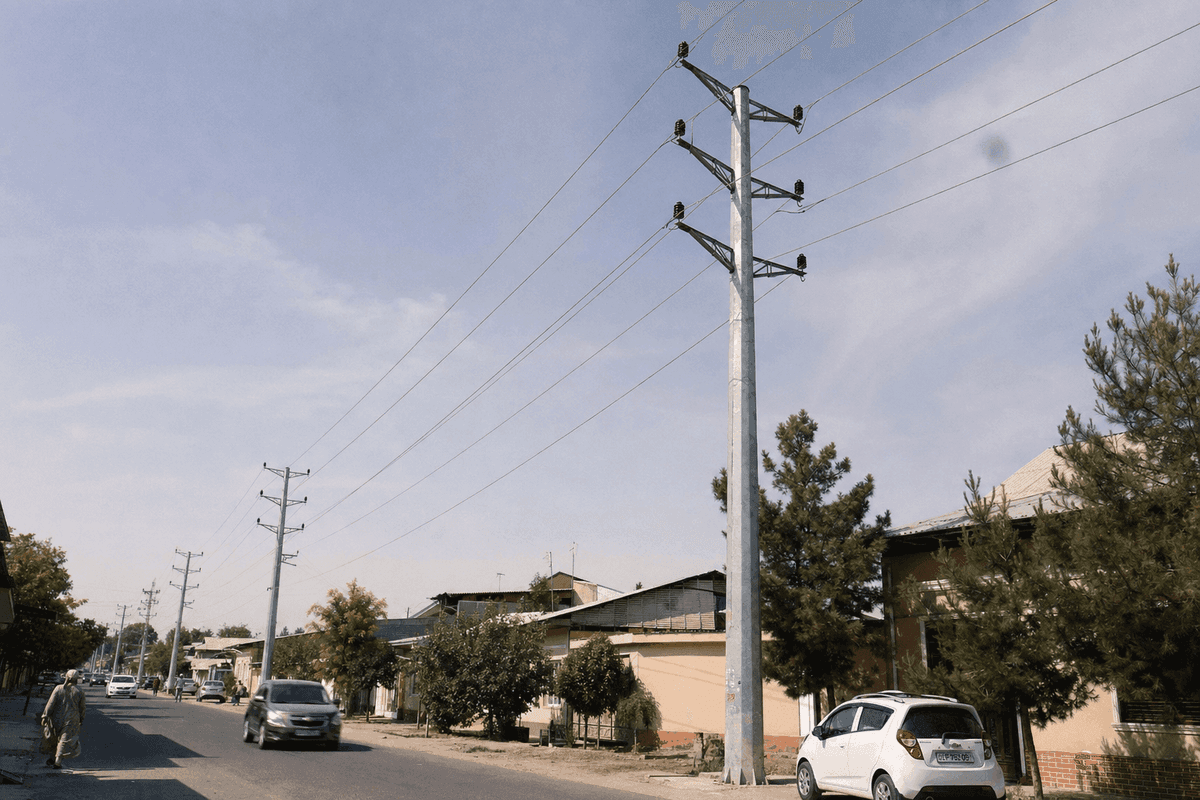
Tashkent Power Transmission Tower Market Analysis: 10kV Distribution Configuration Guide
Summary
Tashkent’s urban distribution profile supports a 10kV medium-voltage Power Transmission Tower class using approximately 237 units of 18m steel tubular poles over about 14km, with 60m spans, ACSR 120 conductor, and wind design at 40m/s under IEC 60826 and GB 50545.
Key Takeaways
- A typical Tashkent municipal distribution corridor of this scale would use approximately 237 units across ~14km, based on the provided 60m span layout.
- The recommended structure class is 10kV single-circuit with 18m tapered steel tubular poles, which fits the 10-35kV / 12-18m distribution range.
- The specified conductor is ACSR 120, rated here at 470kg/km with maximum tension 38kN, suitable for medium-load urban feeders.
- The proposed pole material is hot-dip galvanized Q345 steel, with design life 30 years and accessories including bird guards, vibration dampers, grounding, and climbing steps.
- Wind loading should be checked to Wind Class 4 (40m/s), which is relevant for exposed corridors and open sections around Tashkent’s expanding peri-urban districts.
- Electrical clearances in this configuration include 0.8m phase spacing, 0.5m insulator length, and 5m ground clearance for municipal distribution routing.
- A spread footing foundation is the stated base solution, but geotechnical verification should confirm soil bearing capacity, groundwater level, and frost-depth conditions before IFC drawings.
- For B2B buyers in Uzbekistan, SOLAR TODO should be assessed against compliance with IEC 60826, GB 50545, galvanizing quality, bolt-section logistics, and local utility approval requirements.
Market Context for Tashkent
Tashkent is Uzbekistan’s largest city, and its power distribution demand is shaped by dense urban load, industrial zones, and continued expansion of suburban residential districts around coordinates 41.3, 69.28. According to the Statistics Agency under the President of the Republic of Uzbekistan (2024), Tashkent city has a population above 3 million, making it the country’s largest concentrated electricity demand center. According to the World Bank (2022), Uzbekistan continues grid modernization efforts to reduce losses and improve reliability, which directly supports replacement of older distribution structures with standardized steel pole systems.
Climate and wind exposure matter for pole selection in Tashkent. According to Climate-Data.org (2024), Tashkent has hot summers with July average temperatures above 27°C and winter lows near or below freezing, so corrosion protection and thermal movement must be considered in line hardware and foundation design. According to IEC 60826, overhead line design must account for wind, conductor tension, and climatic loading; for this profile, 40m/s wind class is a conservative planning basis for municipal distribution sections with open exposure.
The city’s network profile is also relevant. Uzbekistan’s urban distribution systems commonly use 6kV, 10kV, and 35kV classes for medium-voltage feeders, with higher voltage transformation at substation level before downstream distribution. Based on this structure, a Tashkent feeder extension or municipal line rehabilitation program would typically point to a 10kV distribution solution rather than a 110kV or 220kV transmission structure. That distinction is important because the correct pole class for 10-35kV is 12-18m height with 1-3 t/pole in the standard product table, even though the project-specific configuration supplied here defines an 18m municipal pole design.
According to the International Energy Agency (2023), electricity demand in Central Asia is rising with urbanization, electrification, and industrial activity. For Tashkent, this means medium-voltage corridors need to balance compact urban routing, moderate span lengths, and faster installation than lattice alternatives in constrained streets or utility easements. SOLAR TODO’s Power Transmission Tower line is therefore most relevant in its steel tubular municipal-distribution form, not as a high-voltage lattice substitute.
The standards environment also supports this approach. IEC states, "IEC 60826 specifies loading and strength requirements for overhead lines," which is directly applicable to wind, conductor, and structural verification. The World Bank notes that improving network reliability in Uzbekistan requires "modernization of transmission and distribution infrastructure," reinforcing the case for standardized, corrosion-protected steel poles in city-grid reinforcement programs.
Recommended Technical Configuration
A typical Tashkent 10kV feeder deployment of this profile would consist of approximately 237 steel tubular poles at 18m height over about 14km, using 60m spans, ACSR 120 conductor, and spread footings for municipal distribution routing.
Based on the provided project-specific configuration and Tashkent’s city-grid profile, the recommended SOLAR TODO Power Transmission Tower solution is a medium-voltage municipal distribution line using 18m tapered steel tubular poles in single-circuit 10kV arrangement. This fits the upper end of the allowed 10-35kV / 12-18m class and avoids the engineering error of oversizing into 66kV or 220kV geometry. The design intent here is not bulk long-span transmission; it is urban and peri-urban feeder continuity with predictable erection logistics.
A typical deployment at this scale would use approximately 237 units to cover ~14km, assuming 60m average span and route conditions that favor shorter urban intervals. The user-provided line length and unit count imply tighter spacing than the generic 80-150m distribution benchmark, which is reasonable where road crossings, angle points, service branching, and clearance constraints increase structure density. In Tashkent, that is plausible for municipal corridors near mixed residential and industrial loads.
The recommended conductor is ACSR 120, specified here at 470kg/km and 38kN maximum tension. This conductor size is a practical fit for 10kV feeders where utilities need a balance between ampacity, sag control, and manageable hardware loads. With 0.8m phase spacing, 0.5m insulator length, and 5m ground clearance, the arrangement aligns with compact medium-voltage distribution geometry rather than sub-transmission spacing.
Material selection should remain hot-dip galvanized Q345 steel with flanged or sectional fabrication suitable for transport into urban sites. Although the generic product family includes anchor-cage concrete foundations, this project-specific configuration calls for a spread footing foundation, which can be suitable where overturning moments and soil conditions permit. SOLAR TODO should therefore present this as a city-specific recommended configuration subject to geotechnical confirmation, not as a fixed universal foundation detail.
For procurement teams, the most relevant buying criteria are galvanizing thickness control, weld quality, section straightness, bolt-hole tolerance, and accessory completeness. A complete package in this configuration would include cross arm, grounding set, climbing steps, bird guard, and vibration damper. In Tashkent, the logistics advantage of tubular poles versus lattice structures is often lower site footprint, fewer loose members, and simpler erection in constrained municipal rights-of-way.
Technical Specifications
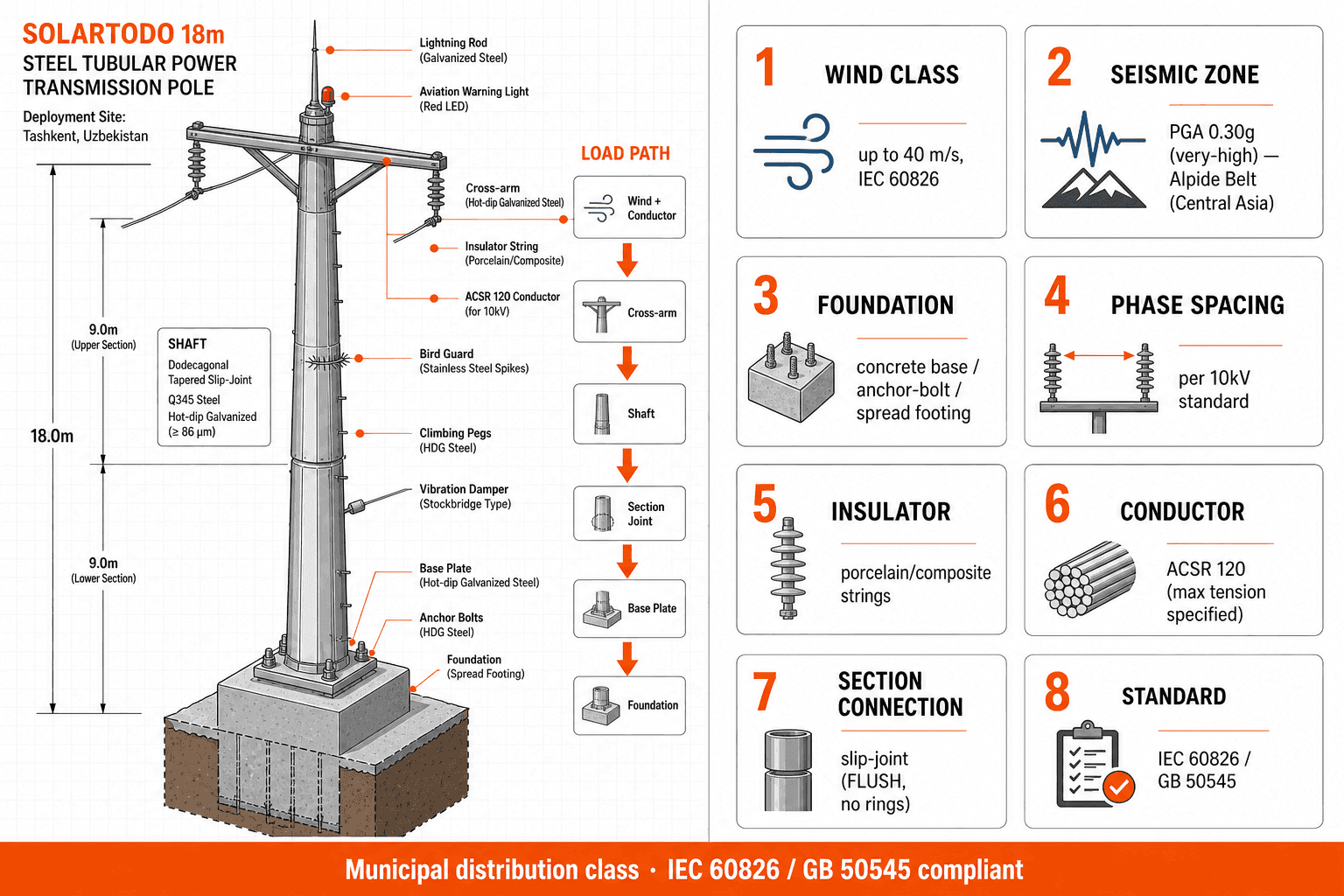
The recommended Tashkent configuration is a 10kV single-circuit steel tubular pole system using 18m Q345 hot-dip galvanized poles, 60m spans, ACSR 120 conductor, and 40m/s wind design under IEC 60826 and GB 50545.
- Product type: Steel tubular Power Transmission Tower for municipal distribution
- Voltage class: 10kV medium-voltage distribution
- Circuit configuration: Single circuit
- Pole form: 18m tapered steel tubular pole
- Material: Q345 hot-dip galvanized steel
- Approximate unit quantity: 237 poles for ~14km route length
- Pole weight (project-specific): ~7t/pole
- Linear steel reference: 400kg/m
- Conductor type: ACSR 120
- Conductor mass: 470kg/km
- Maximum conductor tension: 38kN
- Average span: 60m
- Phase spacing: 0.8m
- Ground clearance: 5m
- Insulator length: 0.5m
- Wind class: Class 4 / 40m/s
- Foundation type: Spread footing foundation
- Accessories: Cross arm, climbing steps, grounding, bird guard, vibration damper
- Design life: 30 years
- Application class: Medium-voltage municipal distribution
- Standards: IEC 60826 / GB 50545
For engineering screening, the governing class remains 10-35kV distribution, which corresponds to 12-18m height in the product selection table. That makes the 18m pole height appropriate for Tashkent’s medium-voltage feeder profile. By contrast, 66-110kV structures would require 18-30m height and a different mechanical envelope, while 220kV would move to 35-55m and much higher pole weights.
Implementation Approach
A typical Tashkent rollout would proceed in 5 phases over roughly 4 to 8 months, covering route survey, detailed design, factory fabrication, civil works, erection, and energized commissioning.
Phase 1 is route definition and utility interface. In Tashkent, this would typically include topographic survey, underground utility checks, road-crossing review, and right-of-way verification along the ~14km corridor. Wind, soil, and clearance assumptions should be validated before finalizing pole spotting at 60m nominal spans. According to IEC 60826, line reliability depends on coordinated assessment of climatic loads, terrain exposure, and mechanical safety factors.
Phase 2 is detailed electrical and structural design. This includes pole schedule, load trees, conductor sag-tension calculations for ACSR 120, foundation reactions, earthing layout, and hardware selection. For a 10kV single-circuit line, attention should focus on urban clearance compliance, angle poles, dead-end positions, and service branching. A Tashkent buyer should request calculation packages that explicitly show 38kN conductor tension assumptions and 40m/s wind verification.
Phase 3 is fabrication and logistics. Steel pole sections in Q345 should be fabricated, galvanized, and packed with traceable bolt sets and accessory kits. For city delivery, sectional tubular poles reduce transport complexity compared with lattice bundles, especially where site access is narrow. SOLAR TODO can support this stage with bill-of-material alignment, packing lists, and inspection documentation before shipment to Uzbekistan.
Phase 4 is civil works and erection. Spread footing foundations should be excavated and cast after confirming soil bearing capacity and groundwater conditions. Once concrete reaches the specified strength, crews can erect poles, mount cross-arms, string ACSR 120, install insulators, and complete grounding. In dense urban settings, erection sequencing often needs traffic management windows and staged conductor pulling to limit service disruption.
Phase 5 is testing and commissioning. This should include pole verticality checks, bolt torque verification, grounding resistance tests, conductor sag inspection, and final clearance confirmation at 5m minimum ground clearance. The line can then move to utility energization procedures. According to IEEE guidance on overhead line practice, documented inspection at handover reduces early-life faults and improves maintenance planning.
Expected Performance & ROI
For a 10kV municipal feeder in Tashkent, a galvanized steel tubular pole system would typically target 30-year service life, lower corrosion-related maintenance than untreated alternatives, and faster urban installation than multi-member lattice structures.
The main economic case is not energy generation but network reliability, maintenance reduction, and urban constructability. According to IEA (2023), distribution modernization improves service continuity and supports rising urban electricity demand. For Tashkent, a 30-year design life with hot-dip galvanizing can reduce repainting cycles and corrosion intervention compared with unprotected steel. This matters in a city where winter moisture, summer heat, and pollution can accelerate surface degradation.
Lifecycle value also comes from simpler inspection and replacement logic. A tubular 18m pole has fewer individual members and bolts than a lattice assembly, which can reduce routine visual inspection time per structure. According to NREL (2022), standardization in grid assets lowers maintenance complexity and spare-part variability across utility fleets. For a corridor using approximately 237 units, those operational savings become material over a multi-decade asset life.
From a financial perspective, utilities usually assess payback through avoided outage costs, reduced emergency repairs, and lower maintenance labor rather than direct revenue uplift. A practical planning model for Tashkent would compare steel tubular replacement against continued maintenance of aging concrete or corroded steel assets over 10 to 15 years. If outage frequency and truck-roll costs are high, the replacement case can be justified even before accounting for urban safety and clearance compliance.
SOLAR TODO should frame ROI in tender responses as a total-cost-of-ownership discussion: fabrication quality, galvanizing life, erection speed, transport efficiency, and accessory completeness. That approach is more credible for utility buyers than generic savings claims. Where the buyer needs a quantified model, a line-by-line OPEX comparison over 30 years is the correct format.
Results and Impact
For Tashkent, the expected impact of a correctly specified 10kV steel tubular line is improved feeder reliability across ~14km, standardized 18m pole geometry, and maintainable urban distribution infrastructure over a 30-year design horizon.
The first operational impact is route consistency. Using 237 matched poles with the same 18m class, 0.8m phase spacing, and common accessories simplifies inspection, spare stocking, and training for maintenance crews. That is useful in municipal systems where mixed legacy assets often create non-standard maintenance procedures.
The second impact is urban fit. A tapered tubular profile occupies less visual and physical space than many lattice alternatives, which helps on roadsides, industrial estates, and peri-urban corridors. In Tashkent, where city growth continues to push distribution extensions outward, compact foundations and sectional transport can reduce site disruption during line construction.
The third impact is compliance and durability. With IEC 60826 / GB 50545 as the design basis, 40m/s wind class, and hot-dip galvanized Q345 steel, the line would be positioned for predictable structural performance under local climatic conditions. For procurement teams, that means fewer surprises during utility review and a clearer path to acceptance testing.
Comparison Table
For Tashkent buyers, the key comparison is between a 10kV tubular municipal pole, an oversized 110kV-class pole, and a conventional lattice alternative, with the 18m tubular option being the technically correct fit.
| Parameter | Recommended Tashkent Option | Oversized Alternative | Conventional Lattice Alternative |
|---|---|---|---|
| Application | 10kV municipal distribution | 66-110kV sub-transmission class | 10-35kV possible, but less compact |
| Structure type | Tapered steel tubular pole | Taller steel tubular pole | Multi-member lattice |
| Height | 18m | 18-30m | 12-18m typical |
| Circuit | Single circuit | Single or double | Single or double |
| Conductor | ACSR 120 | Larger conductor often required | ACSR 70-240 possible |
| Typical span in this guide | 60m | 200-300m class not suitable here | 60-120m depending on route |
| Urban footprint | Low | Higher than needed | Higher due to member spread |
| Logistics | Sectional, fewer loose parts | Heavier transport burden | More loose members and bolts |
| Standards basis | IEC 60826 / GB 50545 | Different structural envelope | Varies by utility standard |
| Fit for Tashkent feeder profile | High | Low, over-specified | Medium |
Pricing & Quotation
SOLAR TODO offers three pricing tiers for this product line: FOB Supply (equipment ex-works China), CIF Delivered (including ocean freight and insurance), and EPC Turnkey (fully installed, commissioned, with 1-year warranty). Volume discounts are available for large-scale deployments. Configure your system online for an instant estimate, or request a custom quotation from our engineering team at [email protected].
Frequently Asked Questions
A Tashkent buyer typically asks about 10kV suitability, installation duration, maintenance, warranty, and quotation scope, with most answers depending on the 18m pole class, 40m/s wind design, and ~14km route conditions.
Q1: Is this Power Transmission Tower configuration suitable for Tashkent’s 10kV network?
Yes. The specified arrangement is a 10kV single-circuit medium-voltage distribution line using 18m steel tubular poles, which is within the correct 10-35kV / 12-18m class. That makes it appropriate for municipal feeders, industrial park extensions, and peri-urban distribution corridors in Tashkent.
Q2: Why use 18m poles instead of taller 24m or 40m structures?
For 10kV distribution, taller structures are usually unnecessary and increase steel tonnage, foundation loads, and visual impact. The engineering table places 10-35kV at 12-18m, so 18m is already the upper end of the correct range. A 40m pole would be a high-voltage mismatch.
Q3: What conductor is recommended for this Tashkent configuration?
The supplied configuration uses ACSR 120, listed here at 470kg/km and 38kN maximum tension. This is a practical medium-voltage choice where the utility wants balanced mechanical loading and suitable current-carrying capacity without moving into heavier sub-transmission hardware.
Q4: How long would a 14km, 237-pole project typically take to install?
A typical schedule is 4 to 8 months, depending on utility approvals, soil conditions, customs clearance, and road access. Survey and design may take 4 to 6 weeks, fabrication 6 to 10 weeks, and civil plus erection work another 6 to 12 weeks for a corridor of this scale.
Q5: What maintenance should be expected over a 30-year design life?
Routine work usually includes annual visual inspection, bolt-torque checks, grounding tests, and conductor/insulator inspection after major wind events. With hot-dip galvanized Q345 steel, maintenance is generally lighter than for unprotected steel. Utilities often schedule detailed structural review every 3 to 5 years.
Q6: How does a tubular pole compare with a lattice tower for urban Tashkent sites?
A tubular pole usually needs less site footprint, has fewer loose components, and can be easier to erect in streets or industrial corridors. Lattice structures remain useful in some applications, but for a 10kV, 18m, 60m-span municipal feeder, tubular poles are often the cleaner fit.
Q7: What should be included in an EPC quotation for this line?
An EPC quotation should separate supply, inland transport, civil works, erection, stringing, testing, and commissioning. It should also list 237 poles, ACSR 120, insulators, grounding, bird guards, vibration dampers, and all foundation assumptions. Buyers should request exclusions and geotechnical assumptions in writing.
Q8: What warranty terms are typical for this product line?
Commercial warranty terms vary by contract scope, but the pricing section here states 1-year warranty for EPC Turnkey supply. Buyers should also request documentation on galvanizing quality, material certificates for Q345 steel, and accessory compliance with the specified standards and drawings.
Q9: Can spread footing foundations be used everywhere in Tashkent?
Not automatically. Spread footings are the stated configuration, but final foundation choice depends on soil bearing capacity, groundwater, frost depth, and overturning loads. A geotechnical review should confirm whether standard footing geometry is sufficient or whether some poles need enlarged or modified foundations.
Q10: What documents should a utility or EPC contractor request before approval?
The minimum package should include general arrangement drawings, pole loading calculations, sag-tension data for ACSR 120, foundation reactions, galvanizing specification, material certificates, bolt lists, and inspection/test plans. For Tashkent projects, it is also useful to request route-specific clearance checks and erection method statements.
References
- Statistics Agency under the President of the Republic of Uzbekistan (2024): Tashkent city population statistics showing the country’s largest urban demand center.
- World Bank (2022): Uzbekistan energy sector and power network modernization priorities, including reliability and infrastructure upgrades.
- International Energy Agency (2023): Regional electricity demand growth and the role of grid modernization in emerging energy systems.
- IEC (2019): IEC 60826 overhead transmission line design criteria covering loading and strength requirements.
- GB Standard (2010): GB 50545 design code reference for overhead transmission line structures used in project specification.
- NREL (2022): Grid infrastructure standardization and lifecycle management guidance relevant to utility asset planning.
- Climate-Data.org (2024): Tashkent climate profile, including seasonal temperature conditions relevant to overhead line design.
For product-level specifications and quotation support, buyers can review the Power Transmission Tower product page or contact us for route-specific engineering input. SOLAR TODO should be evaluated on technical compliance, fabrication quality, and suitability for Uzbekistan’s municipal distribution environment.
Equipment Deployed
- 237 × 18m tapered steel tubular Power Transmission Tower poles, 10kV single circuit
- Hot-dip galvanized Q345 steel pole body, approximately 7t per pole
- ACSR 120 conductor, 470kg/km, maximum tension 38kN
- Cross arm assembly for 10kV single-circuit arrangement
- Insulator set with 0.5m insulator length
- Grounding system for each pole location
- Climbing steps for maintenance access
- Bird guard accessories for avian protection
- Vibration damper set for conductor stability
- Spread footing foundation system designed for Wind Class 4, 40m/s