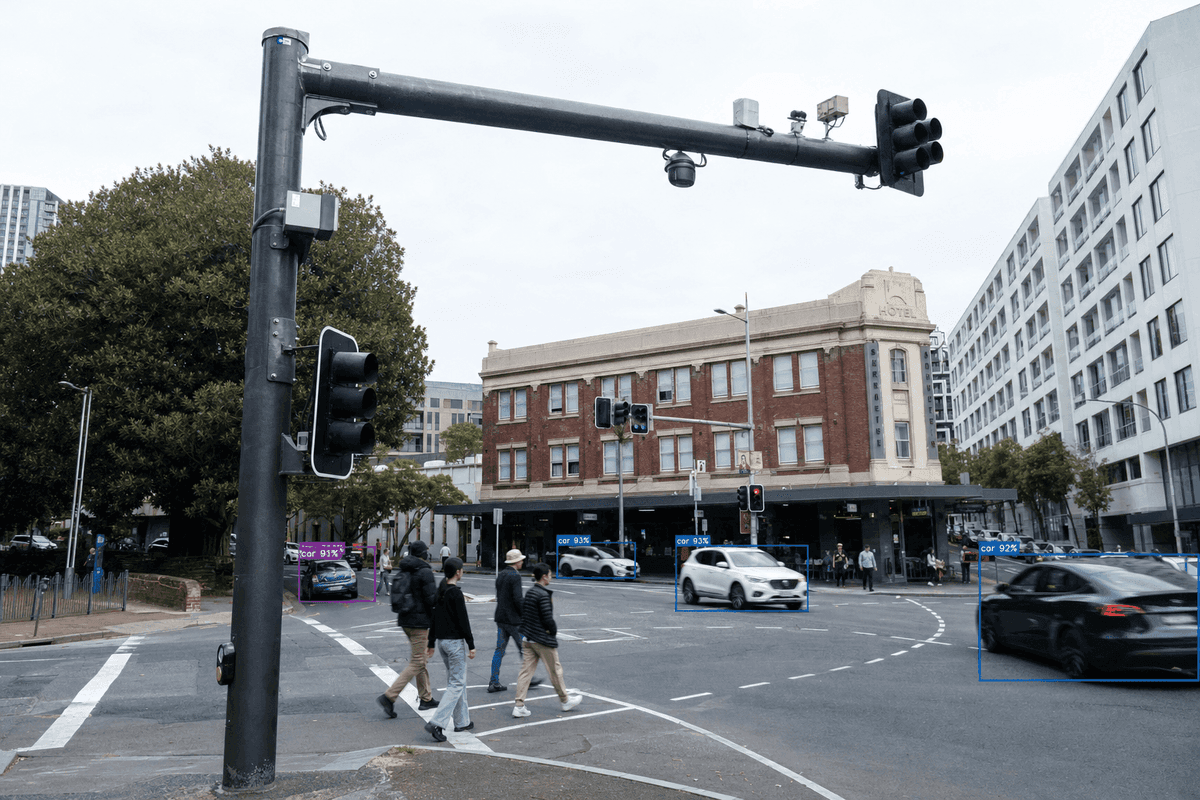
Sydney Smart Traffic System Market Analysis: 24-Intersection 6m L-Arm Pole Configuration Guide
Summary
Sydney’s 5,638,830-person metro market and 4,860 NSW traffic-signal network support a typical 24-intersection Smart Traffic System using 6m L-arm poles, 4K AI cameras, 77GHz radar, and 5G/fiber backhaul.
Key Takeaways
- A recommended Sydney configuration is a typical 24-intersection deployment using 6m dark grey hot-dip galvanized L-arm steel poles.
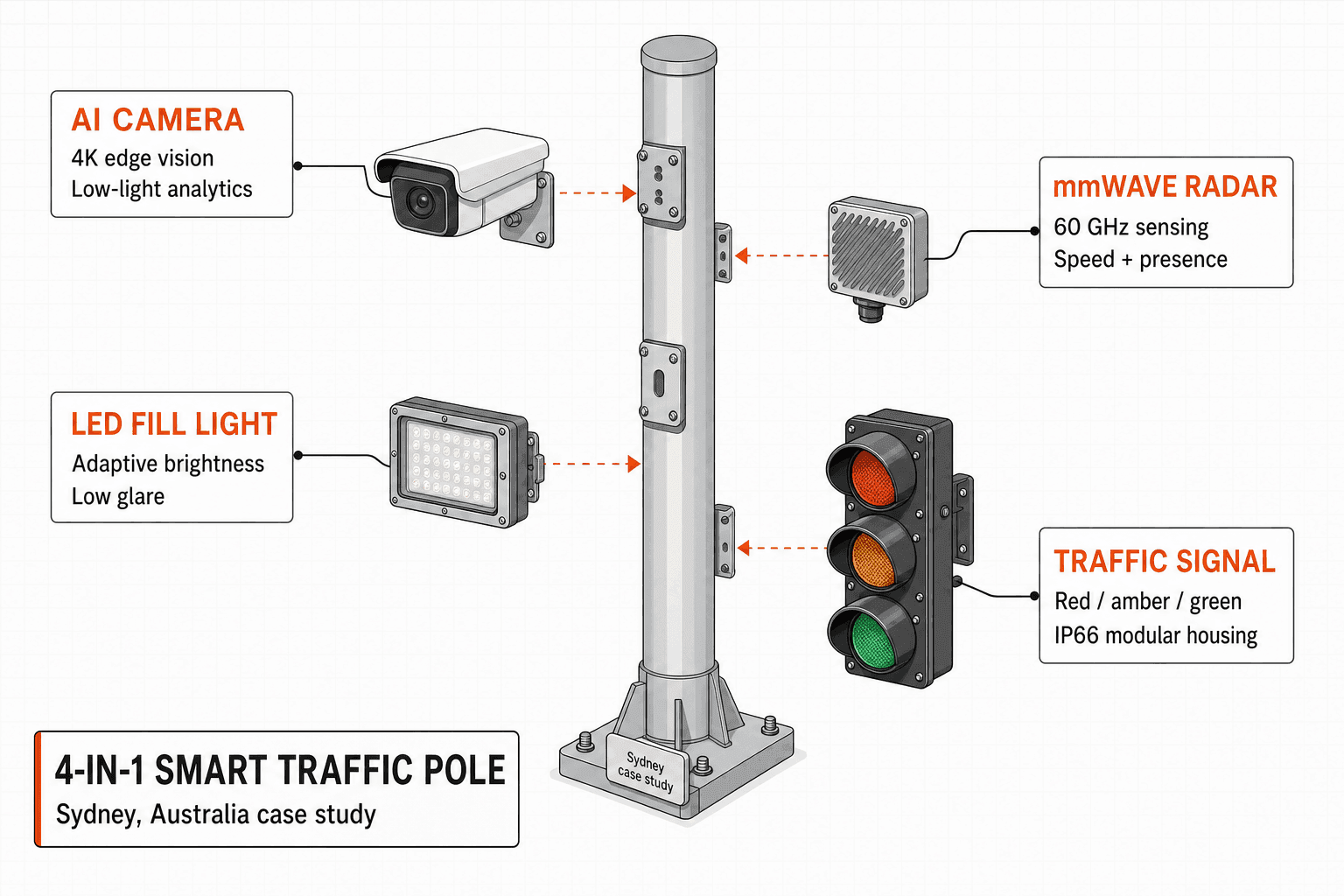
- Each pole integrates 4 always-on modules: 4K AI camera, 77GHz mmWave radar, LED fill light, and LED signal head.
- The AI camera specification is 98% detection accuracy, 45+ detection types, and less than 50ms edge response.
- A practical intersection layout uses 4-12 poles per intersection, with 6m poles suited to compact urban approaches.
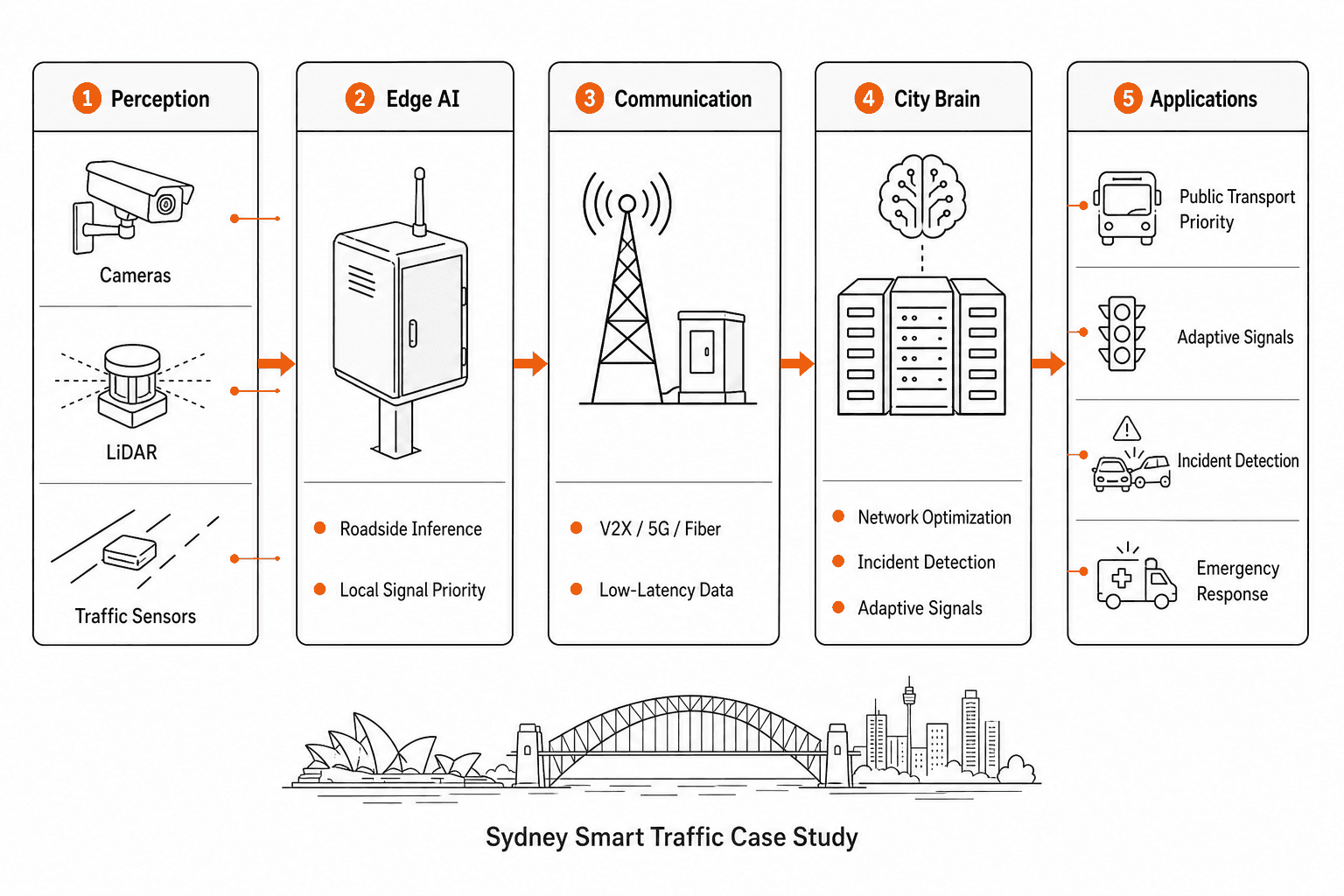
- Edge compute is NVIDIA Jetson, connecting to a 5-layer stack: Perception, Edge AI, 5G/fiber, TrafficGPT, and Apps.
- According to ABS (2026), Greater Sydney reached 5,638,830 residents at 30 June 2025 and grew by 75,230 people in one year.
- According to SCATS NSW (2022), SCATS reports 28% travel-time reduction, 25% stop reduction, 12% fuel reduction, and 15% emissions reduction.
- The commercial model for this Sydney profile is EPC turnkey, with NTCIP and GB 25280 compliance specified.
Market Context for Sydney
Sydney’s 5.64 million residents, dense CBD corridors, and mature SCATS environment make intersection sensing upgrades a stronger fit than isolated signal replacement.
Greater Sydney is Australia’s largest capital-city traffic market by functional metropolitan population. According to the Australian Bureau of Statistics (2026), Sydney had 5,638,830 residents at 30 June 2025 and added 75,230 people during the 2024-25 financial year. ABS also reports Sydney had 203 km² of high and very-high-density population grid area, the largest combined area among Australian capitals. For traffic engineering, this means the highest value sites are not only CBD arterials but also inner-city pedestrian corridors and fast-growing north-west and south-west growth areas.
Sydney already uses adaptive traffic control as a core operating layer. SCATS NSW states, “monitors, controls and optimises the movement of people and goods in cities.” According to SCATS NSW (2022), the platform has been installed at more than 60,000 intersections across 200 cities and 30 countries, and reported benchmark reductions of 28% in travel time, 25% in stops, 12% in fuel consumption, and 15% in emissions. A SOLARTODO Smart Traffic System recommendation for Sydney should therefore complement SCATS-style adaptive control, not duplicate the central signal-management layer.
Safety and pedestrian detection are also central to the Sydney use case. According to publicly reported Transport for NSW traffic-signal context, NSW had approximately 4,860 traffic signals by late 2025, and pedestrian timing improvements were applied at hundreds of intersections over the 2015-2025 period. For a city with high pedestrian density around Haymarket, Chippendale, Ultimo, Parramatta, and transport interchanges, richer roadside sensing can support pedestrian detection, incident auto-alert, and adaptive signal optimization. The technical fit is strongest where camera-only detection is vulnerable to rain, glare, occlusion, or night operation, because 77GHz radar adds non-visual motion sensing.
Recommended Technical Configuration
A typical 24-intersection Sydney package would use 6m L-arm poles with 4K vision, 77GHz radar, Jetson edge AI, and TrafficGPT backhaul.
The recommended size class is the 6m L-arm hot-dip galvanized steel pole in dark grey. Sydney’s compact signalized intersections, pedestrian-heavy crossings, bus corridors, and urban street canyons favor a lower pole height than 8m arterial or 10-12m gantry configurations. The 6m pole places the LED signal head and AI perception modules close enough for crosswalk and stop-line analytics while keeping wind load, civil works, and visual impact manageable.
A typical 24-intersection deployment of this scale would consist of approximately 4-12 poles per intersection, depending on approaches, pedestrian islands, turning lanes, and auxiliary signal heads. For budgeting and network design, planners can model a baseline of approximately 6 smart poles per intersection, then adjust after a line-of-sight and swept-path survey. SOLARTODO’s recommended configuration for this Sydney profile is 24 intersections x 6m L-arm steel pole class, dark grey, hot-dip galvanized, with a 4-in-1 Smart Traffic System module set at each selected pole location.
The technical architecture should use local edge inference first and central optimization second. Each pole runs perception from the 4K AI camera and 77GHz mmWave radar, processes events on NVIDIA Jetson, and sends metadata through 5G or fiber to the TrafficGPT central platform. TrafficGPT supports natural language queries, such as “show pedestrian near-miss alerts at Parramatta Road approaches between 7:00 and 9:00,” while the signal-control interface remains governed by local road-authority requirements and NTCIP/GB 25280 device compatibility.
Technical Specifications
The Sydney 6m specification combines 4 integrated modules, sub-50ms edge response, NTCIP interoperability, and GB 25280 signal-controller alignment.
- Product line: SOLARTODO Smart Traffic System for urban signalized intersections.
- Pole form: 6m L-arm hot-dip galvanized steel pole, dark grey finish, one base form.
- Integrated modules: 4K AI camera, 77GHz mmWave radar, LED fill light, and LED signal head.
- AI performance: 98% camera accuracy, 45+ detection types, and less than 50ms response at the edge.
- Edge AI hardware: NVIDIA Jetson for local detection, event filtering, and low-latency control messages.
- Required features: pedestrian detection, adaptive signal optimization, and incident auto-alert.
- Backhaul: dual-mode 5G/fiber backhaul to TrafficGPT central platform with natural-language query capability.
- Software stack: Perception, Edge AI, Communication, City Brain with TrafficGPT, and operational applications.
- Standards basis: NTCIP for ITS device interoperability and GB 25280 for road traffic signal controller requirements.
- Cooperation model: EPC turnkey, including engineering, procurement, installation coordination, commissioning, and 1-year warranty.
According to NTCIP (2026), NTCIP has served ITS implementation needs since 1996 and maintains standards and guides for field-device communications. NTCIP states, “Standards and other NTCIP documents... assist in implementation of NTCIP.” According to IEEE (2022), IEEE 802.3-2022 specifies Ethernet operation from 1 Mb/s to 400 Gb/s using common MAC and MIB structures, which supports fiber backhaul planning for intersection cabinets and city operation centers.
Implementation Approach
A 24-intersection Sydney rollout should be phased across 4 workstreams: survey, manufacturing, civil installation, and controlled commissioning.
The first phase is a site survey and signal-interface audit. Engineers would document approach geometry, stop-line visibility, pedestrian crossing width, existing controller cabinet type, available power, fiber handoff, 5G signal strength, and mounting constraints. The output is an intersection-by-intersection bill of materials showing where a 6m L-arm pole is sufficient and where auxiliary poles are required.
The second phase is manufacturing and pre-integration. The 6m hot-dip galvanized steel poles should be fabricated with dark grey finish, arm geometry, anchor-bolt template, signal-head interface, radar mounting points, camera bracket, fill-light position, and cabinet cabling defined before shipment. Pre-integration should include Jetson image loading, camera/radar calibration templates, TrafficGPT device registration, and NTCIP object-mapping tests.
The third phase is EPC installation. A typical sequence is foundation setting, conduit and earthing, pole erection, signal head installation, camera/radar aiming, LED fill-light verification, cabinet termination, and 5G/fiber failover testing. For Sydney, night works and staged traffic control would often be required, especially near CBD, bus-priority corridors, and school-zone crossings.
The fourth phase is commissioning and acceptance. Acceptance testing should verify pedestrian detection zones, incident alert thresholds, adaptive signal recommendations, video metadata latency, radar object tracking, fail-safe signal behavior, and TrafficGPT query retrieval. SOLARTODO’s role in an EPC turnkey configuration is best framed as equipment and engineering delivery, with final signal timing authority remaining with the relevant road operator.
Expected Performance & ROI
The expected ROI case depends on 24 intersections achieving measurable delay, stop, incident-response, and maintenance improvements over a 5-10 year lifecycle.
The strongest quantifiable benefits come from delay reduction, fewer stops, faster incident awareness, and lower manual inspection load. According to SCATS NSW (2022), SCATS benchmarks include 28% lower travel time, 25% fewer stops, 12% lower fuel consumption, and 15% lower emissions. A SOLARTODO Smart Traffic System configuration should be evaluated against site-specific before-and-after baselines, not advertised as guaranteeing those outcomes in every Sydney corridor.
For a typical 24-intersection deployment, payback can be modeled from avoided delay and operations efficiency. If an arterial corridor carries high peak-hour vehicle volumes, even small reductions in queue time can create material economic value. For pedestrian-heavy intersections, ROI should also include risk reduction indicators: unsafe crossing events, near-miss alerts, night visibility, and incident response time. These are technical performance indicators, not claims of a completed Sydney deployment.
Maintenance economics are also relevant. A 4-in-1 pole reduces duplicated mounts, camera brackets, separate radar supports, fill-light structures, and signal-head integration work. The hot-dip galvanized pole body supports corrosion resistance in Sydney’s coastal climate, while modular camera, radar, Jetson, and LED components simplify replacement planning. A recommended service model would include quarterly remote diagnostics, annual physical inspection, and firmware updates aligned with road-authority change-control rules.
Results and Impact
A Sydney deployment of this profile should be judged on 8 operational KPIs, not on unsupported claims of completed project outcomes.
The expected impact framework should include average delay, queue spillback, pedestrian wait time, unsafe crossing alerts, incident alert latency, detector uptime, signal-optimization recommendation accuracy, and maintenance truck rolls. For procurement, the baseline should cover at least 4 weeks before installation and 4-8 weeks after commissioning, adjusted for school holidays, weather, public events, and construction detours.
For the 24-intersection technical package, the most defensible result target is improved observability. Legacy loops and push buttons provide limited context, while 4K AI plus 77GHz radar can classify vehicles, pedestrians, cyclists, stopped objects, and abnormal events. The central TrafficGPT layer then makes this information searchable for traffic engineers, asset managers, and operations teams.
Comparison Table
The 6m Sydney configuration is best suited to compact intersections, while 8m and 10-12m variants fit larger arterials and highway gantries.
| Configuration Option | Best Sydney Fit | Pole Height | Modules | Backhaul | Typical Use | Commercial Model |
|---|---|---|---|---|---|---|
| Recommended Sydney Smart Traffic System | 24 urban intersections | 6m L-arm | 4K AI + 77GHz radar + LED fill + LED signal | 5G/fiber | Pedestrian detection, adaptive optimization, incident auto-alert | EPC turnkey |
| Larger arterial smart pole | Major multi-lane junctions | 8m L-arm | Same 4-in-1 module set | 5G/fiber | Wider stop-line visibility and higher signal mounting | BOT or EPC |
| Highway gantry variant | Motorway approaches | 10-12m variant | Camera/radar/signal integration as required | Fiber preferred | Overhead detection and lane-level monitoring | EPC or JV |
| Conventional signal pole | Basic signal control | Varies | Signal head only | Cabinet link | Red/amber/green control without AI sensing | Supply/install |
Pricing & Quotation
SOLARTODO offers three pricing tiers for this product line: FOB Supply (equipment ex-works China), CIF Delivered (including ocean freight and insurance), and EPC Turnkey (fully installed, commissioned, with 1-year warranty). Volume discounts are available for large-scale deployments. Configure your system online for an instant estimate, or request a custom quotation from our engineering team at [email protected].
For Sydney, a quotation should separate pole fabrication, AI module kit, signal head, radar, Jetson edge compute, cabinet integration, communications, civil works, traffic control, commissioning, warranty, and optional maintenance. Buyers can contact us with intersection drawings, controller type, desired detection zones, and preferred 5G/fiber backhaul design.
Frequently Asked Questions
The 24-intersection Sydney configuration is specified as 6m L-arm smart traffic poles with 4K AI, radar, Jetson edge AI, and EPC delivery.
Q1: What is the recommended Smart Traffic System configuration for Sydney? The recommended configuration is a typical 24-intersection package using 6m dark grey hot-dip galvanized L-arm steel poles. Each pole integrates a 4K AI camera, 77GHz mmWave radar, LED fill light, LED signal head, and NVIDIA Jetson edge AI. The system uses 5G/fiber backhaul to TrafficGPT for natural-language operational queries.
Q2: Why use 6m poles instead of 8m or 10m poles in Sydney? The 6m L-arm class fits compact Sydney intersections where pedestrian crossings, stop lines, bus lanes, and signal heads require close-range detection. Larger 8m poles suit wider arterials, while 10-12m variants are better for highway gantries. For the specified 24-intersection profile, 6m reduces civil load and visual impact.
Q3: How long would a 24-intersection EPC deployment typically take? A typical schedule would be 2-4 weeks for surveys and design, 4-8 weeks for manufacturing and pre-integration, then staged installation and commissioning by corridor. Actual duration depends on night-work permits, traffic-control windows, controller access, foundation conditions, and whether fiber is already available at each cabinet.
Q4: What ROI can Sydney buyers reasonably model? ROI should be modeled from local delay reduction, fewer stops, faster incident detection, and maintenance savings. SCATS NSW reports benchmark reductions of 28% travel time, 25% stops, 12% fuel consumption, and 15% emissions, but SOLARTODO recommends validating benefits with before-and-after data for each Sydney corridor.
Q5: How does the system compare with conventional traffic signal poles? A conventional pole mainly supports signal heads and cabling, while the SOLARTODO Smart Traffic System combines sensing, lighting, signal display, edge AI, and communications in one L-arm structure. The 4-in-1 approach reduces separate mounting assets and enables pedestrian detection, adaptive optimization inputs, and incident auto-alerts.
Q6: What maintenance is required after installation? A practical maintenance plan includes remote health checks, quarterly diagnostics, annual physical inspection, lens cleaning, radar alignment checks, firmware updates, and signal-head inspection. The hot-dip galvanized pole body supports corrosion resistance, while modular camera, radar, LED, and Jetson components can be replaced without changing the entire pole.
Q7: Does the system support NTCIP and GB 25280? Yes. The specified configuration includes NTCIP compatibility for ITS communications and GB 25280 alignment for road traffic signal controller requirements. Final acceptance should still map controller objects, communication permissions, fail-safe behavior, and local authority requirements before any adaptive recommendations influence live signal operations.
Q8: What is included in EPC turnkey pricing? EPC turnkey normally includes engineering design, equipment procurement, pole manufacturing, logistics, foundations, installation coordination, cabinet integration, 5G/fiber setup, commissioning, and a 1-year warranty. Civil works and traffic-control costs can vary significantly by Sydney site, so quotations should be based on drawings and site surveys.
Q9: How does TrafficGPT help traffic engineers? TrafficGPT provides a central platform where authorized users can query intersection events, pedestrian detections, incident alerts, detector uptime, and corridor patterns in natural language. It is intended to improve operational visibility and reporting, while signal timing decisions remain governed by road-authority procedures and approved control logic.
Q10: Can the system operate during heavy rain or low light? The design combines 4K video, LED fill light, and 77GHz mmWave radar, which improves resilience compared with camera-only detection. Radar can continue tracking motion when visibility is affected, while fill lighting supports night analytics. Site acceptance should include rain, glare, night, and occlusion test cases.
References
- Australian Bureau of Statistics (2026): Regional Population 2024-25 reports Greater Sydney ERP of 5,638,830, annual growth of 75,230, and 203 km² of high/very-high density population grid area.
- SCATS NSW / Transport for NSW (2022): SCATS describes an intelligent real-time traffic management platform and reports 28% travel-time, 25% stop, 12% fuel, and 15% emissions reductions.
- NTCIP / NEMA-AASHTO-ITE Joint Committee (2026): NTCIP documentation supports implementation of ITS communications standards, including field-device interoperability for traffic signals.
- IEEE Standards Association (2022): IEEE 802.3-2022 specifies Ethernet operation from 1 Mb/s to 400 Gb/s over copper, fiber optic, and related media.
- Transport for NSW (2024): Future Transport Strategy and NSW signal-operation materials frame real-time network management, multimodal movement, and pedestrian safety as state transport priorities.
- Austroads (2019): Guide to Traffic Management Part 9 covers traffic operations principles relevant to signal timing, pedestrian crossings, and intersection performance.
- GB 25280 (2016): Road traffic signal controller standard defining controller requirements used for traffic signal equipment compliance in Chinese-standard projects.
Equipment Deployed
- 6m L-arm hot-dip galvanized steel pole, dark grey finish
- 4-in-1 smart traffic pole module set: 4K AI camera + 77GHz mmWave radar + LED fill light + LED signal head
- 4K AI camera with 98% accuracy, 45+ detection types, and <50ms edge response
- NVIDIA Jetson edge AI compute module for local inference and event filtering
- 5G/fiber backhaul package to TrafficGPT central platform
- TrafficGPT City Brain platform with natural-language query support
- Pedestrian detection, adaptive signal optimization, and incident auto-alert feature set
- NTCIP and GB 25280 standards alignment for traffic signal interoperability