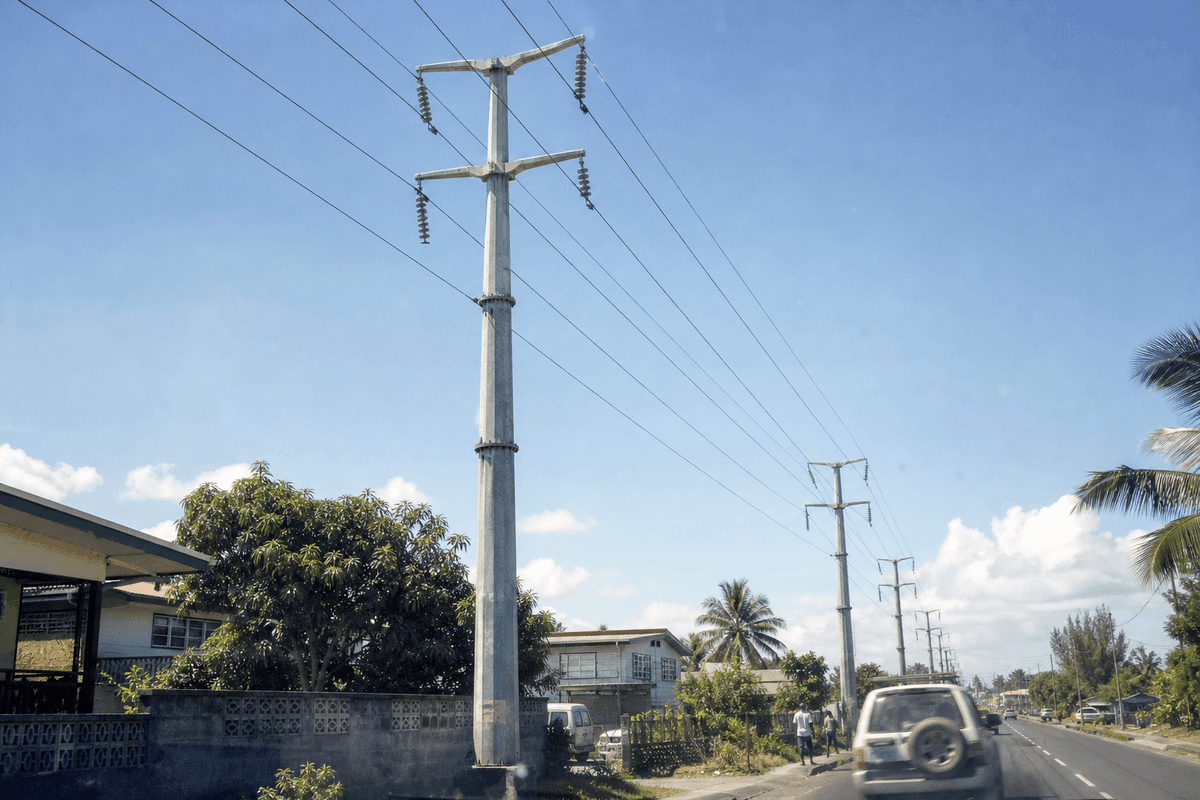
Suva Salt-Air and Flood-Clearance Decision: Power Transmission Tower Configuration for 10kV Double-Circuit Distribution
Summary
Suva’s coastal 10kV corridors face 315-391mm wet-season monthly rainfall, 35m/s wind design exposure, and port-side salt corrosion; a typical 98-unit, 8km double-circuit SOLARTODO steel pole package would need galvanized Q345, ACSR-70, and reinforced grounding.
Key Takeaways
- A typical Suva municipal distribution package would use approximately 98 steel tubular monopoles across about 8km, with 80m spans.
- The specified 10kV double-circuit design uses ACSR-70 conductor at 275kg/km and maximum tension of 22kN.
- Fiji’s Electricity Regulations 2019 specify 240V single-phase, 415/240V three-phase, and 50Hz AC supply systems.
- According to WMO and Fiji Meteorological Service climate data, Suva records 315mm rainfall in January and 391mm in April.
- Fiji Ports Corporation states Port of Suva handles about 60% of Fiji’s foreign trade cargo, making CIF logistics practical for steel poles.
- The standard 10-35kV distribution class is 12-18m and 1-3t/pole; the 25m, approximately 10t/pole package should be treated as a special municipal-clearance specification.
- SOLARTODO should specify hot-dip galvanized Q345 steel, grounding, bird guards, and vibration dampers for 30-year coastal service life.
Market Context for Suva
Suva’s distribution-pole decision is shaped by a coastal capital city with 93,970 city residents, a larger Suva-Nausori urban load corridor, and heavy wet-season rainfall.
Suva is Fiji’s administrative and commercial center on the south-eastern coast of Viti Levu, near latitude -18.14 and longitude 178.44. The Greater Suva Urban Area includes Suva, Lami, Nasinu, and Nausori, so distribution upgrades are not only central-city works; they also affect commuter, port, airport, public-service, and informal-settlement corridors. According to the Fiji Bureau of Statistics (2026), its population grid uses 100m x 100m cells based on the 2017 census and projected to 2026, which is useful for route-density screening before pole spacing is finalized.
Climate is the first engineering constraint. According to the World Meteorological Organization and Fiji Meteorological Service (2026), Suva’s historical monthly mean maximum temperature ranges from 26.5°C in July to 31.0°C in February, while monthly rainfall reaches 315mm in January, 371mm in March, and 391mm in April. Fiji Meteorological Service states, “official source of reliable first-level information” for tropical cyclones in the South-West Pacific, so wind and outage planning should follow local cyclone advisories rather than generic tropical assumptions.
The second constraint is procurement and grid governance. According to Energy Fiji Limited (2026), EFL is responsible for providing and maintaining efficient, cost-effective power supply, while tariffs are reviewed by the Fijian Competition and Consumer Commission. According to Fiji Electricity Regulations 2019, alternating-current systems include 240V single-phase, 415/240V three-phase, and 50Hz frequency with +/-6% voltage tolerance on distributing mains. For a 10kV municipal distribution line, this places the proposed Power Transmission Tower in Fiji’s regulated overhead-supply context, not in a private telecom or lighting category.
The third Suva-specific constraint is logistics. According to Fiji Ports Corporation (2026), Port of Suva is Fiji’s main international gateway, has a 492m quay, accepts vessels up to 12m draft, and handles about 60% of Fiji’s foreign trade cargo. That makes containerized or break-bulk delivery feasible, but dense old-town streets, Walu Bay industrial traffic, salt-laden air, and flood-prone low-lying road sections make laydown planning more important than in inland cities.
Recommended Technical Configuration
A typical Suva 10kV double-circuit recommendation would use 98 hot-dip galvanized Q345 steel monopoles over about 8km, with 80m spans and 35m/s wind class.
For a standard engineering table selection, voltage comes first: 10kV belongs to the 10-35kV distribution class. The normal table range is 12-18m height, 1-3t per pole, single or double circuit, 80-150m spans, and typically 8-12 poles per km. That class is the baseline for distribution feeders in city-edge and municipal corridors.
The project-specific configuration supplied for this Suva analysis is more conservative than the normal class: approximately 98 units of 25m tapered steel tubular pole, each about 10t at 400kg/m, for a 10kV double-circuit line of about 8km. Because 25m and 10t exceed the standard 10-35kV distribution sizing band, SOLARTODO would treat this as a special municipal-clearance configuration for constrained road, flood, salt-air, vegetation, or multi-utility crossing sections rather than as a generic 10kV default. Final acceptance should be by EFL or the licensed supplier’s engineer.
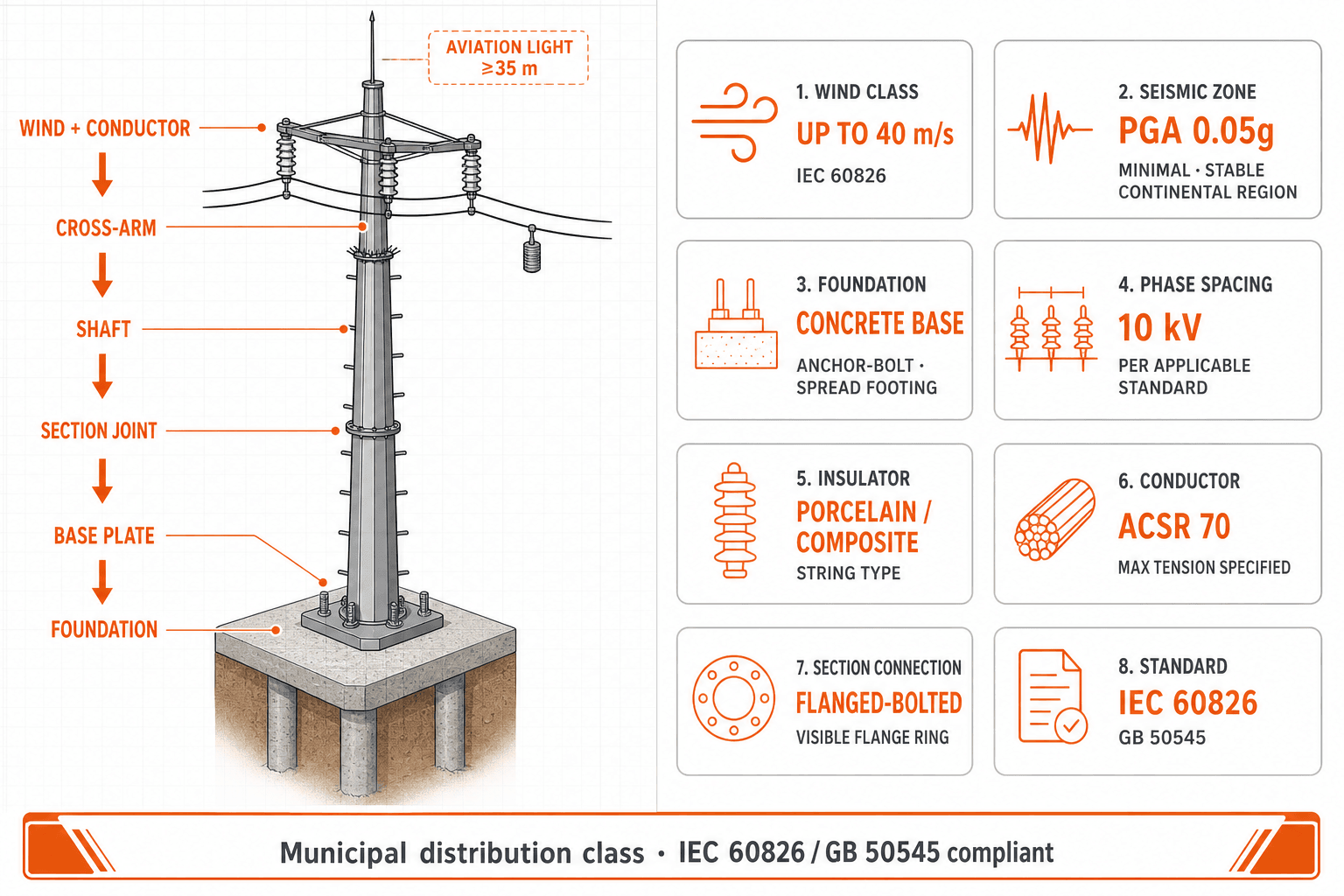
The recommended pole form is one structure type only: tapered round or dodecagonal steel tubular monopole, not lattice, FRP, wood, or concrete. The pole should use hot-dip galvanized Q345 steel, flanged bolt sections, cross-arm brackets for insulator strings, ACSR-70 conductor, grounding, bird guards, vibration dampers, climbing steps, and spread footing foundations with anchor cages. For procurement support, SOLARTODO can provide the product basis at /products/power-tower and engineering coordination through /contact.
Technical Specifications
The correct base size class for 10kV in Suva is 10-35kV distribution: 12-18m, 1-3t/pole, 80-150m span, and 8-12 poles/km.
- Product: SOLARTODO Power Transmission Tower, steel tubular monopole only.
- Voltage class: 10kV medium-voltage municipal distribution; engineering-table class is 10-35kV distribution.
- Circuit: double circuit, with cross-arm brackets for insulator strings and ACSR conductors.
- Project-specific advisory quantity: approximately 98 units for an 8km route, equivalent to about 12.25 poles/km.
- Standard size-class rule: 10-35kV distribution normally uses 12-18m height, 1-3t/pole, 80-150m span, and 8-12 poles/km.
- Supplied Suva special configuration: 25m tapered steel tubular pole, approximately 10t/pole, 400kg/m, requiring project-specific utility approval because it exceeds the normal 10kV distribution table.
- Material: hot-dip galvanized Q345 steel; Q420 may be considered only where structural recalculation requires higher yield strength.
- Conductor: ACSR-70, 275kg/km, maximum tension 22kN.
- Insulator length: 0.5m.
- Phase spacing: 0.8m.
- Ground clearance: 5m, subject to Fiji overhead-line clearance review.
- Span: 80m typical.
- Wind class: 35m/s.
- Foundation: spread footing foundation with concrete anchor cage.
- Accessories: climbing steps, cross arm, grounding, bird guard, and vibration damper.
- Design life: 30 years, with coating inspection cycles adjusted for coastal salt exposure.
- Standards basis: IEC 60826 and GB 50545, with Fiji Electricity Regulations 2019 and AS/NZS Wiring Rules interface checks.
According to IEC (2017), IEC 60826 specifies loading and strength requirements for overhead lines using reliability-based design principles. IEC states, “local climatic data” must be established for national application, which is directly relevant to Suva’s cyclone, rainfall, and salt-air exposure.
Implementation Approach
A Suva rollout should sequence survey, authority review, CIF delivery through Port of Suva, foundations, pole erection, conductor stringing, and 50Hz commissioning.
The first phase is desktop routing and corridor survey. Engineers should confirm road reserve width, buried utilities, drainage crossings, vegetation, traffic control limits, and proximity to coastal spray zones. In old-town or market-adjacent streets, a tubular monopole can reduce ground footprint compared with wider lattice structures, but the 25m special configuration still needs turning-radius checks for delivery trucks and crane pads.
The second phase is technical submittal and standards alignment. A typical package would include pole structural drawings, flange and anchor-bolt calculations, galvanizing certificate, conductor sag-tension schedule, earthing layout, insulator schedule, and maintenance access method statement. According to Fiji Electricity Regulations 2019, overhead supports should be located to avoid pedestrian or vehicular obstruction as far as practicable, and metalwork within 3.05m from ground must be earthed.
The third phase is logistics and civil works. Fiji Ports Corporation data supports Suva as a practical port of entry, but local sequencing should avoid long roadside storage in high-rainfall months when April historical rainfall averages 391mm. Spread footings should be staged so excavation, rebar cage placement, anchor-cage setting, concrete pour, and curing do not leave open pits during intense rain events. For an 8km line, multiple civil crews can prepare foundations ahead of the erection crew.
The fourth phase is erection and electrical commissioning. Pole sections are lifted, flanges torqued, cross arms fitted, insulators installed, ACSR-70 stringing completed, and vibration dampers installed before energization. Commissioning should include conductor clearance checks, grounding resistance verification, phase identification, as-built maps, and owner handover documents. SOLARTODO’s role in such a project would be supply, configuration support, and EPC coordination where contracted, not a claim of past Suva deployment.
Expected Performance & ROI
A properly approved 98-unit Suva 10kV package should improve clearance resilience, reduce corrosion exposure, and spread replacement cost over a 30-year design life.
The main expected performance gain is infrastructure resilience rather than generation revenue. Hot-dip galvanized steel tubular poles can reduce corrosion risk versus untreated steel and reduce replacement frequency where salt air, heavy rain, and urban traffic accelerate deterioration. For Suva, the business case should compare 30-year lifecycle cost, outage exposure, crane access, coating inspection, and safety clearance compliance rather than only upfront equipment cost.
According to the World Bank (2026), Fiji’s access to electricity reached 99.3% in 2023, so the municipal opportunity is not basic electrification; it is reliability, feeder reinforcement, and safer urban distribution. According to IRENA (2026), Fiji targets 100% renewable electricity by 2036 and net-zero emissions by 2050, which increases the value of distribution corridors that can carry future renewable integration and load growth. For a 10kV route, ROI is usually expressed through avoided pole replacement, reduced emergency response, fewer clearance conflicts, and lower storm-restoration complexity.
Indicative project timing would be 8-14 weeks for engineering review and procurement documentation, 4-8 weeks for fabrication and galvanizing depending on batch queue, 3-6 weeks for ocean freight and customs, and 8-12 weeks for civil works, erection, stringing, and commissioning. These ranges are planning benchmarks, not guaranteed delivery dates. For EPC budgeting, buyers should request site-specific soil data, route survey drawings, and cyclone-season work windows before comparing offers.
Comparison Table
The Suva recommendation compares a standard 10-35kV distribution pole with the specified 25m special municipal configuration and higher-voltage alternatives.
| Option | Voltage class | Height | Weight | Span | Typical use in Suva | Fit assessment |
|---|---|---|---|---|---|---|
| Standard distribution monopole | 10-35kV | 12-18m | 1-3t/pole | 80-150m | Normal urban feeders | Baseline engineering class |
| Specified SOLARTODO special configuration | 10kV | 25m | ~10t/pole | 80m | Flood, clearance, port-road, or constrained crossings | Requires utility approval due to above-class sizing |
| Sub-transmission monopole | 66-110kV | 18-30m | 5-15t/pole | 200-300m | Grid reinforcement corridors | Electrically oversized for 10kV feeders |
| HV transmission pole | 220kV | 35-55m | 15-35t/pole | 350-450m | Bulk power transfer | Not appropriate for municipal 10kV distribution |
This comparison intentionally separates voltage-class rules from the supplied Suva configuration. A 25m, 10t pole should not be presented as a normal 10kV default; it is a special city-clearance or structural package. That distinction protects procurement teams from overgeneralizing one constrained design into every feeder segment.
Pricing & Quotation
SOLARTODO quotes 10kV Suva Power Transmission Tower packages by FOB Supply, CIF Delivered, or EPC Turnkey scope, with no article-level price claims.
SOLARTODO offers three pricing tiers for this product line: FOB Supply (equipment ex-works China), CIF Delivered (including ocean freight and insurance), and EPC Turnkey (fully installed, commissioned, with 1-year warranty). Volume discounts are available for large-scale deployments. Configure your system online for an instant estimate, or request a custom quotation from our engineering team at [email protected].
Frequently Asked Questions
A Suva buyer should validate voltage class, 35m/s wind loading, 80m spans, grounding, galvanizing, and EFL approval before ordering 98 poles.
Q1: Is a 25m pole technically correct for a 10kV Suva distribution line? For the standard engineering table, 10-35kV distribution normally uses 12-18m and 1-3t per pole. The supplied 25m, approximately 10t specification is therefore a special municipal-clearance design, not a generic 10kV default. It can be considered for flood clearance, road crossings, vegetation, or constrained corridors, but should be approved by EFL or the licensed supplier’s engineer.
Q2: What is the recommended SOLARTODO configuration for this Suva profile? A typical configuration would use approximately 98 tapered steel tubular monopoles over about 8km, double circuit at 10kV, 80m spans, hot-dip galvanized Q345 steel, ACSR-70 conductor at 275kg/km, 0.8m phase spacing, 0.5m insulators, 5m ground clearance, and 35m/s wind class with spread footing foundations.
Q3: How long would deployment usually take in Suva? A planning schedule is typically 8-14 weeks for survey, design review, and procurement documentation; 4-8 weeks for fabrication and galvanizing; 3-6 weeks for ocean freight and customs; and 8-12 weeks for foundations, erection, stringing, and commissioning. Heavy rainfall from January to April can extend civil-work windows.
Q4: What maintenance is required for coastal steel tubular poles? Maintenance should include annual visual inspection, post-cyclone checks, grounding continuity tests, bolt torque sampling, conductor hardware inspection, and coating review at splash-prone or salt-air sections. Hot-dip galvanizing reduces corrosion risk, but Suva’s coastal humidity and rainfall mean scratches, base-plate zones, and drainage around foundations should be checked more frequently than inland routes.
Q5: How does a steel tubular monopole compare with lattice towers in Suva streets? A steel tubular monopole has a smaller ground footprint and cleaner urban profile than a lattice tower, which helps in dense streets, road reserves, and port-adjacent corridors. Lattice structures may be economical for long rural spans, but this product line is specifically a tapered steel tubular Power Transmission Tower, not lattice, FRP, wood, or concrete.
Q6: What ROI or payback should a municipality expect? ROI should be calculated from avoided replacement, reduced emergency repair, improved clearance compliance, and lower outage exposure over a 30-year design life. Because this is distribution infrastructure, not a revenue-generating solar asset, payback depends on local outage cost, storm damage history, traffic-control cost, and whether the 25m special pole prevents recurring relocation or clearance works.
Q7: Does SOLARTODO provide EPC pricing for Fiji? Yes, SOLARTODO can quote FOB Supply, CIF Delivered, or EPC Turnkey scopes. Article-level prices are intentionally omitted because route length, soil bearing capacity, galvanizing thickness, anchor cage size, freight mode, crane access, and EFL approval requirements can materially change cost. Buyers should request a formal quotation through /contact.
Q8: What warranty is appropriate for this product line? For EPC Turnkey scope, SOLARTODO’s stated tier includes a 1-year warranty. The physical design life target is 30 years, but warranty, coating guarantees, spare hardware, and corrosion exclusions should be specified in the purchase contract. Coastal Suva projects should define inspection intervals and acceptable galvanizing repair procedures before handover.
Q9: What foundation type fits the supplied Suva configuration? The specified foundation is a spread footing foundation with concrete and anchor cage. For Suva, soil investigation is important because coastal fill, saturated clay, drainage channels, and flood-prone road margins can change excavation support and bearing design. Final footing dimensions should follow structural calculations, uplift checks, overturning checks, and the 35m/s wind class.
Q10: Which standards should engineers reference? The supplied standards basis is IEC 60826 and GB 50545, with Fiji Electricity Regulations 2019 and AS/NZS Wiring Rules used for local electrical-safety interface. IEC 60826 supports reliability-based overhead-line loading principles, while Fiji regulations define local supply systems, 50Hz frequency, earthing duties, and overhead-line construction requirements.
References
- World Meteorological Organization / Fiji Meteorological Service (2026): Suva climatological data lists mean daily maximum temperatures of 26.5-31.0°C and monthly rainfall up to 391mm.
- Fiji Bureau of Statistics (2026): Fiji Population Grid 2026 uses 100m x 100m cells based on the 2017 census and projected to 2026 for Greater Suva analysis.
- Fiji Ports Corporation (2026): Port of Suva is Fiji’s main international gateway, has a 492m quay, and handles about 60% of Fiji’s foreign trade cargo.
- Energy Fiji Limited (2026): EFL is responsible for maintaining efficient, cost-effective electricity supply, with tariff oversight by FCCC.
- Government of Fiji / Electricity Regulations (2019): Fiji specifies 240V single-phase, 415/240V three-phase, 50Hz AC systems, earthing duties, and overhead-line construction rules.
- IEC (2017): IEC 60826:2017 provides reliability-based design criteria for overhead transmission-line loading and strength.
- IRENA (2026): Fiji targets 100% renewable electricity by 2036 and net-zero emissions by 2050, increasing the value of resilient distribution corridors.
Equipment Deployed
- 98 units × 25m tapered steel tubular monopole for 10kV double-circuit line
- Hot-dip galvanized Q345 steel, approximately 10t/pole and 400kg/m
- ACSR-70 conductor, 275kg/km, maximum tension 22kN
- Cross-arm brackets with 0.5m insulator strings and 0.8m phase spacing
- Spread footing foundation with concrete anchor cage
- Grounding kit, climbing steps, bird guard, and vibration damper
- 80m typical span across approximately 8km total route
- 35m/s wind class and 30-year design life