Solving ESG compliance: Commercial Solar PV Systems…

SOLAR TODO
Solar Energy & Infrastructure Expert Team
Watch the video
TL;DR
To solve ESG compliance with Commercial Solar PV Systems, focus on auditable design rather than panel count alone. Many 100kWp systems generate 150-190MWh/year, and a DC/AC ratio of 1.15-1.35 often improves inverter use without excessive clipping. Correct string sizing, IEC-certified equipment, and clear EPC scope help buyers reach 5-8 year payback and defend Scope 2 reporting.
Commercial Solar PV Systems help ESG programs cut Scope 2 emissions by 150-190MWh/year per 100kWp site, while a DC/AC ratio of 1.15-1.35 and correct string sizing improve inverter loading, reduce clipping risk, and support 5-8 year payback in many commercial projects.
Summary
Commercial Solar PV Systems help ESG programs cut Scope 2 emissions by 150-190MWh/year per 100kWp site, while a DC/AC ratio of 1.15-1.35 and correct string sizing improve inverter loading, reduce clipping risk, and support 5-8 year payback in many commercial projects.
Key Takeaways
- Size Commercial Solar PV Systems at about 100kWp when annual offset targets are 150-190MWh and ESG teams need measurable Scope 2 reduction data.
- Select a DC/AC ratio of 1.15-1.35 for many commercial sites to raise inverter utilization without creating excessive clipping above project tolerances.
- Verify string sizing against inverter voltage windows, keeping cold-weather Voc below the maximum DC limit and hot-weather Vmp above MPPT minimum.
- Use N-type TOPCon modules with 22.5%-24.5% efficiency and annual degradation below 0.4% to improve long-term ESG reporting quality.
- Compare FOB Supply, CIF Delivered, and EPC Turnkey pricing because balance-of-system, logistics, and installation can change project CAPEX by 15%-30%.
- Model annual savings using local tariffs and demand charges, because commercial solar plus storage can often reach payback in 5-8 years under high daytime loads.
- Document compliance with IEC 61215, IEC 61730, and IEEE 1547-2018 to reduce procurement risk and simplify technical due diligence.
- Plan preventive inspections every 12 months and inverter performance checks every 6-12 months to keep output variance within expected yield models.
Why ESG compliance now depends on correct PV system design
Commercial Solar PV Systems support ESG compliance only when the electrical design is auditable, with DC/AC ratio typically at 1.15-1.35 and annual generation often reaching 150-190MWh per 100kWp system.
For procurement managers and project engineers, ESG compliance is no longer limited to buying renewable electricity certificates or publishing carbon targets. Internal audit teams now ask for measurable kWh generation, avoided CO2 calculations, equipment certifications, and operating data that can be traced to accepted standards such as IEC 61215, IEC 61730, and IEEE 1547-2018. A poorly sized PV array can still produce electricity, but it may underperform against the ESG business case by 5%-15% if inverter loading, string voltage, and clipping behavior are not checked early.
The practical issue is simple. Many commercial buyers focus first on module wattage, total CAPEX, or roof area, while the actual compliance value depends on system yield and reporting confidence over 20-30 years. According to NREL (2024), PV performance estimates depend strongly on irradiance, temperature, and electrical configuration. According to IEA PVPS (2024), commercial PV continues to expand because it reduces purchased electricity exposure while improving corporate decarbonization metrics.
SOLAR TODO typically sees this in tenders where the ESG target is clear but the electrical basis of design is weak. If the DC/AC ratio is too low, the inverter is underused for much of the year. If it is too high, clipping losses can rise beyond the expected design envelope during peak irradiance hours. Correct string sizing is equally important because an overvoltage condition at low temperature can trip or damage equipment, while undervoltage at high temperature can reduce MPPT effectiveness.
The International Energy Agency states, "Solar PV is set to become the largest renewable power source globally by 2029." That matters for ESG planning because buyers are no longer evaluating solar as a pilot technology; they are evaluating it as a core compliance and cost-control asset. NREL states, "Accurate system design and performance modeling are essential to reliable PV energy estimates," which is directly relevant to board-level ESG disclosures.
Technical design fundamentals: DC/AC ratio and string sizing
DC/AC ratio and string sizing determine whether a commercial PV plant operates near modeled yield, with common commercial designs using 1.15-1.35 DC/AC loading and strings sized to stay within inverter voltage limits across temperature extremes.
A commercial PV system converts DC electricity from modules into AC electricity through one or more inverters. The DC/AC ratio compares total installed module power in kWp to inverter AC output in kW. For example, a 100kWp array on an 80kW inverter has a DC/AC ratio of 1.25. This is common in commercial design because module output rarely stays at STC nameplate under real operating temperatures, so moderate oversizing helps the inverter work closer to rated output for more hours per day.
According to NREL (2024), PV output is affected by cell temperature, irradiance, soiling, orientation, and system losses. According to Fraunhofer ISE (2024), real-world module operation often occurs below STC power because module temperatures exceed 25°C in field conditions. That is why a DC/AC ratio of 1.15-1.35 is often a practical commercial range, though exact values depend on tariff structure, clipping tolerance, orientation spread, and grid export limits.
How to evaluate the DC/AC ratio
A DC/AC ratio of 1.20-1.30 often balances energy yield and inverter cost, but projects with export caps or east-west arrays may justify ratios up to about 1.35.
Use the following checks during design review:
- Compare expected annual clipping losses against inverter savings. Many projects accept clipping in the range of 1%-3% if inverter CAPEX drops enough.
- Check tariff structure. If demand charges are high, storage or export control may be more valuable than maximizing midday export.
- Review orientation. East-west rooftops often flatten the generation curve and can support a slightly higher DC/AC ratio than south-facing arrays.
- Confirm interconnection limits. Some utilities cap export at the point of common coupling, which changes inverter selection logic.
- Align with ESG reporting. If annual generation guarantees are contractually tied to sustainability KPIs, conservative modeling is preferred.
How to size strings correctly
String sizing starts with temperature-corrected voltage calculations, ensuring the coldest-site Voc stays below inverter maximum DC voltage and the hottest-site Vmp stays above the MPPT operating threshold.
String sizing is not just counting modules until the nameplate voltage looks acceptable. Engineers must calculate open-circuit voltage at minimum site temperature and operating voltage at maximum site temperature. A module with a Voc around 50V at STC can exceed that value significantly in cold weather. If 20 modules are placed in series, the string may approach or exceed a 1,000V or 1,100V inverter limit depending on temperature coefficient and local minimum temperature.
At the same time, the string must remain above the inverter MPPT minimum during hot conditions. If module Vmp falls too low at high cell temperature, the inverter may not track efficiently, reducing energy harvest. This is why bankable design packages include module datasheets, temperature coefficients, site temperature assumptions, and inverter MPPT windows. SOLAR TODO recommends validating both cold and hot cases in the single-line design before procurement approval.
Sample technical framework for a 100kWp commercial system
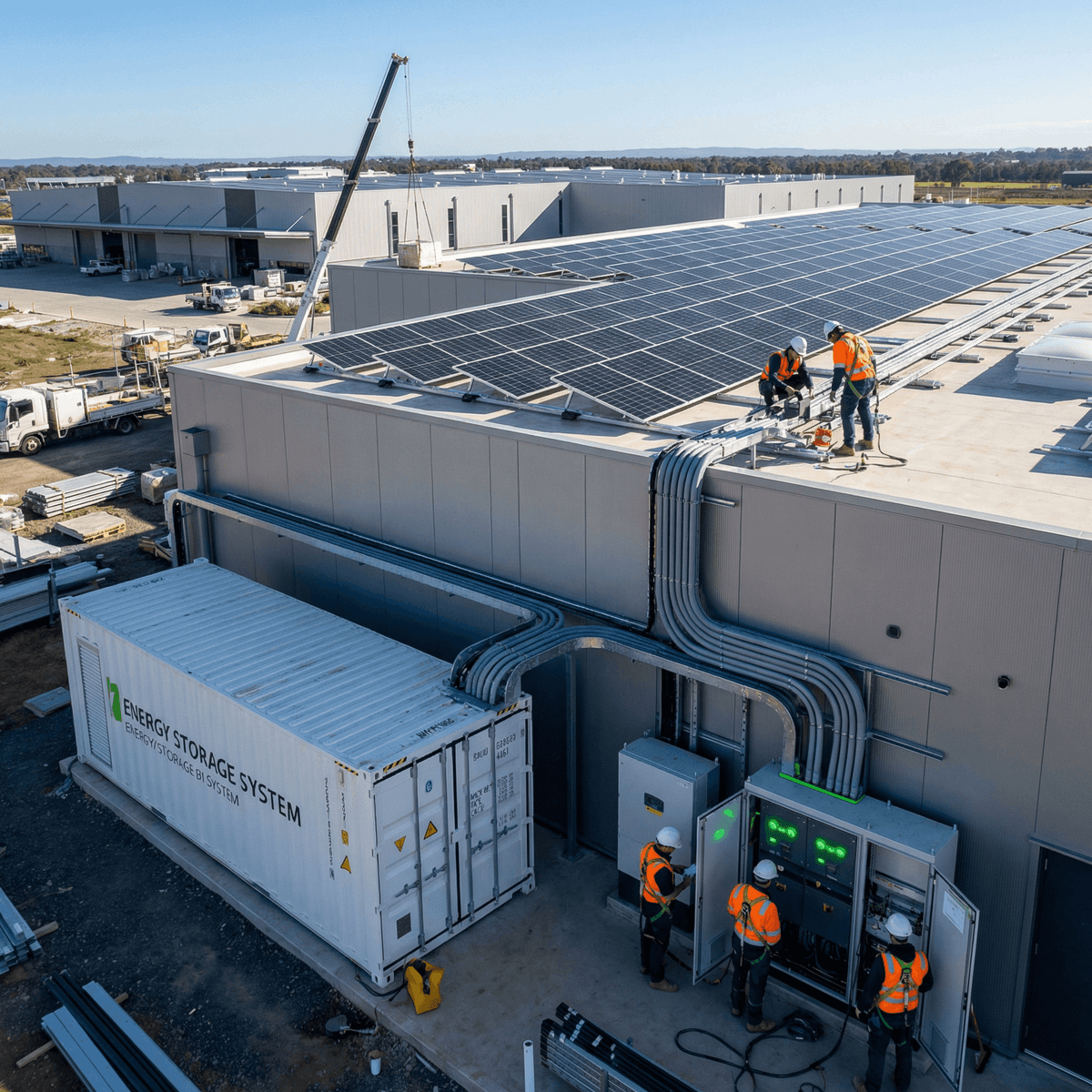
A 100kWp commercial system paired with 200kWh storage can generate about 150-190MWh per year, using high-efficiency modules at 22.5%-24.5% and a hybrid architecture for self-consumption and backup support.
For a commercial hybrid reference configuration, the SOLAR TODO 100kW + 200kWh Solar+Storage Commercial package combines 100kWp of mono TOPCon PV with 200kWh of LFP battery storage. Based on the provided product data, expected annual generation is approximately 150-190MWh, with module efficiency in the 22.5%-24.5% range and first-year degradation below 1.0%. Annual degradation is typically below 0.4%, which supports long-term ESG accounting and performance ratio tracking.
In this class of project, designers typically review fixed-tilt layout, available roof loading, cable routing, inverter topology, and battery dispatch logic together. The battery does not replace correct PV sizing, but it can reduce peak demand, shift midday energy into evening loads, and improve resilience during outages. For ESG programs, that creates a stronger business case because the project addresses both carbon reduction and operational continuity.
ESG reporting, compliance metrics, and procurement documentation
Commercial Solar PV Systems improve ESG reporting when buyers can document certified equipment, measured generation, and avoided emissions using 12-month operational data and recognized standards.
ESG teams usually need more than a commissioning photo and a supplier invoice. They need a traceable package that includes module and inverter certifications, single-line diagrams, commissioning records, performance assumptions, O&M plans, and monthly generation data. For many organizations, the solar project feeds Scope 2 reduction reporting, internal carbon dashboards, and lender or investor disclosures. If the electrical design basis is weak, the ESG claim becomes harder to defend.
According to IRENA (2024), solar PV remains one of the lowest-cost sources of new electricity in many markets. According to BloombergNEF (2024), bankability and equipment quality remain central to project finance decisions, especially where long-term energy yield underpins debt service or sustainability-linked financing. That is why procurement teams should request the exact standard references, not just generic statements of compliance.
A practical compliance file should include:
- Module certification to IEC 61215-1:2021 and IEC 61730-1:2023
- Inverter interconnection compliance aligned with IEEE 1547-2018 where applicable
- Performance modeling assumptions from NREL PVWatts or equivalent methodology
- Warranty terms for modules, inverters, and batteries, with degradation schedules
- Commissioning test records, insulation checks, and protection settings
- O&M schedule with inspection intervals of 6-12 months
- Metering plan for monthly kWh and annual MWh reporting
For many B2B buyers, the procurement decision also depends on whether the supplier understands reporting language used by finance and ESG teams. SOLAR TODO generally structures proposals so the technical package can be reviewed by engineering, procurement, and sustainability stakeholders without rewriting the basis of design after award.
EPC Investment Analysis and Pricing Structure
Commercial Solar PV Systems are usually bought through FOB, CIF, or EPC Turnkey models, and a 100kWp-class project often reaches 5-8 year payback depending on tariff, irradiance, and demand-charge reduction.
EPC means Engineering, Procurement, and Construction. In practical terms, EPC turnkey delivery usually includes system design, bill of materials, logistics coordination, installation, testing, commissioning, and handover documentation. For commercial buyers, the advantage is single-point accountability for schedule, interfaces, and performance assumptions. The tradeoff is that EPC pricing is higher than supply-only pricing because labor, local compliance work, and project management are included.
A useful three-tier pricing structure is:
| Pricing Model | What It Includes | Typical Buyer Use |
|---|---|---|
| FOB Supply | Modules, inverter, structure, BOS packed at origin port | EPC contractors and importers with local installation teams |
| CIF Delivered | FOB scope plus sea freight and insurance to destination port | Buyers who want landed-cost visibility before local works |
| EPC Turnkey | Supply, design, installation, testing, commissioning, handover | End users seeking one contract and defined delivery scope |
For the SOLAR TODO 100kW + 200kWh Solar+Storage Commercial reference package, the provided EPC turnkey budget is USD 79,200 to USD 101,200. Actual project pricing depends on structure type, cable distance, switchgear scope, battery integration, and local labor conditions. Rooftop reinforcement, export control devices, and fire-safety additions can change total CAPEX materially.
Volume pricing guidance for repeat procurement is commonly structured as:
- 50+ units: about 5% discount
- 100+ units: about 10% discount
- 250+ units: about 15% discount
Typical payment terms are:
- 30% T/T + 70% against B/L
- 100% L/C at sight
Financing may be available for large projects above USD 1,000K. For EPC, pricing, and financing discussions, contact [email protected] or call +6585559114.
ROI and savings logic
Commercial solar ROI is driven by avoided grid purchases, lower demand charges, and 150-190MWh annual generation per 100kWp, with many projects reaching simple payback in 5-8 years.
Sample deployment scenario (illustrative): if a commercial site offsets 170MWh per year and the blended electricity cost is USD 0.12/kWh, annual avoided electricity cost is about USD 20,400 before maintenance and financing effects. If storage reduces peak-demand penalties, additional savings may improve the business case. In higher-tariff markets above USD 0.15/kWh, payback can shorten further, while low-tariff markets may require stronger self-consumption or ESG-driven investment criteria.
Comparison and selection guide for commercial buyers
The best commercial PV choice usually combines 22.5%-24.5% module efficiency, a 1.15-1.35 DC/AC ratio, certified components, and a procurement model that matches local installation capability.
The selection process should compare electrical performance, compliance risk, and delivery scope together. A lower module price does not always mean lower lifecycle cost if the module efficiency is lower, degradation is higher, or the supplier cannot provide complete certification records. Likewise, an oversized inverter may reduce clipping but increase CAPEX without improving project IRR.
| Decision Factor | Preferred Range or Requirement | Why It Matters |
|---|---|---|
| Module efficiency | 22.5%-24.5% | Higher output per m2 on constrained roofs |
| DC/AC ratio | 1.15-1.35 | Better inverter utilization with controlled clipping |
| First-year degradation | <1.0% | Improves year-1 ESG yield confidence |
| Annual degradation | <0.4% | Supports 25-30 year output forecasts |
| Certifications | IEC 61215, IEC 61730, IEEE 1547-2018 | Reduces technical and compliance risk |
| Annual generation | 150-190MWh per 100kWp | Basis for ROI and carbon reporting |
| Procurement model | FOB, CIF, or EPC Turnkey | Aligns scope with buyer capability |
For buyers comparing suppliers, ask for the following before award:
- Detailed string calculations using site minimum and maximum temperatures
- Inverter clipping estimate at the proposed DC/AC ratio
- Annual yield model with loss assumptions and degradation curve
- Warranty matrix for modules, inverter, structure, and battery
- Standards list with exact codes and revision years
- Delivery scope split between supplier and local contractor
SOLAR TODO should be evaluated the same way any technical supplier is evaluated: by whether the design package, certification file, and commercial structure are clear enough for procurement approval and later ESG audit review.
FAQ
Commercial Solar PV Systems for ESG compliance require correct electrical sizing, certified equipment, and auditable generation data, and most buyer questions focus on yield, cost, standards, installation, and warranty.
Q: What is the best DC/AC ratio for a commercial solar PV system? A: The best DC/AC ratio for many commercial projects is often between 1.15 and 1.35. This range usually improves inverter utilization without causing excessive clipping, but the final value depends on tariff structure, module orientation, export limits, and the site’s temperature profile.
Q: Why does string sizing matter for ESG compliance? A: String sizing matters because ESG reporting depends on actual kWh generation, not just installed kWp. If strings exceed inverter voltage limits in cold weather or fall below MPPT range in hot weather, output can drop and the reported carbon-reduction benefit becomes less reliable.
Q: How much energy can a 100kWp commercial system produce each year? A: A 100kWp commercial system can typically generate about 150-190MWh per year in good solar regions. Actual output depends on irradiance, shading, temperature, losses, and whether the system is optimized for self-consumption, export, or hybrid operation with storage.
Q: What standards should commercial PV modules and inverters meet? A: Commercial PV modules should typically comply with IEC 61215 and IEC 61730, while inverter interconnection should align with IEEE 1547-2018 where applicable. These standards help procurement teams verify product safety, durability, and grid-interface performance during technical due diligence.
Q: How do I calculate the correct number of modules per string? A: Calculate string length by checking temperature-corrected module Voc at minimum site temperature and module Vmp at maximum operating temperature. The final string must stay below the inverter’s maximum DC voltage and remain within the MPPT window during hot conditions.
Q: What is the difference between FOB, CIF, and EPC Turnkey pricing? A: FOB covers supply at the origin port, CIF adds freight and insurance to the destination port, and EPC Turnkey includes design, installation, testing, and handover. Commercial buyers choose among them based on whether they have local engineering and construction capability.
Q: What payback period should commercial buyers expect? A: Many commercial solar projects achieve simple payback in about 5-8 years, especially where electricity tariffs are high and daytime self-consumption is strong. Storage can improve economics further when demand charges or outage costs are significant.
Q: What does EPC turnkey delivery usually include? A: EPC turnkey delivery usually includes engineering, procurement, construction, testing, commissioning, and project handover documents. It gives the buyer one delivery scope, which reduces interface risk between equipment suppliers, installers, and commissioning teams.
Q: How often should a commercial PV system be maintained? A: Most commercial PV systems should have visual and electrical inspections at least every 12 months, with inverter and monitoring checks every 6-12 months. Dusty sites, coastal sites, or high-soiling roofs may need more frequent cleaning and connector inspections.
Q: Can solar plus storage improve ESG performance beyond carbon reduction? A: Yes. Solar plus storage can improve resilience, reduce diesel generator runtime, and lower peak demand charges in addition to cutting Scope 2 emissions. That broader operational benefit often strengthens internal approval for ESG-linked capital expenditure.
References
- NREL (2024): PVWatts Calculator methodology and solar performance modeling guidance for estimating annual PV system output.
- IEA PVPS (2024): Trends in Photovoltaic Applications report covering global deployment, market direction, and system performance context.
- IRENA (2024): Renewable Power Generation Costs report describing solar PV cost competitiveness across major markets.
- IEC 61215-1 (2021): Terrestrial photovoltaic modules design qualification and type approval requirements.
- IEC 61730-1 (2023): Photovoltaic module safety qualification requirements for construction and testing.
- IEEE 1547-2018 (2018): Standard for interconnection and interoperability of distributed energy resources with electric power systems.
- BloombergNEF (2024): Bankability and manufacturer assessment references used in PV procurement and finance review.
- Fraunhofer ISE (2024): Photovoltaics reports and field-performance analysis relevant to real-world module operating conditions.
Conclusion
Commercial Solar PV Systems deliver the strongest ESG value when 100kWp-class assets are designed with a 1.15-1.35 DC/AC ratio, correct string voltage margins, and certified components that support 150-190MWh annual reporting.
Bottom line: if your organization wants defensible ESG results, do not treat DC/AC ratio and string sizing as minor electrical details. For many commercial sites, a correctly specified SOLAR TODO system can improve auditability, reduce energy cost, and support 5-8 year payback with standards-based documentation.
About SOLARTODO
SOLARTODO is a global integrated solution provider specializing in solar power generation systems, energy-storage products, smart street-lighting and solar street-lighting, intelligent security & IoT linkage systems, power transmission towers, telecom communication towers, and smart-agriculture solutions for worldwide B2B customers.
About the Author

SOLAR TODO
Solar Energy & Infrastructure Expert Team
SOLAR TODO is a professional supplier of solar energy, energy storage, smart lighting, smart agriculture, security systems, communication towers, and power tower equipment.
Our technical team has over 15 years of experience in renewable energy and infrastructure, providing high-quality products and solutions to B2B customers worldwide.
Expertise: PV system design, energy storage optimization, smart lighting integration, smart agriculture monitoring, security system integration, communication and power tower supply.
Cite This Article
SOLAR TODO. (2026). Solving ESG compliance: Commercial Solar PV Systems…. SOLARTODO. Retrieved from https://solartodo.com/knowledge/solving-esg-compliance-commercial-solar-pv-systems-implementation-with-dcac-ratio-and-string-sizing
@article{solartodo_solving_esg_compliance_commercial_solar_pv_systems_implementation_with_dcac_ratio_and_string_sizing,
  title = {Solving ESG compliance: Commercial Solar PV Systems…},
  author = {SOLAR TODO},
  journal = {SOLARTODO Knowledge Base},
  year = {2026},
  url = {https://solartodo.com/knowledge/solving-esg-compliance-commercial-solar-pv-systems-implementation-with-dcac-ratio-and-string-sizing},
  note = {Accessed: 2026-06-05}
}
Published: June 5, 2026 | Available at: https://solartodo.com/knowledge/solving-esg-compliance-commercial-solar-pv-systems-implementation-with-dcac-ratio-and-string-sizing
Subscribe to Our Newsletter
Get the latest solar energy news and insights delivered to your inbox.
View All Articles