Solving diesel generator OPEX: LFP Battery Energy Storage…

SOLAR TODO
Solar Energy & Infrastructure Expert Team
Watch the video
TL;DR
If your diesel-powered site has high fuel logistics cost, repeatable daily peaks, and generators running below 30% load, an LFP battery energy storage system can usually cut runtime by 20-45%. Start sizing with 15-minute load data, target 1-4 hours of storage, verify passive-cooling limits at 35-45°C ambient, and compare FOB, CIF, and EPC turnkey pricing before procurement.
LFP battery energy storage can cut diesel runtime by 20-45%, reduce fuel-linked generation costs that often reach $0.25-$0.60/kWh, and deliver 6,000+ cycles with passive-cooling-friendly cabinet designs when correctly sized for 1-2 daily discharge windows.
Summary
LFP battery energy storage can cut diesel runtime by 20-45%, reduce fuel-linked generation costs that often reach $0.25-$0.60/kWh, and deliver 6,000+ cycles with passive-cooling-friendly cabinet designs when correctly sized for 1-2 daily discharge windows.
Key Takeaways
- Quantify diesel OPEX first: use a baseline of $0.25-$0.60/kWh and 4,000+ annual operating hours to identify sites where BESS payback often falls in the 3-6 year range.
- Size power for peak support: match BESS discharge power to 30-60% of generator rating, such as 100kW support for a 250-350kVA diesel set.
- Size energy for runtime reduction: start with 1-4 hours of usable storage, with 200kWh covering a 100kW load for about 2 hours at 90% depth of discharge.
- Select LFP chemistry for cycling: prioritize 6,000+ cycle cells, 90% usable depth of discharge, and round-trip efficiency above 90% for daily hybrid operation.
- Use passive cooling where ambient conditions allow: target lower auxiliary loads than liquid-cooled systems and verify enclosure thermal limits for 35-45°C site conditions.
- Improve generator loading: keep diesel units above 30% load to reduce wet stacking, lower maintenance frequency, and improve specific fuel consumption.
- Compare EPC scopes carefully: evaluate FOB supply, CIF delivery, and EPC turnkey pricing, then apply volume discounts of 5% at 50+ units, 10% at 100+, and 15% at 250+.
- Verify compliance before procurement: require IEC 62619, IEC 62933, IEEE 1547 where grid-tied, and UL 9540 or equivalent safety documentation for commercial battery energy storage system projects.
Why diesel generator OPEX is rising and where LFP BESS fits
LFP battery energy storage systems reduce diesel fuel use by 20-45% at remote sites, while lowering delivered energy cost from a typical $0.25-$0.60/kWh diesel range through peak shaving, load shifting, and better generator loading.
Diesel generator operating expenditure is not just fuel. It includes lubricant changes every 250-500 hours, filter replacement, engine overhauls, logistics premiums, and derating losses in hot climates above 35°C. At remote industrial and telecom sites, transport can add more than $0.08/liter to fuel cost, which materially changes project economics.
According to IEA (2024), batteries are increasingly used to improve system flexibility and reduce fossil fuel dependence in distributed energy systems. According to IRENA (2024), battery storage continues to improve renewable integration economics, especially where fuel-based generation has high marginal cost. For off-grid operators, the practical question is not whether storage works, but how to size it correctly against diesel runtime, spinning reserve, and site load profile.
The International Energy Agency states, "Battery storage is becoming a key flexibility option in electricity systems." That statement matters for diesel-heavy microgrids because flexibility has direct OPEX value: fewer generator start-stop cycles, lower part-load operation, and reduced nighttime engine hours. SOLAR TODO typically sees the strongest business case where loads are repetitive, solar PV can cover daytime energy, and diesel remains the balancing source.
What drives diesel OPEX in real projects
The largest OPEX drivers are usually fuel consumption, low-load inefficiency, and maintenance linked to excessive runtime. A diesel set running below 30% load can suffer poor combustion and wet stacking, while a unit cycled too often may need more frequent service intervals than the nominal 250-500 hour schedule.
Sample deployment scenario (illustrative): a remote site with a 120kW average load and a 250kVA generator may consume 0.24-0.30 liters/kWh equivalent under mixed loading. If diesel delivered cost is $1.00-$1.30/liter, generation cost can quickly exceed $0.30/kWh before maintenance and transport. In that case, even a mid-size battery energy storage system can reduce annual OPEX materially.
Technical design: passive cooling, LFP chemistry, and hybrid architecture
Passive-cooled LFP battery energy storage systems can lower auxiliary consumption by avoiding compressor-based thermal management, but they must be sized around ambient temperatures, enclosure heat rejection, and daily cycling limits such as 1-2 cycles per day.
LFP chemistry is commonly selected because it offers 6,000+ cycles, about 90% depth of discharge, and a lower thermal runaway risk profile than several other lithium-ion chemistries. For diesel hybrid systems, these characteristics matter more than very high energy density. Buyers are usually optimizing total cost of ownership, not minimizing cabinet footprint by a few square meters.
A typical hybrid architecture includes five core blocks:
- Diesel generator set sized for base and contingency supply
- Battery energy storage system with PCS and battery management system
- Solar PV, if daytime fuel displacement is required
- Hybrid controller with dispatch logic for generator start-stop and SOC windows
- Protection and switchgear compliant with project voltage and fault-level requirements
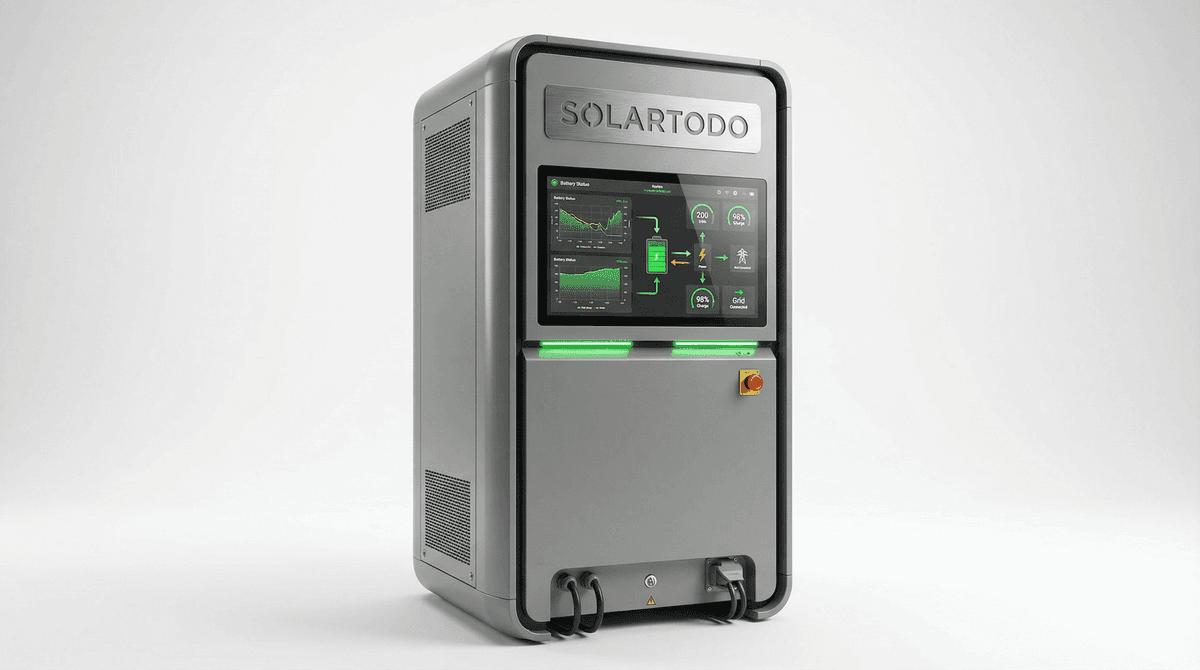
SOLAR TODO's 200kWh Mining Site Off-Grid LFP platform is a useful reference point in this category. It provides 100kW / 200kWh, supports 150kW PV compatibility, uses LFP chemistry, and targets 6,000+ cycles with round-trip efficiency above 90%. That size class is often relevant where operators need to reduce evening diesel runtime without moving immediately to a 1MWh containerized plant.
Passive cooling: when it works and when it does not
Passive cooling is most effective where ambient temperatures are moderate, internal heat generation is controlled, and discharge rates are not continuously pushed near maximum C-rate. In practical terms, cabinet-based systems operating at 0.25C-0.5C average duty in 25-35°C conditions are generally easier to manage passively than 1C utility-scale systems in 45°C desert environments.
The design checks are straightforward:
- Confirm maximum ambient temperature, often 35-45°C in project specifications
- Confirm enclosure ingress protection, commonly IP54 or IP55 for outdoor cabinets
- Confirm allowable cell temperature spread and ventilation path design
- Confirm derating curve above nominal ambient conditions
- Confirm whether auxiliary fans are included even in a passive-cooling architecture
According to NREL (2023), thermal management strongly affects battery life, safety, and usable performance. According to UL (2023), energy storage safety evaluation must consider enclosure, thermal propagation, and system-level controls. Passive cooling can reduce parasitic load, but it does not remove the need for thermal analysis.
The U.S. National Renewable Energy Laboratory states, "Battery lifetime is highly dependent on temperature, depth of discharge, and duty cycle." For procurement teams, that means passive cooling should be specified only after reviewing actual site temperature histograms and dispatch duty, not as a generic cost-saving checkbox.
Capacity sizing methodology for diesel OPEX reduction
Correct BESS sizing starts with 15-minute load data, generator fuel curves, and a target diesel reduction of 20-45%, then converts those numbers into required kW power, kWh energy, and reserve margins.
Sizing errors usually come from focusing on battery capacity alone. Diesel hybrid systems need three separate calculations: power sizing, energy sizing, and control sizing. A battery with enough kWh but insufficient kW will not catch motor starts or evening peaks. A battery with enough kW but too little kWh may reduce only a few minutes of runtime and miss the OPEX target.
Step 1: Size battery power in kW
Battery power should cover the load segment you want to remove from the generator. For example, if a site has a 140kW evening peak but the operator wants the generator to run steadily at 80kW, the battery should provide about 60kW discharge support. In many remote systems, practical BESS power is 30-60% of genset rating.
Step 2: Size usable energy in kWh
Usable energy is based on how long the battery must support the target load reduction. If the site needs 60kW support for 3 hours, usable energy should be about 180kWh. With a 90% depth of discharge design rule, installed nominal energy would be about 200kWh.
Formula:
- Usable kWh = target discharge kW × discharge hours
- Nominal kWh = usable kWh / allowable depth of discharge
Step 3: Set SOC operating window
A diesel hybrid BESS should not operate from 100% to 0% every day. A practical SOC window for LFP may be 10-90% or 15-85%, depending on warranty terms and ambient conditions. Narrower windows reduce usable energy but can improve calendar life over a 10-15 year project horizon.
Step 4: Check generator minimum loading
Most diesel sets should stay above about 30% load to avoid poor combustion. If battery charging during low-load periods would push generator load below that threshold, the dispatch logic should either stop the genset or delay charging. This is often more important than a small difference in battery round-trip efficiency.
Step 5: Validate annual savings
Annual savings come from reduced fuel, lower maintenance, and fewer engine hours. Sample deployment scenario (illustrative): if a site cuts diesel use by 25 liters/day at $1.10/liter, annual fuel savings are about $10,038. Add lower maintenance from 1,000 fewer runtime hours, and the business case can improve further.
| Sizing Parameter | Typical Range | Why It Matters |
|---|---|---|
| BESS power | 30-60% of genset rating | Covers peaks and stabilizes loading |
| BESS duration | 1-4 hours | Determines runtime reduction potential |
| Depth of discharge | 80-90% | Balances usable energy and life |
| Cycle life | 6,000+ cycles | Supports daily dispatch over 10+ years |
| Round-trip efficiency | >90% | Reduces charging losses |
| Minimum genset load | >30% | Avoids wet stacking and inefficiency |
| Data interval for sizing | 15 minutes or better | Captures real peaks and dispatch windows |
Applications, economics, and EPC Investment Analysis and Pricing Structure
For remote mines, telecom hubs, hotels, and islanded commercial sites, a properly sized LFP battery energy storage system often delivers 3-6 year payback when diesel costs exceed $0.30/kWh and runtime exceeds 4,000 hours per year.
The strongest use cases share three traits: repeatable daily load patterns, expensive delivered fuel, and a generator fleet that spends too many hours at low or variable load. Mining camps, quarry operations, off-grid hospitality assets, and telecom aggregation sites are common examples. In each case, the battery reduces both fuel burn and maintenance-linked OPEX.
According to IRENA (2024), battery systems support higher renewable penetration and lower curtailment in hybrid power systems. According to NREL (2024), behind-the-meter and off-grid storage economics improve when dispatch is aligned to short-duration peaks and tariff or fuel-cost drivers. For diesel displacement, the equivalent principle is simple: discharge when fuel is most expensive or generator efficiency is worst.
EPC Investment Analysis and Pricing Structure
EPC turnkey delivery typically includes site survey, single-line diagram review, battery energy storage system supply, PCS, EMS or hybrid controller, switchgear coordination, installation supervision, commissioning, and operator training. For larger projects, it may also include PV integration, generator synchronization logic, and remote monitoring for 12-24 months.
A practical three-tier commercial structure is:
- FOB Supply: battery cabinets, PCS, EMS, and documentation supplied ex-works or FOB port; buyer manages freight, civil works, and installation.
- CIF Delivered: equipment supplied with ocean freight and insurance to destination port; buyer manages customs clearance, local transport, and installation.
- EPC Turnkey: full delivery including engineering, procurement, installation, testing, and commissioning to agreed performance criteria.
Volume pricing guidance for framework procurement is commonly structured as:
- 50+ units: 5% discount
- 100+ units: 10% discount
- 250+ units: 15% discount
Payment terms commonly used in export projects are:
- 30% T/T deposit + 70% against B/L
- 100% L/C at sight
Financing is available for large projects above $1,000K, subject to project profile, jurisdiction, and credit review. For budgetary quotes, EPC scope review, or hybrid sizing support, procurement teams can contact [email protected] or reach SOLAR TODO at +6585559114.
ROI comparison: diesel-only vs diesel + LFP BESS
Sample deployment scenario (illustrative): a site consuming 500 kWh/day from diesel at $0.35/kWh spends about $63,875 per year on generation. If a 100kW / 200kWh LFP BESS cuts generator runtime and fuel use by 25%, annual savings are about $15,969 before maintenance reductions. If total installed project cost is $60,000-$95,000 depending on scope, simple payback may fall near 3.8-6.0 years.
| Option | Upfront Cost | Fuel Savings | Maintenance Savings | Typical Payback |
|---|---|---|---|---|
| Diesel only | Low initial | None | None | Not applicable |
| FOB BESS supply | Lowest BESS capex | Medium to high | Medium | 3-6 years |
| CIF delivered BESS | Mid capex | Medium to high | Medium | 4-6 years |
| EPC turnkey hybrid | Highest capex | High | High | 4-7 years |
SOLAR TODO should be evaluated on total delivered scope, not battery rack price alone. The right comparison includes controls, protection, commissioning, warranty terms, and whether passive cooling is suitable for the actual ambient profile.
Comparison and procurement checklist
The best LFP BESS option for diesel OPEX reduction is the one that matches 15-minute load data, 30% minimum generator loading, and a 1-4 hour storage window rather than the lowest nominal $/kWh quote.
Procurement teams should compare systems across technical fit, thermal design, compliance, and commercial scope. A low-cost cabinet can become expensive if it lacks proper EMS logic, spare parts support, or acceptable derating at 40-45°C ambient conditions.
What to compare before issuing a PO
- Power and energy ratio, such as 100kW / 200kWh for 2-hour duty
- Cell chemistry and cycle warranty, such as LFP with 6,000+ cycles
- Cooling method and auxiliary load, especially for passive-cooling claims
- Enclosure rating, such as IP54 or IP55 for outdoor deployment
- Standards documentation, including IEC 62619 and UL 9540 or equivalent
- EMS functionality for generator start-stop, SOC reserve, and PV curtailment
- Spare parts list, response time, and commissioning support terms
- Warranty scope by throughput, years, ambient condition, and operating window
| Evaluation Item | Passive-Cooled LFP Cabinet | Active/Liquid-Cooled BESS |
|---|---|---|
| Auxiliary power | Lower in many cases | Higher due to pumps/compressors |
| Thermal control precision | Moderate | Higher |
| Best use case | 0.25C-0.5C, 25-35°C typical | 0.5C-1C, hotter or higher-duty sites |
| Maintenance complexity | Lower | Higher |
| Capex | Often lower | Often higher |
| Hot-climate tolerance | Project-specific, check derating | Usually better |
FAQ
Q: What problem does an LFP battery energy storage system solve in diesel-powered sites? A: It reduces diesel generator operating expenditure by cutting fuel burn, runtime hours, and low-load operation. In many off-grid projects, fuel-based electricity costs reach $0.25-$0.60/kWh, and a correctly sized LFP battery energy storage system can reduce generator runtime by 20-45% while improving power stability.
Q: Why is LFP usually preferred over other lithium chemistries for diesel hybrid applications? A: LFP is often selected because it offers 6,000+ cycles, about 90% usable depth of discharge, and a favorable safety profile for daily cycling. For sites using 1-2 cycles per day, those characteristics usually matter more than maximum energy density, especially when total cost of ownership is the procurement priority.
Q: How do I size battery power versus battery capacity for a generator hybrid system? A: Size power in kW for the peak load you want the battery to carry, and size capacity in kWh for how long that support must last. For example, 100kW / 200kWh can support a 100kW load for about 2 hours, subject to depth of discharge and inverter efficiency.
Q: When is passive cooling a good choice for battery energy storage? A: Passive cooling is a good fit when average duty is moderate, ambient temperature is manageable, and the battery is not pushed continuously at high C-rate. Many cabinet systems work well in 25-35°C environments, but sites reaching 40-45°C need thermal review, derating checks, and enclosure ventilation validation.
Q: How much diesel savings can a battery energy storage system realistically deliver? A: Savings depend on load profile, dispatch controls, and whether solar PV is included. A practical planning range is 20-45% diesel runtime reduction for hybrid systems with repetitive daily loads, especially where the battery shifts solar energy into evening demand or absorbs short-duration peaks.
Q: What is the typical payback period for diesel reduction with LFP BESS? A: Many commercial and industrial projects land in the 3-6 year payback range when diesel generation costs exceed $0.30/kWh and annual operating hours are above 4,000. Payback improves when fuel transport premiums are high, maintenance costs are significant, and the battery also reduces generator starts and service intervals.
Q: Can SOLAR TODO supply systems for off-grid mining or remote industrial sites? A: Yes. SOLAR TODO supplies battery energy storage system solutions for remote industrial and mining applications, including reference configurations such as 100kW / 200kWh LFP systems with PV compatibility up to 150kW. Final sizing should be based on actual 15-minute load data, generator rating, and site temperature profile.
Q: What standards should buyers request for commercial battery energy storage projects? A: Buyers should request battery, system, and interconnection documentation relevant to the project scope. Common references include IEC 62619 for industrial battery safety, IEC 62933 for energy storage system guidance, IEEE 1547 for interconnected DER applications, and UL 9540 or equivalent system safety certification where required.
Q: What does EPC turnkey delivery include for a diesel hybrid battery project? A: EPC turnkey delivery usually includes engineering review, equipment supply, control integration, installation, testing, commissioning, and operator training. In larger projects, it may also include PV integration, remote monitoring, performance verification, and warranty coordination across the battery energy storage system, PCS, and generator controls.
Q: How are pricing and payment terms usually structured? A: Projects are commonly quoted as FOB Supply, CIF Delivered, or EPC Turnkey depending on scope split. Standard export payment terms are often 30% T/T plus 70% against B/L, or 100% L/C at sight, with financing available for projects above $1,000K subject to review.
Q: What warranty points should procurement managers check before purchase? A: Review warranty duration, throughput limits, retained capacity, ambient-temperature exclusions, and commissioning requirements. A 10-year warranty may still depend on SOC window, annual throughput, and maximum site temperature, so buyers should confirm whether passive-cooling operation at 40°C or above changes coverage terms.
Q: How much maintenance does a passive-cooled LFP battery system require? A: Maintenance is usually lower than for diesel generation and often lower than for liquid-cooled storage because there are fewer moving thermal components. Buyers should still plan periodic inspection of terminals, filters or vents, firmware, insulation checks, and enclosure condition at intervals such as every 6-12 months.
References
- NREL (2023): Battery thermal management and performance research highlighting the effect of temperature, duty cycle, and operating conditions on battery life and safety.
- NREL (2024): Storage and distributed energy analysis showing economic value when dispatch aligns with short-duration peaks and operational cost drivers.
- IEA (2024): Energy storage and power system flexibility analysis describing batteries as a key flexibility option in electricity systems.
- IRENA (2024): Battery storage market and renewable integration analysis showing the role of storage in reducing curtailment and supporting hybrid systems.
- IEC 62619 (2022): Secondary cells and batteries containing alkaline or other non-acid electrolytes - Safety requirements for industrial lithium cells and batteries.
- IEC 62933 series (2023): Electrical energy storage system standards covering safety, planning, and performance considerations.
- IEEE 1547-2018: Standard for interconnection and interoperability of distributed energy resources with associated electric power systems interfaces.
- UL 9540 (2023): Safety standard for energy storage systems and equipment, including system-level evaluation requirements.
Conclusion
LFP battery energy storage systems can reduce diesel generator OPEX by 20-45%, especially where delivered generation cost reaches $0.25-$0.60/kWh and annual runtime exceeds 4,000 hours.
The bottom line is simple: if your site has repeatable peaks, high fuel logistics cost, and generators operating below 30% load, a correctly sized passive-cooled or low-auxiliary LFP battery energy storage system from SOLAR TODO deserves a formal ROI study based on 15-minute load data and full EPC scope.
About SOLARTODO
SOLARTODO is a global integrated solution provider specializing in solar power generation systems, energy-storage products, smart street-lighting and solar street-lighting, intelligent security & IoT linkage systems, power transmission towers, telecom communication towers, and smart-agriculture solutions for worldwide B2B customers.
About the Author

SOLAR TODO
Solar Energy & Infrastructure Expert Team
SOLAR TODO is a professional supplier of solar energy, energy storage, smart lighting, smart agriculture, security systems, communication towers, and power tower equipment.
Our technical team has over 15 years of experience in renewable energy and infrastructure, providing high-quality products and solutions to B2B customers worldwide.
Expertise: PV system design, energy storage optimization, smart lighting integration, smart agriculture monitoring, security system integration, communication and power tower supply.
Cite This Article
SOLAR TODO. (2026). Solving diesel generator OPEX: LFP Battery Energy Storage…. SOLAR TODO. Retrieved from https://solartodo.com/knowledge/solving-diesel-generator-opex-lfp-battery-energy-storage-systems-implementation-with-passive-cooling-and-capacity-sizing
@article{solartodo_solving_diesel_generator_opex_lfp_battery_energy_storage_systems_implementation_with_passive_cooling_and_capacity_sizing,
  title = {Solving diesel generator OPEX: LFP Battery Energy Storage…},
  author = {SOLAR TODO},
  journal = {SOLAR TODO Knowledge Base},
  year = {2026},
  url = {https://solartodo.com/knowledge/solving-diesel-generator-opex-lfp-battery-energy-storage-systems-implementation-with-passive-cooling-and-capacity-sizing},
  note = {Accessed: 2026-05-24}
}
Published: May 24, 2026 | Available at: https://solartodo.com/knowledge/solving-diesel-generator-opex-lfp-battery-energy-storage-systems-implementation-with-passive-cooling-and-capacity-sizing
Subscribe to Our Newsletter
Get the latest solar energy news and insights delivered to your inbox.
View All Articles