Solar-Powered Surveillance System Report 2026: Off-Grid…

SOLAR TODO
Solar Energy & Infrastructure Expert Team
Watch the video
TL;DR
A 2026 solar-powered surveillance system for a medium remote site typically uses 16 cameras, 32 detectors, 3-6 kWp solar, and 10-30 kWh battery storage. Turnkey pricing often falls in the USD 7,100-9,200 range, and compared with diesel-primary power, payback is commonly 2-5 years where fuel logistics and downtime costs are high.
Off-grid solar-powered surveillance systems in 2026 typically cost USD 7,100-9,200 for a 32-zone border package, cut diesel runtime by 70-95%, and deliver 24/7 monitoring with 16 cameras and 32 detectors where grid power is unavailable.
Summary
Off-grid solar-powered surveillance systems in 2026 typically cost USD 7,100-9,200 for a 32-zone border package, cut diesel runtime by 70-95%, and deliver 24/7 monitoring with 16 cameras and 32 detectors where grid power is unavailable.
Key Takeaways
- Size off-grid surveillance power systems for 2.5-4.5 days of autonomy and 15-25% design margin to maintain 24/7 uptime during low-irradiance periods.
- Compare power architecture early: a 16-camera, 32-detector site often needs roughly 3-6 kWp PV, 10-30 kWh battery storage, and a 32-channel NVR load review.
- Use layered detection with 16 cameras and 32 alarm points to reduce blind spots and improve incident verification versus camera-only layouts.
- Budget by delivery scope: equipment-only is lowest cost, CIF delivered adds freight, and EPC turnkey for medium off-grid checkpoint systems commonly reaches USD 7,100-9,200.
- Verify compliance with EN 50131, IEC 62676, UL 681, and NFPA 72 when specifying intrusion, CCTV, installation practice, and alarm signaling interfaces.
- Model lifecycle cost against diesel alternatives because fuel, maintenance, and generator replacement can push 5-year operating cost 30-60% above solar-hybrid designs.
- Plan communications redundancy with 4G, Ethernet, radio, or satellite fallback because remote security sites often face 1-3 network outages per month.
- Negotiate volume pricing for portfolios: 50+ systems can target 5% discount, 100+ about 10%, and 250+ about 15% under framework procurement.
Market Outlook and Why Off-Grid Surveillance Is Expanding
Off-grid solar-powered surveillance is growing because remote security sites need 24/7 uptime, while solar-plus-battery systems can reduce generator fuel use by 70-95% and stabilize operating costs over 5-10 years.
Border crossings, pipelines, telecom compounds, mining roads, and rural substations share the same constraint: security loads are continuous, but utility power is either absent or unstable. According to the International Energy Agency, energy access gaps still affect large remote regions in Sub-Saharan Africa and parts of Asia, which keeps off-grid infrastructure relevant through 2030. For security managers, this is not only an energy issue. It is an uptime issue tied to evidence retention, alarm verification, and response time.
According to IEA (2024), global energy investment in clean technologies is expected to exceed USD 2 trillion in 2024, nearly double fossil fuel investment. That matters for surveillance because battery prices and solar module costs have both improved procurement economics. According to BloombergNEF (2024), lithium-ion battery pack prices fell to about USD 139/kWh in 2023, down 14% year on year. According to IRENA (2024), utility-scale solar PV costs remain among the lowest-cost new generation options in many markets.
The International Energy Agency states, "Solar PV is set to become the largest renewable power source by 2029." For remote surveillance, that statement translates into cheaper daytime generation and better project bankability. NREL states, "Battery storage can improve resilience and reduce fuel consumption in remote power systems," which is directly relevant to checkpoint and perimeter security sites with 8,760 operating hours per year.
2021-2026 trend line and 2030-2040 outlook
The 2021-2026 trend is clear: more cameras, more analytics, and more hybrid power designs. From 2021 to 2024, battery pack pricing moved from roughly USD 132-151/kWh ranges in major market trackers to around USD 139/kWh in BloombergNEF's 2024 release, while AI-enabled video analytics became standard in professional NVR and VMS platforms. In 2025-2026, buyers are shifting from generator-primary systems to solar-battery-primary systems with generator backup.
By 2027-2030, the likely baseline for remote sites is DC-coupled or AC-coupled solar plus lithium storage with 4G or satellite communications redundancy. By 2030-2040, thermal cameras, edge AI, and lower-power processors should reduce false alarms and energy demand per channel by 10-25%, depending on recording resolution and compression standards. The commercial effect is lower total cost of ownership per protected zone.
Regional demand snapshot
Regional demand is strongest where remote infrastructure and power instability overlap, with Asia-Pacific, Middle East/Africa, Latin America, and North America all showing different cost and uptime drivers between 2025 and 2030.
| Region | Main demand drivers | Typical off-grid security use cases | 2026 cost sensitivity |
|---|---|---|---|
| Asia-Pacific | Rural infrastructure, telecom, border control | Border posts, islands, substations | High, with focus on battery sizing |
| Europe | Critical infrastructure resilience, temporary sites | Perimeter security, transport depots | Medium, with compliance focus |
| North America | Remote utilities, oil & gas, tribal lands | Pipelines, substations, remote yards | Medium-high, with labor cost pressure |
| Middle East/Africa | Grid instability, desert sites, border control | Checkpoints, pipelines, solar farms | Very high, with autonomy focus |
| Latin America | Remote mining, agriculture, border monitoring | Mine roads, ranch perimeters, customs posts | High, with logistics cost pressure |
Technical Architecture and Power Sizing Benchmarks
A medium off-grid surveillance site with 16 cameras and 32 detectors typically requires 3-6 kWp PV, 10-30 kWh usable battery storage, and 2.5-4.5 days of autonomy depending on irradiance, recording mode, and communications load.
For procurement teams, the first technical mistake is sizing from camera nameplate wattage alone. A real site load includes fixed cameras, PTZ peaks, IR illuminators, NVR, alarm panel, wireless bridge, router, switch losses, and battery conversion losses. A 16-camera site may average 350-900 W continuous depending on whether the cameras are 4-8 W fixed units, 20-60 W PTZ units, and whether heaters or IR are active at night.
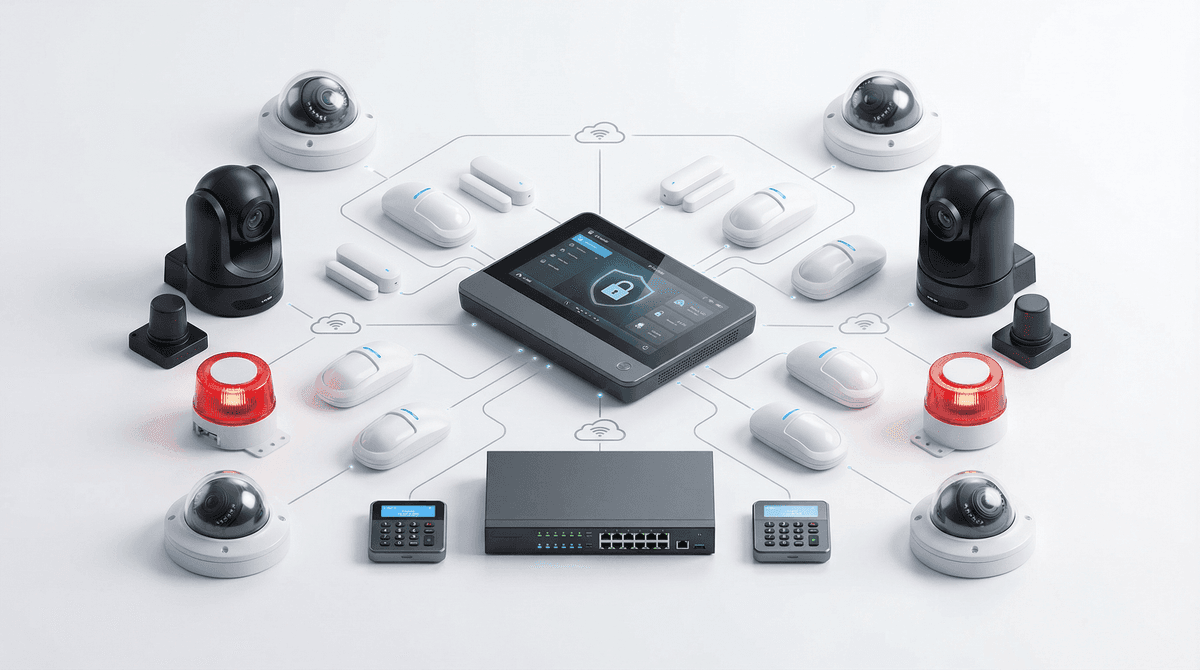
The SOLAR TODO Border Checkpoint 32-Zone Off-Grid package is a useful benchmark for 2026. It includes 12 HD fixed IP cameras, 4 PTZ cameras, 32 intrusion detectors, a 32-channel NVR, and a 64-zone hybrid alarm panel configured for 32 active zones. This layout suits 1 primary gate area, 2-4 vehicle lanes, 1 inspection building, 1 perimeter strip, and multiple controlled access points. EPC turnkey pricing is listed at USD 7,100-9,200.
Sample power budget for a 32-zone off-grid checkpoint
A sample 16-camera checkpoint can draw 12 fixed cameras x 8 W, 4 PTZ cameras x 35 W average, NVR 60 W, network and radio 40 W, alarm panel and peripherals 35 W, plus 15% conversion loss. That yields about 427 W average, or roughly 10.2 kWh/day. With 3 days of autonomy and 80% depth of discharge, usable battery capacity should be near 30.6 kWh, implying around 38.3 kWh nominal lithium storage.
If the site has 5.0 peak sun hours and 80% system efficiency, PV sizing for 10.2 kWh/day is about 2.55 kWp. In practice, engineers usually increase this to 3.5-4.5 kWp to cover seasonal losses, dust, battery aging, and future expansion. In desert or monsoon climates, that margin can be 20-30%.
| Load item | Qty | Unit power | Daily energy assumption |
|---|---|---|---|
| Fixed IP camera | 12 | 8 W | 2.30 kWh/day |
| PTZ camera | 4 | 35 W avg | 3.36 kWh/day |
| 32-channel NVR | 1 | 60 W | 1.44 kWh/day |
| Switch/router/radio | 1 set | 40 W | 0.96 kWh/day |
| Alarm panel + detectors | 1 set | 35 W | 0.84 kWh/day |
| Conversion/system loss | - | 15% | 1.33 kWh/day |
| Total | - | 427 W avg | 10.23 kWh/day |
Security layer design benchmarks
Layered security improves detection probability because cameras alone do not always provide timely alarm logic, especially across 200-800 m perimeter sections. A 32-zone design often splits zones into gate, lane, building, fence line, utility room, and storage partitions. The 64-zone panel in the SOLAR TODO package leaves 32 spare zones for future beam sets, fence vibration loops, panic buttons, or thermal relay inputs.
The relevant standards stack is straightforward. EN 50131 covers intrusion and hold-up systems. IEC 62676 covers video surveillance systems. UL 681 addresses installation and classification practice for burglary systems. NFPA 72 becomes relevant when supervisory signaling or fire interface is required. For B2B buyers, standards alignment affects insurer acceptance, commissioning scope, and maintenance documentation.
Cost Analysis, ROI, and Diesel Comparison
Solar-powered surveillance usually has a higher upfront capex than basic generator-backed CCTV, but over 5 years it can lower total ownership cost by 15-40% when fuel delivery, maintenance, and downtime risk are included.
Remote security cost analysis should separate capex, opex, and outage cost. Capex includes cameras, detectors, poles, power system, batteries, communications, and installation. Opex includes fuel, cleaning, battery replacement, preventive maintenance, SIM data, and guard dispatch. Outage cost includes missed incidents, evidence gaps, and false dispatches. In border and utility sites, one 4-12 hour outage can be more expensive than several months of preventive maintenance.
For a medium checkpoint package, SOLAR TODO lists EPC turnkey at USD 7,100-9,200. Equipment-only pricing will be lower, but buyers must add freight, local civil works, commissioning, and import duties. Diesel alternatives often look cheaper on day 1, yet a small generator running security loads 24/7 can consume roughly 1-3 liters per hour depending on loading and inefficiency. At USD 0.90-1.50 per liter, annual fuel can reach USD 7,884-39,420 before service visits.
| Cost component | Solar-battery off-grid | Diesel-primary security power |
|---|---|---|
| Initial system capex | Higher | Lower |
| Annual fuel cost | USD 0-1,500 | USD 7,884-39,420 |
| Annual maintenance | USD 300-1,200 | USD 1,000-4,000 |
| Noise/emissions | Very low | High |
| Uptime with proper sizing | High | Variable due to refueling/service |
| 5-year TCO trend | Lower in many remote sites | Often higher |
ROI by region and application
ROI varies by fuel price, logistics cost, irradiance, and labor rates. Sites in the Middle East/Africa and Latin America often see faster payback because diesel logistics are expensive and solar resource is strong. North America and Europe can still justify off-grid solar when labor, emissions, and outage penalties are high.
| Region | Typical payback vs diesel-primary | Main ROI driver | Typical solar resource effect |
|---|---|---|---|
| Asia-Pacific | 2.5-5.0 years | Fuel avoidance, reduced service trips | Medium to high |
| Europe | 4.0-6.5 years | Resilience, labor savings, emissions | Medium |
| North America | 3.0-5.5 years | Truck roll reduction, remote uptime | Medium to high |
| Middle East/Africa | 2.0-4.0 years | High fuel logistics cost | High |
| Latin America | 2.5-4.5 years | Remote mining/agri security economics | High |
EPC Investment Analysis and Pricing Structure
For 2026 projects, EPC delivery combines engineering, procurement, installation, testing, and commissioning, while medium off-grid surveillance packages commonly price from equipment-only up to USD 7,100-9,200 for turnkey checkpoint deployment.
B2B buyers should request three commercial layers in every quotation. First is FOB supply, which covers factory delivery and core equipment. Second is CIF delivered, which adds ocean or air freight, insurance, and destination logistics. Third is EPC turnkey, which includes engineering review, mounting structures, field installation, cable routing, testing, commissioning, and handover documents.
A practical pricing structure for security portfolios is shown below. Exact pricing depends on detector count, camera resolution, pole quantity, battery chemistry, autonomy days, and communications method. Satellite backhaul, thermal cameras, and anti-corrosion structures can raise capex by 10-35%.
| Commercial scope | What is included | Typical cost position |
|---|---|---|
| FOB Supply | Equipment only, factory dispatch | Lowest upfront price |
| CIF Delivered | Equipment + freight + insurance | Mid-level landed price |
| EPC Turnkey | Equipment + installation + commissioning | Highest upfront, lowest coordination burden |
Volume pricing guidance for framework procurement is standard in infrastructure projects. Buyers can target about 5% discount at 50+ systems, 10% at 100+, and 15% at 250+, subject to battery commodity pricing and shipping terms. Payment terms are commonly 30% T/T + 70% against B/L, or 100% L/C at sight. Financing is available for large projects above USD 1,000K. For quotation support, contact [email protected].
Warranty and lifecycle planning
Warranty coverage should be split by subsystem because cameras, batteries, controllers, and structures age differently over 3-10 year cycles. Lithium batteries are often warranted for 6,000 cycles or 5-10 years, while cameras and NVRs may carry 2-3 year terms. Mounting structures and galvanized poles may exceed 10-15 years depending on ASTM coating class, salt exposure, and wind loading.
For maintenance planning, schedule quarterly remote health checks, semiannual field inspection, and annual battery and grounding review. A well-documented preventive plan can reduce emergency callouts by 20-40% and improve evidence continuity. This is where SOLAR TODO can support B2B buyers with equipment scope definition and offline quotation for project-specific conditions.
Product Comparison and Selection Guide
The right surveillance package depends on zone count, power availability, and monitoring model, with 32-zone off-grid systems fitting medium remote sites while 128-zone grid-powered systems suit large campuses with 64 cameras.
The three SOLAR TODO security packages below illustrate how buyers should compare power architecture, zone scale, and monitoring requirement rather than only camera count. A border checkpoint and a gas station chain may both use 16 cameras, but the power and communications assumptions are different.
| Package | Power model | Zones | Cameras | Key use case | Indicative pricing |
|---|---|---|---|---|---|
| Border Checkpoint 32-Zone Off-Grid | Solar-battery off-grid | 32 active / 64 panel | 16 | Remote checkpoint, unstable grid | EPC USD 7,100-9,200 |
| Gas Station Chain 32-Zone Cloud | Grid-powered with 4G/Ethernet/WiFi | 32 | 16 | Multi-site fuel retail | Project-specific |
| Government Building 128-Zone Maximum | Grid-powered | 128 | 64 | Large government campus | EPC USD 36,300-46,600 |
How to choose the right off-grid configuration
Choose a 32-zone off-grid system when the site has 1 gate, 2-4 lanes, 1 inspection building, and a medium perimeter requiring 16 cameras and 32 detector points. Increase to larger architectures when the site exceeds 4 perimeters, 20 controlled rooms, or 64 camera channels. If the site has stable utility power above 99% availability, a grid-powered architecture may be cheaper unless resilience requirements justify battery backup.
Communications design matters as much as power design. For low-bandwidth sites, event-driven upload plus local NVR storage is usually cheaper than full cloud video. For high-risk sites, combine local recording with 4G or radio alarm transmission and optional satellite backup. This avoids the common failure mode where the cameras are powered but the evidence cannot be exported during an incident.
FAQ
A properly sized off-grid surveillance system for 16 cameras usually needs 3-6 kWp solar and 10-30 kWh usable storage, but exact sizing depends on PTZ duty cycle, night IR load, and autonomy target. Sites with 2.5-4.5 days of autonomy perform better during cloudy periods and reduce generator starts.
Q: What is a solar-powered surveillance system? A: A solar-powered surveillance system uses PV modules, battery storage, cameras, detectors, and communications equipment to provide 24/7 security without relying on stable grid power. Typical medium sites use 16 cameras, 32 detectors, and 3-6 kWp solar with battery autonomy of 2.5-4.5 days.
Q: How much does an off-grid security system cost in 2026? A: A medium checkpoint package can reach EPC turnkey pricing of about USD 7,100-9,200, while equipment-only pricing is lower but excludes installation and logistics. Final cost depends on camera count, battery size, pole works, communications method, and local labor.
Q: Why is solar better than diesel for remote surveillance? A: Solar-battery systems usually cut fuel use by 70-95% and reduce service visits over a 5-year period. Diesel can still be useful as backup, but fuel logistics, maintenance, noise, and outage risk often make diesel-primary systems more expensive in remote sites.
Q: How do I size battery storage for 24/7 surveillance? A: Start with daily energy demand in kWh, then multiply by the required autonomy days, usually 2.5-4.5 days for remote security. Divide by allowable depth of discharge, such as 80% for lithium, and add 10-20% margin for aging and seasonal conditions.
Q: What standards should a professional surveillance package meet? A: Buyers should check EN 50131 for intrusion systems, IEC 62676 for video surveillance, UL 681 for installation practice, and NFPA 72 where signaling interfaces are required. These standards help with insurer acceptance, commissioning quality, and maintenance documentation.
Q: How much solar capacity is needed for 16 cameras and 32 detectors? A: Many medium sites fall in the 3-6 kWp range, but actual sizing depends on camera wattage, PTZ use, NVR load, and local peak sun hours. A sample 427 W average load consumes about 10.2 kWh/day and often justifies 3.5-4.5 kWp after design margin.
Q: What maintenance does an off-grid surveillance system require? A: Most systems need quarterly remote diagnostics, semiannual site inspection, and annual battery, grounding, and enclosure checks. Dust removal on PV modules, firmware updates, and cable inspection are important because a 5-10% energy loss can reduce winter autonomy.
Q: When should I choose cloud monitoring instead of local NVR storage? A: Choose cloud monitoring when you manage multiple sites and need centralized visibility across 5-500 locations. Choose local NVR-first architecture when bandwidth is limited, then add event-based cloud upload or alarm transmission for resilience and lower data cost.
Q: What is included in EPC turnkey delivery? A: EPC turnkey usually includes engineering review, equipment procurement, mounting structures, installation, cable routing, testing, commissioning, and handover documents. Commercial terms commonly use 30% T/T + 70% against B/L or 100% L/C at sight, with financing for projects above USD 1,000K.
Q: How do volume discounts work for security portfolios? A: Framework buyers can often target about 5% discount at 50+ systems, 10% at 100+, and 15% at 250+, subject to battery and freight pricing. Standardizing camera models, battery blocks, and controller types usually improves both unit price and spare-parts planning.
Conclusion
Off-grid solar-powered surveillance in 2026 is most cost-effective where diesel logistics are expensive, with medium 32-zone systems often paying back in 2-5 years and turnkey pricing around USD 7,100-9,200.
For remote checkpoints, utility yards, and perimeter sites, the bottom line is simple: specify the power system from real 24/7 loads, require EN 50131 and IEC 62676 alignment, and compare 5-year TCO rather than day-1 capex. SOLAR TODO can support offline quotation, EPC scope review, and project financing discussion for larger deployments.
References
- International Energy Agency (2024): World Energy Investment 2024, showing clean energy investment above USD 2 trillion.
- IRENA (2024): Renewable Power Generation Costs in 2023, documenting solar PV cost competitiveness and global cost trends.
- BloombergNEF (2024): Battery Pack Prices Fall to USD 139/kWh, reporting 14% year-on-year decline.
- NREL (2024): Guidance and research on resilient power systems, solar-plus-storage, and remote energy system performance.
- IEC 62676 (2024): Video surveillance systems for use in security applications.
- EN 50131 (current editions): Intrusion and hold-up alarm systems requirements and grading framework.
- UL 681 (current editions): Installation and classification of burglary and holdup alarm systems.
- NFPA 72 (2025): National Fire Alarm and Signaling Code for signaling pathways and interface practices.
About SOLARTODO
SOLARTODO is a global integrated solution provider specializing in solar power generation systems, energy-storage products, smart street-lighting and solar street-lighting, intelligent security & IoT linkage systems, power transmission towers, telecom communication towers, and smart-agriculture solutions for worldwide B2B customers.
About the Author

SOLAR TODO
Solar Energy & Infrastructure Expert Team
SOLAR TODO is a professional supplier of solar energy, energy storage, smart lighting, smart agriculture, security systems, communication towers, and power tower equipment.
Our technical team has over 15 years of experience in renewable energy and infrastructure, providing high-quality products and solutions to B2B customers worldwide.
Expertise: PV system design, energy storage optimization, smart lighting integration, smart agriculture monitoring, security system integration, communication and power tower supply.
Cite This Article
SOLAR TODO. (2026). Solar-Powered Surveillance System Report 2026: Off-Grid…. SOLAR TODO. Retrieved from https://solartodo.com/knowledge/solar-powered-surveillance-system-report-2026-off-grid-security-cost-analysis
@article{solartodo_solar_powered_surveillance_system_report_2026_off_grid_security_cost_analysis,
  title = {Solar-Powered Surveillance System Report 2026: Off-Grid…},
  author = {SOLAR TODO},
  journal = {SOLAR TODO Knowledge Base},
  year = {2026},
  url = {https://solartodo.com/knowledge/solar-powered-surveillance-system-report-2026-off-grid-security-cost-analysis},
  note = {Accessed: 2026-05-10}
}
Published: May 10, 2026 | Available at: https://solartodo.com/knowledge/solar-powered-surveillance-system-report-2026-off-grid-security-cost-analysis
Subscribe to Our Newsletter
Get the latest solar energy news and insights delivered to your inbox.
View All Articles