solar powered street light manufacturer | SOLARTODO

Cinn Song
Founder & Chief Solutions Architect
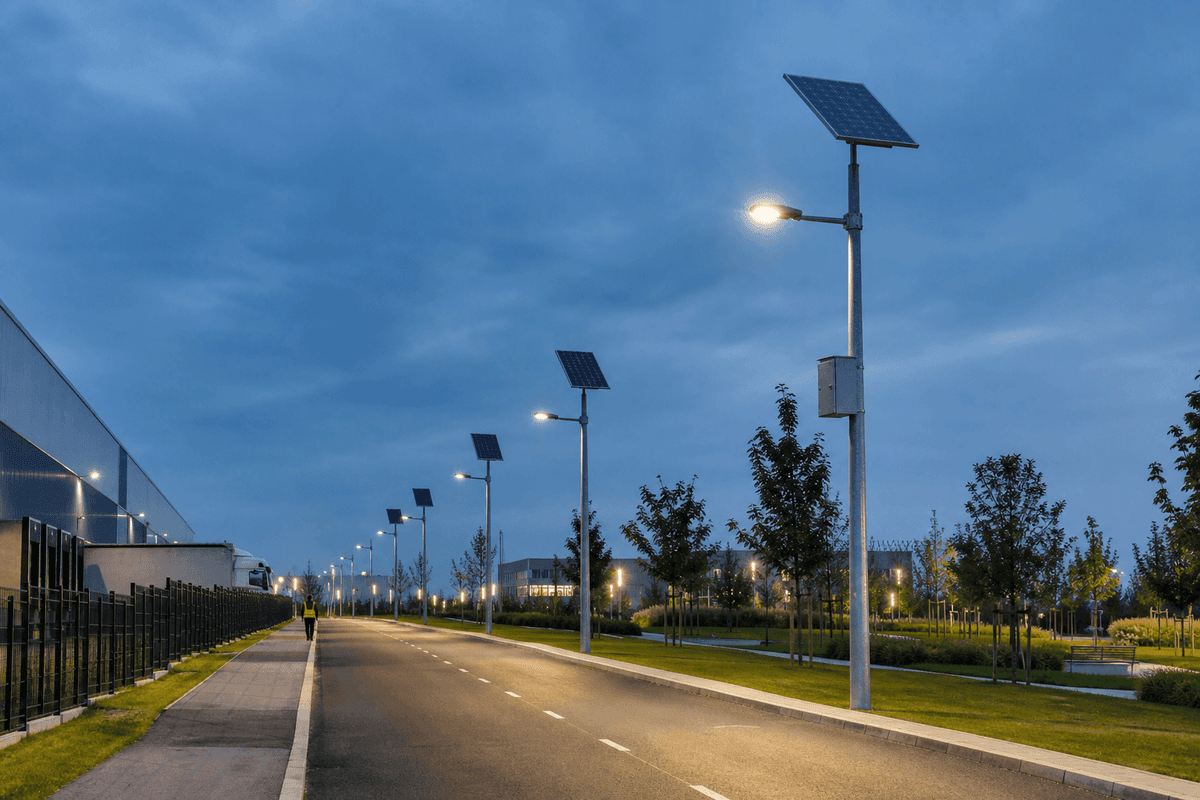
Watch the video
TL;DR
A strong solar powered street light manufacturer should provide engineered 60W-150W systems, 4-day LiFePO4 battery autonomy, IP66 weather protection, certified PV and luminaire components, and clear FOB, CIF, or EPC turnkey pricing. SOLARTODO supports B2B municipal and industrial projects with technical quotations, volume discounts up to 15%, and financing review for projects above $1,000K.
A solar powered street light manufacturer should deliver 60W-150W systems, 4-day LiFePO4 autonomy, IP66 protection, and EPC support for roads, parks, logistics yards, and municipal off-grid lighting projects.
Summary
A solar powered street light manufacturer should deliver 60W-150W systems, 4-day LiFePO4 autonomy, IP66 protection, and EPC support for roads, parks, logistics yards, and municipal off-grid lighting projects.
Key Takeaways
Use manufacturer selection criteria across 6-8 dimensions so procurement teams can compare 60W-150W solar street lights without relying on brochure claims.
- Specify 60W-150W LED output with 170 lm/W efficacy to match pathways, urban roads, and industrial corridors.
- Require 4-day LiFePO4 autonomy with 500Wh-1,200Wh battery capacity for rainy-season reliability.
- Verify IP66 housings, IEC 60598 luminaire compliance, and hot-dip galvanized poles for 10-25 year field life.
- Compare all-in-one and split systems by pole height, with 8m/60W for urban roads and 12m/150W for industrial roads.
- Model ROI over 5-8 years by avoiding trenching, grid connection, and monthly electricity costs.
- Request EPC pricing in 3 tiers: FOB supply, CIF delivered, and EPC turnkey with installation scope.
- Negotiate volume discounts of 5% at 50+ units, 10% at 100+ units, and 15% at 250+ units.
- Confirm remote monitoring via 4G or LoRaWAN for fault alerts, dimming profiles, and battery health data.
Choosing a Solar Powered Street Light Manufacturer
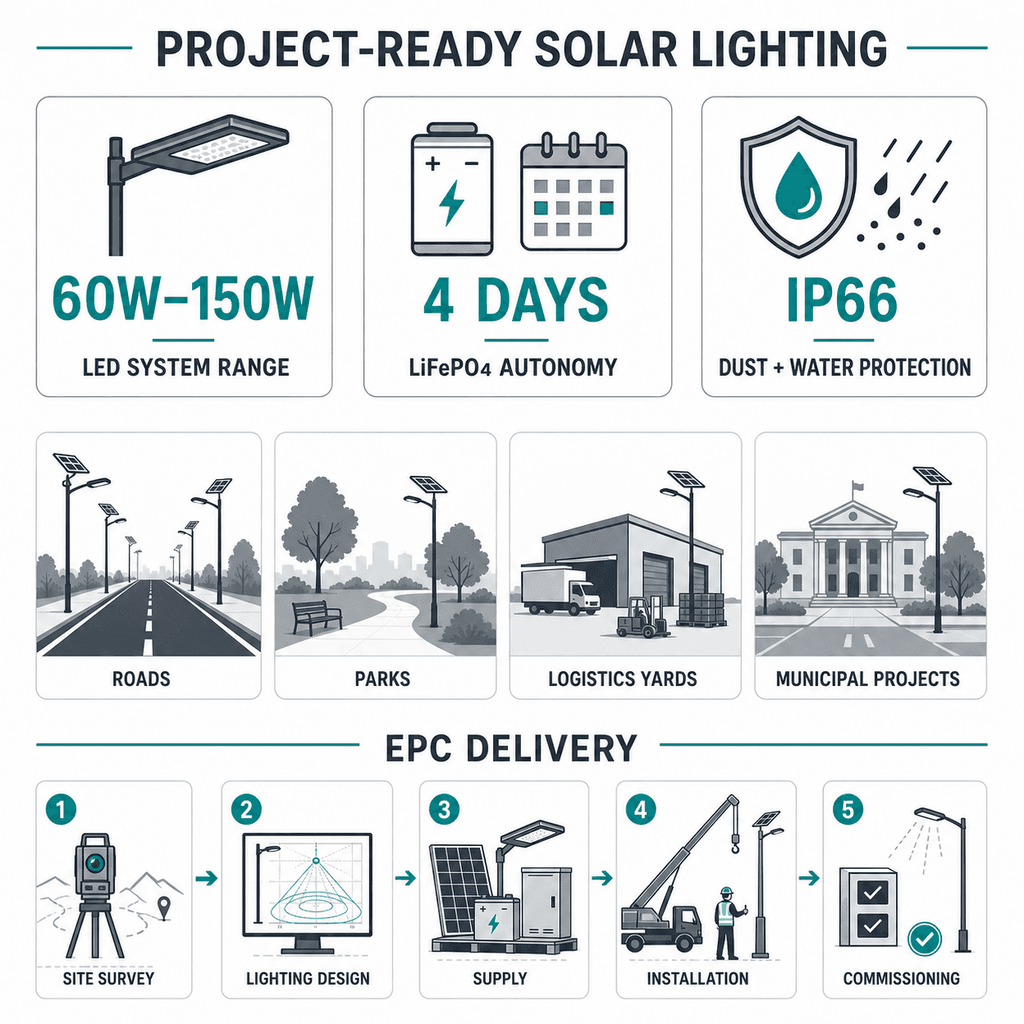
A qualified solar powered street light manufacturer should combine 60W-150W luminaires, 120Wp-300Wp PV modules, LiFePO4 storage, and project-grade EPC documentation.
For B2B buyers, the core purchasing question is not whether solar lighting works; it is whether the supplier can engineer a predictable system for the site. A municipal road, logistics corridor, industrial campus, or rural highway has different illuminance targets, pole heights, wind loads, operating hours, and maintenance constraints. SOLARTODO positions itself as a B2B manufacturer and exporter, not an online marketplace, with inquiry-based quotations and project financing for qualified large projects.
According to IEA (2024), its Renewables 2024 report provides deployment forecasts to 2030 and assesses barriers to faster renewable growth. The International Energy Agency states, "Renewables 2024 offers a comprehensive country-level analysis," which matters because street lighting projects are usually specified under local grid, road, climate, and public safety rules.
A manufacturer should be evaluated on engineering depth, repeatable production, component transparency, certification readiness, and after-sales support. Procurement teams should ask for solar yield assumptions, lighting simulation files, battery sizing logic, pole drawings, controller settings, test reports, and warranty boundaries before comparing prices.
SOLARTODO typically supports project categories across Latin America, the Middle East, Africa, Southeast Asia, and Europe, where off-grid lighting can reduce civil works and improve road safety in areas with weak or expensive grid access. For decision-makers, the best manufacturer is the one that can translate a site layout into a bill of materials, photometric plan, delivery schedule, and financial model.
Technical System Architecture and Specifications
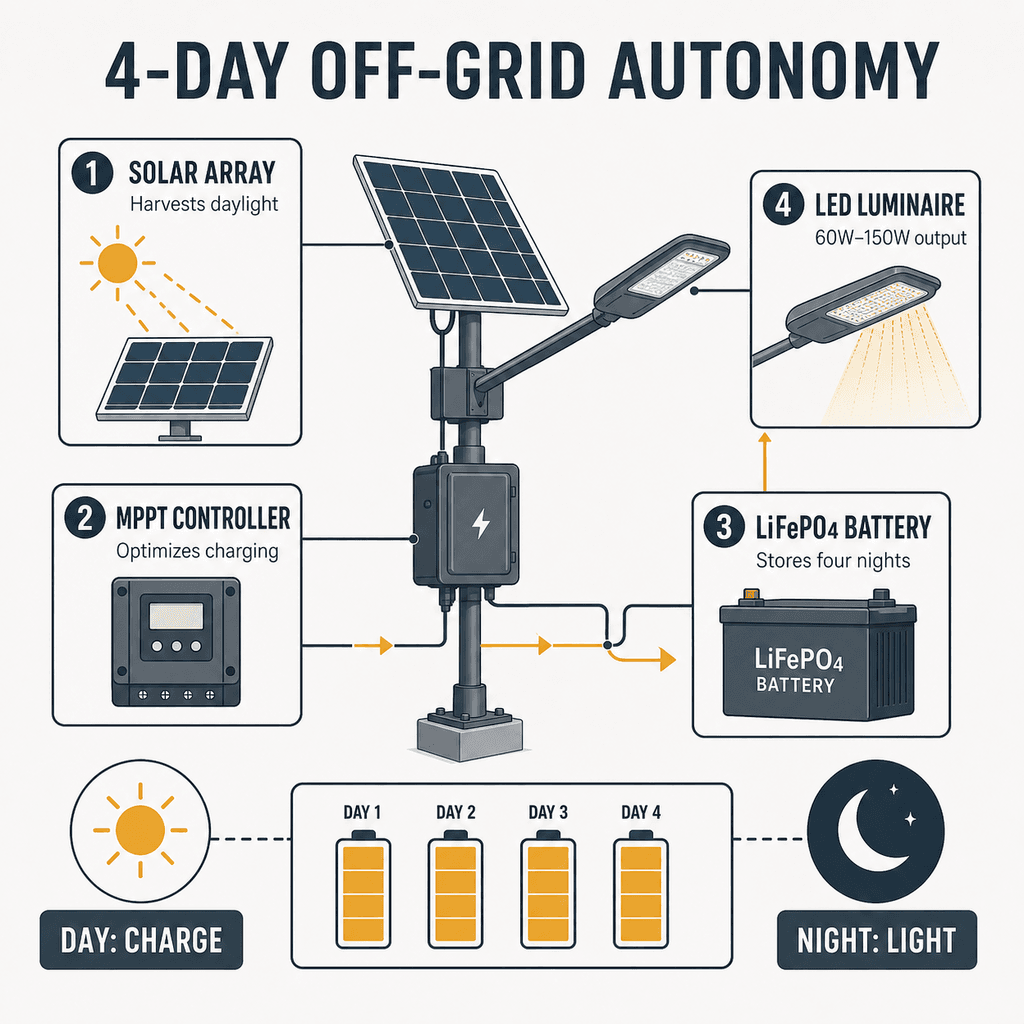
A bankable solar street light system integrates 120Wp-300Wp PV generation, 500Wh-1,200Wh LiFePO4 storage, MPPT charging, and IP66 LED optics.
Solar powered street lights are compact power systems. The photovoltaic module harvests energy during daylight, the MPPT controller charges the battery, and the LED luminaire operates from dusk to dawn using programmed dimming schedules. For roadway applications, the system must balance lumen output, autonomy, pole structure, optical distribution, and long-term serviceability.
According to NREL PVWatts methodology (2024), solar production estimates depend on site irradiance, array orientation, system losses, and weather data. In procurement terms, that means a 300Wp panel in a 4.5 peak-sun-hour region can support a different load profile than the same panel in a cloudy coastal or high-latitude site.
Core Components
SOLARTODO product knowledge includes two representative configurations. An 8m urban all-in-one 60W model uses a 120Wp monocrystalline TOPCon panel, 500Wh LiFePO4 battery, MPPT controller, and 60W LED module delivering more than 10,200 lm. A 12m industrial split 150W model uses a 300Wp TOPCon panel, 1,200Wh LiFePO4 battery, 30A MPPT controller, and approximately 25,500 lm output.
LiFePO4 chemistry is preferred because it offers thermal stability, long cycle life, and better safety for unattended roadside installations. A well-specified battery pack should include BMS protection for overcharge, over-discharge, short circuit, cell balancing, state-of-charge estimation, and low-temperature charge inhibition.
LED optical design is as important as wattage. Type II or Type III lenses direct light onto the road surface, improving uniformity and reducing glare. A high-efficacy 170 lm/W luminaire can reduce battery size compared with inefficient fixtures, which lowers both capital cost and long-term replacement risk.
Specification Table
The following table gives procurement teams a practical baseline for comparing solar street light manufacturer quotations.
| Specification | Urban All-in-One | Industrial Split |
|---|---|---|
| Mounting height | 8m | 12m |
| LED power | 60W | 150W |
| Approximate luminous flux | 10,200 lm | 25,500 lm |
| Solar panel | 120Wp TOPCon | 300Wp TOPCon |
| Battery | 500Wh LiFePO4 | 1,200Wh LiFePO4 |
| Autonomy | 4 days | 4 days |
| Controller | MPPT, PIR optional | 30A MPPT, RS-485 optional |
| Housing rating | IP66 | IP66 enclosure |
| Typical use | Urban roads, parks | Industrial roads, logistics yards |
Applications and Manufacturer Selection Guide
The right manufacturer maps 8m-12m pole designs to traffic class, road width, wind zone, autonomy target, and maintenance access.
Solar powered street lights are used where trenching costs, unstable utility supply, or sustainability targets make grid lighting unattractive. Typical applications include municipal streets, industrial parks, rural roads, campuses, parking areas, ports, mining access roads, and perimeter security corridors. The business case is strongest when grid extension requires long cable runs, transformer upgrades, excavation, or recurring electricity tariffs.
According to IRENA (2024), solar PV continued to be among the lowest-cost new generation options globally, with renewable additions led by solar. IRENA states, "renewable power remains cost-competitive," and that cost trend supports decentralized lighting where each pole generates and stores its own energy.
Buyers should separate product suppliers from project-capable manufacturers. A product supplier may quote a lamp and pole, while a manufacturer with engineering capability can provide lux simulations, wind-load assumptions, foundation guidance, packing lists, installation manuals, and spare-part strategy. For public tenders, these deliverables often determine whether the bid is technically compliant.
Use this selection checklist when shortlisting manufacturers:
- Confirm factory experience with 8m, 10m, and 12m poles for local wind requirements.
- Ask for IEC 60598 luminaire test alignment and IEC 61215/61730 PV module documentation.
- Require battery data including Wh capacity, cell chemistry, BMS protections, and cycle rating.
- Request dimming schedules with 12-hour operating profiles and motion-sensor behavior.
- Verify corrosion protection, including hot-dip galvanizing and stainless-steel fasteners.
- Ask for spare parts availability for batteries, controllers, LED drivers, lenses, and sensors.
SOLARTODO can support standard procurement, OEM adaptation, and project-based quotations. Because SOLARTODO works through inquiry and offline quotation, engineers can size products around road width, latitude, climate, lighting class, and budget instead of forcing every buyer into a fixed catalog configuration.
EPC Investment Analysis and Pricing Structure
EPC delivery should price 50-250+ solar street lights through FOB supply, CIF delivered, and turnkey installation models with transparent ROI assumptions.
EPC means Engineering, Procurement, and Construction. For solar powered street lighting, EPC turnkey delivery can include site survey review, lighting design, PV and battery sizing, structural drawings, bill of materials, manufacturing, quality control, shipping, installation supervision, commissioning, training, and handover documentation. The exact scope should be defined before price comparison.
SOLARTODO can quote three common commercial structures. FOB supply covers product manufacturing and export handover. CIF delivered adds international freight and insurance to the destination port. EPC turnkey adds installation, commissioning, and project management where local execution partners are available. For public or industrial projects, this separation prevents confusion between equipment price and installed project cost.
| Pricing Tier | What It Includes | Best For |
|---|---|---|
| FOB Supply | Manufactured lights, poles, packing, export documentation | Buyers with freight and installation teams |
| CIF Delivered | FOB scope plus ocean freight and insurance | Importers needing landed cost visibility |
| EPC Turnkey | Engineering, procurement, delivery, installation, commissioning | Municipal, industrial, and financed projects |
Volume pricing should be negotiated by project size. As guidance, 50+ units may qualify for a 5% discount, 100+ units for 10%, and 250+ units for 15%, subject to specification, delivery schedule, currency, and raw-material conditions. Payment terms are typically 30% T/T deposit plus 70% against bill of lading, or 100% L/C at sight for approved transactions.
ROI depends on avoided trenching, avoided grid connection, electricity savings, maintenance intervals, and safety benefits. A conventional grid lighting project may require cable trenching, distribution panels, metering, permits, and recurring utility bills. A solar powered street light can reduce civil works and compress deployment, often producing a 5-8 year payback in areas with high grid-extension cost or expensive electricity.
For large projects above $1,000K, financing may be available subject to buyer qualification, country risk, contract structure, and bank documentation. Procurement teams can contact [email protected] or +6585559114 for technical quotation, EPC scope discussion, and financing review.
Compliance, Quality Control, and Warranty Risk
A compliant system should align with at least 5 standards covering luminaires, PV modules, lithium batteries, corrosion protection, and road lighting design.
Compliance reduces procurement risk because solar street lights combine electrical, structural, optical, and environmental requirements. IEC 60598-2-3 applies to road and street luminaires, while IEC 61215 and IEC 61730 are common references for crystalline PV module design qualification and safety. IEC 62619 is relevant for industrial lithium battery safety, and ASTM A123 supports hot-dip galvanizing requirements for steel poles.
According to IEC 61215 (2021), crystalline silicon PV modules are tested for design qualification under environmental stress conditions. According to IEC 61730 (2023), PV module safety qualification addresses construction and testing requirements. These standards do not replace project engineering, but they help buyers filter out unverified components.
Quality control should cover incoming components, assembly checks, aging tests, waterproof inspections, battery capacity checks, controller programming, and final packing verification. For export projects, documentation should include commercial invoice, packing list, certificates of origin when required, installation manuals, warranty terms, and component datasheets.
Warranty terms should be explicit. A strong manufacturer will separate warranties for LED module, battery, controller, PV panel, pole, and workmanship because each component ages differently. Buyers should also ask who pays freight for replacement parts, what evidence is required for claims, and whether remote monitoring logs can support diagnosis.
FAQ
These 10 FAQ answers cover 60W-150W specifications, 4-day autonomy, EPC pricing, installation, maintenance, warranty, and manufacturer selection.
Q: What does a solar powered street light manufacturer actually supply? A: A solar powered street light manufacturer supplies the complete lighting system, including LED luminaire, solar panel, LiFePO4 battery, MPPT controller, pole, brackets, cables, and installation documentation. For B2B projects, SOLARTODO can also support lighting design, EPC quotation, shipping documents, and financing review for projects above $1,000K.
Q: How do I choose between all-in-one and split solar street lights? A: Choose all-in-one systems for 6m-8m roads, parks, and faster installation where compact design matters. Choose split systems for 10m-12m poles, industrial roads, and sites needing larger 300Wp panels or 1,200Wh batteries. Split designs allow better panel tilt optimization and easier ground-level battery maintenance.
Q: What wattage is suitable for urban and industrial roads? A: Urban roads commonly use 40W-80W solar street lights on 6m-8m poles, while industrial corridors often require 100W-150W luminaires on 10m-12m poles. A 60W fixture can deliver about 10,200 lm at 170 lm/W, while a 150W fixture can deliver about 25,500 lm.
Q: How much battery autonomy should a project require? A: A 3-4 day autonomy target is common for public and industrial projects exposed to rainy or cloudy periods. SOLARTODO reference systems use 500Wh batteries for 60W urban units and 1,200Wh batteries for 150W industrial units. Final sizing should reflect nightly hours, dimming schedule, latitude, and local irradiance.
Q: What standards should procurement teams request? A: Request IEC 60598 alignment for luminaires, IEC 61215 and IEC 61730 documentation for PV modules, IEC 62619 relevance for lithium battery safety, and ASTM A123 for hot-dip galvanized steel poles. These references help verify electrical safety, environmental durability, corrosion protection, and export-grade product quality.
Q: How long does installation take per solar street light? A: All-in-one units can often be installed in under 30 minutes per pole after foundation preparation, while split 12m systems take longer because panel, battery box, wiring, and dual-arm luminaires are installed separately. Total project schedule depends on foundations, road access, lifting equipment, customs clearance, and crew capacity.
Q: What does EPC turnkey pricing include? A: EPC turnkey pricing can include engineering design, product procurement, manufacturing, logistics, installation, commissioning, training, and handover documents. SOLARTODO can quote FOB supply, CIF delivered, or EPC turnkey tiers. Buyers should define whether civil works, foundations, local permits, cranes, and night-time commissioning are included.
Q: What payment terms and discounts are typical? A: Typical payment terms are 30% T/T deposit and 70% against bill of lading, or 100% L/C at sight for approved projects. Volume pricing may reach 5% discount at 50+ units, 10% at 100+ units, and 15% at 250+ units, depending on specification and delivery schedule.
Q: What maintenance is required after commissioning? A: Maintenance is usually light but should be scheduled every 6-12 months for panel cleaning, bolt inspection, battery health checks, controller logs, and luminaire condition. Dusty, coastal, or industrial sites may need more frequent cleaning. Remote 4G or LoRaWAN monitoring can reduce truck rolls by identifying faults early.
Q: How should buyers compare warranty offers? A: Compare warranty by component, not only by total years. PV panels may carry 25-year output warranties, LEDs often exceed 50,000 hours, and LiFePO4 batteries are commonly rated by cycle life. Ask whether replacement freight, labor, controller logs, and failure evidence are covered before accepting a low-price quotation.
Conclusion
A strong solar powered street light manufacturer delivers 60W-150W engineered systems, 4-day autonomy, verified standards, and EPC pricing that supports bankable procurement decisions.
The bottom line: for municipal and industrial projects, SOLARTODO can supply 8m/60W and 12m/150W solar powered street lights with LiFePO4 storage, MPPT control, IP66 protection, and FOB, CIF, or EPC turnkey quotation paths. Buyers should prioritize lifecycle reliability, photometric performance, and financing-ready documentation over the lowest unit price.
References
These 7 references cover solar cost trends, PV yield modeling, road lighting, PV safety, battery safety, galvanizing, and smart infrastructure procurement.
- IEA (2024): Renewables 2024, analysis and forecasts to 2030; official source: https://www.iea.org/reports/renewables-2024
- IRENA (2024): Renewable Power Generation Costs and renewable capacity statistics for solar PV cost competitiveness and global additions; official source: https://www.irena.org
- NREL (2024): PVWatts Calculator methodology for estimating photovoltaic energy production from site irradiance and system losses; official source: https://www.nrel.gov/pv/pvwatts
- IEC 60598-2-3 (2011): Particular requirements for luminaires for road and street lighting applications.
- IEC 61215-1 (2021): Terrestrial photovoltaic modules design qualification and type approval test requirements.
- IEC 61730-1 (2023): Photovoltaic module safety qualification requirements for construction and testing.
- ASTM A123/A123M (2024): Standard specification for zinc hot-dip galvanized coatings on iron and steel products.
About SOLARTODO
SOLARTODO is a global integrated solution provider specializing in solar power generation systems, energy-storage products, smart street-lighting and solar street-lighting, intelligent security & IoT linkage systems, power transmission towers, telecom communication towers, and smart-agriculture solutions for worldwide B2B customers.
About the Author

Cinn Song
Founder & Chief Solutions Architect
Cinn Song founded SOLARTODO LIMITED and leads its smart-city infrastructure engineering — from solar, storage and integrated smart poles to the company's push into physical-AI city edge nodes: pole-mounted edge computing, vertical LLMs for smart cities, drone-based O&M with autonomous battery swapping, robotic maintenance, and high-speed counter-UAS interception. Since 2010, he has directed turnkey EPC + BOT delivery across 50+ countries, including telecom monopole supply for national grid operators, off-grid solar street-lighting for African municipalities, and integrated smart-pole programs for Gulf smart cities.
Cite This Article
Cinn Song. (2026). solar powered street light manufacturer | SOLARTODO. SOLARTODO. Retrieved from https://solartodo.com/knowledge/solar-powered-street-light-manufacturer
@article{solartodo_solar_powered_street_light_manufacturer,
  title = {solar powered street light manufacturer | SOLARTODO},
  author = {Cinn Song},
  journal = {SOLARTODO Knowledge Base},
  year = {2026},
  url = {https://solartodo.com/knowledge/solar-powered-street-light-manufacturer},
  note = {Accessed: 2026-10-14}
}
Published: July 10, 2026 | Available at: https://solartodo.com/knowledge/solar-powered-street-light-manufacturer
Subscribe to Our Newsletter
Get the latest solar energy news and insights delivered to your inbox.
View All Articles