Solar-Powered Security Systems for Remote Facilities

SOLARTODO Editorial Team
Solar Energy & Infrastructure Expert Team
Watch the video
TL;DR
Remote facilities without utility power can maintain 24/7 surveillance by using solar PV, battery storage, local NVR recording, and event-based cloud backup. A medium system can support 16 cameras and 32 alarm zones with 2-5 days of autonomy, while EPC turnkey pricing often falls around USD 7,100-9,200 depending on storage, communications, and civil scope.
Solar-powered security systems keep remote facilities protected with 24/7 surveillance, 4G/cloud backup, and 2-5 days of battery autonomy. A 32-zone design can support 16 cameras and 32 detectors, while EPC turnkey budgets often range from USD 7,100-9,200.
Summary
Solar-powered security systems keep remote facilities protected with 24/7 surveillance, 4G/cloud backup, and off-grid autonomy sized for 2-5 days. A 32-zone package can support 16 cameras and 32 detectors, while EPC turnkey budgets typically range from USD 7,100-9,200.
Key Takeaways
- Size off-grid security power for at least 2-5 days of autonomy to keep 16 cameras, 32 detectors, and communications online during poor weather or generator outages.
- Specify layered detection with 12 fixed IP cameras, 4 PTZ cameras, 32 alarm points, and a 32-channel NVR to reduce blind spots at gates, fences, and inspection areas.
- Use cloud storage with 4G plus Ethernet redundancy to protect critical footage when local NVRs fail, are damaged, or face delayed retrieval from sites 50-500 km away.
- Reserve expansion capacity by selecting a 64-zone hybrid panel with 32 active zones and 32 spare zones for fence sensors, panic buttons, or thermal relay inputs.
- Compare delivery models early: FOB supply, CIF delivered, and EPC turnkey; for remote checkpoint-class systems, turnkey budgets commonly start around USD 7,100-9,200.
- Calculate ROI against diesel-only security power, where solar plus battery systems can cut fuel visits, generator runtime, and maintenance events by more than 50% in remote operations.
- Verify compliance with IEC 62676, EN 50131, UL 681, and NFPA 72 principles so the surveillance, intrusion, and signaling architecture meets common procurement and insurer requirements.
- Plan communications around bandwidth and evidence needs by combining local 30-day retention, event-based cloud upload, and AI analytics to reduce nuisance alarms by up to 90% versus motion-only legacy setups.
Why Remote Facilities Need Solar-Powered Security Systems
Solar-powered security systems solve the core remote-site problem by combining 24/7 surveillance, 2-5 days of battery autonomy, and cloud evidence storage when grid power is unavailable or unstable.
Remote facilities often fail at the same three points: power, communications, and evidence retention. A mining perimeter, telecom shelter, border checkpoint, pump station, or agricultural depot may sit 20-300 km from the nearest maintenance team, yet still require continuous monitoring across 8-32 alarm zones. When utility supply is absent, grid-tied CCTV and alarm designs become unreliable, and diesel-only backup raises fuel, theft, and service costs.
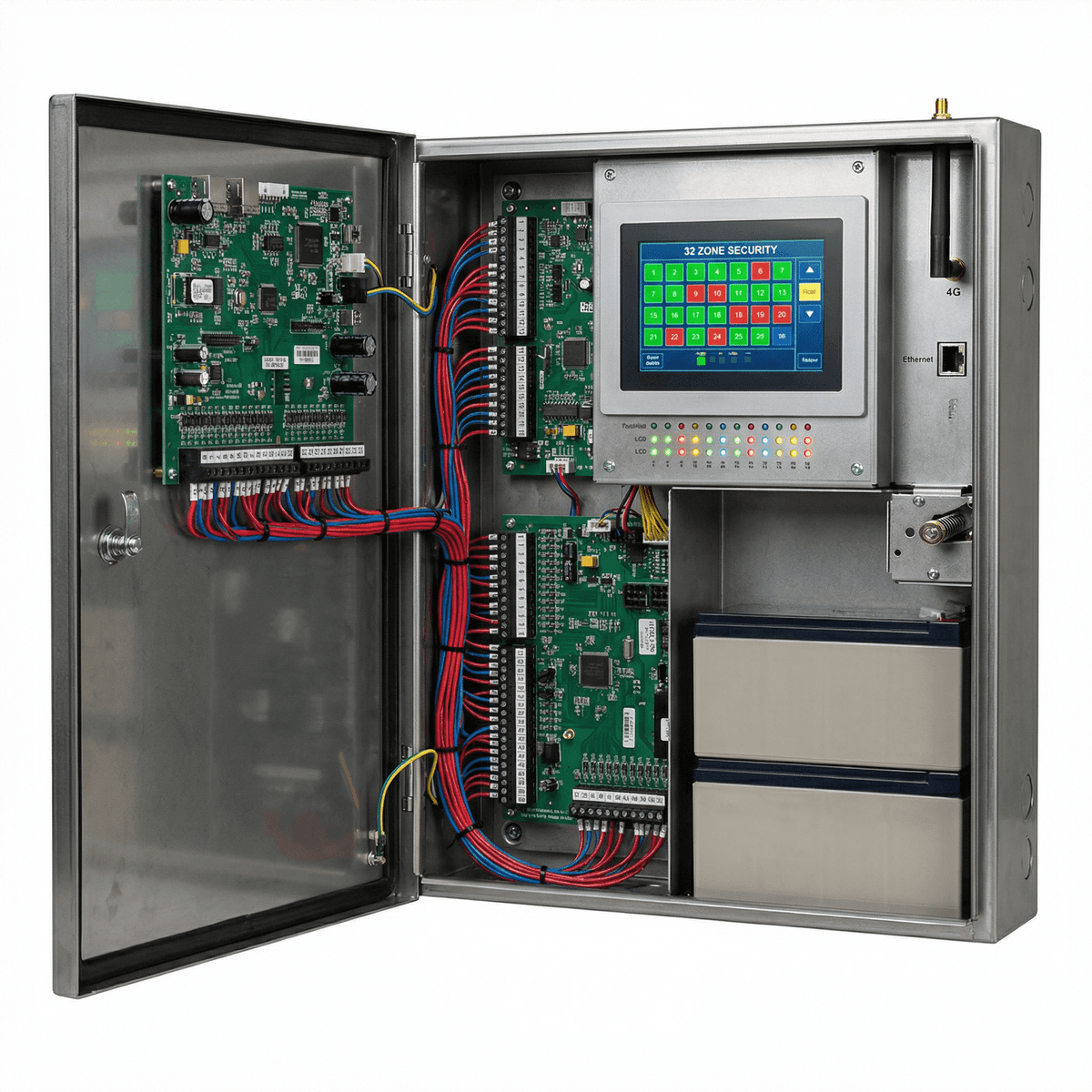
A solar-powered architecture addresses these gaps by pairing photovoltaic generation, battery storage, low-voltage surveillance loads, and cloud-connected monitoring. SOLAR TODO commonly sees buyer requirements centered on 24/7 operation, 4G uplink, and local recording redundancy. For medium remote sites, a package similar to the Border Checkpoint 32-Zone Off-Grid configuration supports 16 cameras, 32 intrusion detectors, a 32-channel NVR, and a 64-zone hybrid alarm panel with 32 spare zones for expansion.
According to IEA (2024), energy security and resilience are now core drivers for distributed energy deployment in critical infrastructure. According to NREL (2024), solar-plus-storage modeling remains the standard approach for off-grid reliability analysis because load profile, irradiance, and autonomy days determine battery sizing more accurately than panel wattage alone. The International Energy Agency states, "Solar PV is expected to become the largest renewable power source by 2029," which matters because remote security loads are small enough to benefit quickly from distributed PV economics.
For B2B buyers, the practical question is not whether solar can run cameras. The question is whether the complete security and surveillance system can maintain detection, recording, communications, and alarm signaling through 1-3 consecutive low-sun days without losing evidence. That is why procurement teams should evaluate the whole architecture: generation, storage, network path, detector logic, retention policy, and field maintenance interval.
System Architecture: Power, Surveillance, Intrusion, and Cloud Storage
A remote off-grid security architecture typically combines a PV array, MPPT charge control, 24V or 48V battery bank, 16-camera video layer, 32 alarm points, and 4G/cloud backup in one monitored platform.
The power subsystem starts with daily energy demand. A remote site with 16 IP cameras, 1 NVR, 1 alarm panel, 4G router, wireless bridge, and auxiliary devices may draw roughly 1.8-4.5 kWh per day depending on camera wattage, IR use, PTZ duty cycle, and ambient temperature. Designers then apply 2-5 autonomy days, depth-of-discharge limits, cable losses of 3-5%, and seasonal irradiance margins. In hot regions above 35°C, battery derating and enclosure ventilation should be included in the calculation.
Typical equipment stack for a medium remote site
A medium remote facility usually needs 12 fixed cameras, 4 PTZ cameras, 32 detector points, and one 32-channel recorder to cover gates, perimeter strips, buildings, and controlled access points.
A practical specification set includes:
- 12 HD fixed IP cameras for lanes, doors, and fence lines
- 4 PTZ cameras for long-range verification and incident tracking
- 8 perimeter beam sets for outer boundary detection
- 16 PIR detectors for indoor or sheltered spaces
- 16 dual-technology detectors for wind-prone or thermally unstable areas
- 1 32-channel NVR with local retention target of 15-30 days
- 1 64-zone hybrid alarm panel configured with 32 active zones
- 4G router plus Ethernet or point-to-point radio backhaul
- Solar array, MPPT controller, battery bank, DC protection, and surge protection
This layered design matters because cameras alone do not provide efficient alarm logic. Intrusion detectors create event triggers, cameras verify events, and cloud storage preserves evidence if local devices are damaged or stolen. SOLAR TODO generally recommends keeping event-critical footage in both local and cloud repositories, especially where physical access to the site may take 12-48 hours.
According to IEC 62676 guidance, video surveillance performance depends on scene design, identification distance, recording quality, and system availability rather than camera count alone. According to EN 50131 practice, zone segmentation and detector grading matter because alarm logic should distinguish perimeter, interior, and restricted-area events. UL (2018) installation guidance under UL 681 also supports disciplined wiring, tamper protection, and transmission path planning for burglary systems.
Why cloud storage matters in off-grid security
Cloud storage protects evidentiary footage by duplicating priority video clips and alarms off-site within seconds to minutes, even when the local NVR remains the main 15-30 day archive.
For remote facilities, cloud storage is less about replacing the NVR and more about risk transfer. If vandals steal the recorder, if lightning damages local storage, or if a guard cannot retrieve footage for 24 hours, event clips already synchronized to the cloud remain available. A common design is continuous local recording with event-based cloud upload, using motion analytics or alarm inputs to reduce bandwidth consumption by 60-90% compared with full-time cloud video.
According to NREL (2024), communications energy use can materially affect small off-grid systems, so bandwidth strategy should be part of power sizing. According to BloombergNEF (2024), digital monitoring and asset intelligence continue to improve uptime economics in distributed infrastructure. SOLAR TODO therefore advises buyers to define three retention layers: edge storage in the camera where applicable, central NVR storage for 15-30 days, and cloud retention for critical events or selected cameras.
The National Fire Protection Association states in NFPA 72 that signal transmission reliability and supervision are central to alarm communication performance. In practical terms, that means remote security projects should not rely on a single path. A 4G primary link with Ethernet, microwave, or satellite fallback is often justified where incident response costs exceed the monthly data plan.
Technical Sizing and Design Criteria for No-Grid Sites
Reliable no-grid security design starts with measured daily load in kWh, then adds 20-30% design margin, 2-5 autonomy days, and communications redundancy sized to the site’s incident risk.
Procurement teams often compare camera counts but overlook the energy math that determines uptime. A fixed camera may consume 4-12 W, while a PTZ can draw 20-60 W during movement and IR operation. An NVR may add 20-80 W depending on storage drives, and a 4G router plus switch can add another 10-30 W. Once continuous loads are summed over 24 hours, the battery bank and PV array can be sized with realistic reserve capacity.
Sample sizing logic
A 16-camera remote site with 3.2 kWh/day demand and 3 autonomy days may require roughly 9.6 kWh usable storage before depth-of-discharge and temperature derating are applied.
Sample deployment scenario (illustrative):
- Daily load: 3.2 kWh/day
- Design margin: 25%
- Adjusted daily load: 4.0 kWh/day
- Autonomy target: 3 days
- Required usable storage: 12.0 kWh
- If lithium battery usable DoD is 80%, nominal battery bank: about 15.0 kWh
- If site PSH is 4.5 hours and total system efficiency is 75%, PV array: about 1.2 kW minimum, often increased to 1.5-1.8 kW for seasonal resilience
This is why remote security power systems should be sized from load and weather data, not from generic “small/medium/large” labels. According to IRENA (2024), solar generation costs remain structurally low, but storage and balance-of-system design determine project economics in off-grid applications. According to NREL (2024), hourly or sub-hourly load modeling improves reliability estimates compared with daily averages, especially when PTZ cameras, IR illumination, or radio links create nighttime peaks.
Environmental and compliance factors
Remote security systems should account for IEC 62676 video requirements, EN 50131 intrusion logic, UL 681 installation practice, and NFPA 72 signaling principles before procurement approval.
Environmental conditions change component selection. Desert dust may raise cleaning intervals to every 1-3 months. Coastal sites may require corrosion-resistant enclosures and stainless fasteners. High-wind zones may require structural checks aligned with local codes and mounting details that protect panel frames, poles, and camera brackets. Battery enclosures should maintain operating temperatures within manufacturer limits, often 0-45°C for charging and -10-50°C for discharge depending on chemistry.
Applications, Comparison, and Selection Guide
Remote solar-powered security systems are best selected by matching site risk, camera count, storage policy, and delivery model, with 16-camera and 32-zone packages fitting many medium facilities.
Common use cases include border checkpoints, telecom compounds, oil and gas valve stations, water pumping sites, mining access roads, and agricultural storage yards. Each site has different priorities. A border checkpoint may prioritize PTZ coverage and perimeter beams. A telecom shelter may prioritize cabinet intrusion, door contacts, and low-power operation. A fuel site may prioritize hazardous-area zoning, cloud visibility, and multi-site management.
Comparison table for remote facility buyers
A comparison table helps buyers align power strategy, retention, and budget with site risk across off-grid and hybrid security architectures.
| Configuration | Typical Site | Cameras / Zones | Power Source | Storage Strategy | Communications | Budget Guidance |
|---|---|---|---|---|---|---|
| Basic Off-Grid | Small pump station or telecom shelter | 4-8 cameras / 8-16 zones | Solar + battery | Local NVR 7-15 days + event cloud | 4G | Lower CAPEX, limited expansion |
| Medium Off-Grid | Border gate, depot, farm hub | 16 cameras / 32 zones | Solar + battery | Local NVR 15-30 days + event cloud | 4G + Ethernet/radio | Strong balance of cost and resilience |
| Hybrid Cloud Multi-Site | Gas station or distributed retail | 16 cameras / 32 zones | Grid + battery backup | 30-day local + cloud dashboard | 4G + Ethernet + WiFi | Best for central operations |
| Large Government Compound | Public building campus | 64 cameras / 128 zones | Grid + generator + UPS | Long local retention + analytics | Fiber + cellular backup | Highest security depth |
For buyers comparing products, the Border Checkpoint 32-Zone Off-Grid package is relevant where utility power is absent and the facility needs 16 cameras, 32 detectors, and 24/7 monitoring. The Gas Station Chain 32-Zone Cloud package is more suitable where grid power exists but cloud visibility across 5-500 sites is the main requirement. SOLAR TODO can supply equipment-only, delivered cargo, or turnkey EPC depending on local contractor capability.
EPC Investment Analysis and Pricing Structure
EPC investment analysis for remote security should compare FOB, CIF, and turnkey delivery, with medium off-grid checkpoint-class systems commonly priced around USD 7,100-9,200 for EPC scope.
EPC means Engineering, Procurement, and Construction. In security projects, that typically includes site survey, single-line and load design, equipment supply, mounting structures, cabling, controller and battery integration, camera and detector installation, commissioning, testing, and operator training. For remote sites, EPC scope may also include pole foundations, trenching, lightning protection, and communications setup.
A practical three-tier structure is:
- FOB Supply: equipment only, ex-factory or port basis; buyer handles freight, customs, and installation
- CIF Delivered: equipment plus freight and insurance to destination port; buyer handles inland works and installation
- EPC Turnkey: design, supply, installation, commissioning, and handover under one scope
For a medium remote package similar to the Border Checkpoint 32-Zone Off-Grid system, EPC turnkey guidance is USD 7,100-9,200 depending on battery autonomy, camera specification, communications path, and civil scope. Larger autonomy windows, for example 5 days instead of 2 days, can materially increase battery cost. Multi-site cloud architectures may shift more budget into software, data plans, and central dashboard licensing.
Volume pricing guidance from SOLAR TODO is typically:
- 50+ units: about 5% discount
- 100+ units: about 10% discount
- 250+ units: about 15% discount
Payment terms are commonly 30% T/T in advance and 70% against B/L, or 100% L/C at sight for qualified orders. Financing is available for large projects above USD 1,000K. For quotation support, buyers can contact [email protected] or call +6585559114.
ROI should be measured against diesel-only or generator-dependent security. Sample deployment scenario (illustrative): if a remote site spends USD 2,400-4,800 per year on fuel runs, generator servicing, and emergency callouts, a solar-plus-battery security package can often reduce those recurring costs by 40-70%. That can place simple payback in the 2-5 year range depending on solar resource, maintenance access cost, and whether cloud monitoring reduces guard visits. According to IRENA (2024), off-grid renewable systems improve cost stability because fuel price volatility is removed from most of the operating profile.
FAQ
A well-designed remote solar security system can support 16 cameras, 32 detectors, and cloud backup, but final sizing depends on kWh load, 2-5 autonomy days, and communications bandwidth.
Q: What is a solar-powered security system for a remote facility? A: A solar-powered security system is an off-grid security and surveillance system that uses PV modules, batteries, cameras, detectors, and communications equipment instead of utility power. Typical medium designs support 16 cameras, 32 alarm points, and 24/7 operation with 2-5 days of battery autonomy.
Q: How does cloud storage help when there is no grid power? A: Cloud storage protects critical footage by sending alarm clips and selected video off-site through 4G or another network path. If the local NVR is stolen, damaged, or unreachable for 24-48 hours, investigators can still access time-stamped evidence stored in the cloud.
Q: How many cameras can an off-grid solar system realistically support? A: The answer depends on continuous load, not camera count alone. A properly sized system can support 4-8 cameras at small sites or 16 cameras plus a 32-channel NVR at medium sites, provided the battery bank and PV array are sized for 2-5 autonomy days.
Q: What battery autonomy should remote facilities specify? A: Most remote facilities should specify 2-5 days of autonomy based on weather risk and service access time. Sites with difficult access, high incident exposure, or rainy seasons usually justify 3-5 days, while lower-risk locations with backup generators may accept 2 days.
Q: Is local NVR storage still necessary if cloud storage is used? A: Yes, local NVR storage is still recommended because continuous recording to the cloud can be bandwidth-intensive and expensive. A common design keeps 15-30 days on the NVR and uploads event clips or selected streams to the cloud for evidence protection.
Q: What communications options work best at remote sites? A: 4G is the most common primary path because it is widely available and simple to deploy. Higher-security sites often add Ethernet, microwave radio, or satellite backup so alarms and event clips still transmit if one network path fails.
Q: How much does a remote solar-powered security system cost? A: Cost depends on camera count, battery autonomy, cloud scope, and civil works. For a medium checkpoint-class package with 16 cameras and 32 zones, EPC turnkey budgets commonly fall around USD 7,100-9,200, while FOB and CIF pricing are lower because installation is excluded.
Q: What does EPC turnkey delivery include for these systems? A: EPC usually includes engineering, procurement, installation, commissioning, testing, and training. Remote projects may also include solar mounting, battery integration, trenching, poles, surge protection, and communications setup, which is why turnkey pricing is higher than FOB supply.
Q: How do buyers compare off-grid and grid-powered cloud security systems? A: Off-grid systems are selected when utility power is absent or unreliable, and they shift design focus to kWh load, battery autonomy, and solar yield. Grid-powered cloud systems are simpler electrically, but they still need backup power and redundant communications for 24/7 evidence retention.
Q: What standards should procurement teams request? A: Procurement teams should request alignment with IEC 62676 for video surveillance, EN 50131 for intrusion systems, UL 681 for installation practice, and NFPA 72 where alarm signaling or fire interface is relevant. These references help standardize design review and contractor scope.
Q: What maintenance is required for remote solar security systems? A: Maintenance usually includes panel cleaning every 1-3 months in dusty areas, battery and controller checks every 3-6 months, and full camera, detector, and communications inspections every 6-12 months. Remote diagnostics can reduce site visits, but physical inspection is still required.
Q: What warranty and payment terms are typical from SOLAR TODO? A: Warranty terms vary by component category, project scope, and contract, so buyers should confirm the exact coverage in the quotation. SOLAR TODO commonly offers 30% T/T plus 70% against B/L, or 100% L/C at sight, with financing support available for projects above USD 1,000K.
References
A remote solar security design should be validated against at least 5 authoritative sources, including IEC, UL, NFPA, IEA, IRENA, and NREL, before final procurement approval.
- NREL (2024): PVWatts Calculator and solar resource methodology used to estimate PV output, losses, and system performance for distributed and off-grid applications.
- IEC 62676 (2024): Video surveillance systems for use in security applications; covers system requirements, performance, and operational considerations.
- EN 50131 (2024): Intrusion and hold-up alarm systems framework used for alarm zoning, detector logic, and system grading.
- UL 681 (2018): Installation and classification guidance for burglary and holdup alarm systems, including transmission and tamper considerations.
- NFPA 72 (2022): National Fire Alarm and Signaling Code; relevant where supervisory signaling, communications reliability, or life-safety interfaces are required.
- IEA (2024): Renewable Energy Market Update and distributed energy resilience context for critical infrastructure applications.
- IRENA (2024): Renewable Power Generation Costs and off-grid renewable economics relevant to solar-plus-storage project evaluation.
- BloombergNEF (2024): Market intelligence on distributed infrastructure, digital monitoring, and asset performance trends relevant to cloud-connected security systems.
Conclusion
For remote facilities without utility power, a solar-powered security and surveillance system with 16 cameras, 32 zones, 2-5 autonomy days, and cloud backup is a practical way to maintain 24/7 evidence and reduce generator dependence.
The bottom line is simple: if a site cannot tolerate power loss, delayed footage retrieval, or repeated fuel logistics, SOLAR TODO should be evaluated on a full-system basis—power, storage, communications, and EPC scope—not on camera count alone.
About SOLARTODO
SOLARTODO is a global integrated solution provider specializing in solar power generation systems, energy-storage products, smart street-lighting and solar street-lighting, intelligent security & IoT linkage systems, power transmission towers, telecom communication towers, and smart-agriculture solutions for worldwide B2B customers.
About the Author

SOLARTODO Editorial Team
Solar Energy & Infrastructure Expert Team
SOLAR TODO is a professional supplier of solar energy, energy storage, smart lighting, smart agriculture, security systems, communication towers, and power tower equipment.
Our technical team has over 15 years of experience in renewable energy and infrastructure, providing high-quality products and solutions to B2B customers worldwide.
Expertise: PV system design, energy storage optimization, smart lighting integration, smart agriculture monitoring, security system integration, communication and power tower supply.
Cite This Article
SOLARTODO Editorial Team. (2026). Solar-Powered Security Systems for Remote Facilities. SOLARTODO. Retrieved from https://solartodo.com/knowledge/solar-powered-security-systems-for-remote-facilities-solving-no-grid-power-with-cloud-storage
@article{solartodo_solar_powered_security_systems_for_remote_facilities_solving_no_grid_power_with_cloud_storage,
  title = {Solar-Powered Security Systems for Remote Facilities},
  author = {SOLARTODO Editorial Team},
  journal = {SOLARTODO Knowledge Base},
  year = {2026},
  url = {https://solartodo.com/knowledge/solar-powered-security-systems-for-remote-facilities-solving-no-grid-power-with-cloud-storage},
  note = {Accessed: 2026-10-14}
}
Published: July 12, 2026 | Available at: https://solartodo.com/knowledge/solar-powered-security-systems-for-remote-facilities-solving-no-grid-power-with-cloud-storage
Subscribe to Our Newsletter
Get the latest solar energy news and insights delivered to your inbox.
View All Articles