Solar-Powered Security Systems Cost-Benefit: security…

SOLARTODO Editorial Team
Solar Energy & Infrastructure Expert Team
Watch the video
TL;DR
For remote solar farms, solar-powered security systems often beat traditional wired solutions because they avoid expensive trenching, stay online during outages, and scale more easily across 500 m to 3 km perimeters. Typical systems support 12-64 cameras, use 1-3 days of battery autonomy, and can reach payback in 2-5 years when avoided theft, downtime, and patrol costs are counted.
Solar-powered security systems can cut trenching and cabling costs by 30-60%, keep cameras online during grid outages, and protect solar farms with 16-64 cameras across 24/7 remote sites. For many utility-scale projects, payback falls in the 2-5 year range when theft, downtime, and patrol costs are included.
Summary
Solar-powered security systems can cut trenching and cabling costs by 30-60%, keep cameras online during grid outages, and protect solar farms with 16-64 cameras across 24/7 remote sites. For many utility-scale projects, payback falls in the 2-5 year range when theft, downtime, and patrol costs are included.
Key Takeaways
- Compare total installed cost, not camera price alone; off-grid solar security can reduce trenching, conduit, and utility extension costs by 30-60% on perimeter runs above 300 m.
- Size power correctly; a typical remote camera node with 1 PTZ camera, 1 radio, and 1 NVR uplink often needs 150-300 W of PV and 1.2-3.0 kWh of battery storage for 24/7 duty.
- Use layered detection; combining 8-20 perimeter beam sets with AI video analytics can cut nuisance alarms by up to 90% versus motion-only legacy CCTV in exposed sites.
- Plan retention and evidence quality; 4K or HD recording with 15-30 days of storage on a 32-channel NVR improves incident verification and insurance documentation.
- Calculate ROI from avoided losses; one cable theft event can cost thousands in repair labor, production interruption, and replacement copper, making 2-5 year payback realistic.
- Select standards-based equipment; specify IEC 62676 video surveillance, EN 50131 intrusion logic, UL 681 installation practice, and NFPA 72 signaling interfaces where required.
- Reserve expansion capacity; a 64-zone hybrid panel with 32 active zones leaves 32 spare points for fence sensors, gate contacts, thermal relays, or panic buttons.
- Negotiate project pricing by scope; FOB supply, CIF delivery, and EPC turnkey pricing differ materially, and orders above 50 sets commonly justify 5-15% volume discounts.
Why Solar-Powered Security Systems Often Beat Traditional Solutions in Solar Farms
Solar-powered security systems often lower total project cost by 30-60% on remote perimeter sections above 300 m while maintaining 24/7 coverage through grid outages with correctly sized PV and battery storage.
Solar farms create an unusual security problem because the asset itself is spread across hundreds of meters or several kilometers, yet many critical intrusion points are far from a stable AC source. Traditional solutions usually rely on trenching, armored cable, utility coordination, and backup generators or UPS units. On sites with 1-4 km of perimeter, those civil and electrical works can exceed the camera hardware cost.
A solar-powered architecture shifts the cost model. Instead of extending AC power to every pole, each node uses a local PV module, battery, charge controller, enclosure, and communications link. For B2B buyers, the comparison is not simply solar camera versus wired camera. It is distributed off-grid node versus centralized grid-fed infrastructure, with different capex, outage risk, maintenance routines, and expansion paths.
According to NREL (2024), distributed energy system modeling should account for site-specific load, solar resource, and autonomy days rather than nominal panel wattage alone. According to IEA (2024), solar deployment continues to expand into larger and more remote utility-scale sites, increasing the value of resilient site infrastructure. The International Energy Agency states, "Solar PV has become the cheapest source of electricity in many regions," and that same economics supports auxiliary systems such as security power in remote assets.
For buyers evaluating suppliers, SOLAR TODO typically discusses the site in four layers: perimeter detection, visual verification, alarm logic, and power autonomy. That method is closer to EPC planning than to commodity camera procurement. A 16-camera to 64-camera package can be justified when the avoided theft, reduced guard patrols, and lower outage exposure are calculated over 3-10 years.
Technical Architecture and Cost Drivers
A practical solar-farm security design uses 12-64 cameras, 8-32 detectors, and 1-3 days of battery autonomy, with the final PV size usually driven by communications load and night operation rather than daylight camera power alone.
The main cost difference between solar-powered and traditional systems sits in infrastructure. A conventional design often includes trench excavation, conduit, pull boxes, AC distribution, grounding, surge protection, and sometimes transformer coordination. If the nearest reliable power point is 500 m away, the installed cost per camera position can rise sharply before the first image is recorded.
A solar-powered node replaces much of that civil work with local generation. A typical node may include a 150-300 W solar module, 20-40 A MPPT charge controller, 12 V or 24 V battery bank sized at 1.2-3.0 kWh, pole-mount enclosure, and LTE or point-to-point wireless backhaul. For PTZ cameras, illuminators, or thermal devices, the power budget can increase to 400-800 W PV and 3-8 kWh storage depending on latitude and autonomy requirement.
Typical Security Layers for Solar Farms
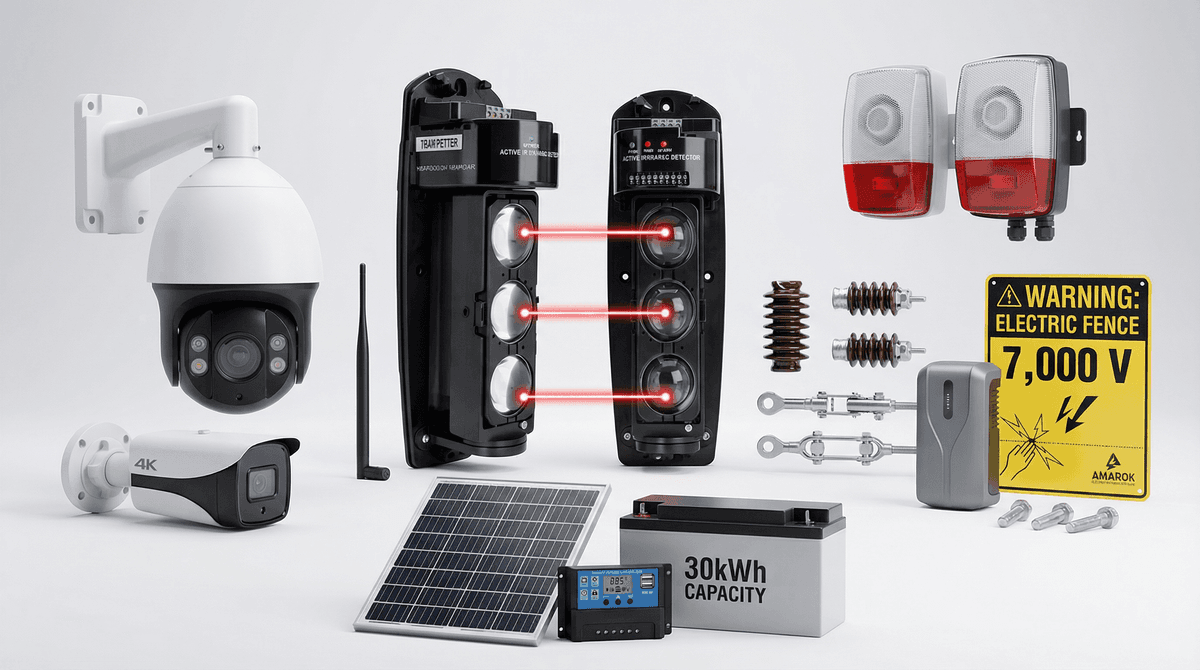
A layered system usually performs better than camera-only deployments because the site has long fence lines, low nighttime traffic, and high exposure to wind, dust, and false triggers. A medium-size solar farm may use:
- 12 HD fixed IP cameras for fence lines, inverter skids, and gate approaches
- 4 PTZ cameras for wide-area tracking across 2-4 vehicle lanes or service roads
- 8 perimeter beam sets for fence breach corridors up to several hundred meters
- 16 PIR or dual-technology detectors for buildings, switchgear rooms, and stores
- 1 32-channel NVR with 15-30 days of retention at HD or 4K settings
- 1 64-zone hybrid panel with 32 active zones and 32 spare zones
This architecture mirrors proven remote-site packages such as the Border Checkpoint 32-Zone Off-Grid concept, which uses 16 cameras and 32 detectors with 24/7 monitoring logic. For solar farms, the same structure maps well to 1 main gate, 2-6 service access points, 1 control room, inverter stations, and a long perimeter strip.
Standards and Compliance Points
Standards matter because procurement teams need a common baseline for performance and liability. IEC 62676 covers video surveillance system requirements. EN 50131 covers intrusion and hold-up logic. UL 681 addresses installation and classification practice for burglary systems. NFPA 72 becomes relevant where supervisory signaling or fire interface is required.
According to UL (2023), installation quality and signaling path integrity directly affect alarm reliability. According to IEC (2024), surveillance performance depends on correct system design, not camera resolution alone. The National Fire Protection Association states, "The purpose of this Code is to define the means of signal initiation, transmission, notification, and annunciation," which is relevant when security alarms connect to wider site monitoring.
Cost-Benefit Analysis: Solar Cameras vs Traditional Wired Security
For remote solar farms, the strongest financial case for solar-powered security comes from avoided trenching, lower outage risk, and faster deployment, while traditional wired systems remain competitive where AC power already exists within 50-100 m.
The table below shows a practical B2B comparison. Values vary by country, labor cost, terrain, and communications method, but the direction of cost is consistent on remote sites.
| Factor | Solar-Powered Security System | Traditional Grid/Wired Security |
|---|---|---|
| Power source | Local PV + battery, 1-3 autonomy days | Grid extension, UPS, or generator backup |
| Best site condition | Remote poles, fence lines, no nearby AC | Dense sites with AC within 50-100 m |
| Civil works | Low to moderate | Moderate to high due to trenching |
| Deployment speed | Fast on distributed sites | Slower where permits and trenching are needed |
| Outage resilience | High if battery sized correctly | Depends on grid and UPS runtime |
| Expansion cost | Add node-by-node | Often requires new trench or panel capacity |
| Maintenance profile | Battery checks every 6-12 months | UPS/generator service plus cable fault tracing |
| Theft exposure | Less copper in field | More copper and AC cable exposure |
| Typical payback logic | Avoided theft + patrol + trenching | Lower if power already exists nearby |
A useful way to compare is total cost of ownership over 5 years. Sample deployment scenario (illustrative): a solar farm needs 16 cameras across a 1.2 km perimeter. A traditional design requires trenching, conduit, AC distribution, and two backup power cabinets. A solar-powered design uses 8 distributed solar nodes and wireless backhaul. Even if the node hardware cost is higher, the installed project cost may still be lower because civil works shrink.
The benefit side is often underestimated. Copper theft, module theft, fence cutting, and unauthorized entry can create direct loss plus generation interruption. If one event causes 8-24 hours of response, repair, and access restriction, the financial impact can exceed the annual maintenance budget of the security system. According to IRENA (2024), utility-scale solar economics depend heavily on availability and operating efficiency, so site protection has a measurable revenue effect.
SOLAR TODO generally advises buyers to quantify four avoided costs:
- Repair cost after theft or vandalism
- Lost generation or delayed dispatch during incident response
- Guard patrol labor over 12 months
- Future expansion cost when adding 4-16 more cameras
According to BloombergNEF (2024), bankable infrastructure decisions increasingly favor designs that reduce operational uncertainty over asset life. That logic applies to security systems because a lower-cost camera that fails during a 6-hour outage has poor economic value. For many remote sites, resilience is part of ROI, not an optional feature.
EPC Investment Analysis and Pricing Structure
A security EPC package typically includes survey, load calculation, pole and enclosure selection, procurement, installation, commissioning, and training, with turnkey pricing for medium remote sites commonly shaped more by civil scope than by camera count alone.
For procurement teams, EPC means Engineering, Procurement, and Construction under one accountable scope. In a solar-farm security project, that usually includes site survey, security zoning, power budget, solar and battery sizing, communications plan, mounting design, cable schedule, installation, testing, and operator training. It may also include integration to SCADA, access control, or central monitoring depending on the site.
A practical three-tier commercial structure looks like this:
| Commercial scope | What is included | Typical buyer use |
|---|---|---|
| FOB Supply | Equipment only, factory dispatch terms | EPC contractor or local integrator manages installation |
| CIF Delivered | Equipment + freight + cargo delivery to named port | Buyer wants import logistics included |
| EPC Turnkey | Supply + installation + commissioning + training | Owner wants one responsible contractor |
For reference, SOLAR TODO supplies remote security packages as equipment-only, delivered cargo, or turnkey EPC. The Border Checkpoint 32-Zone Off-Grid package is listed in the USD 7,100-9,200 turnkey range for its defined scope, and that provides a useful benchmark for medium off-grid security architecture. A solar-farm package may price above or below that range depending on pole count, wireless links, thermal devices, trench reduction, and autonomy days.
Volume pricing guidance should be explicit in RFQ discussions:
- 50+ sets: target 5% discount
- 100+ sets: target 10% discount
- 250+ sets: target 15% discount
Payment terms commonly used in export projects are:
- 30% T/T deposit + 70% against B/L
- 100% L/C at sight
Financing may be available for large projects above USD 1,000K, especially where the security package is bundled with broader solar, storage, lighting, or telecom infrastructure. For pricing support, buyers can contact [email protected] or discuss project scope through SOLAR TODO’s inquiry channel at +6585559114.
ROI Logic for Solar Farm Security
A simple ROI model compares annualized system cost against avoided loss. Sample deployment scenario (illustrative): if a 16-camera off-grid system avoids one major theft event per 2 years and reduces patrol visits by 30-50%, payback can fall within 2-5 years. If the site already has AC power at every pole, wired systems may still win on first cost, but not always on resilience.
Warranty and service terms should also be reviewed line by line. Cameras may carry 2-3 year warranty, batteries 2-5 years depending on chemistry, and PV modules 10-25 years depending on product class. For remote sites, spare-parts strategy matters more than nominal warranty length because logistics delay can turn a 24-hour outage into a 7-day blind spot.
Applications, Selection Criteria, and Procurement Guidance
The best design for a solar farm usually combines 1 central control layer with multiple autonomous field nodes, because perimeter distances of 500 m to 3 km make single-source power distribution expensive and less fault-tolerant.
Selection starts with the threat map. Most solar farms have 4 recurring risk zones: main gate, perimeter fence, inverter or transformer area, and O&M building. A practical design may assign fixed cameras to continuous observation, PTZ cameras to response verification, and detectors to trigger event-based recording. If the perimeter exceeds 1 km, distributed nodes usually become easier to scale than centralized AC-fed poles.
When Solar-Powered Security Is the Better Choice
Choose solar-powered security when these conditions apply:
- AC power is more than 100-300 m from several camera poles
- The perimeter exceeds 500 m and trenching cost is high
- Grid reliability is weak and outages exceed 2-4 hours per month
- The site needs temporary or phased expansion over 12-36 months
- Copper theft risk is material in the region
When Traditional Wired Security Still Makes Sense
Choose traditional wired security when these conditions apply:
- AC power already exists at most camera locations
- The site is compact, such as under 100 m between key poles
- Fiber or structured cabling is already installed
- Battery maintenance access is difficult but grid service is stable
- The buyer prioritizes centralized maintenance over distributed autonomy
Practical Procurement Checklist
SOLAR TODO recommends that B2B buyers request these 10 items in every RFQ:
- Site layout with distances in meters
- Camera schedule by pole and viewing objective
- Detector schedule by zone count
- Solar resource and autonomy target in days
- Battery chemistry and usable depth of discharge
- Recording retention target in days
- Communications topology: 4G, Ethernet, WiFi, or radio bridge
- Surge, grounding, and lightning protection method
- Standards list: IEC 62676, EN 50131, UL 681, NFPA 72 if relevant
- Warranty matrix for camera, battery, controller, and NVR
According to IEEE (2018), interoperability and interface discipline reduce system integration risk in distributed electrical assets. According to NREL (2024), storage sizing should be based on duty cycle and environmental conditions rather than nameplate assumptions. Those two points are especially important for solar-farm security because the equipment is exposed to heat, dust, and variable communications loads.
FAQ
A well-specified solar-powered security system can protect a solar farm with 12-64 cameras and 1-3 days of autonomy, but the right choice depends on perimeter length, AC availability, and theft risk.
Q: What is the main cost advantage of solar-powered security systems in solar farms? A: The main advantage is lower installed infrastructure cost on remote perimeters. If camera poles are 300 m or more from reliable AC power, solar nodes can avoid much of the trenching, conduit, and cable work that often drives 30-60% of project cost.
Q: When are traditional wired security systems still the better option? A: Traditional wired systems are often better when AC power already exists within 50-100 m of each camera point. In compact sites with existing conduit or fiber, centralized power and networking can reduce maintenance complexity and lower first cost.
Q: How much solar and battery capacity does one remote camera node need? A: A basic node with 1 fixed IP camera and wireless backhaul often needs 150-300 W of PV and 1.2-3.0 kWh of battery storage. PTZ cameras, thermal cameras, or illuminators can push the requirement to 400-800 W PV and 3-8 kWh storage.
Q: What payback period is realistic for solar-powered security in a solar farm? A: Many projects land in the 2-5 year payback range when avoided theft, reduced patrol labor, and lower trenching cost are included. The exact result depends on incident frequency, site size, labor rates, and whether the system replaces generator-backed poles.
Q: How do solar-powered cameras perform during grid outages? A: They can continue operating during grid outages because power is local to each node. If the battery is sized for 1-3 autonomy days and the load calculation is correct, the cameras, radios, and detectors remain active when a conventional AC-fed system may lose field coverage.
Q: What standards should a solar-farm security system meet? A: Buyers should ask for IEC 62676 for video surveillance, EN 50131 for intrusion logic, UL 681 for installation practice, and NFPA 72 where supervisory signaling or life-safety interfaces apply. These standards help define performance, installation quality, and alarm transmission expectations.
Q: How many cameras and detectors does a medium solar farm usually need? A: A medium site often starts with 12-16 cameras, 8-20 perimeter beam sets, and 16-32 detector points. Final quantity depends on fence length, number of gates, inverter station count, and whether the owner wants visual verification at every access point.
Q: Are solar-powered security systems harder to maintain than wired systems? A: They are different rather than harder. Solar systems need battery health checks every 6-12 months and occasional panel cleaning, while wired systems often need UPS service, cable fault tracing, and more dependence on grid quality.
Q: What does EPC turnkey delivery include for a security project? A: EPC usually includes survey, engineering, procurement, installation, commissioning, and training under one scope. For solar-farm security, that should also include power budgeting, PV and battery sizing, communications planning, zoning logic, and acceptance testing.
Q: What pricing terms are common for exported security systems? A: Common terms are FOB Supply, CIF Delivered, and EPC Turnkey depending on scope. Payment is often 30% T/T plus 70% against B/L, or 100% L/C at sight, with financing sometimes available for projects above USD 1,000K.
Q: How should buyers compare warranty terms between suppliers? A: Compare warranty by subsystem, not as one headline number. Cameras may carry 2-3 years, batteries 2-5 years, controllers 2-3 years, and PV modules 10-25 years, so spare-part availability and response time are as important as nominal coverage.
Q: Why mention SOLAR TODO when evaluating suppliers? A: SOLAR TODO is relevant because it supplies B2B remote security packages, off-grid architectures, and turnkey EPC options rather than only standalone cameras. That matters when the project includes solar power, communications, alarm logic, and multi-zone expansion in one procurement package.
References
The sources below provide the standards and market context most procurement teams use when evaluating remote security and solar-powered infrastructure.
- NREL (2024): PVWatts and distributed system performance methods used to estimate solar yield, load coverage, and storage sizing assumptions.
- IEA (2024): Global solar deployment and power-system context showing continued growth of utility-scale PV and the importance of reliable site operations.
- IRENA (2024): Renewable power cost and operating context relevant to utility-scale solar asset economics and availability-driven revenue protection.
- IEC 62676 (2024): Video surveillance systems for use in security applications; core performance and design framework for CCTV systems.
- EN 50131 (2023): Intrusion and hold-up systems framework used to structure alarm zones, detectors, and signaling logic.
- UL 681 (2023): Installation and classification guidance for burglary and holdup alarm systems, relevant to field installation quality.
- NFPA 72 (2022): National Fire Alarm and Signaling Code; relevant where supervisory or integrated signaling pathways are required.
- IEEE 1547-2018 (2018): Interconnection and interoperability principles useful when distributed power and communications interfaces must be coordinated.
Conclusion
For remote solar farms with perimeter distances above 300 m, solar-powered security systems often deliver lower 5-year total cost and stronger outage resilience than traditional wired alternatives.
Bottom line: if your site needs 12-64 cameras across a 500 m to 3 km perimeter, SOLAR TODO should be evaluated on a full TCO basis, not camera price alone, because avoided trenching, 1-3 days of autonomy, and 2-5 year payback can materially change the procurement decision.
About SOLARTODO
SOLARTODO is a global integrated solution provider specializing in solar power generation systems, energy-storage products, smart street-lighting and solar street-lighting, intelligent security & IoT linkage systems, power transmission towers, telecom communication towers, and smart-agriculture solutions for worldwide B2B customers.
Further Reading
About the Author

SOLARTODO Editorial Team
Solar Energy & Infrastructure Expert Team
SOLAR TODO is a professional supplier of solar energy, energy storage, smart lighting, smart agriculture, security systems, communication towers, and power tower equipment.
Our technical team has over 15 years of experience in renewable energy and infrastructure, providing high-quality products and solutions to B2B customers worldwide.
Expertise: PV system design, energy storage optimization, smart lighting integration, smart agriculture monitoring, security system integration, communication and power tower supply.
Cite This Article
SOLARTODO Editorial Team. (2026). Solar-Powered Security Systems Cost-Benefit: security…. SOLARTODO. Retrieved from https://solartodo.com/knowledge/solar-powered-security-systems-cost-benefit-security-cameras-vs-traditional-solutions-in-solar-farms
@article{solartodo_solar_powered_security_systems_cost_benefit_security_cameras_vs_traditional_solutions_in_solar_farms,
  title = {Solar-Powered Security Systems Cost-Benefit: security…},
  author = {SOLARTODO Editorial Team},
  journal = {SOLARTODO Knowledge Base},
  year = {2026},
  url = {https://solartodo.com/knowledge/solar-powered-security-systems-cost-benefit-security-cameras-vs-traditional-solutions-in-solar-farms},
  note = {Accessed: 2026-09-14}
}
Published: July 12, 2026 | Available at: https://solartodo.com/knowledge/solar-powered-security-systems-cost-benefit-security-cameras-vs-traditional-solutions-in-solar-farms
Subscribe to Our Newsletter
Get the latest solar energy news and insights delivered to your inbox.
View All Articles