Solar Module Manufacturer B2B Guide 2026

Cinn Song
Founder & Chief Solutions Architect
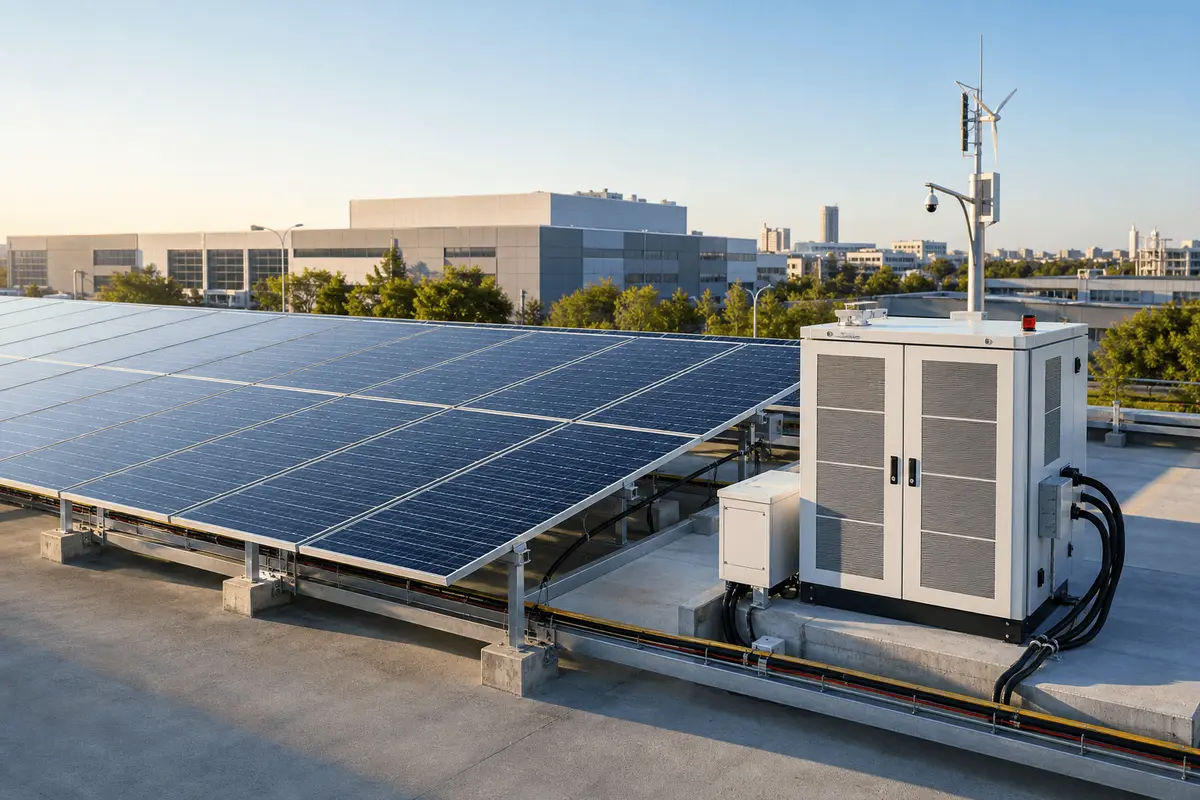
Watch the video
TL;DR
For B2B solar procurement, choose a manufacturer that provides 22.5-24.5% N-Type TOPCon modules, IEC 61215/61730 compliance, export documentation, 25-30 year warranty support, and clear FOB, CIF, or EPC turnkey pricing. SOLARTODO supports 100 kW-500 kW+ commercial projects with optional 200 kWh-1 MWh LFP storage and financing discussion for projects above $1,000K.
B2B solar module sourcing in 2026 is about bankable N-Type TOPCon supply, 22.5-24.5% module efficiency, IEC/UL compliance, and EPC pricing that can cut C&I energy cost to about $0.03-0.06/kWh.
Summary
B2B solar module sourcing in 2026 is about bankable N-Type TOPCon supply, 22.5-24.5% module efficiency, IEC/UL compliance, and EPC pricing that can cut C&I energy cost to about $0.03-0.06/kWh.
Key Takeaways
B2B buyers should evaluate solar module manufacturers across 8 core criteria: efficiency, bankability, warranty, certificates, logistics, EPC support, storage readiness, and financing.
- Specify N-Type TOPCon modules at 22.5-24.5% efficiency when rooftop or land area is constrained.
- Verify IEC 61215 and IEC 61730 certificates before issuing a 1 MW+ purchase order.
- Compare FOB, CIF, and EPC turnkey pricing because logistics and installation can change landed cost by 10-25%.
- Require 25-30 year performance warranties with first-year degradation near 1% and annual degradation below 0.5%.
- Model energy yield with PVWatts, PVSyst, or local irradiance data before finalizing a 100 kW-500 kW+ project.
- Add 200 kWh-1 MWh LFP storage for peak shaving, backup power, and higher solar self-consumption.
- Negotiate volume discounts of 5% at 50+ units, 10% at 100+ units, and 15% at 250+ units.
- Request bankability documents, factory QA data, and shipping schedules at least 30 days before production slot allocation.
Why B2B Solar Module Manufacturer Selection Matters
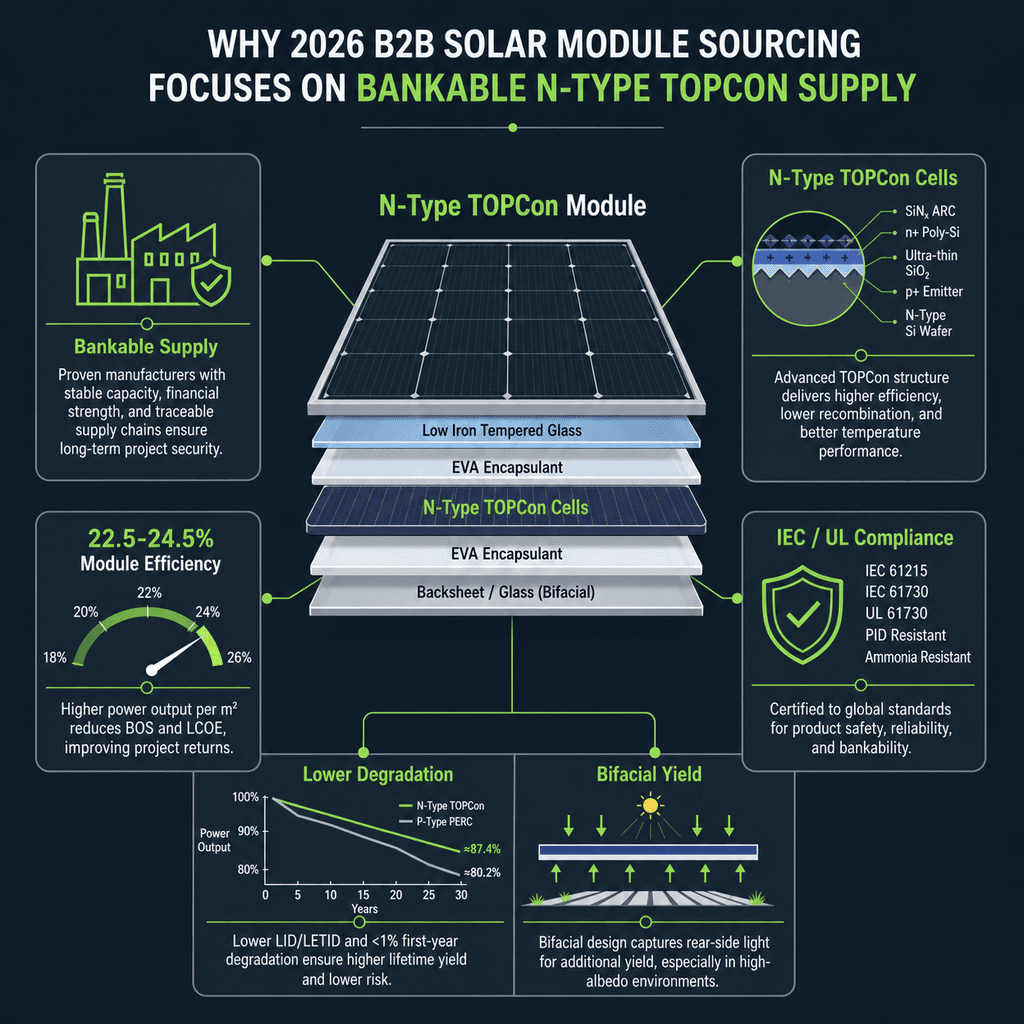
A B2B solar module manufacturer affects 30-year energy yield, warranty risk, project bankability, and procurement cost more than any single EPC line item.
For procurement managers, the lowest module price is rarely the lowest project cost. A 1 MW commercial PV project can use more than 1,400 high-power modules, and a 0.5% annual degradation difference can materially affect 25-30 year revenue. Engineers also need stable electrical parameters, certified safety construction, consistent flash-test data, and containerized delivery that matches site sequencing.
According to IEA (2025), global renewable power capacity is expected to increase by 4,600 GW by 2030, with solar PV accounting for almost 80% of the increase. That demand is expanding the buyer pool from utilities to factories, logistics parks, telecom operators, mining sites, municipalities, agribusinesses, and commercial property owners.
The IEA states, "Solar PV accounts for almost 80%" of global renewable capacity growth to 2030. For B2B buyers, that means module availability is strong, but supplier due diligence is more important because oversupply, price compression, and regional trade rules can affect warranty continuity.
SOLARTODO positions solar modules as part of complete B2B energy systems, not as online marketplace SKUs. The sourcing workflow should therefore connect technical design, module selection, inverter matching, optional LFP battery storage, export documentation, and offline quotation into one procurement file.
Technical Specifications Buyers Should Require
A bankable B2B module specification should define 7 measurable items: cell technology, wattage, efficiency, degradation, certificates, mechanical load, and warranty terms.
For most commercial and industrial buyers in 2026, N-Type TOPCon is the practical default. Modern large-format TOPCon modules commonly reach 700-725 W class output and 22.5-24.5% efficiency, while offering lower light-induced degradation than older P-Type PERC modules. Bifacial modules can add 10-30% rear-side yield in high-albedo ground-mount or tracker projects when spacing, tilt, and ground reflectance are properly designed.
According to NREL PVWatts documentation, PV performance estimates should account for system size, module type, array type, losses, tilt, azimuth, DC-to-AC ratio, inverter efficiency, albedo, bifaciality, and soiling. That list is useful for B2B procurement because it forces the discussion beyond panel wattage and into bankable energy yield.
Recommended Procurement Specification
- Module technology: N-Type TOPCon monocrystalline, bifacial optional.
- Power class: 580-725 W depending on roof handling, racking, and container planning.
- Module efficiency: 22.5-24.5% for high-density C&I projects.
- Warranty: 12-25 year product warranty and 25-30 year linear performance warranty.
- Degradation: about 1% first year and below 0.5% annually thereafter.
- Certificates: IEC 61215, IEC 61730, and market-specific UL or CE documentation.
- System pairing: string inverter or central inverter, matched to 1.1-1.3 DC/AC ratio where suitable.
- Storage option: 200 kWh-1 MWh LFP battery system for peak shaving and backup.
IEA (2025) also reports that solar PV prices are down more than 60% since 2023 in China because of module oversupply and market competition. That is good for buyers, but it can pressure manufacturer margins; bankability, audited production capacity, and warranty reserves should be reviewed before accepting unusually low offers.
EPC Investment Analysis and Pricing Structure
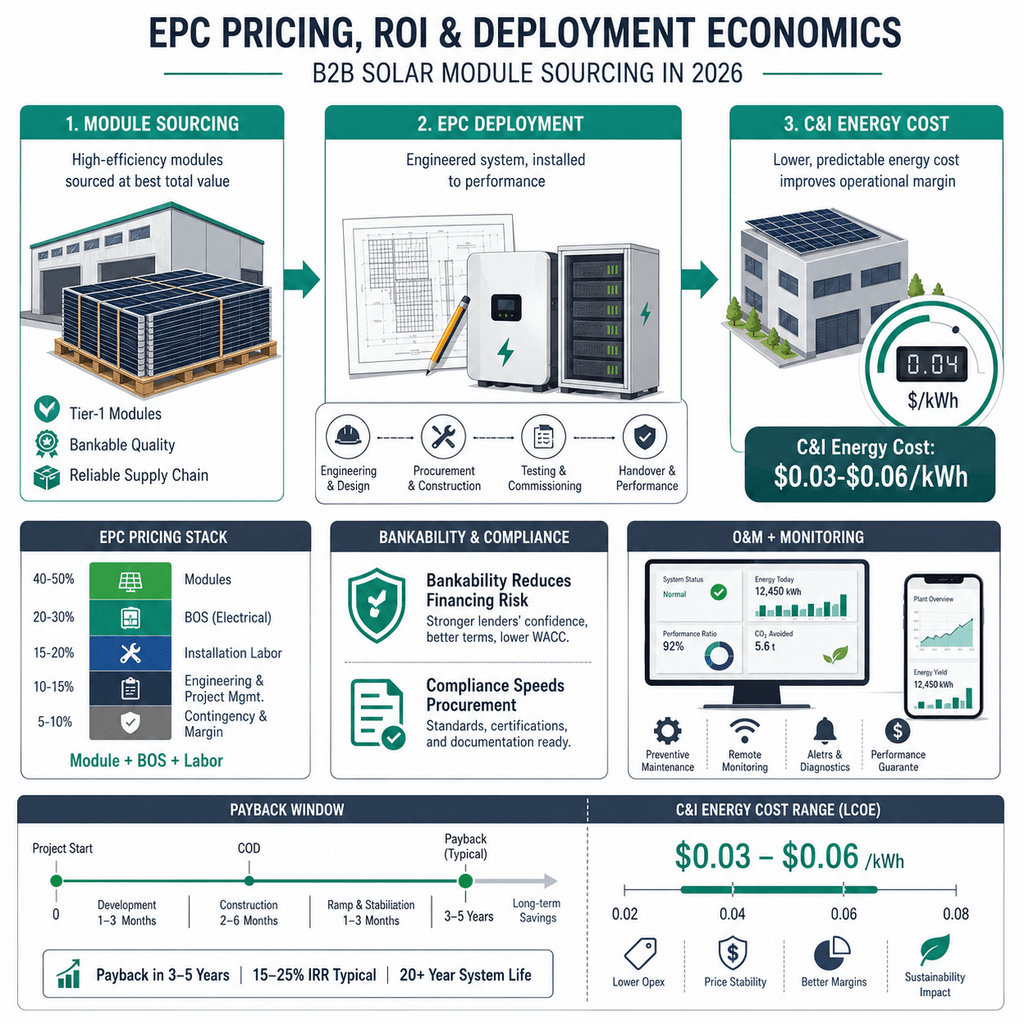
A complete EPC investment model should compare 3 price levels, 3 volume discount bands, payback years, payment terms, and financing availability.
EPC means Engineering, Procurement, and Construction. In a solar module manufacturer B2B project, turnkey EPC delivery typically includes site assessment, PV layout, structural design, electrical single-line diagrams, module and inverter procurement, mounting systems, DC/AC cabling, protection devices, installation, testing, commissioning, training, and handover documentation.
SOLARTODO supports inquiry to offline quotation for projects such as 100 kW, 500 kW, and larger C&I solar-plus-storage systems. Project financing can be discussed for large projects above $1,000K, especially where customers need staged CAPEX, energy savings analysis, and bankable export documentation.
| Pricing tier | What it includes | Best for | Buyer risk |
|---|---|---|---|
| FOB Supply | Modules loaded at origin port or factory handover | Experienced importers and EPCs | Buyer manages freight, insurance, customs, and installation |
| CIF Delivered | Product cost, insurance, and freight to destination port | Distributors and project owners needing import support | Buyer still manages local clearance and site installation |
| EPC Turnkey | Engineering, procurement, installation, commissioning, and handover | C&I owners wanting one accountable delivery path | Requires site data, permits, and local execution coordination |
Volume pricing should be treated as guidance, not a substitute for a formal quotation. SOLARTODO can structure discounts around project size: 50+ units may qualify for about 5% discount, 100+ units for about 10%, and 250+ units for about 15%, subject to module wattage, Incoterms, shipping lane, and delivery schedule.
Payment terms normally follow 30% T/T deposit plus 70% against bill of lading, or 100% L/C at sight for approved trade finance structures. For major EPC or supply packages above $1,000K, financing discussions should begin before final bill of materials approval. Contact [email protected] for formal EPC pricing and project finance review.
ROI depends on tariff, irradiance, demand charge, and storage value. In strong-sun C&I markets, a 100 kW solar array paired with 200 kWh LFP storage can reduce daytime grid purchases, shift energy into evening peaks, and improve resilience during outages. The target business case is often 4-7 year payback, with 25-30 years of module output.
Manufacturer Comparison and Selection Guide
A B2B solar module manufacturer should be compared with at least 10 measurable criteria before technical approval and purchase commitment.
According to IEA (2025), corporate PPAs, utility contracts, and merchant plants are expected to account for 30% of global renewable capacity expansion to 2030. This matters because B2B solar buyers increasingly need procurement documents that banks, insurers, and corporate energy teams can understand.
| Selection criterion | Minimum B2B requirement | Why it matters |
|---|---|---|
| Cell technology | N-Type TOPCon or equivalent high-efficiency platform | Improves yield and reduces degradation risk |
| Module efficiency | 22.5-24.5% for premium C&I modules | Reduces roof or land area per kW |
| Warranty | 25-30 year linear output warranty | Supports long-term ROI and financing |
| Certificates | IEC 61215, IEC 61730, UL/CE as applicable | Required for safety, grid approval, and insurance |
| Factory QA | Flash test, EL image, BOM traceability | Reduces hidden defects and mismatch loss |
| Logistics | Container plan, pallet count, Incoterms | Prevents project delays and damage claims |
| EPC support | Design, installation, commissioning | Reduces interface risk for project owners |
| Storage integration | 200 kWh-1 MWh LFP options | Enables peak shaving and backup power |
| Market fit | Latin America, Middle East, Africa, Southeast Asia, Europe | Aligns documents, languages, and export requirements |
| Commercial model | Inquiry, offline quotation, financing available | Fits B2B procurement rather than retail checkout |
The UN Secretary-General has said fossil fuels are "running out of road," while IRENA (2025) reported that 91% of new renewable projects commissioned in 2024 were more cost-effective than fossil alternatives. For manufacturers, this creates demand; for buyers, it creates a need to lock quality and delivery early.
SOLARTODO can support module-only supply, solar PV systems, and hybrid solar-plus-storage packages. For telecom towers, factories, farms, warehouses, and infrastructure sites, the selection should start with load profile and grid reliability, then move to module power class and EPC scope.
Applications for Commercial and Infrastructure Projects
B2B solar modules are best deployed where projects exceed 100 kW, energy prices are material, and 25-year yield predictability affects operating cost.
The strongest use cases are commercial rooftops, ground-mounted industrial parks, telecom base stations, municipal buildings, water pumping, logistics centers, agriculture monitoring sites, and hybrid microgrids. These applications often need more than panels: they require inverters, mounting, monitoring, protection, energy storage, and documented commissioning.
According to IEA (2024), renewables could account for almost half of global electricity generation by 2030, with wind and solar PV reaching 30%. The same report warns that grid connection queues and curtailment are becoming real constraints, which is why B2B projects should include export limits, self-consumption modeling, and storage evaluation.
For Latin America, Middle East, Africa, Southeast Asia, and Europe, procurement teams should also evaluate shipping route reliability, local grid code, warranty claim process, and spare module strategy. A good manufacturer helps align module datasheets, inverter certificates, packing lists, and commissioning reports before customs or utility approval becomes a bottleneck.
FAQ
B2B buyers usually ask 10 recurring questions about module technology, certifications, EPC scope, warranty, cost, delivery, storage, and ROI before issuing purchase orders.
Q: What is a B2B solar module manufacturer? A: A B2B solar module manufacturer produces photovoltaic panels for project developers, EPC contractors, distributors, utilities, and commercial buyers rather than retail consumers. The manufacturer should support bulk supply, technical datasheets, certificates, export documents, warranty terms, and project quotation. For C&I projects, typical order sizes range from 100 kW to 500 kW+.
Q: How should procurement teams choose between TOPCon, PERC, and HJT modules? A: Choose N-Type TOPCon for most 2026 B2B projects because it offers high efficiency, low degradation, and strong availability. PERC can still work for cost-sensitive projects with enough area, while HJT may suit premium applications requiring high bifaciality or temperature performance. Compare lifetime kWh, not only $/W.
Q: What certifications should B2B solar modules include? A: Require IEC 61215 for design qualification and IEC 61730 for module safety qualification. For the United States and some insurance-driven markets, UL certification may also be required. Grid-connected projects should also check inverter and interconnection requirements such as IEEE 1547-2018 where applicable.
Q: What does EPC turnkey delivery include? A: EPC turnkey delivery includes engineering, procurement, construction, testing, commissioning, and handover documentation. For a solar module project, that usually covers layout design, structural checks, electrical diagrams, modules, inverters, mounting, protection devices, cabling, installation labor, monitoring setup, and acceptance testing. It reduces interface risk for owners.
Q: How is pricing different for FOB, CIF, and EPC turnkey projects? A: FOB covers supply at origin, CIF adds insurance and freight to the destination port, and EPC turnkey includes full project delivery. FOB is best for experienced importers, CIF suits buyers needing logistics support, and EPC fits owners wanting one accountable delivery path. Volume discounts may reach 5-15% depending on quantity.
Q: What payment terms are common for B2B solar module orders? A: Common terms are 30% T/T deposit and 70% against bill of lading, or 100% L/C at sight for approved buyers. Larger projects above $1,000K may qualify for financing discussion, but bank review, project documents, buyer credit, and destination market risk must be assessed before approval.
Q: What warranty should buyers expect from commercial solar modules? A: Buyers should expect a product warranty of 12-25 years and a linear performance warranty of 25-30 years. High-quality N-Type modules typically target about 1% first-year degradation and less than 0.5% annual degradation afterward. Warranty value depends on manufacturer bankability and claim process.
Q: How much battery storage should be paired with solar modules? A: Storage size depends on load profile, tariff structure, backup duration, and export rules. For C&I projects, 200 kWh paired with 100 kW solar can support peak shaving and short backup, while 1 MWh systems suit larger factories or microgrids. LFP chemistry is common for safety and cycle life.
Q: How long does a B2B solar module project take from inquiry to delivery? A: A module-only order may move from quotation to shipment in several weeks if stock and certificates are available. EPC projects usually require more time for site survey, design approval, permits, production scheduling, shipping, installation, and commissioning. Buyers should provide load data and site drawings early.
Q: Why work with SOLARTODO instead of an online marketplace? A: SOLARTODO is a B2B manufacturer and exporter, not an online marketplace. The company supports solar modules, complete PV systems, energy storage, smart streetlights, telecom infrastructure, and smart infrastructure equipment through inquiry, offline quotation, and project financing discussion. This model fits engineered projects with 100 kW-500 kW+ requirements.
Conclusion
For B2B solar module sourcing, select a manufacturer that combines 22.5-24.5% N-Type modules, IEC/UL compliance, EPC pricing, and 25-30 year warranty support.
The bottom line: commercial buyers above 100 kW should prioritize verified energy yield, bankable documentation, and landed project cost over headline module price. SOLARTODO is best positioned for buyers that need export-ready solar modules, hybrid storage options, EPC quotation, and financing discussion through [email protected].
References
Authoritative solar procurement decisions should rely on at least 7 current sources covering costs, forecasts, performance modeling, safety, and grid interconnection.
- IEA (2025): Renewables 2025 forecasts 4,600 GW of new renewable capacity by 2030, with solar PV providing almost 80% of growth.
- IEA (2024): Renewables 2024 provides forecasts to 2030, including solar PV and wind accounting for 95% of renewable capacity growth.
- IRENA (2025): Renewable Power Generation Costs in 2024 reports that 91% of new renewable projects commissioned in 2024 were cheaper than fossil alternatives.
- NREL (2026): PVWatts Calculator estimates photovoltaic energy production using system size, losses, tilt, azimuth, DC/AC ratio, and weather data.
- IEC 61215-1 (2021): Terrestrial photovoltaic modules design qualification and type approval requirements for crystalline silicon PV modules.
- IEC 61730-1 (2023): Photovoltaic module safety qualification requirements covering construction, electrical safety, and testing.
- IEEE 1547-2018 (2018): Standard for interconnection and interoperability of distributed energy resources with electric power systems interfaces.
- UL 61730 (2023): North American safety standard for photovoltaic module construction and testing aligned with IEC safety requirements.
About SOLARTODO
SOLARTODO is a global integrated solution provider specializing in solar power generation systems, energy-storage products, smart street-lighting and solar street-lighting, intelligent security & IoT linkage systems, power transmission towers, telecom communication towers, and smart-agriculture solutions for worldwide B2B customers.
About the Author

Cinn Song
Founder & Chief Solutions Architect
Cinn Song founded SOLARTODO LIMITED and leads its smart-city infrastructure engineering — from solar, storage and integrated smart poles to the company's push into physical-AI city edge nodes: pole-mounted edge computing, vertical LLMs for smart cities, drone-based O&M with autonomous battery swapping, robotic maintenance, and high-speed counter-UAS interception. Since 2010, he has directed turnkey EPC + BOT delivery across 50+ countries, including telecom monopole supply for national grid operators, off-grid solar street-lighting for African municipalities, and integrated smart-pole programs for Gulf smart cities.
Cite This Article
Cinn Song. (2026). Solar Module Manufacturer B2B Guide 2026. SOLARTODO. Retrieved from https://solartodo.com/knowledge/solar-module-manufacturer-b2b-2
@article{solartodo_solar_module_manufacturer_b2b_2,
  title = {Solar Module Manufacturer B2B Guide 2026},
  author = {Cinn Song},
  journal = {SOLARTODO Knowledge Base},
  year = {2026},
  url = {https://solartodo.com/knowledge/solar-module-manufacturer-b2b-2},
  note = {Accessed: 2026-10-14}
}
Published: July 9, 2026 | Available at: https://solartodo.com/knowledge/solar-module-manufacturer-b2b-2
Subscribe to Our Newsletter
Get the latest solar energy news and insights delivered to your inbox.
View All Articles