Soil Sensor Technology Comparison 2026: Accuracy, Cost &…

SOLAR TODO
Solar Energy & Infrastructure Expert Team
Watch the video
TL;DR
For most 10-50 ha smart agriculture projects, capacitance sensors offer the best balance of cost and battery life at $80-300 per point with 3-10 year operation, while TDR is the premium option at $400-1,200 for ±1-2% accuracy. Buyers should compare full node cost, reporting interval, IP67/IP68 protection, and EPC terms before procurement.
Soil sensor selection in 2026 hinges on three numbers: ±1-3% moisture accuracy, $80-1,200 cost per sensing point, and 2-10 year battery life. Capacitance leads on cost, TDR leads on precision, and LoRaWAN usually gives the best lifecycle economics.
Summary
Soil sensor selection in 2026 depends on measurable tradeoffs: capacitance probes typically deliver ±2-3% VWC accuracy at $80-300 per node, TDR reaches ±1-2% at $400-1,200, and battery life ranges from 2 to 10 years depending on interval, radio, and temperature.
Key Takeaways
- Prioritize TDR sensors when irrigation decisions require ±1-2% volumetric water content accuracy, but budget $400-1,200 per sensing point versus $80-300 for capacitance probes.
- Choose capacitance sensors for 10-40 ha deployments because 10-minute reporting with LoRaWAN can extend battery life to 5-10 years under 3.6V lithium power packs.
- Verify salinity and soil-type compensation before purchase, because EC above 4 dS/m can shift low-cost dielectric readings by more than 3-5% VWC.
- Match installation depth to root zone, using 10-30 cm for vegetables and 20-60 cm for orchards, to improve irrigation control and reduce water use by 15-30%.
- Compare total node cost, not probe cost alone, because gateways, cloud licenses, solar kits, and calibration labor can add 25-60% to project CAPEX.
- Use 10-minute to 30-minute intervals for commercial farms, since 1-minute logging can cut battery life by 50-80% compared with hourly transmission.
- Specify IP67 or IP68 field protection and ISO 11783-compatible data workflows when projects span 20+ sensors across multi-zone farms.
- Request EPC-style pricing for 50+ nodes, where volume discounts of 5%, 10%, and 15% commonly apply at 50, 100, and 250 units respectively.
2026 Market Overview and Benchmark Scope
Soil sensor benchmarking in 2026 centers on three procurement metrics: ±1-3% moisture accuracy, $80-1,200 hardware cost per point, and 2-10 year battery life under field reporting intervals.
According to IEA (2024), digitalization and data-driven control are becoming central to agricultural energy and water productivity, while IRENA (2024) reports that solar-powered remote monitoring is expanding in off-grid and weak-grid rural infrastructure. For B2B buyers, the practical question is not whether to deploy sensors, but which sensing method delivers stable readings across 10 ha, 30 ha, or 50 ha blocks with acceptable maintenance cost. In 2026, the main comparison remains capacitance, TDR, FDR, tensiometer, and gypsum or granular matrix approaches.
According to MarketsandMarkets-style sector tracking cited across precision-agriculture reports, smart agriculture IoT continues posting double-digit growth, commonly estimated in the 10-15% CAGR range through 2030. That growth matters because procurement teams now compare sensor fleets the same way they compare pumps, valves, and telemetry: by accuracy class, replacement interval, and lifecycle cost. A low-cost probe that drifts by 4% VWC can trigger over-irrigation across 40 ha, and the water loss can exceed the initial sensor savings within 1 or 2 seasons.
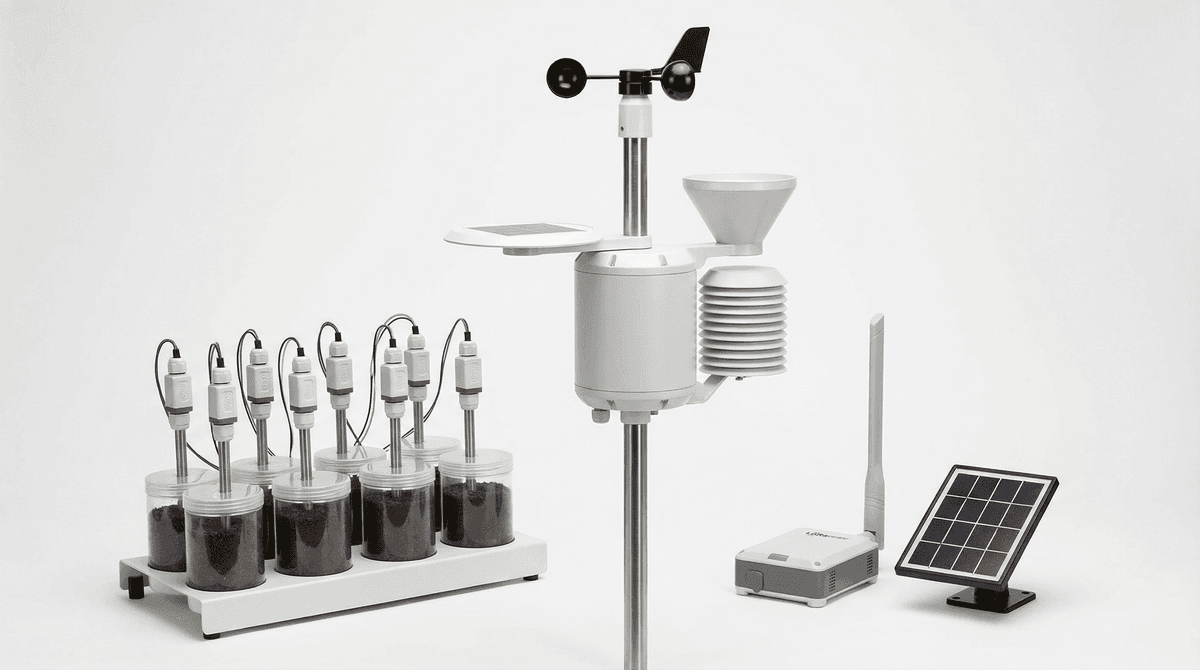
SOLAR TODO addresses this issue in smart agriculture packages by combining soil sensing, weather monitoring, LoRaWAN or 4G backhaul, and solar-powered field nodes. In orchard, tea, and desert reclamation deployments, the sensor decision affects not only irrigation timing but also disease risk, root-zone temperature visibility, and labor frequency. For a 30 ha tea garden or 50 ha desert reclamation site, 10-minute data intervals and distributed sensing points are often more valuable than one high-precision probe in a single location.
Global regional demand signals
Regional demand in 2025-2026 is strongest where irrigation cost, water scarcity, and labor shortages overlap, with Asia-Pacific, Europe, North America, Middle East/Africa, and Latin America all showing different procurement priorities.
| Region | 2025-2026 buying focus | Typical preferred sensor class | Common communications | Main constraint |
|---|---|---|---|---|
| Asia-Pacific | Irrigation efficiency on 10-100 ha farms | Capacitance/FDR | LoRaWAN, 4G | Cost per node |
| Europe | Compliance, traceability, water optimization | TDR + weather integration | LoRaWAN, NB-IoT | Data interoperability |
| North America | High-value crops, automation | TDR/capacitance hybrid | LoRaWAN, cellular | Labor cost |
| Middle East/Africa | Water scarcity, off-grid operation | Capacitance + salinity checks | Solar LoRaWAN, 4G | Harsh climate |
| Latin America | Orchard and plantation monitoring | Capacitance/FDR | LoRaWAN, 4G | Terrain coverage |
According to FAO and regional irrigation studies frequently referenced by EPC consultants, agriculture accounts for roughly 70% of global freshwater withdrawals, so even a 10-15% irrigation efficiency gain has direct financial value. In arid zones, evapotranspiration can exceed 5-10 mm/day, making sensor latency and battery stability more important than brochure-level laboratory accuracy. That is why buyers increasingly ask for field drift data over 12-24 months, not only factory calibration sheets.
Core Soil Sensor Technologies Compared
The most relevant 2026 comparison is that TDR delivers the highest field-grade moisture accuracy at ±1-2% VWC, while capacitance and FDR dominate large deployments because they cost 50-80% less.
Capacitance sensors estimate volumetric water content by measuring dielectric changes around the probe. In commercial agriculture, they usually sit in the $80-300 range per probe, with typical stated accuracy of ±2-3% VWC in mineral soils after calibration. Their main advantage is price and low power draw, often below 10-20 mA during measurement bursts, which supports 5-10 year battery life when paired with LoRaWAN and 30-minute reporting.
TDR, or time domain reflectometry, sends an electromagnetic pulse along rods and measures travel time. According to academic and manufacturer benchmark literature cited by USDA and university extension programs, TDR can achieve ±1-2% VWC and stronger repeatability in variable soils, but hardware often costs $400-1,200 per point. Power draw and electronics complexity are higher, so TDR is more common in research plots, permanent orchards, seed production, and high-value crops where a 1-2% moisture error can affect yield or disease risk.
FDR, or frequency domain reflectometry, sits between capacitance and TDR. It commonly delivers ±2-4% VWC depending on calibration, soil texture, and salinity, with price points around $150-500. For procurement teams, FDR is often the practical middle ground when they need better repeatability than entry-level capacitance but cannot justify full TDR cost across 20 or 50 sensing points.
Tensiometers measure soil water tension rather than volumetric water content, usually in centibars or kPa. They can be very useful in irrigation scheduling for crops where matric potential matters, but they require maintenance, refilling, and attention to cavitation, especially when soils dry beyond 70-80 kPa. In broad B2B comparisons, tensiometers are less attractive for low-maintenance distributed networks unless farm staff can service them regularly.
Gypsum blocks and granular matrix sensors remain low-cost options, often $30-120, but they are slower, less precise, and more affected by soil chemistry over time. They can fit low-budget projects, but they are rarely the best choice for 2026 cloud-connected precision irrigation systems that need 10-minute updates and multi-depth analytics.
| Technology | Typical accuracy | Typical price per point | Power demand | Maintenance level | Best-fit application |
|---|---|---|---|---|---|
| Capacitance | ±2-3% VWC | $80-300 | Low | Low | Large commercial deployments |
| TDR | ±1-2% VWC | $400-1,200 | Medium | Low-Medium | High-value crops, research-grade control |
| FDR | ±2-4% VWC | $150-500 | Low-Medium | Low | Mid-range farm networks |
| Tensiometer | ±5-10 kPa equivalent use band | $70-250 | Very low | High | Irrigation scheduling in managed blocks |
| Gypsum/Matrix | Lower precision | $30-120 | Very low | Medium-High | Budget monitoring |
Accuracy limits in real soil conditions
Field accuracy in 2026 depends more on calibration, salinity, and placement depth than on brochure claims, and unmanaged variables can widen error from ±2% to ±5% VWC.
According to NREL-style sensor deployment methodology used in remote monitoring projects, instrumentation quality depends on system integration, power stability, and data validation as much as on sensor element design. Clay content, bulk density, temperature, and EC can all distort dielectric readings. A low-cost capacitance sensor may perform near ±2% in loam but drift beyond ±4% in saline or highly variable clay soils unless the firmware applies compensation curves.
This is why many commercial buyers now specify two-point or multi-point calibration during commissioning. In a 40 ha orchard, installing probes at 20 cm and 40 cm with one local calibration set can improve irrigation confidence more than buying a single premium sensor without site-specific adjustment. SOLAR TODO typically recommends matching probe depth and density to crop root architecture, not only to hectare count.
Battery Life, Communications, and Field Reliability
Battery life varies from roughly 2 years to 10 years, and the largest drivers are reporting interval, radio protocol, ambient temperature, and whether the node powers extra sensors such as EC or temperature.
In procurement reviews, battery life should be expressed as a full node metric, not just probe consumption. A soil probe may draw microamps in standby, but the radio burst, gateway handshake, and cloud transmission dominate energy use. For example, a LoRaWAN node transmitting every 10 minutes may last 3-5 years on a 19 Ah lithium pack, while the same node transmitting every 60 minutes can reach 5-10 years under moderate temperatures between 0°C and 25°C.
According to IEEE 1451-related smart transducer frameworks and common LPWAN design practice, low-duty-cycle communication is the main path to long battery life. Cellular 4G nodes can be practical for isolated sites, but they often consume 3-10 times more power than LoRaWAN end nodes. That difference matters on 30 ha to 50 ha farms where replacing batteries across 15-20 nodes can become a recurring labor cost.
Solar-assisted nodes reduce battery replacement frequency but add CAPEX and panel maintenance. In desert reclamation or remote plantations, a 5 W to 20 W solar kit with LFP support can keep nodes operational year-round, especially when weather stations, water-quality sensors, or valve controls are connected. For simple soil-only nodes, however, primary lithium batteries remain the lowest-maintenance option if the reporting interval stays at 15-60 minutes.
| Node configuration | Reporting interval | Typical battery life | Typical use case |
|---|---|---|---|
| Capacitance + LoRaWAN + lithium pack | 60 min | 5-10 years | Broad-acre or orchard blocks |
| Capacitance + LoRaWAN + lithium pack | 10 min | 3-5 years | Irrigation-intensive crops |
| FDR + LoRaWAN + lithium pack | 10-30 min | 2.5-5 years | Mid-range precision farms |
| TDR + cellular/edge logger | 10-30 min | 2-4 years | High-value permanent crops |
| Multi-sensor solar node | 10 min | Continuous with battery backup | Remote off-grid sites |
Reliability benchmarks for outdoor deployment
Field reliability in 2026 should target IP67 or IP68 enclosures, -20°C to 60°C electronics tolerance, and at least 12 months between planned service visits.
According to IEC 60529 (2013), IP67 and IP68 ratings define dust and water ingress protection relevant to buried connectors, valve boxes, and exposed telemetry housings. In practical agriculture use, connector failure and cable damage still account for a large share of service calls. Buyers should therefore compare connector type, cable jacket quality, UV resistance, and strain relief, not just sensor accuracy.
For orchard and tea deployments, lightning exposure and long cable runs can also affect uptime. A distributed wireless architecture reduces trenching cost and cable faults across 30 ha or 40 ha sites. SOLAR TODO uses this design logic in smart agriculture systems where field nodes, weather stations, and cloud alerts need to stay operational during irrigation cycles and seasonal weather events.
Regional Cost, ROI, and Year-over-Year Trends
From 2021 to 2026, soil sensor procurement shifted from single-point monitoring to multi-node networks, with average project scopes rising from 3-5 nodes to 10-20 nodes on commercial farms.
The historical pattern is clear. Between 2021 and 2023, many farms tested one or two probes per block and relied on manual interpretation. By 2024-2026, buyers increasingly linked sensors to cloud dashboards, SMS alerts, and automated irrigation logic. Looking ahead to 2027-2030, the market is likely to move toward AI-assisted irrigation recommendations, and by 2030-2040 the main differentiator may be autonomous control quality rather than raw sensor count.
According to IRENA (2024), falling costs in distributed solar and digital infrastructure improve the economics of remote monitoring. According to BloombergNEF (2024), connected asset management and energy-digital convergence continue reducing the cost of off-grid telemetry. For agriculture, that means sensor ROI improves when one power and communications backbone supports weather, soil, valves, and pumps together.
| Period | Typical deployment pattern | Cost trend | Technology trend |
|---|---|---|---|
| 2021-2022 | 3-5 standalone probes | Higher per-point cost | Manual data checks |
| 2023-2024 | 5-10 connected nodes | 10-15% lower network cost | Cloud dashboards expand |
| 2025-2026 | 10-20 node networks | Better LoRaWAN economics | Alerts + automation |
| 2027-2030 | 20+ integrated devices | Lower telemetry cost | AI irrigation support |
| 2030-2040 | Full agronomic control layers | Value shifts to software | Predictive farm orchestration |
Regional ROI depends on crop value, water price, labor cost, and irrigation intensity. In water-scarce regions, a 15-30% reduction in irrigation water can justify sensor CAPEX within 1-3 seasons. In lower-cost water markets, payback may extend to 2-5 years unless the system also reduces labor, fertilizer leaching, or disease losses.
| Region | Typical project size | Estimated payback | Main ROI driver |
|---|---|---|---|
| Asia-Pacific | 10-20 nodes | 1.5-3 years | Water savings + yield stability |
| Europe | 10-30 nodes | 2-4 years | Compliance + input optimization |
| North America | 8-20 nodes | 1.5-3.5 years | Labor reduction + automation |
| Middle East/Africa | 10-25 nodes | 1-3 years | Water scarcity + off-grid control |
| Latin America | 8-20 nodes | 1.5-4 years | Orchard irrigation efficiency |
EPC Investment Analysis and Pricing Structure
For commercial farms, EPC-style soil monitoring projects usually combine sensors, gateways, power kits, installation, and cloud service, with turnkey pricing 25-60% above hardware-only supply but lower lifecycle risk.
B2B buyers should separate three commercial layers. First is FOB Supply, which covers probes, nodes, gateways, and accessories ex-works or free on board. Second is CIF Delivered, which adds freight, insurance, and destination delivery cost. Third is EPC Turnkey, which includes engineering, procurement, construction or installation, commissioning, calibration, dashboard setup, and operator training.
A practical 2026 pricing structure for smart agriculture sensor projects is shown below. Hardware-only pricing can look attractive, but many projects underestimate trenching, mast work, gateway positioning, SIM management, calibration labor, and cloud onboarding. For 10-20 node systems, these soft costs can add 25-60% to the initial equipment budget.
| Commercial model | What is included | Typical cost position |
|---|---|---|
| FOB Supply | Sensors, nodes, gateway, manuals | Lowest upfront price |
| CIF Delivered | FOB + freight + insurance | 8-18% above FOB |
| EPC Turnkey | CIF + installation + calibration + commissioning + training | 25-60% above FOB |
Volume pricing matters on plantation and district-scale projects. A common structure is 5% discount for 50+ units, 10% for 100+, and 15% for 250+ units, subject to sensor mix and gateway count. Standard payment terms are typically 30% T/T deposit and 70% against B/L, or 100% L/C at sight for qualified transactions. Financing is commonly available for large projects above $1,000K.
For buyers evaluating SOLAR TODO, the commercial path is usually inquiry, technical clarification, and offline quotation rather than online checkout. Contact for project pricing and EPC discussion: [email protected]. SOLAR TODO can also align soil sensing with orchard frost warning, tea garden disease monitoring, or 500 kW solar-powered desert agriculture systems when the project scope goes beyond standalone probes.
Selection Guide for 2026 Smart Agriculture Projects
The best 2026 choice is usually capacitance for cost-sensitive 10-50 ha networks, TDR for premium accuracy blocks, and hybrid architectures when crop value justifies mixed sensor classes.
For orchards, vineyards, citrus, and tea, root-zone variability often matters more than lab-grade accuracy. A farm with 4 irrigation zones across 30 ha may gain more from 8-12 well-placed capacitance probes plus one weather station than from 2 TDR probes alone. For greenhouse or nursery operations with tighter control targets, TDR or calibrated FDR can justify the higher cost.
Sample deployment scenario (illustrative): a 40 ha orchard using 10 sensing points at 20 cm and 40 cm depth may choose capacitance probes with LoRaWAN, 10-minute intervals, and SMS or app alerts. If each node costs $180-250 and the complete network including gateway and cloud costs $3,500-7,000, the project may pay back in 1-3 seasons if irrigation water use drops 15-25% and frost or disease response improves.
Buyers should also ask five technical questions before issuing a PO:
- What is the stated field accuracy in mineral soil and saline soil above 2 dS/m or 4 dS/m?
- What battery life is guaranteed at 10-minute, 30-minute, and 60-minute intervals?
- Does the node support IP67 or IP68, and what is the operating range in °C?
- Can the data export align with ISO 11783 or API-based farm management systems?
- What are the recalibration and warranty terms at 12 months and 24 months?
Two authority statements are worth noting. The International Energy Agency states, "Digital technologies are becoming essential tools for improving energy efficiency, productivity and resilience across sectors." Fraunhofer ISE states, "Reliable measurement and monitoring are fundamental for optimizing system performance and operational decisions." Those points apply directly to smart irrigation networks where measurement quality determines water, energy, and labor outcomes.
FAQ
Soil sensor buyers in 2026 most often ask about accuracy, cost, battery life, installation depth, calibration, and EPC terms, because these six factors determine real farm ROI.
Q: What soil sensor technology is most accurate in 2026? A: TDR is generally the most accurate mainstream option in 2026, with typical field performance around ±1-2% volumetric water content after calibration. Capacitance sensors usually deliver ±2-3%, while FDR often falls in the ±2-4% range depending on soil texture, salinity, and installation quality.
Q: Which soil sensor type offers the lowest total cost for large farms? A: Capacitance sensors usually provide the lowest total cost for 10-50 ha deployments because hardware often costs $80-300 per point and power demand is low. Their lower node price, longer battery life, and easy LoRaWAN integration often outweigh the precision advantage of TDR in broad-acre projects.
Q: How long do soil sensor batteries last in real field use? A: Real field battery life typically ranges from 2 to 10 years. A LoRaWAN node transmitting every 10 minutes often lasts 3-5 years, while 60-minute transmission can extend life to 5-10 years if temperatures stay moderate and the node is not powering multiple high-draw sensors.
Q: Why do brochure accuracy figures differ from field results? A: Brochure figures are usually measured under controlled conditions, while field conditions add salinity, temperature variation, compaction, and installation error. In practice, an unmanaged site can widen error from ±2% to ±4% or ±5% VWC, especially in clay or saline soils above 4 dS/m.
Q: What installation depth should commercial farms use? A: Installation depth should match the active root zone and irrigation strategy. Vegetables often use 10-30 cm placement, while orchards and citrus commonly need 20-60 cm depth bands. Multi-depth installation is usually better than a single deep sensor because it shows infiltration and root uptake separately.
Q: Are tensiometers still relevant for irrigation control? A: Yes, tensiometers are still relevant when irrigation is managed by matric potential rather than volumetric water content. They work well in managed blocks and can be low power, but they require more maintenance, including refilling and checking for cavitation when soils dry beyond roughly 70-80 kPa.
Q: When should a buyer choose LoRaWAN instead of 4G for soil sensors? A: LoRaWAN is usually the better choice when a farm has 5-20 nodes within gateway range and wants 3-10 year battery life. 4G is more suitable for isolated sites or projects without local gateway infrastructure, but power consumption is higher and operating cost is usually less favorable.
Q: What certifications or standards matter for soil sensor projects? A: Buyers should check IP67 or IP68 enclosure protection under IEC 60529, wireless compliance for the target market, and data interoperability requirements such as ISO 11783 where farm systems need structured machine-readable data. For power and telemetry assemblies, battery safety and surge protection details also matter.
Q: How should I compare FOB, CIF, and EPC pricing? A: FOB covers equipment supply only, CIF adds freight and insurance, and EPC Turnkey adds installation, calibration, commissioning, and training. Turnkey pricing is often 25-60% above FOB, but it reduces project risk and usually shortens time to stable operation on 10-20 node commercial deployments.
Q: What payment terms are common for B2B soil sensor projects? A: Common payment terms are 30% T/T upfront and 70% against B/L, or 100% L/C at sight for qualified orders. For larger projects above $1,000K, financing may be available depending on scope, destination, and whether the package includes solar power, telemetry, and automation.
Q: How often do commercial soil sensors need maintenance or recalibration? A: Most solid-state capacitance, FDR, and TDR probes need low routine maintenance, but field verification every 6-12 months is recommended. Connectors, cables, and node enclosures usually require more attention than the sensing element itself, especially in high-UV, flooded, or rodent-prone environments.
Q: Can SOLAR TODO combine soil sensors with weather and automation systems? A: Yes. SOLAR TODO can combine soil moisture and temperature sensing with weather stations, cloud alerts, solar-powered nodes, LoRaWAN gateways, and irrigation-related controls. This is useful for orchard frost warning, tea garden monitoring, and desert agriculture projects where one platform must manage multiple field variables.
References
According to authoritative industry and standards sources, soil sensor procurement decisions should rely on measurable specifications, interoperability, and environmental protection ratings rather than headline marketing claims.
- IEA (2024): Energy Technology Perspectives and digitalization guidance relevant to data-driven productivity and remote infrastructure management.
- IRENA (2024): Renewable Capacity Statistics and distributed energy cost trends supporting solar-powered rural monitoring systems.
- NREL (2024): Remote monitoring and system performance methodologies used in distributed energy and field instrumentation projects.
- IEC 60529 (2013): Degrees of protection provided by enclosures, including IP67 and IP68 definitions for outdoor electronics.
- ISO 11783 (multiple parts): Agricultural electronics and data communication framework for interoperability between farm equipment and digital systems.
- IEEE 1451 (latest applicable editions): Smart transducer interface framework relevant to sensor integration and digital measurement systems.
- BloombergNEF (2024): Energy transition and connected infrastructure market analysis relevant to off-grid telemetry economics.
- Fraunhofer ISE (2024): Monitoring and measurement guidance across renewable and digital infrastructure applications.
Conclusion
The strongest 2026 procurement choice is usually a calibrated capacitance network for cost-sensitive farms and TDR for premium-accuracy zones, with payback commonly falling between 1 and 4 years depending on water savings and crop value.
Bottom line: for 10-50 ha smart agriculture projects, SOLAR TODO recommends comparing ±1-3% accuracy, $80-1,200 per point cost, and 2-10 year battery life as the three numbers that determine total ownership value.
About SOLARTODO
SOLARTODO is a global integrated solution provider specializing in solar power generation systems, energy-storage products, smart street-lighting and solar street-lighting, intelligent security & IoT linkage systems, power transmission towers, telecom communication towers, and smart-agriculture solutions for worldwide B2B customers.
About the Author

SOLAR TODO
Solar Energy & Infrastructure Expert Team
SOLAR TODO is a professional supplier of solar energy, energy storage, smart lighting, smart agriculture, security systems, communication towers, and power tower equipment.
Our technical team has over 15 years of experience in renewable energy and infrastructure, providing high-quality products and solutions to B2B customers worldwide.
Expertise: PV system design, energy storage optimization, smart lighting integration, smart agriculture monitoring, security system integration, communication and power tower supply.
Cite This Article
SOLAR TODO. (2026). Soil Sensor Technology Comparison 2026: Accuracy, Cost &…. SOLAR TODO. Retrieved from https://solartodo.com/knowledge/soil-sensor-technology-comparison-2026-accuracy-cost-battery-life-benchmarks
@article{solartodo_soil_sensor_technology_comparison_2026_accuracy_cost_battery_life_benchmarks,
  title = {Soil Sensor Technology Comparison 2026: Accuracy, Cost &…},
  author = {SOLAR TODO},
  journal = {SOLAR TODO Knowledge Base},
  year = {2026},
  url = {https://solartodo.com/knowledge/soil-sensor-technology-comparison-2026-accuracy-cost-battery-life-benchmarks},
  note = {Accessed: 2026-05-03}
}
Published: May 3, 2026 | Available at: https://solartodo.com/knowledge/soil-sensor-technology-comparison-2026-accuracy-cost-battery-life-benchmarks
Subscribe to Our Newsletter
Get the latest solar energy news and insights delivered to your inbox.
View All Articles