Smart Streetlight Environmental Monitoring: Air Quality…

Cinn Song
Founder & Chief Solutions Architect
Watch the video
TL;DR
Smart streetlight environmental monitoring is best for campuses, parks, and municipal corridors that need air-quality and noise data without separate sensor masts. A SOLARTODO 8 m pole can combine 7 environmental parameters, 80 W LED lighting, WiFi, camera readiness, and USB service in 1 asset, with EPC turnkey budgets around USD 1,400-1,600 per installed unit.
Smart streetlight environmental monitoring combines 7 air/noise parameters, 80 W LED lighting, and IP66 pole hardware to convert each 8 m campus or park pole into a data node that can reduce field devices from 5 to 1.
Summary
Smart streetlight environmental monitoring combines 7 air/noise parameters, 80 W LED lighting, and IP66 pole hardware to convert each 8 m campus or park pole into a data node that can reduce field devices from 5 to 1.
Key Takeaways
Use 7 measured parameters per pole to turn streetlighting assets into air-quality, noise, safety, and operations data points for campuses and parks.
- Specify PM2.5, PM10, O3, NO2, noise, temperature, and humidity sensors when environmental reporting must cover 7 practical urban indicators.
- Consolidate 5 devices into 1 smart pole to reduce foundations, cable routes, and maintenance records by roughly 30-60% in campus or park layouts.
- Select an 8 m IP66 pole with 80 W LED output near 13,600 lumens for pedestrian roads, plazas, landscaped paths, and parking edges.
- Require calibrated sensing, 1-minute to 15-minute data intervals, and API export when ESG dashboards or public-health alerts are part of the project scope.
- Compare FOB, CIF, and EPC turnkey pricing because installed smart streetlight environmental monitoring typically ranges from USD 1,400-1,600 per pole.
- Plan 50+, 100+, and 250+ pole batches to capture 5%, 10%, and 15% volume discounts while standardizing spares and commissioning.
- Use WiFi 6, 4G/5G, or LoRaWAN backhaul according to bandwidth: cameras need high throughput, while sensor telemetry often needs low power and long range.
- Budget annual cleaning and calibration checks because sensor drift, dust loading, and enclosure seals affect data credibility after 12-24 months.
Smart Streetlight Environmental Monitoring for B2B Projects
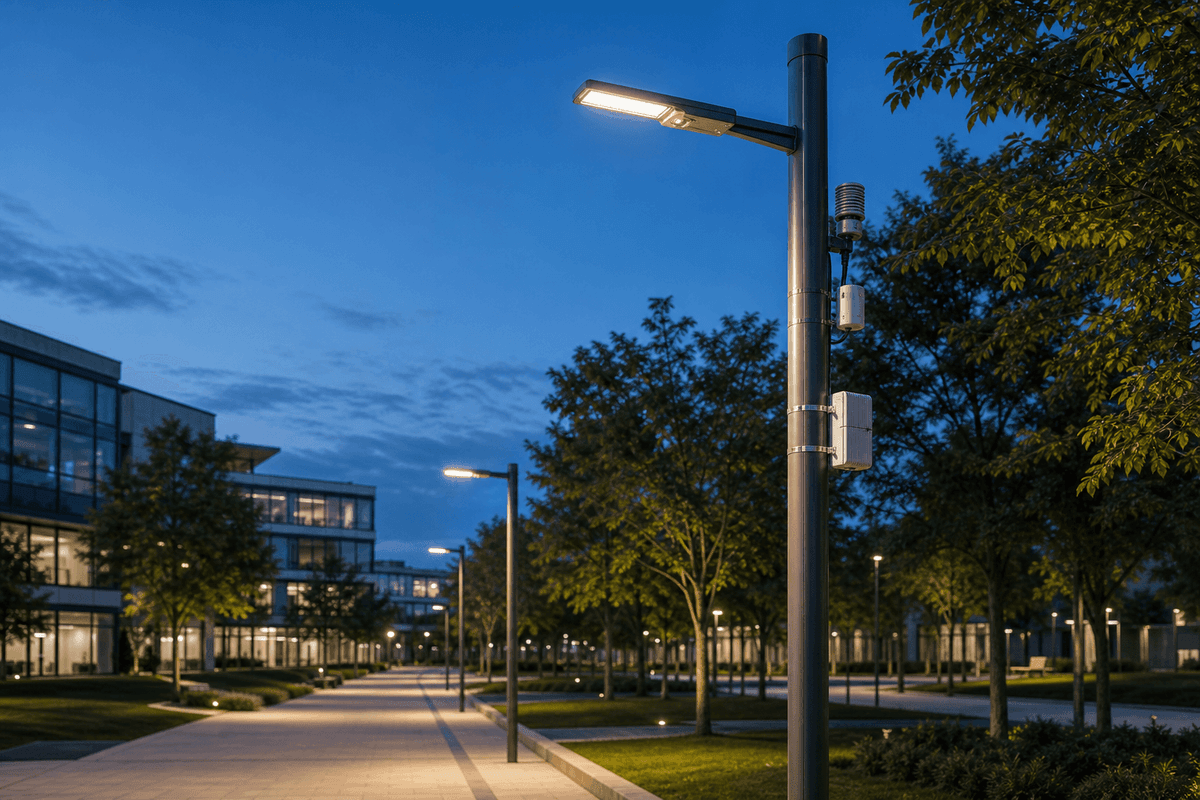
Smart streetlight environmental monitoring turns an 8 m lighting pole into a 7-parameter sensing node for air quality, noise, connectivity, and lighting control.
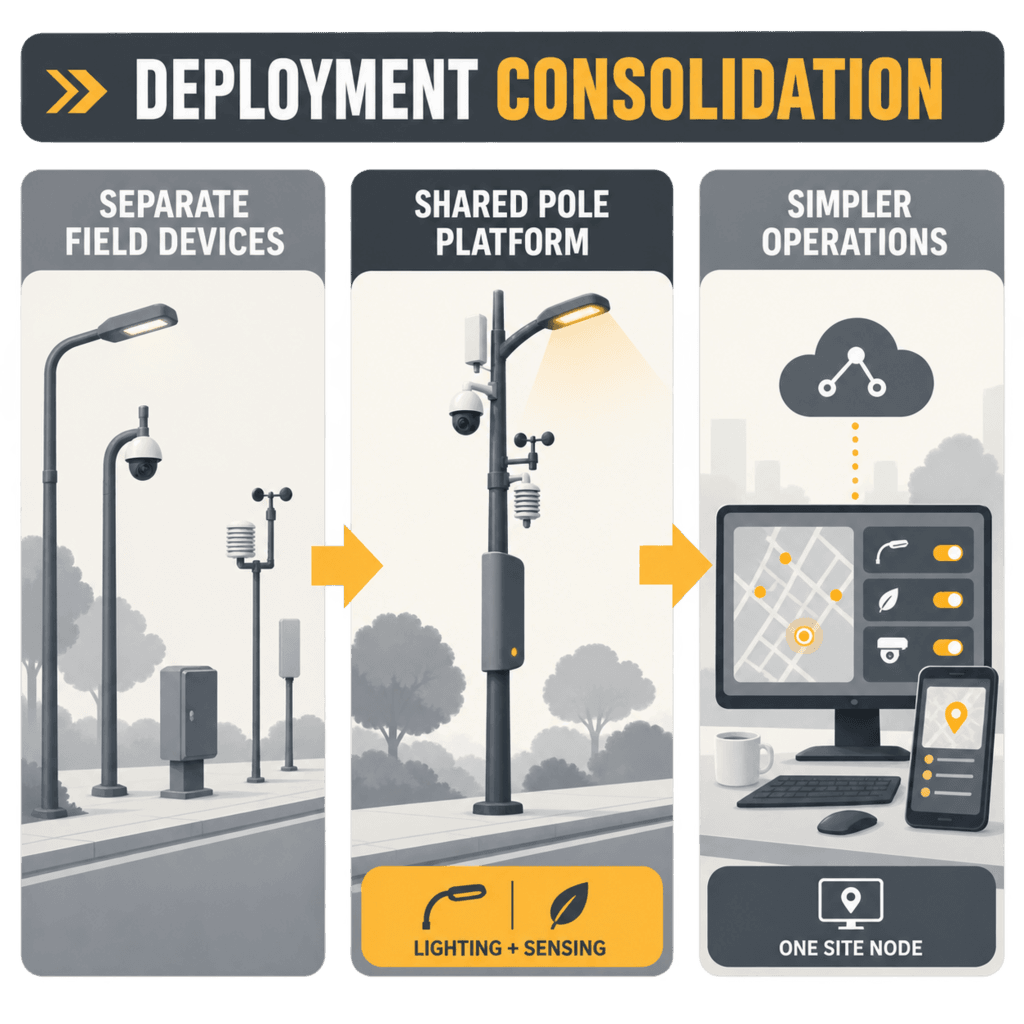
For procurement managers and engineers, the business case is not only better illumination. The stronger value is infrastructure consolidation: one SOLARTODO pole can host an 80 W LED luminaire, professional environmental sensor, AI camera, WiFi module, and USB charging interface. That replaces separate light poles, camera masts, sensor cabinets, wireless brackets, and charging pedestals.
The most relevant measurements are PM2.5, PM10, ozone, nitrogen dioxide, A-weighted noise, temperature, and humidity. According to WHO (2021), annual PM2.5 should not exceed 5 micrograms per cubic meter, while annual NO2 should not exceed 10 micrograms per cubic meter. A smart pole network does not replace a regulatory reference station, but it provides dense local data that helps owners identify hotspots, trends, and maintenance priorities.
WHO states, 'Clean air is fundamental to health.' That is why universities, municipal parks, industrial campuses, resorts, and mixed-use districts increasingly ask for environmental visibility at the asset level. A conventional air-quality station may be too expensive or too sparse for site-level decisions, while low-cost standalone sensors often lack reliable mounting, power, and communications. The smart streetlight solves those deployment gaps by using an asset already distributed across the site.
SOLARTODO positions this product as a B2B infrastructure system, not an online marketplace product. Buyers normally submit project drawings, pole quantity, voltage, communications requirements, and target standards, then receive an offline quotation with FOB, CIF, or EPC scope. For large projects, SOLARTODO can also discuss financing where total value exceeds USD 1,000K.
Sensor Architecture and Technical Specification
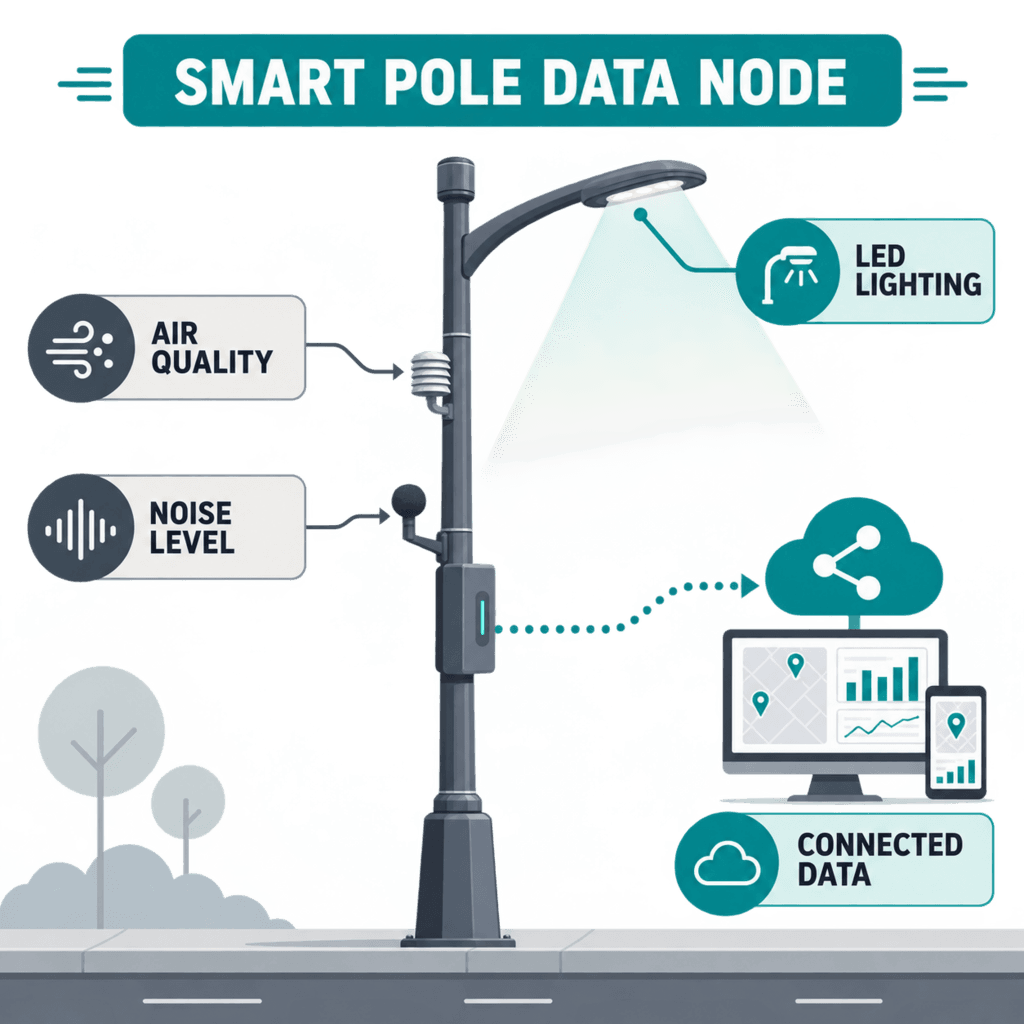
A practical smart streetlight sensor stack uses 7 environmental channels, IP66 protection, and 4G/5G or LoRaWAN telemetry for reliable outdoor monitoring.
The environmental module typically combines laser-scattering particulate sensors for PM2.5 and PM10, electrochemical cells for O3 and NO2, a MEMS microphone for noise, and digital sensors for temperature and relative humidity. The pole controller timestamps readings and sends them to a dashboard at intervals such as 1, 5, or 15 minutes. For most campus and park projects, 5-minute intervals balance data resolution, storage, and network cost.
Lighting and structure still matter. The SOLARTODO 8 m campus/park configuration uses an 80 W LED luminaire with about 170 lm/W efficacy, producing approximately 13,600 lumens. The pole is designed around hot-dip galvanized Q235 steel, IP66 outdoor protection, and typical operation from -40 C to +55 C. Product-family engineering targets include about 150 km/h wind resistance and a 25-year design life under suitable foundation and corrosion assumptions.
According to IEC 60598-1:2024, luminaires are governed by general safety requirements and tests for operation up to 1,000 V. That matters because smart poles add sensors, cameras, communications, and USB charging to a lighting structure; each added module increases electrical and enclosure coordination requirements. For outdoor buyers, the specification should define surge protection, grounding, ingress protection, access doors, cable segregation, and service clearances.
Communications should be selected by data type. Environmental readings are small packets, so LoRaWAN or LTE-M can be sufficient where video is not required. Cameras and public WiFi require higher bandwidth, usually 4G/5G backhaul, fiber, or local Ethernet. IEEE notes that 802.11ax, marketed as WiFi 6, was built for dense environments and has a theoretical data rate of 9.6 Gbit/s, making it suitable for plazas and campus gathering areas when backhaul is sized correctly.
Data Quality and Calibration
Environmental smart streetlights should be specified with calibration intervals, sensor-access design, and data validation rules before procurement.
Air-quality sensors mounted at 8 m can show trends and site comparisons, but they may not match reference-grade instruments without calibration and correction. Procurement teams should ask for factory calibration certificates, field calibration procedures, sensor replacement cycles, and environmental compensation for humidity and temperature. A strong specification also defines outlier filtering, uptime targets above 95%, and monthly data completeness reports.
Noise monitoring should use A-weighted decibel reporting because it better represents perceived human hearing impact than raw sound pressure alone. WHO Europe (2018) recommends road traffic noise below 53 dB Lden and 45 dB Lnight to reduce adverse health effects. A smart pole can map noisy zones near gates, parking areas, sports facilities, or traffic edges, then support scheduling, enforcement, landscape buffering, or lighting-control responses.
Applications, ROI, and Deployment Models
Smart streetlight monitoring works best in 50-500 pole programs where energy savings, shared foundations, and environmental dashboards justify integrated infrastructure.
Universities use smart poles to monitor pedestrian routes, dormitory edges, sports zones, and transport stops. Public parks use them for air-quality transparency, nighttime safety, visitor connectivity, and maintenance planning. Industrial campuses use the same architecture to identify dust events, vehicle-related NO2, acoustic disturbance, and perimeter security events. In each case, the value improves when data is operational, not just displayed.
According to DesignLights Consortium research cited in 2017-2020 lighting-control studies, networked lighting controls can average roughly 47-49% lighting energy savings compared with uncontrolled lighting. For an 80 W LED pole running 11 hours per night, annual consumption is about 321 kWh before dimming. If scheduling and occupancy control reduce output by 30%, the pole saves about 96 kWh per year before counting the avoided maintenance and civil-work savings from device consolidation.
The stronger ROI usually comes from civil and maintenance simplification. A conventional deployment may require 5 field devices, 5 records, and multiple foundation or bracket interfaces. The SOLARTODO 5-in-1 configuration reduces this to 1 pole assembly. Across 100 poles, that can eliminate hundreds of mounting points, cable runs, and inspection records, which is why EPC teams often evaluate total installed cost rather than pole purchase price alone.
IEA states, 'There is no AI without energy.' The same principle applies to smart infrastructure: every sensor, camera, access point, and analytics layer needs power, uptime, and maintenance. Smart streetlight environmental monitoring should therefore be designed as infrastructure first and data product second. The owner should confirm who maintains sensors, who owns the data, how alerts are escalated, and how long raw data is stored.
EPC Investment Analysis and Pricing Structure
EPC delivery for smart streetlight environmental monitoring typically prices 50-250+ poles across FOB supply, CIF delivery, and installed turnkey scopes.
EPC means Engineering, Procurement, and Construction. For this product category, an EPC turnkey package can include pole engineering, module selection, lighting layout coordination, foundation design assumptions, cable routing, installation supervision, commissioning, dashboard setup, training, and warranty handover. It is different from FOB supply, where the buyer manages freight, import, civil works, installation, and integration.
| Pricing tier | Typical scope | Buyer responsibility | Budget guidance |
|---|---|---|---|
| FOB Supply | Pole, luminaire, sensor, camera-ready interfaces, packed for export | Ocean freight, import, installation, civil works | Lowest unit price; best for experienced EPC buyers |
| CIF Delivered | FOB scope plus international freight and insurance to destination port | Customs, inland transport, installation, commissioning | Better landed-cost visibility for distributors |
| EPC Turnkey | Engineering, supply, installation support, commissioning, training | Site access, permits, utility coordination | USD 1,400-1,600 per installed unit for standard campus/park scope |
Volume pricing should be planned early. A 50+ pole package can target about 5% discount, 100+ poles can target about 10%, and 250+ poles can target about 15%, subject to final configuration, freight, commodity costs, and local installation assumptions. Standardizing the environmental sensor, LED driver, camera interface, and controller across all sites also reduces spare-parts inventory and commissioning time.
Payment terms are normally 30% T/T deposit plus 70% against bill of lading, or 100% L/C at sight for qualified buyers. Project financing may be available for large projects above USD 1,000K, especially where public lighting modernization, campus ESG upgrades, or municipal smart-city programs create stable repayment logic. For quotation, contact SOLARTODO at [email protected] or +6585559114 with quantity, drawings, destination port, and desired delivery scope.
Payback depends on local labor, trenching, energy prices, and whether the buyer values environmental data as a compliance or ESG asset. A conservative model should compare the smart pole against separate lighting, CCTV, environmental sensor, WiFi, and charging assets. Where civil works are expensive, integrated poles can reduce installed interfaces by 30-45%; where energy prices are high, LED plus controls can add another 15-49% lighting-energy reduction.
Comparison and Selection Guide
A 5-in-1 environmental smart streetlight is usually the best fit when buyers need 7 sensors without paying for premium 10-in-1 city-center functions.
| Option | Typical devices | Environmental coverage | Installed complexity | Best-fit use case |
|---|---|---|---|---|
| Conventional lighting pole | 1 light only | None | Low, but no data value | Basic roads and low-budget paths |
| Separate sensor station | 1-3 dedicated units | Strong if reference-grade | Medium to high | Compliance monitoring or research |
| SOLARTODO 5-in-1 smart pole | 5 functions on 1 pole | 7 parameters | Medium, integrated | Campuses, parks, plazas, green corridors |
| Premium 10-in-1 smart pole | 8-10 functions | 7+ parameters plus displays or SOS | High | CBD, transport hubs, smart-city showcases |
For most B2B buyers, the 5-in-1 configuration is the practical middle ground. It avoids the cost of LED displays, EV charging, SOS intercoms, and large edge cabinets, while retaining environmental sensing, lighting, connectivity, and camera readiness. That keeps the installed budget closer to USD 1,400-1,600 per pole instead of premium urban poles that can exceed USD 4,000-10,000 depending on modules.
Selection should begin with the data use case. If the owner only needs public reporting, 15-minute environmental readings may be enough. If the owner wants security-event correlation, 1-minute environmental data and camera timestamps should share a common time base. If the owner wants regulatory reporting, reference-station co-location and calibration protocols should be included in the specification from day 1.
FAQ
Smart streetlight environmental monitoring answers 10 common procurement questions covering sensors, pricing, installation, standards, maintenance, and ROI for 50+ pole projects.
Q: What is smart streetlight environmental monitoring? A: Smart streetlight environmental monitoring uses a lighting pole as a fixed platform for air-quality, noise, and weather sensors. A typical SOLARTODO configuration measures 7 parameters: PM2.5, PM10, O3, NO2, noise, temperature, and humidity. The system sends readings through LoRaWAN, 4G/5G, or Ethernet to a dashboard for site management.
Q: Which air-quality sensors should a campus or park smart pole include? A: A practical campus or park pole should include PM2.5, PM10, O3, and NO2 sensors as the core air-quality package. These 4 pollutants cover particulate dust, traffic-related emissions, and ozone events. Temperature and humidity should also be measured because they affect sensor response and help interpret local environmental patterns.
Q: How accurate are smart streetlight air-quality sensors? A: Smart pole sensors are best for dense trend monitoring, hotspot detection, and operational alerts, not as a full replacement for reference-grade stations. Accuracy depends on sensor grade, calibration, humidity compensation, airflow, and maintenance. Buyers should require calibration certificates, 12-24 month service procedures, and optional co-location against a reference monitor.
Q: Why add noise sensors to smart streetlights? A: Noise sensors turn lighting assets into acoustic monitoring points for roads, gates, event areas, and public parks. A-weighted decibel data helps owners identify recurring disturbance above thresholds such as 53 dB Lden for road traffic guidance. The data can support traffic changes, event scheduling, enforcement, or landscape-buffer decisions.
Q: How much does an environmental smart streetlight cost? A: A standard SOLARTODO 8 m campus/park environmental smart streetlight typically fits an EPC turnkey budget of USD 1,400-1,600 per installed unit. FOB supply is lower but excludes freight, import, civil works, and commissioning. Volume orders can target 5% discount at 50+ poles, 10% at 100+, and 15% at 250+.
Q: What does EPC turnkey delivery include? A: EPC turnkey delivery includes engineering, procurement, construction support, installation coordination, commissioning, dashboard setup, training, and warranty handover. It is useful when buyers want one accountable delivery path instead of managing separate pole, luminaire, sensor, camera, and communications suppliers. Payment can be 30% T/T plus 70% against B/L or 100% L/C at sight.
Q: What communication network is best for environmental sensor data? A: LoRaWAN is often sufficient for low-bandwidth environmental readings at 1-15 minute intervals, while 4G/5G or fiber is better when cameras or public WiFi are included. WiFi 6 can serve dense user zones, but it still needs adequate backhaul. The correct design separates sensor telemetry from high-bandwidth video traffic.
Q: How often should smart pole sensors be maintained? A: Environmental sensor heads should be inspected at least every 12 months, with cleaning after dust storms, pollen seasons, or construction activity. Calibration or replacement intervals are usually 12-24 months depending on sensor grade and site conditions. IP66 seals, cable glands, filters, and mounting brackets should be checked during the same visit.
Q: Can smart streetlight monitoring support ESG reporting? A: Yes, smart streetlight monitoring can support ESG reporting by producing site-level PM2.5, PM10, NO2, O3, noise, temperature, and humidity records. The data is most useful when exported through APIs or monthly reports with uptime above 95%. It should be presented as operational environmental intelligence, not regulatory certification unless validated.
Q: What standards should be referenced in procurement documents? A: Procurement documents should reference IEC 60598-1:2024 for luminaire safety, IEC 62722-2-1 for LED luminaire performance, ASTM A123/A123M for hot-dip galvanizing, and IEEE 802.11ax-2021 where WiFi 6 is specified. Projects may also reference WHO 2021 air-quality guidelines and WHO Europe 2018 environmental noise guidance for threshold context.
Conclusion
Smart streetlight environmental monitoring is a practical 5-in-1 infrastructure upgrade when 7-parameter sensing, 80 W LED lighting, and 50-250+ pole deployment economics matter.
The bottom line: SOLARTODO environmental smart streetlights help campuses, parks, and municipal corridors consolidate 5 field devices into 1 pole while tracking PM2.5, PM10, O3, NO2, noise, temperature, and humidity. For B2B projects above 50 poles, evaluate total installed cost, calibration duty, and dashboard usability before selecting the lowest unit price.
References
- IEC 60598-1:2024 (2024): Luminaires - Part 1: general safety requirements and tests for luminaires operating up to 1,000 V. — https://webstore.iec.ch/
- IEC 62722-2-1 (2023): LED luminaire performance standard used to evaluate output, durability, and performance claims for LED lighting. — https://webstore.iec.ch/
- IEEE 802.11ax-2021 (2021): High-Efficiency WLAN amendment marketed as WiFi 6 for dense wireless access planning. — https://standards.ieee.org/ieee/1547/7382/
- ASTM A123/A123M (2024): Standard specification for zinc hot-dip galvanized coatings on iron and steel products. — https://www.astm.org/
- IEA Energy and AI (2025): Report on digital infrastructure electricity demand and energy-aware smart system planning. — https://www.iea.org/reports/world-energy-outlook-2024 These 8 references anchor smart streetlight environmental monitoring specifications in air-quality, lighting, communications, galvanizing, and energy-control standards.
- WHO (2021): Global Air Quality Guidelines for PM2.5, PM10, O3, NO2, SO2, and CO, including annual PM2.5 guidance of 5 micrograms per cubic meter.
- WHO Regional Office for Europe (2018): Environmental Noise Guidelines recommending road traffic exposure levels below 53 dB Lden and 45 dB Lnight.
- IEC 60598-1:2024 (2024): Luminaires - Part 1, general safety requirements and tests for luminaires up to 1,000 V.
- IEC 62722-2-1 (2023): LED luminaire performance requirements relevant to output, durability, and performance claims for outdoor LED lighting.
- IEEE 802.11ax-2021 (2021): High-Efficiency WLAN amendment marketed as WiFi 6 for dense wireless environments and outdoor connectivity planning.
- ASTM A123/A123M (2024): Zinc hot-dip galvanized coating specification for iron and steel products used in corrosion-resistant pole structures.
- DesignLights Consortium (2017): Networked lighting control study estimating average lighting energy savings of approximately 47% from connected controls.
- IEA (2025): Energy and AI report explaining digital infrastructure electricity demand and the need for efficient, monitored smart systems.
About SOLARTODO
SOLARTODO is a global integrated solution provider specializing in solar power generation systems, energy-storage products, smart street-lighting and solar street-lighting, intelligent security & IoT linkage systems, power transmission towers, telecom communication towers, and smart-agriculture solutions for worldwide B2B customers.
About the Author

Cinn Song
Founder & Chief Solutions Architect
Cinn Song founded SOLARTODO LIMITED and leads its smart-city infrastructure engineering — from solar, storage and integrated smart poles to the company's push into physical-AI city edge nodes: pole-mounted edge computing, vertical LLMs for smart cities, drone-based O&M with autonomous battery swapping, robotic maintenance, and high-speed counter-UAS interception. Since 2010, he has directed turnkey EPC + BOT delivery across 50+ countries, including telecom monopole supply for national grid operators, off-grid solar street-lighting for African municipalities, and integrated smart-pole programs for Gulf smart cities.
Cite This Article
Cinn Song. (2026). Smart Streetlight Environmental Monitoring: Air Quality…. SOLARTODO. Retrieved from https://solartodo.com/knowledge/smart-streetlight-environmental-monitoring-air-quality-and-noise-sensors
@article{solartodo_smart_streetlight_environmental_monitoring_air_quality_and_noise_sensors,
  title = {Smart Streetlight Environmental Monitoring: Air Quality…},
  author = {Cinn Song},
  journal = {SOLARTODO Knowledge Base},
  year = {2026},
  url = {https://solartodo.com/knowledge/smart-streetlight-environmental-monitoring-air-quality-and-noise-sensors},
  note = {Accessed: 2026-10-14}
}
Published: August 13, 2026 | Available at: https://solartodo.com/knowledge/smart-streetlight-environmental-monitoring-air-quality-and-noise-sensors
Subscribe to Our Newsletter
Get the latest solar energy news and insights delivered to your inbox.
View All Articles