Smart Streetlight Cybersecurity: Protecting Connected…

Cinn Song
Founder & Chief Solutions Architect
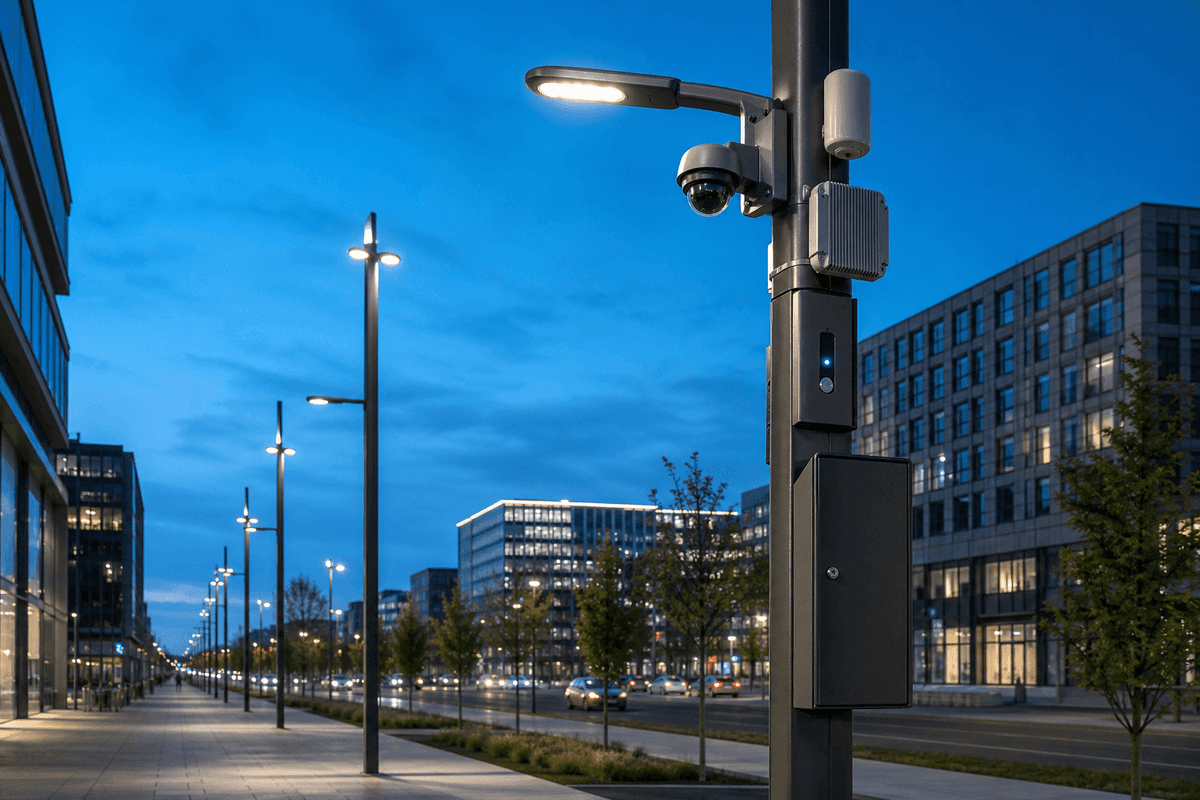
Watch the video
TL;DR
Smart streetlight cybersecurity protects connected poles that combine LED lighting, AI cameras, WiFi, sensors, and emergency calls. For 50+ pole projects, buyers should require IEC 62443 processes, 802.1X or VPN access, UL 2900-style testing, 90-day logs, and USD 80-180 per pole per year for maintenance to preserve 20%-35% energy savings and 5-8 year ROI.
Smart streetlight cybersecurity protects 10m connected poles with 4-10 modules, IP66 hardware, 802.1X access control, IEC 62443 processes, and 24/7 monitoring to reduce lighting, camera, WiFi, and emergency-call risk.
Summary
Smart streetlight cybersecurity protects 10m connected poles with 4-10 modules, IP66 hardware, 802.1X access control, IEC 62443 processes, and 24/7 monitoring to reduce lighting, camera, WiFi, and emergency-call risk.
Key Takeaways
A secure smart streetlight program should control 4-10 connected modules per pole through segmented networks, signed firmware, monitored logs, and 30-day patch governance.
- Map 100% of pole assets, including LED drivers, AI cameras, WiFi APs, emergency call modules, gateways, and smart controllers.
- Segment 4 traffic classes: lighting control, video surveillance, public WiFi, and emergency communications.
- Require 802.1X, mutual authentication, and encrypted backhaul for every Ethernet, 4G/5G, and fiber connection.
- Specify IEC 62443 supplier controls before procurement so firmware, patching, access rights, and vulnerability disclosure are contractually covered.
- Monitor 24/7 security logs from gateways, cameras, controllers, and cloud platforms with 90-day retention for incident review.
- Budget USD 80-180 per pole per year for cybersecurity maintenance, including patch validation, log review, and credential rotation.
- Compare EPC options across FOB supply, CIF delivered, and EPC turnkey pricing to avoid underfunding integration and commissioning.
- Plan 5-8 year ROI by combining 20%-35% LED energy savings, reduced device count, and lower maintenance visits.
Why Smart Streetlight Cybersecurity Matters
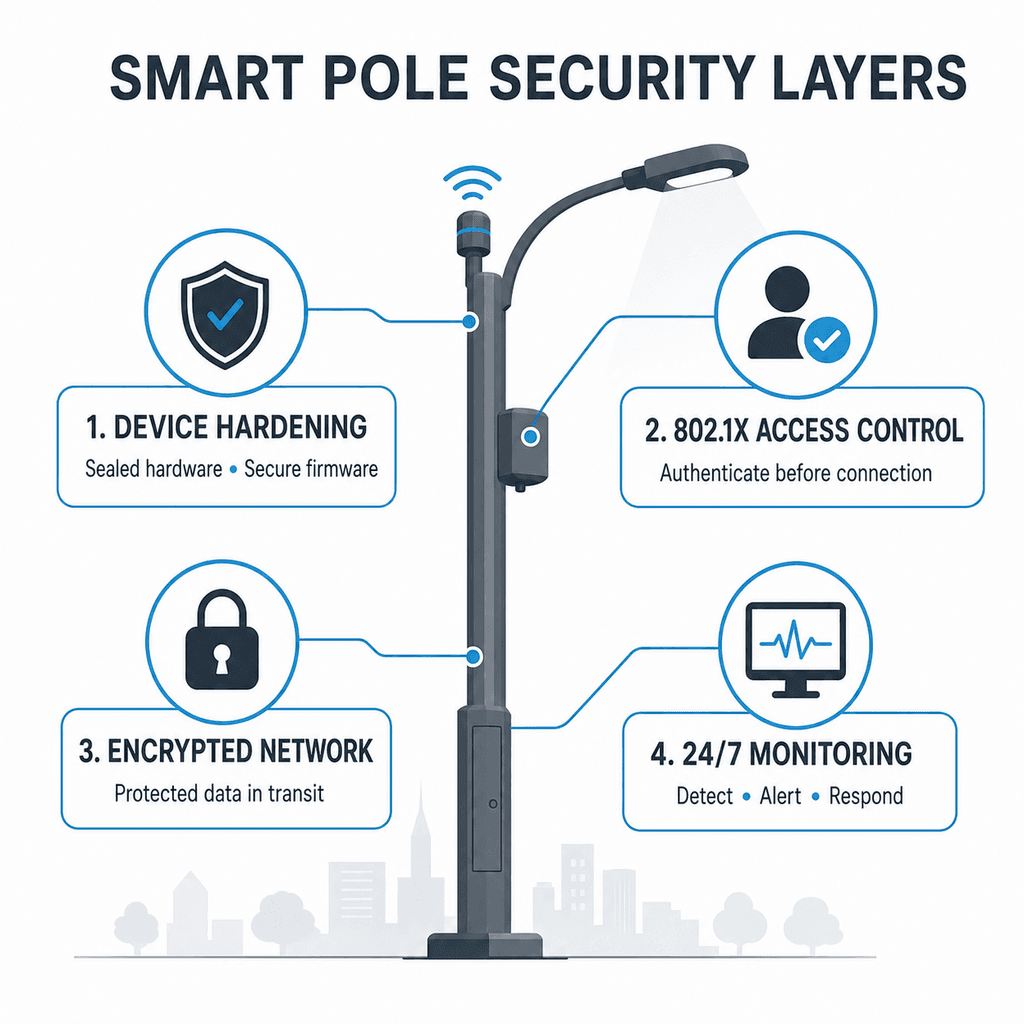
Smart streetlight cybersecurity is now a procurement requirement because one 10m pole can combine 120W LED lighting, AI video, WiFi, emergency calls, and 4G/5G backhaul.
A connected streetlight is no longer only an outdoor luminaire. In a SOLARTODO smart streetlight project, one pole may host lighting control, a 4K AI camera, a WiFi access point, an emergency call button, an environmental sensor, and a gateway connected to a city platform. That combination improves safety and operations, but it also creates a larger attack surface than a conventional lighting circuit.
The risk is operational, not theoretical. A weak default password can expose camera streams. An unpatched gateway can become a pivot into a municipal network. An open WiFi SSID can create liability for the asset owner. A compromised lighting controller can cause service disruption across 50, 500, or 5,000 poles if the network design allows uncontrolled lateral movement.
According to NIST (2024), the Cybersecurity Framework 2.0 helps organizations govern, identify, protect, detect, respond, and recover from cybersecurity risk. NIST states, 'The CSF has been a vital tool for many organizations.' For smart infrastructure buyers, the practical lesson is clear: cybersecurity must be specified before tender award, not added after installation.
According to the IEA 4E SSLC Platform (2024), lighting accounts for approximately 12% of global end-use electricity, and solid-state lighting with controls can reduce that consumption by 50% or more. That efficiency value is strongest when connected controls remain trustworthy. A cyber incident that disables dimming schedules, remote diagnostics, or camera-assisted safety can erase part of the operational benefit.
SOLARTODO treats smart streetlight cybersecurity as a system requirement across hardware, communications, software, installation, and maintenance. The goal is not to promise zero risk. The goal is to make unauthorized access difficult, make abnormal behavior visible, and make recovery practical within defined service windows.
Threat Model for Connected Urban Poles
A practical smart pole threat model should cover at least 6 attack paths: device access, firmware, cloud API, wireless, video data, and maintenance credentials.
For B2B procurement teams, the first step is to define what must be protected. Smart streetlight assets include the luminaire controller, AI camera, network switch, WiFi AP, cellular router, LoRaWAN gateway, emergency call module, local edge computer, cloud dashboard, mobile maintenance app, and power cabinet. Each component has different exposure and different consequences if compromised.
The highest-risk paths usually start with weak identity controls. Shared installer passwords, unmanaged VPN accounts, public management ports, and reused API keys can expose hundreds of poles. A second common path is unmanaged firmware. If a camera, router, or controller cannot receive signed updates, the owner may carry known vulnerabilities for the full 10-25 year infrastructure life.
Video and biometric features require extra governance. A community entrance pole with face recognition may process identifiable images, timestamped access events, and incident records. Depending on jurisdiction, retention may be 7-90 days, with role-based access for security staff and privacy notices for residents or visitors. The face recognition function can also be configured for 1:1 verification, 1:N matching, or disabled while retaining standard analytics.
According to ISA (2026), the ISA/IEC 62443 series defines cybersecurity requirements and processes for industrial automation and control systems. ISA describes it as the 'world's only consensus-based' automation cybersecurity standard family. For smart streetlights, IEC 62443 is useful because poles behave like distributed operational technology: they affect public lighting, safety systems, and field maintenance, not only IT data.
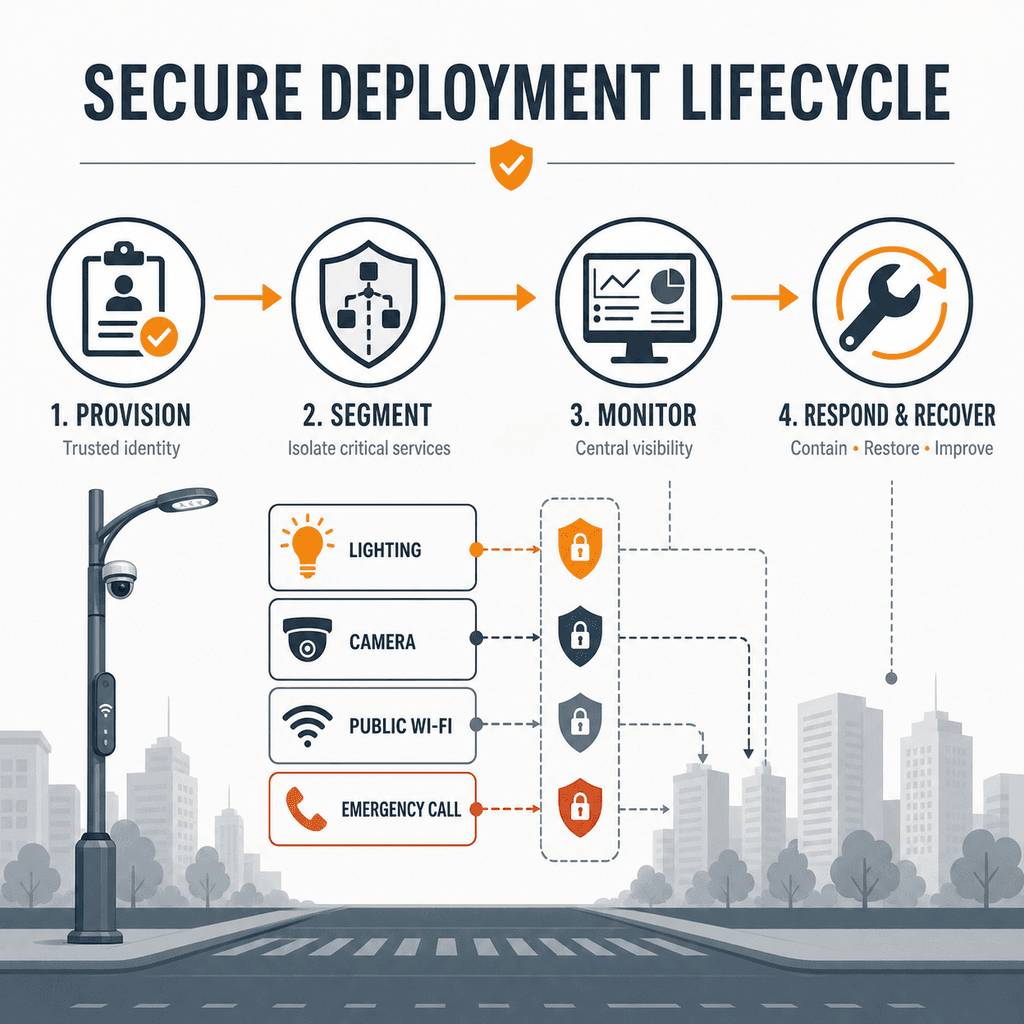
A defensible threat model should assign each function to a security zone. Lighting control belongs in an operations zone. Cameras and storage belong in a video security zone. Public WiFi belongs in a guest zone. Emergency call traffic belongs in a life-safety or security-response zone. Administrative dashboards and remote maintenance should sit behind stronger authentication than daily user applications.
Minimum Security Architecture
The minimum architecture for a 50-pole deployment should include 4 segmented networks, unique device credentials, encrypted remote access, and centralized security logging.
Segmentation is the control that prevents one compromised module from becoming a citywide incident. Public WiFi should never share a flat network with lighting controllers. Camera video should not expose controller management interfaces. Emergency call systems should have priority routing and separate monitoring. The controller cabinet should include documented ports, hardened services, and a lockable physical design.
Authentication must be device-specific. IEEE 802.1X-2020 specifies port-based network access control and mutual authentication mechanisms for LAN access. For smart poles, this supports certificate-based access for switches, cameras, controllers, and maintenance laptops. Where 802.1X is not feasible, projects should require VPN access, IP allowlisting, strong unique credentials, and logged administrative sessions.
Firmware management should be written into the tender. Buyers should request signed firmware, secure boot where available, vulnerability disclosure procedures, software bill of materials support for critical components, and a defined patch process. A realistic service-level objective is to evaluate critical vulnerabilities within 7 days and deploy approved patches within 30 days, after test validation.
EPC Investment Analysis and Pricing Structure
A secure EPC smart streetlight package should price cybersecurity across FOB, CIF, and turnkey delivery, with 50+ pole discounts and 5-8 year ROI modeling.
EPC delivery means Engineering, Procurement, and Construction. For a smart streetlight cybersecurity project, engineering includes network zoning, device schedules, pole layout, data flow diagrams, access-control policy, and integration with the owner's monitoring platform. Procurement includes poles, luminaires, controllers, cameras, routers, switches, software licenses, certificates, spare parts, and cybersecurity documentation. Construction includes foundations, cabling, installation, commissioning, testing, training, and handover.
SOLARTODO is a B2B manufacturer and exporter, not an online marketplace. A typical inquiry moves from technical scoping to offline quotation, commercial negotiation, sample or pilot confirmation, manufacturing, shipment, installation support, and after-sales service. Project financing may be available for large projects above USD 1,000K, subject to country, buyer profile, and financing review.
| Pricing tier | What it includes | Cybersecurity scope | Best fit |
|---|---|---|---|
| FOB Supply | Factory supply at origin port | Device hardening checklist, documentation, and optional credentials policy | Buyers with their own logistics and integrator |
| CIF Delivered | Equipment delivered to destination port | FOB scope plus shipping coordination and pre-shipment configuration records | EPCs managing local installation |
| EPC Turnkey | Engineering, supply, installation, commissioning, and handover | Full network design, access policy, testing, training, and monitoring setup | Municipal, campus, and gated-community owners |
Volume pricing should be modeled early. For many SOLARTODO smart streetlight projects, 50+ poles can support about 5% discount, 100+ poles about 10%, and 250+ poles about 15%, depending on module mix, steel specification, logistics, software scope, and payment terms. Standard commercial terms may include 30% T/T deposit plus 70% against bill of lading, or 100% L/C at sight for approved buyers.
Cybersecurity has a visible operating cost, but underfunding it is usually more expensive. A practical planning allowance is USD 80-180 per pole per year for credential rotation, firmware review, monitoring, log retention, vulnerability response, and periodic access audit. Against conventional fragmented deployments, integrated smart poles can reduce device count from 3-4 roadside assets to 1 coordinated platform and reduce civil works and maintenance interfaces by approximately 25%-40%.
The ROI case should combine energy savings, lower maintenance trips, avoided separate cabinets, and reduced incident exposure. A 120W LED luminaire at 170 lm/W can generate about 20,400 lumens while reducing lighting energy consumption by approximately 20%-35% versus a 150W sodium fixture in comparable entrance lighting. For 100 poles operating 12 hours per night, cybersecurity-protected controls help preserve scheduling, dimming, diagnostics, and service continuity over a 25-year design life.
For EPC pricing, warranty, and project financing review, contact SOLARTODO at [email protected] or +6585559114 with pole height, module list, wind speed, quantity, destination port, and integration requirements.
Procurement and Technical Selection Guide
Procurement teams should score smart streetlight vendors across 8 controls: standards, firmware, identity, encryption, logging, privacy, maintenance, and warranty.
A smart streetlight tender should not ask only for lumens, pole height, and camera resolution. It should require evidence that the connected system can be deployed, updated, monitored, and recovered. This is especially important for mixed deployments across Latin America, the Middle East, Africa, Southeast Asia, and Europe, where climate, telecom coverage, privacy law, and municipal IT maturity vary widely.
| Requirement | Baseline specification | Why it matters |
|---|---|---|
| Pole platform | 8m, 10m, or 12m smart pole | Defines camera view, wind load, and service access |
| Lighting | 80W-120W LED, 170-190 lm/W | Reduces energy load and improves camera image quality |
| Protection | IP66 enclosure, -40°C to +55°C operation | Supports dust, rain, heat, and cold exposure |
| Network access | IEEE 802.1X or VPN with unique credentials | Blocks unauthorized field and remote access |
| Cybersecurity process | IEC 62443-aligned supplier controls | Makes patching and responsibility auditable |
| Product testing | UL 2900-style vulnerability and malware evaluation | Supports objective testing of connectable products |
| Logs | 90-day security and access log retention | Enables incident reconstruction and compliance review |
| Maintenance | 12-month audit cycle with 30-day critical patch target | Keeps long-life infrastructure current |
According to UL (2026), UL 2900-1 applies to network-connectable products evaluated for vulnerabilities, software weaknesses, and malware. This standard is relevant to smart streetlights because cameras, routers, emergency systems, and controllers are all network-connectable products. UL 2900-2-3 is also useful for physical security and life-safety signaling systems, including video surveillance, access control, alarms, and emergency communication.
Selection should also consider privacy-by-design. If face recognition is included, the buyer should define lawful basis, signage, retention period, user roles, audit trail, data export process, and deletion procedure. If public WiFi is included, the system should isolate guest users from operational technology and avoid collecting unnecessary personal data.
SOLARTODO can configure security-oriented 4-in-1 community entrance poles or larger smart streetlight platforms with environmental monitoring, WiFi, cameras, LoRaWAN, and emergency modules. The recommended configuration depends on site risk: community gates prioritize identity verification and incident response, campuses prioritize environmental data and open-area surveillance, while boulevards prioritize traffic, lighting, and city platform integration.
FAQ
Smart streetlight cybersecurity programs should answer 10 procurement questions before award, including cost, standards, installation, privacy, monitoring, maintenance, warranty, and ROI.
Q: What is smart streetlight cybersecurity? A: Smart streetlight cybersecurity is the protection of connected lighting, cameras, sensors, WiFi, emergency call systems, and controllers from unauthorized access or disruption. A secure project usually combines 4 layers: hardened devices, segmented networks, encrypted communication, and monitored operations with defined patch procedures.
Q: Why are smart streetlights vulnerable to cyberattacks? A: Smart streetlights are vulnerable because each pole may combine 4-10 networked devices in public outdoor space. Attackers may target exposed management ports, weak passwords, outdated firmware, public WiFi, camera interfaces, or cloud APIs, especially when hundreds of poles share the same configuration.
Q: Which standards should buyers specify for cybersecurity? A: Buyers should specify IEC 62443 for operational technology security processes, IEEE 802.1X-2020 for network access control, NIST CSF 2.0 for governance, and UL 2900 for connectable product testing. Lighting safety and performance should still reference IEC 60598 and IEC 62722.
Q: How should public WiFi be isolated from lighting controls? A: Public WiFi should use a separate guest network with no route to lighting controllers, camera management, or emergency call systems. At minimum, the design should use VLANs or separate AP routing, firewall rules, bandwidth limits, and 90-day access logs for operational review.
Q: What cybersecurity controls should be included at installation? A: Installation should include unique device credentials, closed unused ports, encrypted backhaul, certificate or VPN access, documented IP plans, and baseline firmware versions. The commissioning team should also verify camera access roles, controller schedules, alarm routing, and log forwarding before handover.
Q: How much does cybersecurity add to smart streetlight cost? A: Cybersecurity maintenance commonly adds USD 80-180 per pole per year, depending on monitoring depth, software licenses, and service response requirements. For EPC turnkey projects, the initial cost may also include network design, secure commissioning, training, and integration testing across 50-250+ poles.
Q: How often should smart streetlight firmware be updated? A: Firmware should be reviewed at least quarterly, with critical vulnerabilities evaluated within 7 days and approved patches deployed within about 30 days. Updates should be tested first because a failed camera, router, or controller patch can interrupt lighting, surveillance, or emergency communications.
Q: How does cybersecurity affect face recognition streetlight projects? A: Cybersecurity protects face recognition projects by controlling who can access biometric records, video streams, and event logs. Buyers should define 7-90 day retention rules, role-based permissions, encrypted storage, audit trails, and the option to use 1:1 verification or disable recognition where law requires.
Q: What should be included in an EPC turnkey cybersecurity scope? A: EPC turnkey scope should include threat modeling, network segmentation, device hardening, installation, commissioning, administrator training, log integration, and handover documentation. Pricing should distinguish FOB supply, CIF delivered, and EPC turnkey so buyers can see whether cybersecurity engineering is included.
Q: What warranty questions should procurement teams ask? A: Procurement teams should ask whether the warranty covers hardware defects, firmware support, vulnerability disclosure, spare parts, and remote troubleshooting. For 25-year pole structures and long-life LED systems, buyers still need clear software support terms, because cybersecurity obligations change faster than steel or optics.
Q: Can cybersecurity improve ROI for smart streetlights? A: Cybersecurity improves ROI by preserving remote dimming, diagnostics, camera uptime, and service continuity. When a 120W LED pole supports 20%-35% energy savings and reduces 3-4 roadside devices to 1 platform, secure operations help protect the savings over 5-8 years.
Q: What information should I provide for a SOLARTODO quotation? A: Provide pole height, quantity, module list, wind speed, destination port, preferred pricing tier, and cybersecurity requirements. For faster EPC review, include whether you need 802.1X, VPN, cloud hosting, local VMS integration, face recognition, 90-day logs, and financing for projects above USD 1,000K.
References
Smart streetlight cybersecurity should reference at least 7 authorities covering cyber governance, industrial control security, network access, product testing, lighting performance, and energy efficiency.
- NIST (2024): Cybersecurity Framework 2.0, CSWP 29, guidance for governing, identifying, protecting, detecting, responding to, and recovering from cybersecurity risk. https://www.nist.gov/publications/nist-cybersecurity-framework-csf-20
- ISA/IEC 62443 (2024-2026): Industrial automation and control systems security standards for asset owners, service providers, suppliers, and component security. https://www.isa.org/standards-and-publications/isa-standards/isa-iec-62443-series-of-standards
- IEEE 802.1X-2020 (2020): Port-Based Network Access Control standard for authentication and secure controlled-port communication on LANs. https://1.ieee802.org/security/802-1x/
- UL 2900-1 (2026): Software Cybersecurity for Network-Connectable Products, general requirements for evaluating vulnerabilities, software weaknesses, and malware. https://www.shopulstandards.com/ProductDetail.aspx?productId=UL2900-1_2_S_20231213
- UL 2900-2-3 (2017): Software cybersecurity requirements for network-connectable physical security and life-safety signaling systems. https://www.ul.com/services/cybersecurity-physical-security-systems
- IEA 4E SSLC Platform (2024): Annual report noting lighting accounts for approximately 12% of global end-use electricity and connected controls can reduce consumption. https://www.iea-4e.org/4e-2024-annual-report/
- NREL (2024): RESCue Pilot Final Report on cybersecurity for renewable and storage systems, cyber-informed engineering, and resilient design. https://doi.org/10.2172/2447831
- IEC 60598 and IEC 62722 (current editions): Luminaire safety and LED luminaire performance standards used to evaluate outdoor smart streetlight lighting systems.
Conclusion
Smart streetlight cybersecurity protects 4-10 connected modules per pole by combining IEC 62443 governance, 802.1X access control, UL 2900 testing, and 24/7 monitoring.
The bottom line: for 50+ pole deployments, SOLARTODO recommends budgeting cybersecurity from the tender stage, not after commissioning. A secure smart streetlight program preserves 20%-35% LED energy savings, supports 5-8 year ROI, and reduces operational risk across lighting, AI video, WiFi, and emergency communication systems.
About SOLARTODO
SOLARTODO is a global integrated solution provider specializing in solar power generation systems, energy-storage products, smart street-lighting and solar street-lighting, intelligent security & IoT linkage systems, power transmission towers, telecom communication towers, and smart-agriculture solutions for worldwide B2B customers.
About the Author

Cinn Song
Founder & Chief Solutions Architect
Cinn Song founded SOLARTODO LIMITED and leads its smart-city infrastructure engineering — from solar, storage and integrated smart poles to the company's push into physical-AI city edge nodes: pole-mounted edge computing, vertical LLMs for smart cities, drone-based O&M with autonomous battery swapping, robotic maintenance, and high-speed counter-UAS interception. Since 2010, he has directed turnkey EPC + BOT delivery across 50+ countries, including telecom monopole supply for national grid operators, off-grid solar street-lighting for African municipalities, and integrated smart-pole programs for Gulf smart cities.
Cite This Article
Cinn Song. (2026). Smart Streetlight Cybersecurity: Protecting Connected…. SOLARTODO. Retrieved from https://solartodo.com/knowledge/smart-streetlight-cybersecurity-protecting-connected-urban-infrastructure
@article{solartodo_smart_streetlight_cybersecurity_protecting_connected_urban_infrastructure,
  title = {Smart Streetlight Cybersecurity: Protecting Connected…},
  author = {Cinn Song},
  journal = {SOLARTODO Knowledge Base},
  year = {2026},
  url = {https://solartodo.com/knowledge/smart-streetlight-cybersecurity-protecting-connected-urban-infrastructure},
  note = {Accessed: 2026-07-18}
}
Published: July 18, 2026 | Available at: https://solartodo.com/knowledge/smart-streetlight-cybersecurity-protecting-connected-urban-infrastructure
Subscribe to Our Newsletter
Get the latest solar energy news and insights delivered to your inbox.
View All Articles