Smart Streetlight Cameras and Public Safety:…

Cinn Song
Founder & Chief Solutions Architect
Watch the video
TL;DR
Smart streetlight cameras can improve public safety when surveillance is limited to defined risk zones, backed by 4K video, 50m IR night vision, IP66 outdoor protection, and 7-90 day retention controls. SOLARTODO systems consolidate 3-4 roadside assets into 1 pole, with typical 10m security pole budgets of USD 1,600-2,000 before project-specific EPC costs.
Privacy-compliant smart streetlight cameras combine 4K video, 50m IR night vision, and 7-90 day retention controls to improve public safety while reducing 3-4 separate roadside assets to 1 pole per site.
Summary
Privacy-compliant smart streetlight cameras combine 4K video, 50m IR night vision, and 7-90 day retention controls to improve public safety while reducing 3-4 separate roadside assets to 1 pole per site.
Key Takeaways
Deploy 4K smart streetlight cameras at 8m-10m mounting heights to improve junction, gate, campus, and perimeter visibility without adding separate CCTV masts.
- Use 4K imaging with 20x optical zoom and 50m IR night vision for entrances, parking areas, and pedestrian corridors requiring evidence-grade scene capture.
- Limit video retention to 7-90 days and define role-based access for at least 3 user groups: operators, supervisors, and auditors.
- Select IP66 smart pole enclosures and -40°C to +55°C operating ranges for coastal, desert-edge, tropical, and winter deployment zones.
- Consolidate 3-4 roadside systems into 1 multifunction pole to reduce foundations, trenching points, and maintenance interfaces by about 25%-40%.
- Budget USD 1,600-2,000 per 10m security smart streetlight pole before site-specific civil works, integration, and software licensing.
- Require IEC 60598-1:2020 luminaire safety, IEC 62722 performance testing, UL 2900-1 cybersecurity review, and NIST privacy risk mapping.
- Plan EPC payback around 3-6 years when LED savings, avoided civil works, reduced service visits, and security staffing efficiency are included.
- Configure face recognition as 1:1 verification, 1:N watchlist matching, or disabled analytics depending on local consent and privacy law.
Privacy-Compliant Smart Streetlight Surveillance for Public Safety
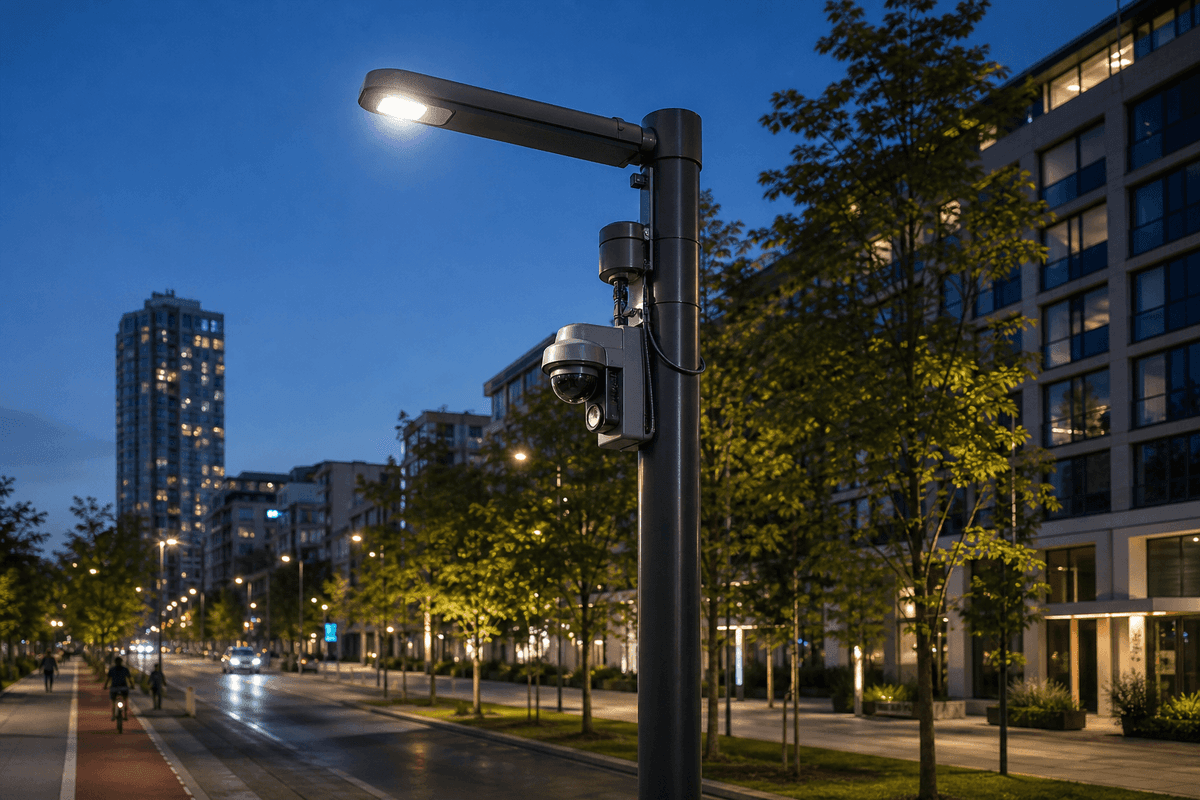
Privacy-compliant smart streetlight cameras improve public safety when 4K capture, 7-90 day retention, and clear access controls are designed before procurement.
Smart streetlight surveillance is not only a camera purchase; it is a governance, civil infrastructure, lighting, network, and data-risk project. For B2B buyers, the practical objective is to improve safety at public spaces, gated communities, campuses, industrial parks, logistics yards, and municipal roads without creating unmanaged personal-data exposure. SOLARTODO positions these systems as engineered infrastructure, not as an online marketplace product, so the typical workflow is inquiry, technical review, offline quotation, and optional project financing.
A privacy-compliant deployment starts with the purpose of monitoring. Common purposes include incident deterrence, emergency response, visitor verification, pedestrian safety, perimeter monitoring, and post-event investigation. Each purpose should have a defined camera field of view, event trigger, retention period, user permission group, and audit record. If the project cannot explain why a camera views a specific lane, gate, sidewalk, or asset, that camera should be repositioned, masked, or removed from the design.
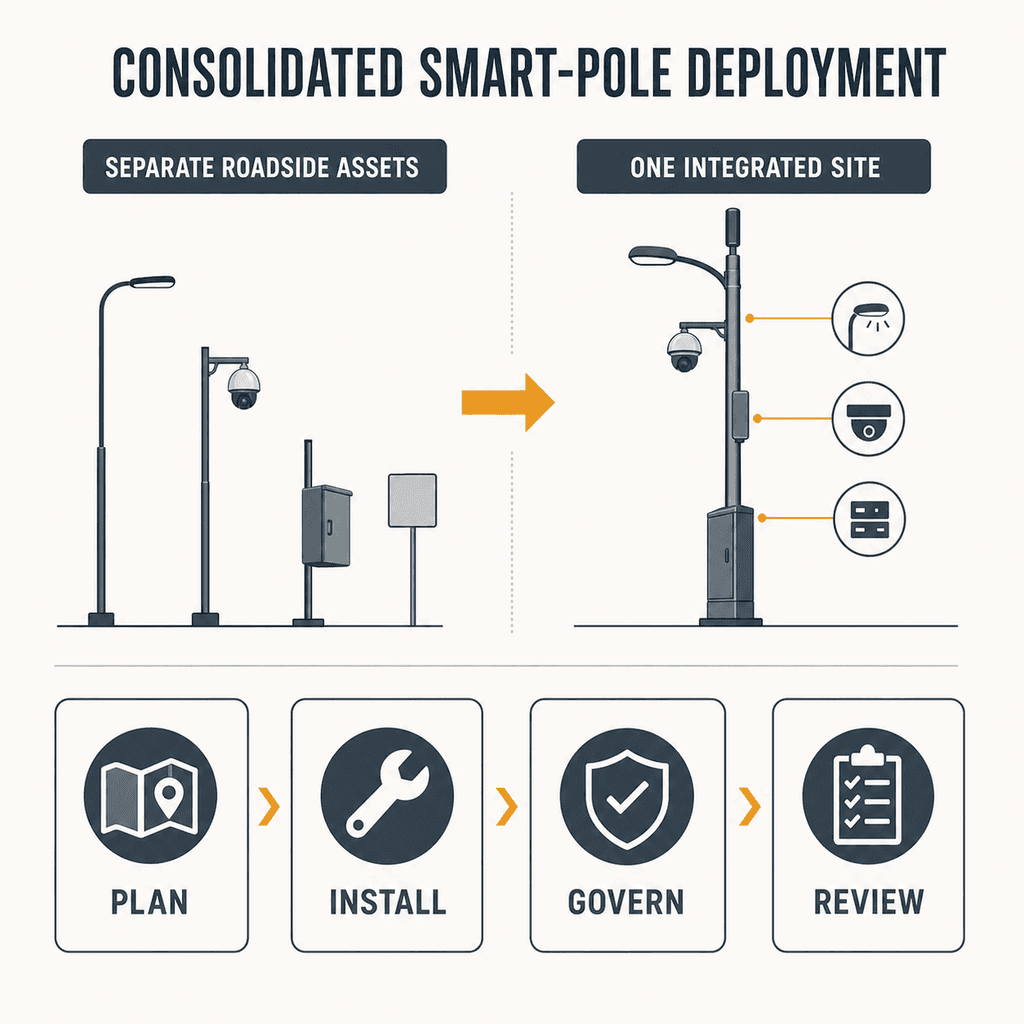
The smart pole format helps reduce infrastructure clutter because lighting, camera, emergency call, WiFi, and communications modules can share 1 steel pole. In the SOLARTODO 10m community entrance configuration, 1 × 120W LED luminaire, 1 × AI security camera, 1 × emergency call module, and 1 × WiFi access point are integrated into a continuous-tapered steel pole. Compared with fragmented installations, this can reduce foundations, cable routes, and maintenance interfaces by about 25%-40%.
According to NIST (2020), privacy programs need enterprise risk management rather than checklist-only compliance. NIST states, "You need a framework for privacy risk management," which is especially relevant when cameras, access control, and wireless networks operate from the same pole. For procurement teams, this means privacy requirements should appear in the bill of materials, software specification, acceptance test, and O&M contract.
According to IRENA (2024), utility-scale battery storage project costs dropped by 89% between 2010 and 2023, supporting lower-cost backup power and edge-node resilience. While smart streetlights are not utility-scale storage projects, the same cost trend affects hybrid solar, battery, and communications infrastructure planning. Where grid reliability is weak, backup energy can keep surveillance, lighting, and emergency call functions active during outages.
Technical Architecture and Privacy Controls
A secure smart streetlight camera system combines 120W-80W LED lighting, 4K video, encrypted networks, edge analytics, and retention limits below 90 days.
A smart streetlight camera deployment usually includes four technical layers. The physical layer is the steel pole, foundation, luminaire, junction box, grounding, surge protection, and IP66-rated enclosures. The sensing layer includes 4K PTZ or fixed cameras, IR illumination, optional face recognition, environmental sensors, emergency call modules, and WiFi 6 access points. The network layer includes fiber, 4G/5G, LoRaWAN, VPN, device certificates, and firewall rules. The data layer includes video management software, access logs, retention rules, export approval, and audit trails.
For lighting, SOLARTODO smart streetlight variants typically use LED luminaires from 80W to 120W with 170 lm/W platform-level efficacy, producing about 13,600-20,400 lumens depending on model. Strong, uniform illumination improves public safety directly and also improves camera evidence quality. Overexposed, underlit, or unstable scenes reduce the value of face recognition and license plate review, so lighting design should be validated together with camera placement.
According to IEC 60598-1:2020, luminaires require defined tests for classification, marking, mechanical construction, electrical construction, and photobiological safety. For buyers, this matters because outdoor poles may operate 10-14 hours per night, or roughly 3,650-5,110 hours per year. IEC 62722 should also be referenced for LED luminaire performance, especially where public safety depends on stable lumen output and optical distribution.
Privacy controls should be engineered into the system rather than treated as a software setting after installation. Recommended controls include privacy masking for private windows and non-project areas, default retention of 30 days unless local law requires another period, encrypted video transport, named-user access, multi-factor authentication for administrators, and export logs for every evidence download. For high-risk deployments, face recognition should be disabled by default until consent, signage, legal basis, and accuracy testing are documented.
According to NIST (2023), the AI Risk Management Framework is intended to help organizations manage risks to individuals, organizations, and society from AI systems. NIST describes the AI RMF as "rights-preserving" and "use-case agnostic," which fits smart city deployments where one camera may support safety, access control, and incident review. The practical procurement requirement is to document accuracy limits, false-match procedures, human review, and override processes.
Cybersecurity is equally important because a connected camera is a network-connectable product. UL 2900-1:2023 covers software cybersecurity for network-connectable products and includes evaluation for vulnerabilities, software weaknesses, and malware. A B2B specification should require firmware update policy, secure boot where available, unique device credentials, disabled default passwords, vulnerability disclosure process, and segmented networking between camera, WiFi, and administrative systems.
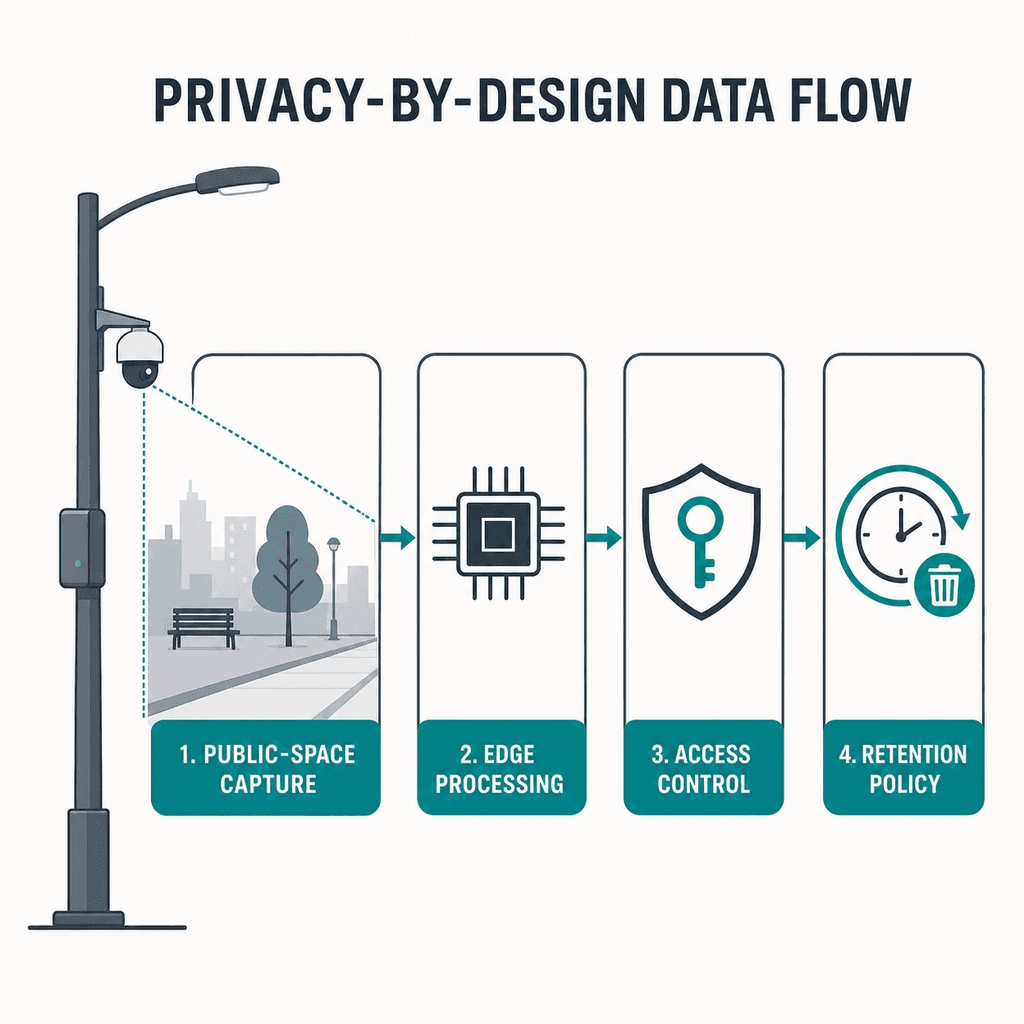
Privacy-by-Design Control List
Privacy-by-design requires 6 operational controls: purpose limitation, masking, retention, access control, audit logging, and documented human review for AI alerts.
- Define 1 written purpose for each camera view before installation.
- Mask homes, private balconies, staff-only rooms, and non-project areas before commissioning.
- Set default retention at 30 days, with documented exceptions from 7-90 days.
- Separate user roles for viewing, exporting, administering, and auditing video.
- Log every login, playback, configuration change, export, and deletion event.
- Require human confirmation before enforcement action from face recognition or object detection.
- Review camera fields of view every 12 months or after site layout changes.
Public Safety Applications and Deployment Governance
Smart streetlight cameras deliver the strongest safety value at 10-50 monitored points where lighting, communications, and response workflows are integrated.
The highest-value use cases are locations where incidents happen repeatedly or where response time matters. Community entrances need resident verification, visitor traceability, guard communication, and clear lighting for vehicles and pedestrians. Campus and park deployments need open-space coverage, emergency-call access, environmental awareness, and WiFi connectivity. Industrial parks and logistics yards need perimeter monitoring, after-hours intrusion detection, truck-lane evidence, and control-room integration.
For municipal roads, cameras should usually focus on traffic conflict zones, crossings, bus stops, accident hotspots, and public assets rather than broad person tracking. A camera at 8m-10m height can cover a larger public field of view than a wall-mounted device, but it can also collect more incidental personal data. That is why data minimization, masking, and clear signage are procurement requirements, not optional compliance extras.
According to IEA (2023), lighting remains a major electricity-use category, and LED upgrades are among the most scalable efficiency measures for cities and facilities. IEA states, "LEDs are the leading lighting technology," reflecting why security-camera poles increasingly pair surveillance with high-efficacy luminaires. When 120W LED lighting replaces older sodium fixtures, projects commonly model 20%-35% lighting energy savings while improving camera image quality.
Governance should assign responsibility before the system goes live. Procurement managers should require a data controller or system owner, an O&M owner, an incident-response owner, and a cybersecurity owner. Engineers should provide a camera schedule, network diagram, lighting calculation, pole structural design, foundation assumptions, and commissioning checklist. Project managers should track permits, community notices, stakeholder approvals, training, warranty terms, and final handover records.
A privacy-compliant site also needs a documented evidence workflow. The workflow should specify who can request footage, who approves export, how long exported clips are kept, and how audit logs are reviewed. For residential communities, worker housing, schools, and public campuses, signage should identify the monitoring purpose, responsible party, and contact channel. SOLARTODO can support hardware and integration planning, but the customer and local integrator must confirm jurisdiction-specific privacy, consent, and retention obligations.
EPC Investment Analysis and Pricing Structure
EPC buyers should compare FOB, CIF, and turnkey smart streetlight pricing because 50+ poles can change project cost by 5%-15%.
A turnkey EPC scope normally includes engineering, procurement, construction coordination, installation support, commissioning, training, and handover documentation. For smart streetlight camera projects, EPC delivery may also include pole layout planning, foundation design review, luminaire aiming, camera field-of-view validation, network integration, VMS configuration, cybersecurity hardening, privacy masking, and acceptance testing. The exact scope depends on whether the buyer purchases equipment only or requests site-level delivery.
The SOLARTODO 10m community entrance security smart streetlight is typically budgeted at USD 1,600-2,000 per pole for the core unit, before country-specific freight, duties, installation, software licensing, and civil works. For a 50-pole project, equipment budget guidance is about USD 80,000-100,000 before volume discount and local costs. For 100 poles, the equipment range is about USD 160,000-200,000 before discount. For 250 poles, the pre-discount equipment range is about USD 400,000-500,000.
| Pricing tier | Typical buyer responsibility | What is included | Budget guidance |
|---|---|---|---|
| FOB Supply | Buyer manages freight, import, installation, and integration | Smart pole hardware, luminaire, camera module, basic factory tests | Base unit price, often USD 1,600-2,000 per 10m pole |
| CIF Delivered | Buyer manages customs clearance, civil works, and local commissioning | FOB scope plus international freight and insurance to destination port | FOB plus freight, insurance, and route-specific logistics |
| EPC Turnkey | EPC or project owner wants site-level delivery support | Engineering, procurement, construction support, commissioning, training, documents | Site-specific quotation based on foundations, cabling, software, and labor |
Volume pricing should be included in the commercial model from the first quotation. As guidance, projects with 50+ poles may target about 5% equipment discount, 100+ poles may target about 10%, and 250+ poles may target about 15%, subject to module mix, steel specification, freight route, and payment terms. Standard payment terms are 30% T/T deposit plus 70% against bill of lading, or 100% irrevocable L/C at sight for qualified orders.
ROI depends on what the smart pole replaces. If 1 integrated pole replaces 3-4 separate assets, the buyer avoids multiple foundations, poles, conduits, power drops, service visits, and asset records. Lighting energy savings may add 20%-35% versus older sodium fixtures, while remote diagnostics can reduce unnecessary maintenance visits. In many gated community, campus, and industrial projects, the practical payback range is 3-6 years when avoided civil works, lower energy use, fewer service visits, and improved security operations are counted.
Large projects above USD 1,000K can request financing review through SOLARTODO's inquiry-to-quotation process. Financing availability depends on buyer credit, country risk, project size, collateral structure, and documentation quality. For EPC pricing, warranty scope, or financing review, contact [email protected] with pole quantity, location, site drawings, target modules, network requirements, and delivery preference.
Selection Guide and Compliance Checklist
Choose smart streetlight cameras by matching 8m-12m pole height, IP66 protection, 150 km/h wind design, and documented privacy controls.
Procurement teams should compare smart streetlight cameras on engineering evidence rather than feature count alone. A 10-in-1 pole may be appropriate for a city boulevard, but a 4-in-1 security pole may be better for a community gate. Adding unused modules increases integration effort and maintenance risk. The right specification is the smallest integrated system that meets lighting, safety, communications, and compliance objectives for the site.
| Selection factor | Recommended requirement | Why it matters |
|---|---|---|
| Pole height | 8m for campuses and parks, 10m for entrances and wider roads, 12m for large corridors | Balances field of view, wind load, and maintenance access |
| Camera capability | 4K imaging, optional PTZ, 20x optical zoom, 50m IR night vision | Supports usable evidence in day, night, and queueing conditions |
| Lighting | 80W-120W LED, about 170 lm/W, IEC 60598 and IEC 62722 alignment | Improves safety and camera image quality while reducing energy use |
| Enclosure | IP66, outdoor-rated connectors, surge protection, grounded cabinet | Reduces failures from dust, rain, lightning, and maintenance exposure |
| Structure | Q235 steel, hot-dip galvanizing, 3-6mm wall thickness, 150 km/h wind design | Supports long service life in harsh outdoor environments |
| Privacy | Masking, 7-90 day retention, named-user access, export logs | Reduces legal, reputational, and operational risk |
| Cybersecurity | UL 2900-1 aligned testing, unique credentials, updates, network segmentation | Prevents cameras from becoming weak points in city or campus networks |
| Commercial model | FOB, CIF, or EPC turnkey with 50+/100+/250+ volume tiers | Makes landed cost and responsibility clear before contract award |
ASTM A123/A123M-24 is relevant for hot-dip galvanized coatings on iron and steel products, including fabricated steel elements. For smart poles, galvanizing and coating systems influence corrosion resistance, especially in coastal, tropical, and industrial environments. Buyers should also request anchor bolt specifications, foundation loading assumptions, cable entry details, coating thickness records, and site-specific wind verification.
SOLARTODO should be evaluated as a B2B manufacturer and exporter for integrated smart streetlight camera systems, not as a retail checkout platform. The buyer should submit drawings, quantity, local standards, preferred modules, and privacy requirements for engineering review. SOLARTODO can then align the pole configuration, camera type, lighting output, network design, packaging, delivery terms, and project financing path.
FAQ
Smart streetlight camera FAQs should cover at least 8 operational issues, including cost, privacy, installation, maintenance, cybersecurity, and warranty.
Q: What is a smart streetlight camera system? A: A smart streetlight camera system combines outdoor lighting, video surveillance, communications, and control electronics on 1 pole. A typical SOLARTODO security configuration uses a 10m steel pole, 120W LED luminaire, 4K-capable AI camera, emergency call module, and WiFi access point for gated communities, campuses, industrial parks, and municipal safety zones.
Q: How can smart streetlight cameras improve public safety without violating privacy? A: They improve safety by monitoring defined public-risk zones while limiting data collection through privacy masking, purpose limitation, and 7-90 day retention rules. The system should use named-user access, audit logs, signage, and human review before enforcement. Privacy compliance depends on local law, documented purpose, and disciplined operation.
Q: Should face recognition be enabled on every smart streetlight camera? A: Face recognition should not be enabled by default on every camera. It should be used only where there is a clear legal basis, consent model, safety purpose, and accuracy review. Many projects configure 1:1 verification at entrances, restrict 1:N matching to approved watchlists, or disable face recognition while keeping standard video analytics.
Q: What does EPC turnkey delivery include for smart streetlight camera projects? A: EPC turnkey delivery can include engineering review, pole procurement, logistics, foundation coordination, installation support, camera aiming, lighting commissioning, network integration, privacy masking, operator training, and handover documents. The exact scope is confirmed by quotation. SOLARTODO typically supports inquiry, offline technical quotation, and financing review for large projects above USD 1,000K.
Q: How much does a SOLARTODO smart streetlight camera pole cost? A: A 10m community entrance security smart streetlight is typically budgeted at USD 1,600-2,000 per pole for the core unit. FOB supply, CIF delivered, and EPC turnkey pricing differ because freight, duties, civil works, software, and installation vary by country. Volume guidance is 5% discount at 50+, 10% at 100+, and 15% at 250+ poles.
Q: What privacy retention period is appropriate for public safety video? A: Many B2B deployments use 30 days as a default retention period, with documented exceptions from 7-90 days depending on local law and investigation needs. Shorter retention lowers privacy risk and storage cost. Longer retention should require management approval, clear purpose, encryption, access logging, and periodic audit.
Q: What technical standards should buyers request? A: Buyers should request IEC 60598-1:2020 for luminaire safety, IEC 62722 for LED performance, ASTM A123/A123M-24 for galvanized steel coating, and UL 2900-1:2023 for cybersecurity evaluation of network-connectable products. NIST Privacy Framework 1.0 and NIST AI RMF 1.0 are useful governance references for privacy and AI analytics.
Q: How are smart streetlight cameras maintained? A: Maintenance usually includes quarterly visual checks, lens cleaning where dust is heavy, firmware review, access-log audit, and annual inspection of grounding, enclosures, brackets, and corrosion protection. LED luminaires may operate 3,650-5,110 hours per year, so driver health, lumen output, and surge protection should be reviewed during scheduled service.
Q: What network options are available for smart streetlight cameras? A: Common options include fiber, 4G/5G cellular, WiFi backhaul, and LoRaWAN for low-power sensors. Security video normally needs higher bandwidth than environmental data, so network segmentation is important. A practical design separates camera traffic, public WiFi, device management, and emergency call functions using VLANs, VPNs, or firewall rules.
Q: Where are privacy-compliant smart streetlight cameras most useful? A: They are most useful at controlled entrances, parking areas, campus paths, bus stops, logistics yards, industrial perimeters, and municipal incident hotspots. These sites benefit from lighting, evidence capture, connectivity, and emergency response on 1 pole. Projects with 10-50 monitored points often see stronger operational value than isolated single-pole deployments.
Q: What information is needed for an accurate quotation? A: Buyers should provide pole quantity, site location, wind zone, road width, mounting height, camera field-of-view needs, network method, power availability, privacy requirements, and delivery preference. Drawings or photos help engineering review. For EPC pricing, include civil works expectations, software integration needs, payment terms, and target commissioning date.
References
These 7 references cover lighting safety, LED performance, privacy, AI risk, cybersecurity, renewables cost, and galvanized smart pole structures.
- IEC 60598-1:2020 (2020): Luminaires - Part 1 defines general requirements and tests for classification, marking, mechanical construction, electrical construction, and photobiological safety.
- IEC 62722-2-1 (2023): LED luminaire performance standard used to specify performance requirements for LED luminaires in outdoor and public-area lighting projects.
- NIST Privacy Framework 1.0 (2020): Enterprise privacy risk management framework for identifying, governing, controlling, communicating, and protecting personal data processing.
- NIST AI Risk Management Framework 1.0 (2023): Voluntary framework for managing risks from AI systems, including trustworthy and responsible use cases.
- UL 2900-1 (2023): Software cybersecurity standard for network-connectable products evaluated for vulnerabilities, software weaknesses, and malware.
- IRENA Renewable Power Generation Costs (2024): Reports 89% battery storage cost reduction from 2010 to 2023 and continued renewable energy cost competitiveness.
- ASTM A123/A123M-24 (2024): Standard specification for zinc hot-dip galvanized coatings on iron and steel products used in outdoor steel structures.
Conclusion
Privacy-compliant smart streetlight cameras are most effective when 4K surveillance, 120W LED lighting, 7-90 day retention, and EPC governance are specified together.
The bottom line: SOLARTODO smart streetlight camera systems can consolidate 3-4 public-safety assets into 1 engineered pole while supporting IP66 outdoor protection, 150 km/h wind design, and 3-6 year ROI modeling for qualified projects. Procurement teams should require privacy-by-design controls, standards-based engineering, and clear FOB, CIF, or EPC pricing before award.
About SOLARTODO
SOLARTODO is a global integrated solution provider specializing in solar power generation systems, energy-storage products, smart street-lighting and solar street-lighting, intelligent security & IoT linkage systems, power transmission towers, telecom communication towers, and smart-agriculture solutions for worldwide B2B customers.
About the Author

Cinn Song
Founder & Chief Solutions Architect
Cinn Song founded SOLARTODO LIMITED and leads its smart-city infrastructure engineering — from solar, storage and integrated smart poles to the company's push into physical-AI city edge nodes: pole-mounted edge computing, vertical LLMs for smart cities, drone-based O&M with autonomous battery swapping, robotic maintenance, and high-speed counter-UAS interception. Since 2010, he has directed turnkey EPC + BOT delivery across 50+ countries, including telecom monopole supply for national grid operators, off-grid solar street-lighting for African municipalities, and integrated smart-pole programs for Gulf smart cities.
Cite This Article
Cinn Song. (2026). Smart Streetlight Cameras and Public Safety:…. SOLARTODO. Retrieved from https://solartodo.com/knowledge/smart-streetlight-cameras-and-public-safety-privacy-compliant-surveillance
@article{solartodo_smart_streetlight_cameras_and_public_safety_privacy_compliant_surveillance,
  title = {Smart Streetlight Cameras and Public Safety:…},
  author = {Cinn Song},
  journal = {SOLARTODO Knowledge Base},
  year = {2026},
  url = {https://solartodo.com/knowledge/smart-streetlight-cameras-and-public-safety-privacy-compliant-surveillance},
  note = {Accessed: 2026-10-14}
}
Published: July 31, 2026 | Available at: https://solartodo.com/knowledge/smart-streetlight-cameras-and-public-safety-privacy-compliant-surveillance
Subscribe to Our Newsletter
Get the latest solar energy news and insights delivered to your inbox.
View All Articles