Smart Irrigation System ROI Report 2026: Water Savings…

SOLARTODO Editorial Team
Solar Energy & Infrastructure Expert Team
Watch the video
TL;DR
Smart irrigation systems in 2026 usually save 20-50% water and 10-30% pumping energy, with payback in 2-6 years. ROI is strongest for orchards, vineyards, vegetables, tea, and desert agriculture. Buyers should specify soil, weather, and flow sensing together, compare FOB vs CIF vs EPC pricing, and use 10-30 minute monitoring intervals for reliable commercial performance.
Smart irrigation systems in 2026 typically cut water use by 20-50%, reduce pumping energy by 10-30%, and deliver 2-6 year payback. ROI is strongest in orchards, vineyards, vegetables, and desert agriculture where water cost and crop value are both high.
Summary
Smart irrigation systems in 2026 typically cut water use by 20-50%, reduce pumping energy by 10-30%, and deliver 2-6 year payback depending on crop value, water tariffs, and automation depth. According to FAO and IEA-linked energy data, ROI is strongest in orchards, vineyards, vegetables, and water-stressed regions.
Key Takeaways
- Prioritize orchards and vineyards, where smart irrigation commonly reduces water use by 25-45% and shortens payback to 2-4 years when water costs exceed $0.20/m3.
- Deploy soil moisture, weather, and flow monitoring together, because combined control typically improves water savings by 8-15 percentage points versus timer-only automation.
- Benchmark ROI by crop value, since vegetables and fruit often support 12-25% higher gross-margin gains than cereals under the same 20-30% water reduction.
- Size communications for field scale: LoRaWAN commonly covers 2-15 km, while 4G LTE is practical for dispersed sites above 50 ha with 10-minute data intervals.
- Use evapotranspiration-based scheduling, which according to FAO guidance can improve irrigation precision by 10-20% compared with fixed-interval irrigation.
- Compare total delivered models carefully: FOB supply is lowest upfront, CIF adds freight certainty, and EPC turnkey can reduce commissioning risk by 5-10% on multi-zone projects.
- Plan maintenance every 6-12 months, because sensor drift, clogged emitters, and valve faults can erode 5-12% of expected savings if calibration is skipped.
- Negotiate volume pricing early: 50+ units often support 5% discount, 100+ units 10%, and 250+ units 15%, improving project IRR by 1-3 percentage points.
Global Smart Irrigation Market and ROI Outlook
Smart irrigation ROI in 2026 is driven by 20-50% water savings, 10-30% energy savings, and payback that typically ranges from 2 to 6 years across most commercial crop categories.
According to the Food and Agriculture Organization, agriculture accounts for about 70% of global freshwater withdrawals, while irrigated land produces roughly 40% of global food output on about 20% of cultivated land. That imbalance explains why irrigation control has become a capex line item rather than an agronomy accessory. For B2B buyers, the decision is no longer whether to digitize irrigation, but which sensor and control stack produces measurable savings within a 24-72 month budget window.
According to IRENA (2024), renewable-powered water and agricultural systems continue to gain traction as solar pumping and digital control lower operating costs in off-grid and weak-grid regions. According to the International Energy Agency, electricity demand from water pumping remains material in many agricultural economies, so a 10-30% reduction in pumping hours directly affects opex. The International Energy Agency states, "Digitalization can improve the efficiency, reliability and sustainability of energy systems," and irrigation is one of the clearest field applications of that principle.
For 2026 procurement planning, buyers should separate three value drivers: water saved per hectare, yield or quality uplift, and labor reduction per irrigation zone. In permanent crops, a 5-10% quality improvement can matter more than a 30% water reduction. In broadacre crops, the reverse is often true because margins per hectare are lower and system cost must be diluted over larger areas.
| Region | 2026 smart irrigation adoption trend | Typical water savings | Typical payback | Main ROI driver |
|---|---|---|---|---|
| Asia-Pacific | High growth, especially India, China, Australia | 20-40% | 2-5 years | Water stress and labor reduction |
| Europe | Moderate to high growth in Spain, Italy, Greece | 20-35% | 3-6 years | Water pricing and compliance |
| North America | High adoption in California, Texas, Midwest specialty crops | 15-35% | 2-5 years | Labor, energy, and yield stability |
| Middle East & Africa | Fast growth in GCC, North Africa, desert farming | 25-50% | 2-4 years | Water scarcity and solar pumping |
| Latin America | Rising adoption in Brazil, Chile, Peru, Mexico | 20-40% | 2-5 years | Export crop quality and water savings |
Year-over-year market trend, 2021-2040
The smart irrigation market is moving from timer automation toward sensor-led control, with 2021-2025 adoption led by weather-based scheduling and 2026-2030 growth led by multi-sensor analytics and remote valve automation.
From 2021 to 2023, most projects still relied on controller upgrades and limited soil sensing, especially in farms below 100 ha. In 2024 and 2025, procurement shifted toward integrated platforms combining soil moisture, weather, flow, and app alerts at 10-60 minute intervals. By 2026, buyers increasingly request cloud dashboards, leak alarms, and API-ready data exports for ESG reporting and irrigation audits.
From 2027 to 2030, the near-term outlook points to wider use of AI-assisted irrigation recommendations, lower-cost probes, and more solar-powered field nodes. Long-term, from 2030 to 2040, the highest-value systems will likely combine irrigation control with fertigation, disease prediction, and water-quality monitoring. According to McKinsey and sector analyses from IEA-linked digital agriculture discussions, farms that digitize both water and energy management can unlock compound savings above single-function automation.
| Period | Dominant system type | Typical control logic | Data interval | Expected ROI profile |
|---|---|---|---|---|
| 2021-2023 | Timer + basic controller | Fixed schedule | Daily to manual | 4-7 years |
| 2024-2025 | Weather-based automation | ET + rainfall | 30-60 min | 3-6 years |
| 2026-2030 | Multi-sensor IoT control | ET + soil + flow + alerts | 10-30 min | 2-5 years |
| 2030-2040 | Predictive irrigation platforms | AI + crop model + water quality | 5-15 min | 2-4 years |
Water Savings Data by Crop Type
Crop-level ROI is strongest where irrigation precision directly affects fruit quality, disease pressure, or pumping cost, with orchards, vineyards, vegetables, and tea commonly outperforming cereals on payback.
Water savings vary by crop architecture, root depth, irrigation method, and value per hectare. According to FAO irrigation guidance and multiple precision-agriculture field studies, sensor-guided irrigation often reduces applied water by 20-50% without reducing yield when the baseline is calendar-based scheduling. The upper end is more common in drip-irrigated permanent crops and water-stressed climates, while the lower end is typical in already-optimized broadacre systems.
For orchards, the economics are clear because over-irrigation increases disease pressure and under-irrigation affects fruit size. SOLAR TODO's Orchard Frost Early Warning 40ha platform shows how professional weather monitoring, soil moisture-temperature sensing, and cloud alerts can support irrigation and frost decisions in one architecture across 40 ha with 10 sensing points and 10-minute intervals. That matters because a single platform can spread capex across two operational risks instead of one.
For tea, disease and moisture variability by slope can materially affect leaf quality. SOLAR TODO's Tea Garden Precision Monitoring 30ha package combines 15 sensors or devices, 10-minute data intervals, and AI-based leaf disease detection across 30 ha. In tea estates with 10 m to 500 m elevation variation, irrigation timing and disease response often interact, so ROI should include both water and quality outcomes.
| Crop type | Typical water savings with smart irrigation | Yield/quality effect | Typical payback | ROI strength |
|---|---|---|---|---|
| Orchards (apple, citrus) | 25-45% | 5-15% quality/yield protection | 2-4 years | Very high |
| Vineyards | 20-40% | 3-12% quality improvement | 2-4 years | Very high |
| Vegetables | 20-35% | 5-20% marketable yield gain | 2-5 years | High |
| Tea | 15-30% | 5-12% leaf quality consistency | 3-5 years | High |
| Row crops (maize, soybean, wheat) | 10-25% | 0-8% yield stability | 4-7 years | Moderate |
| Desert reclamation crops | 30-50% | 10-25% yield improvement | 2-4 years | Very high |
Regional crop economics
Regional economics change ROI more than hardware price because water tariffs, energy cost, and crop export value differ by a factor of 2 to 10 across markets.
In Asia-Pacific, rice, vegetables, tea, and orchard crops dominate many irrigation control projects, with payback often below 4 years where groundwater pumping is expensive. In Europe, vineyards, olives, citrus, and greenhouse vegetables benefit from water compliance and drought restrictions, so avoided water penalties can be part of ROI. In North America, almonds, pistachios, grapes, berries, and vegetables often justify denser sensor placement because crop value per hectare is high.
In the Middle East and Africa, water scarcity and desalinated or pumped water costs can make every cubic meter financially visible. SOLAR TODO's Desert Reclamation Solar+Agriculture 50ha package is relevant here: 500 kW solar PV, 20 sensors, 4G LTE communications, 10-minute intervals, 12 soil probes, 4 water-quality points, and automated drip-irrigation control across 50 ha. According to the provided product data, such systems can reduce irrigation water use by up to 50% when paired with agronomic response protocols.
Technical Architecture and Performance Benchmarks
The highest-performing smart irrigation systems combine 3 control layers—soil, weather, and hydraulic data—and typically outperform single-input systems by 8-15 percentage points in water savings.
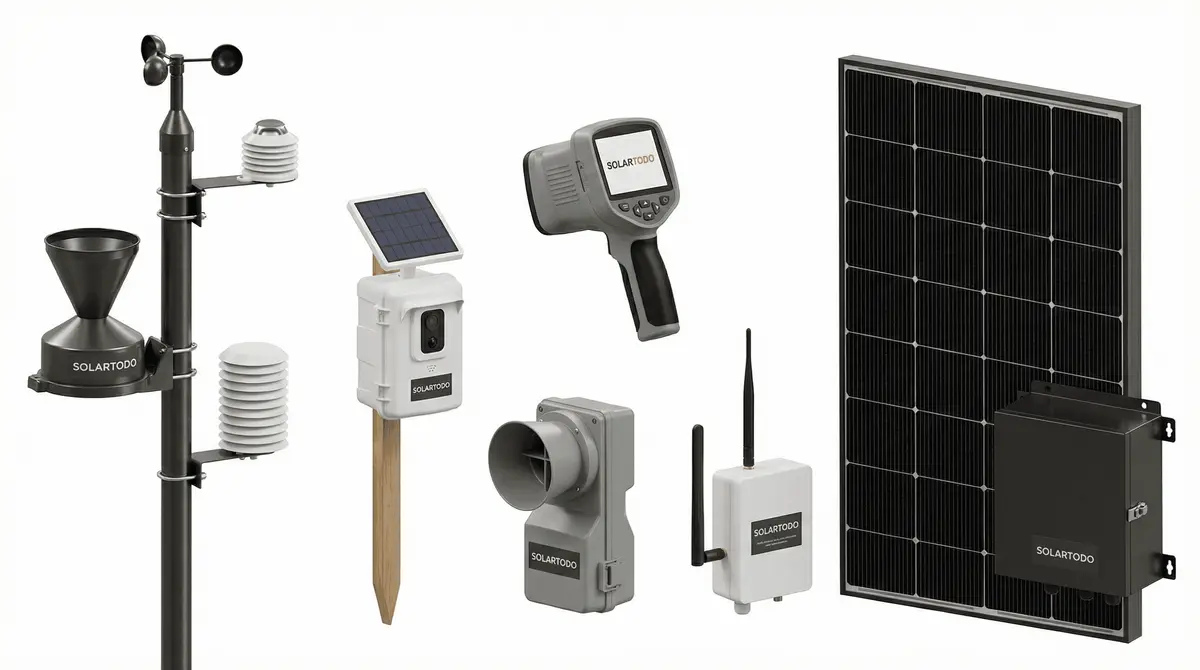
A commercial smart irrigation stack usually includes soil moisture probes, soil temperature sensors, a weather station, flow meters, pressure sensors, electric valves, a gateway, and cloud software. The most practical data interval for agriculture is often 10-30 minutes, because shorter intervals increase battery and bandwidth demand while daily intervals miss leak and stress events. In large fields, LoRaWAN commonly supports 2-15 km communication depending on topography, while 4G LTE is practical where zones are dispersed or existing telecom coverage is stable.
According to NREL (2024), solar-powered remote monitoring architectures can reduce field electrification complexity in distributed assets. That is relevant for irrigation because sensor nodes are often placed 100 m to 2,000 m from the nearest reliable power point. For B2B buyers, solar-powered field nodes with LFP battery support reduce trenching and speed deployment, especially across 30-50 ha blocks.
The International Electrotechnical Commission emphasizes that interoperable and safe field electronics matter in harsh environments. IEC-aligned design choices, IP67/IP68 enclosure practice, and ISO 11783 agricultural data interoperability are not marketing extras; they affect replacement rates, data continuity, and service cost over 3-7 years. According to Fraunhofer ISE (2024), digital optimization and high-resolution monitoring are increasingly part of bankable renewable and agricultural infrastructure decisions.
| System layer | Typical specification | ROI impact | Procurement note |
|---|---|---|---|
| Soil sensing | 4-20 probes per 30-50 ha | High | Add depth-specific probes for orchards |
| Weather station | 8-10 parameters | High | Needed for ET-based scheduling |
| Flow and pressure | 1-4 points per block | High | Detects leaks and clogged lines |
| Communications | LoRaWAN 2-15 km or 4G LTE | Medium | Match topology and coverage |
| Control | Valve automation by zone | Very high | Converts data into savings |
| Power | Solar node + LFP battery | Medium | Reduces cabling and downtime |
What buyers should specify in 2026 tenders
A 2026 irrigation tender should define at least 8 technical items: hectares covered, number of zones, 10-30 minute data interval, communication method, sensor depths, valve count, cloud retention period, and IP rating.
Buyers should also request calibration intervals, spare-parts list, API or export format, and alarm logic for leak, low pressure, and abnormal irrigation duration. If the project includes fertigation or water-quality control, specify EC, pH, and pump status points from the start. A weak specification often saves 5% on capex and loses 15-20% on realized ROI.
EPC Investment Analysis and Pricing Structure
EPC irrigation delivery usually improves execution certainty on projects above 30 ha, while typical smart irrigation payback remains 2-6 years depending on crop value, water cost, and automation depth.
For B2B procurement, three commercial models are common. FOB Supply covers hardware only and suits buyers with local installers and in-house agronomy teams. CIF Delivered adds international freight and import planning, which reduces logistics uncertainty but still leaves installation and commissioning to the buyer. EPC Turnkey includes engineering, procurement, construction, field installation, commissioning, training, and handover documentation.
A practical EPC scope should include hydraulic zoning review, sensor layout, gateway placement, controller programming, cloud onboarding, acceptance testing, and operator training. On projects above 30-50 ha, turnkey delivery often reduces commissioning delays by 2-6 weeks compared with split-package procurement. That time gain matters in seasonal crops where a missed irrigation window can erase the first-year savings case.
Indicative commercial guidance for SOLAR TODO and similar B2B supply structures is as follows:
- FOB Supply: lowest upfront cost, buyer manages local installation and testing
- CIF Delivered: hardware plus freight and shipping coordination
- EPC Turnkey: full delivery including installation, commissioning, and training
- Volume pricing guidance: 50+ units = 5% discount, 100+ units = 10%, 250+ units = 15%
- Payment terms: 30% T/T + 70% against B/L, or 100% L/C at sight
- Financing: available for large projects above $1,000K
- Commercial contact: [email protected]
| Commercial model | What is included | Relative cost | Best fit |
|---|---|---|---|
| FOB Supply | Hardware, standard documentation | 1.00x | Experienced local EPC or distributor |
| CIF Delivered | Hardware, freight, shipping coordination | 1.08-1.18x | Importers needing logistics certainty |
| EPC Turnkey | Design, supply, installation, testing, training | 1.20-1.45x | Farms, estates, and public projects |
ROI should be modeled against conventional irrigation using four inputs: annual water cost, annual pumping energy cost, labor hours, and crop-value uplift. Sample deployment scenario (illustrative): a 40 ha orchard spending $28,000 per year on water and pumping that cuts water use by 30% and energy by 18% could save about $10,000-$12,000 annually before quality gains. If installed cost is $35,000-$48,000, simple payback is about 3.2-4.5 years.
SOLAR TODO should be evaluated as a project supplier rather than an online marketplace. The normal process is inquiry, offline quotation, technical review, and financing discussion where applicable. For multi-country buyers in Latin America, the Middle East, Africa, Southeast Asia, and Europe, that structure is often better aligned with tender compliance and project documentation.
Buyer Selection Guide by Application
The best smart irrigation configuration depends on crop value, field size, and water risk, with 30-50 ha projects usually requiring multi-zone control, 10-minute data intervals, and at least 1 weather station.
For orchards, prioritize multi-depth soil probes, frost-linked weather data, and zone-level valve control. For tea and sloped plantations, prioritize distributed sensing across elevation bands and disease-linked moisture monitoring. For desert reclamation and weak-grid projects, prioritize solar-powered nodes, water-quality monitoring, and 4G LTE or dual-gateway redundancy.
A practical shortlist should compare five items: hectares per gateway, number of sensing points, supported alerts, cloud tier, and expansion path. If the system cannot scale from 10 to 20 sensing points or from one block to four zones, the second-phase capex often becomes inefficient. According to Wood Mackenzie and digital infrastructure procurement practice, scalability and serviceability are often more important than the cheapest initial BOM.
SOLAR TODO has relevant packaged references within smart agriculture: 40 ha orchard frost and irrigation-related monitoring, 30 ha tea precision monitoring, and 50 ha desert reclamation with solar PV and automated drip irrigation. Those package sizes give buyers a starting point for specification alignment, even when the final tender requires customization by crop, zone count, and communications method.
FAQ
Smart irrigation buyers usually ask about water savings, payback, sensor count, communications, and EPC scope, and the short answers below cover the 2026 numbers most often used in procurement reviews.
Q: What ROI can a smart irrigation system deliver in 2026? A: Most commercial projects deliver simple payback in 2-6 years. High-value crops such as orchards, vineyards, and vegetables often reach 2-4 years, while row crops may need 4-7 years because margin per hectare is lower and sensor cost is spread over larger areas.
Q: How much water can smart irrigation actually save by crop type? A: Water savings commonly range from 10% to 50% depending on crop and baseline practice. Orchards and desert reclamation projects often achieve 25-50%, vegetables 20-35%, tea 15-30%, and row crops 10-25% when moving from calendar irrigation to sensor-led control.
Q: Which sensors are essential for a commercial irrigation ROI project? A: The minimum practical set is soil moisture, weather, and flow monitoring. Projects that add pressure sensing and automatic valves usually perform better because they can detect leaks, clogged lines, and overrun events that a dashboard alone cannot correct.
Q: Is LoRaWAN or 4G LTE better for agricultural irrigation monitoring? A: LoRaWAN is usually better for compact farms where 2-15 km coverage is practical and battery life matters. 4G LTE is often better for dispersed sites, multi-block estates, or projects above 50 ha where direct backhaul and simpler network architecture are preferred.
Q: What is included in EPC turnkey delivery for smart irrigation? A: EPC turnkey normally includes engineering review, procurement, field installation, controller setup, commissioning, testing, and operator training. Compared with hardware-only supply, it usually reduces coordination risk and can shorten deployment by 2-6 weeks on multi-zone agricultural projects.
Q: How should buyers compare FOB, CIF, and EPC pricing? A: FOB is lowest upfront but leaves installation and testing to the buyer. CIF adds freight certainty, while EPC turnkey includes installation and commissioning at roughly 1.20x to 1.45x hardware-only cost, often improving first-season performance and reducing rework risk.
Q: What payment terms are common for B2B irrigation projects? A: Standard export terms are often 30% T/T in advance and 70% against B/L, or 100% L/C at sight. For larger projects above $1,000K, financing may be available subject to project review, buyer profile, and delivery scope.
Q: How many sensing points are needed for 30-50 hectares? A: A practical starting range is 8-20 sensing points depending on crop variability and zone count. Uniform flat fields need fewer points, while orchards, tea slopes, and desert reclamation sites usually need denser placement to capture moisture and microclimate differences.
Q: How often should a smart irrigation system be maintained? A: Most systems should be checked every 6-12 months, with seasonal calibration before peak irrigation periods. Skipping maintenance can reduce realized savings by 5-12% because probe drift, valve faults, and emitter blockage distort the control logic.
Q: Can smart irrigation work with solar-powered agriculture projects? A: Yes, and the economics are often stronger in weak-grid or off-grid areas. Solar-powered nodes reduce trenching cost, and solar pumping combined with digital scheduling can lower both water and energy opex, especially in desert or remote agricultural blocks.
Q: What standards and data practices should procurement teams request? A: Ask for IP67/IP68 outdoor protection practice, ISO 11783 interoperability where relevant, and clear documentation for communications, calibration, and data export. For electrical integration, buyers should also review local grid, low-voltage, and control-panel compliance requirements before award.
Q: How do I start a project with SOLAR TODO? A: Start with a field brief covering crop type, hectares, irrigation method, water source, and number of zones. SOLAR TODO typically works through inquiry, offline quotation, technical clarification, and financing discussion where applicable, rather than online checkout.
References
- FAO (2024): Global agricultural water use and irrigation productivity datasets showing agriculture at about 70% of freshwater withdrawals.
- IEA (2024): Energy system digitalization and efficiency insights relevant to agricultural pumping and remote monitoring.
- IRENA (2024): Renewable-powered agriculture and water system economics, including solar-enabled operating cost reductions.
- NREL (2024): Remote energy and monitoring system design guidance relevant to solar-powered field instrumentation.
- Fraunhofer ISE (2024): Monitoring, digital optimization, and renewable system performance analysis for infrastructure projects.
- ISO 11783 (2023): Agricultural electronics and data communication framework for interoperability.
- Wood Mackenzie (2024): Energy and infrastructure procurement analysis relevant to digital field asset scalability and serviceability.
- WMO (2023): Weather observation guidance applicable to agricultural weather station deployment and data quality.
Conclusion
Smart irrigation in 2026 delivers the best ROI where water costs, crop value, and pumping energy are all visible, with 20-50% water savings and 2-6 year payback across most commercial applications.
For orchards, tea estates, and desert reclamation projects above 30 ha, SOLAR TODO-style multi-sensor systems with 10-minute data, LoRaWAN or 4G LTE, and EPC delivery can improve first-season execution and produce a stronger total-cost outcome than timer-based irrigation alone.
About SOLARTODO
SOLARTODO is a global integrated solution provider specializing in solar power generation systems, energy-storage products, smart street-lighting and solar street-lighting, intelligent security & IoT linkage systems, power transmission towers, telecom communication towers, and smart-agriculture solutions for worldwide B2B customers.
Further Reading
Procurement paths
About the Author

SOLARTODO Editorial Team
Solar Energy & Infrastructure Expert Team
SOLAR TODO is a professional supplier of solar energy, energy storage, smart lighting, smart agriculture, security systems, communication towers, and power tower equipment.
Our technical team has over 15 years of experience in renewable energy and infrastructure, providing high-quality products and solutions to B2B customers worldwide.
Expertise: PV system design, energy storage optimization, smart lighting integration, smart agriculture monitoring, security system integration, communication and power tower supply.
Cite This Article
SOLARTODO Editorial Team. (2026). Smart Irrigation System ROI Report 2026: Water Savings…. SOLARTODO. Retrieved from https://solartodo.com/knowledge/smart-irrigation-system-roi-report-2026-water-savings-data-by-crop-type-global
@article{solartodo_smart_irrigation_system_roi_report_2026_water_savings_data_by_crop_type_global,
  title = {Smart Irrigation System ROI Report 2026: Water Savings…},
  author = {SOLARTODO Editorial Team},
  journal = {SOLARTODO Knowledge Base},
  year = {2026},
  url = {https://solartodo.com/knowledge/smart-irrigation-system-roi-report-2026-water-savings-data-by-crop-type-global},
  note = {Accessed: 2026-10-15}
}
Published: July 5, 2026 | Available at: https://solartodo.com/knowledge/smart-irrigation-system-roi-report-2026-water-savings-data-by-crop-type-global
Subscribe to Our Newsletter
Get the latest solar energy news and insights delivered to your inbox.
View All Articles