Smart City Lighting Standards and Certifications: A…

Cinn Song
Founder & Chief Solutions Architect
Watch the video
TL;DR
Smart city lighting procurement should be based on verified standards, not wattage or visual design. Require IEC 60598, IEC 62722, EN 13201, IP66, IK08-IK10, 120-150W LED output at about 170 lm/W, and clear FOB/CIF/EPC pricing. For 50-250+ pole deployments, this improves compliance, lifecycle cost control, and ROI.
Smart city lighting procurement should require IEC 60598, IEC 62722, EN 13201, IP66, IK08-IK10, 136+ lm/W efficacy, and documented EPC pricing to reduce compliance risk, energy use, and lifecycle cost over 25 years.
Summary
Smart city lighting procurement should require IEC 60598, IEC 62722, EN 13201, IP66, IK08-IK10, 136+ lm/W efficacy, and documented EPC pricing to reduce compliance risk, energy use, and lifecycle cost over 25 years.
Key Takeaways
- Require IEC 60598 and IEC 62722 compliance for every LED luminaire to verify safety, performance, and 100,000-hour L70 claims.
- Specify EN 13201 lighting calculations with 25-30 lux and Uo >=0.40 targets for two-lane urban roads and campus corridors.
- Verify IP66 ingress protection and IK08-IK10 impact ratings before approving smart poles for coastal, desert, or high-vandalism sites.
- Compare FOB, CIF, and EPC turnkey offers across 50, 100, and 250+ pole quantities to capture 5%, 10%, and 15% volume discounts.
- Model LED retrofit savings against legacy sodium systems, where 120-150W LEDs can reduce lighting energy use by 20%-35%.
- Audit cybersecurity, camera privacy, and data retention rules before activating 4K AI video, face recognition, WiFi 6, or LoRaWAN modules.
- Select 10m multifunction poles with 120-150W LED output, 150 km/h wind design, and IP66 access cabinets for municipal-scale reliability.
- Include 12-18 month maintenance inspections and spare driver inventories to protect 25-year asset performance and warranty claims.
Why Smart City Lighting Standards Matter in Procurement
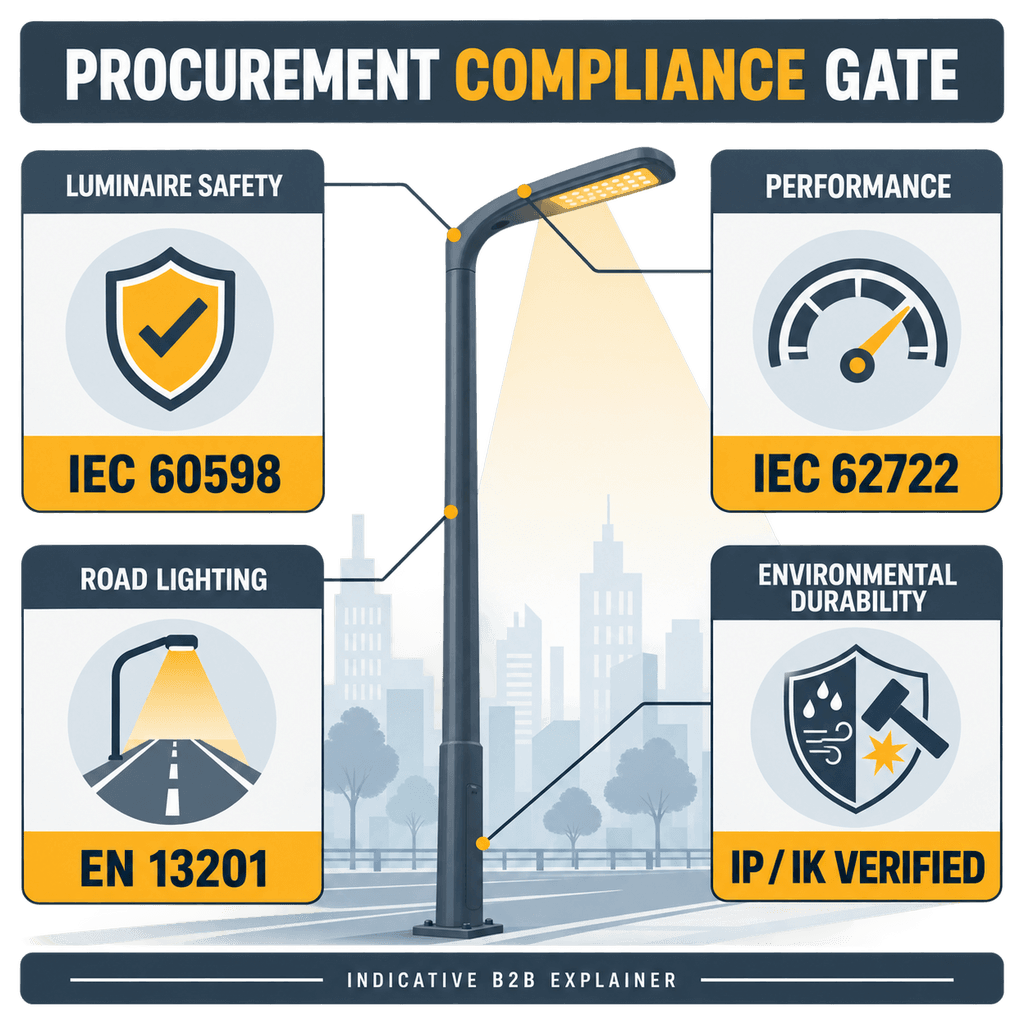
Smart city lighting standards convert a 10m pole purchase into a 25-year infrastructure decision covering safety, lighting quality, connectivity, and lifecycle risk.
For B2B buyers, the main procurement error is treating smart lighting as a fixture order instead of a standards-controlled infrastructure package. A smart pole may combine LED illumination, surveillance, WiFi, emergency audio, environmental sensors, edge computing, and power distribution on one foundation. If the tender does not define standards, test reports, warranty evidence, and acceptance criteria, the buyer receives a price but not a controlled engineering outcome.
According to the IEA (2026), lighting in buildings and outdoor applications represented about 8% of global electricity demand in 2024, equal to roughly 2,200 TWh. The same IEA commentary states, "LEDs sold today average close to 100 lm/W," while professional products can exceed 200 lm/W. That gap is why procurement teams must specify measured luminaire efficacy, optical distribution, dimming controls, and maintenance factors instead of relying on nominal wattage.
For SOLARTODO smart streetlight projects, standards are also a supplier qualification tool. Municipal buyers in Latin America, the Middle East, Africa, Southeast Asia, and Europe often compare products from several factories with similar visual designs. Certification documents separate an export-ready smart lighting system from a prototype assembled from unrelated modules.
A compliant procurement package should define:
- Luminaire safety and performance standards.
- Roadway lighting design class and photometric files.
- Pole structural design, wind load, foundation assumptions, and corrosion protection.
- Ingress, impact, electrical protection, surge protection, and grounding.
- Communications, cybersecurity, video surveillance, and data privacy responsibilities.
- Factory acceptance testing, site acceptance testing, warranty, spare parts, and training.
Core Standards and Certification Checklist
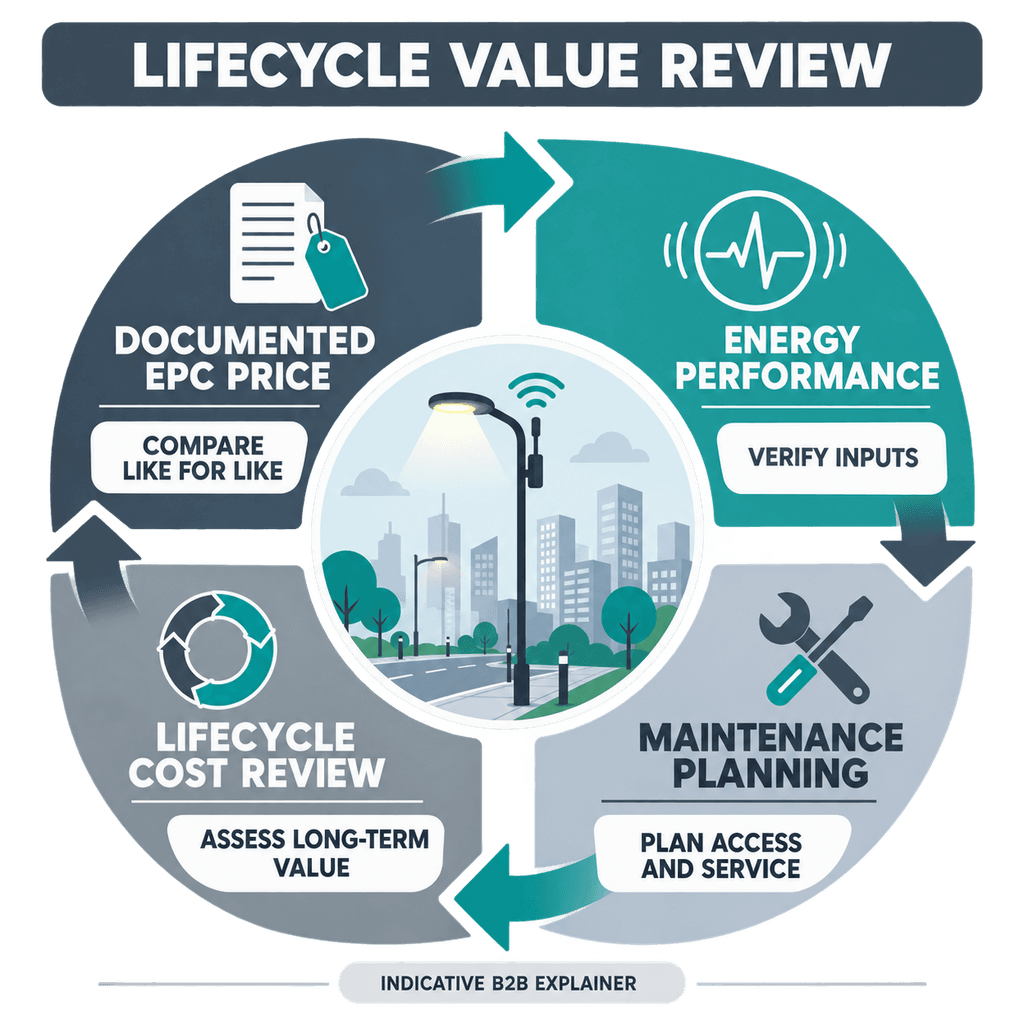
A compliant smart lighting tender should reference at least 6 standard families: IEC luminaires, EN road lighting, IES photometry, IP/IK protection, EMC, and structural codes.
The most important baseline is IEC 60598 for luminaire safety. It addresses construction, electrical insulation, protection against electric shock, thermal behavior, and marking. For LED performance, IEC 62722 helps buyers evaluate output, power, lifetime, and performance claims. For roadway performance, EN 13201 defines lighting classes, luminance or illuminance targets, uniformity, glare, and calculation methods.
In North American or export projects, IES LM-79 and IES LM-80 are frequently requested. According to the U.S. Department of Energy FEMP exterior lighting guidance updated in 2023, outdoor pole or arm-mounted area and roadway luminaires should meet at least 136 lm/W luminaire efficacy rating for federal procurement. That benchmark gives EPC teams a practical minimum when comparing 120W and 150W smart streetlight luminaires.
SOLARTODO typically positions the 10m Community Entrance Security+Face Recognition model as a 4-in-1 platform with 1 x 120W LED luminaire, AI face recognition camera, emergency call module, and WiFi access point. The larger 10m Smart City 5-in-1 Standard adds broader smart city functions, typically including 150W LED lighting, 4K AI PTZ surveillance, environmental monitoring, wireless connectivity, and public address.
| Procurement Area | Standard or Rating | What Buyers Should Require | Typical Target |
|---|---|---|---|
| Luminaire safety | IEC 60598 | Test certificate, label, wiring, insulation, thermal protection | Mandatory |
| LED performance | IEC 62722 | Rated power, lumen output, CCT, CRI, lifetime evidence | 120-150W, 170 lm/W |
| Road lighting | EN 13201 | Dialux or equivalent calculation, maintenance factor, uniformity | 25-30 lux, Uo >=0.40 |
| Photometry | IES LM-79 | Independent photometric and electrical test report | Full luminaire test |
| Lumen maintenance | IES LM-80 / TM-21 | LED package data and lifetime projection | L70 up to 100,000 h |
| Ingress protection | IEC 60529 | IP test report for luminaire and cabinet | IP66 preferred |
| Impact resistance | IEC 62262 | IK rating for lens, camera, and cabinet | IK08-IK10 |
| Surveillance | IEC 62676-1 | Video system performance and security use framework | 4K, IR 50m where needed |
Documentation Buyers Should Request
For each bidder, request original or traceable copies of certificates, test reports, declarations of conformity, ISO 9001 manufacturing evidence, and product serial traceability. A certificate without model numbers, test date, issuing laboratory, or standard revision should not be accepted as proof.
For LED luminaires, ask for IES files, LM-79 reports, driver datasheets, surge protection rating, dimming protocol, and thermal test evidence. For poles, require structural drawings, steel grade, wall thickness, galvanization thickness, anchor bolt specification, foundation load assumptions, and wind zone assumptions.
For SOLARTODO 10m smart pole tenders, buyers commonly specify Q345B steel, 3-6mm wall thickness depending on wind loading, hot-dip galvanization, IP66 access doors, and wind resistance around 150 km/h. The final structural design should still be checked against local soil and wind codes before installation.
Technical Requirements for Smart Pole Systems
A smart city lighting system should be specified as a coordinated 5-layer asset: structure, power, lighting, communications, and digital services.
The structural layer carries the physical load. A 10m multifunction pole must support the luminaire arm, camera, WiFi antenna, speaker, sensor package, internal cabling, and service access cabinet without unacceptable deflection or vibration. Wind design is especially important for coastal, desert-edge, and typhoon-prone regions. A nominal 150 km/h wind rating is useful for comparison, but the foundation design must match local soil bearing capacity and return-period wind criteria.
The power layer includes incoming AC supply, protective breakers, surge protection, grounding, driver compartment, and power distribution to each smart module. In grid-powered systems, the buyer should require isolation between lighting circuits, camera equipment, network devices, and emergency call equipment. For solar-hybrid variants, the tender must also define PV module power, battery chemistry, usable capacity, autonomy days, charge controller, and battery enclosure temperature limits.
The lighting layer must be designed around delivered road performance, not wattage. A 120W luminaire at 170 lm/W produces about 20,400 lumens, while a 150W luminaire at the same efficacy produces about 25,500 lumens. In entrance roads and pedestrian checkpoints, uniformity and glare control are more important than maximum brightness. In boulevard or arterial applications, pole spacing, mounting height, arm length, tilt angle, and optical distribution decide whether the system meets EN 13201.
The communications layer should specify fiber, Ethernet, 4G/5G, LoRaWAN, WiFi 6, or hybrid architecture. If sensors report every 1 minute, bandwidth needs are low; if 4K video streams continuously, uplink capacity and storage policy become major cost drivers. Edge analytics can reduce upstream video load, but procurement teams should request cybersecurity architecture, firmware update policy, and user access controls.
The digital services layer includes dashboard, lighting control, fault alarms, video management, environmental data, public address, API integration, and reporting. Buyers should define whether the control system is cloud-hosted, locally hosted, or hybrid. They should also define who owns the data, how long video is retained, and what happens if subscription services are not renewed.
EPC Investment Analysis and Pricing Structure
EPC pricing should separate FOB supply, CIF delivered, and turnkey installation so buyers can compare 50, 100, and 250+ pole projects accurately.
For smart city lighting, EPC means Engineering, Procurement, and Construction. Engineering includes site survey, lighting simulation, pole layout, foundation drawings, electrical single-line diagrams, communication architecture, and acceptance criteria. Procurement includes poles, luminaires, cameras, sensors, cabinets, network devices, spare parts, packaging, and shipping. Construction includes foundations, trenching, cabling, pole erection, module installation, testing, commissioning, and training.
SOLARTODO is a B2B manufacturer and exporter, not an online marketplace. The normal process is inquiry, technical review, offline quotation, and project financing discussion when applicable. For procurement teams, this is important because a 10m smart pole is rarely a one-price commodity; pricing depends on module mix, steel design, certification package, camera specification, software scope, shipping route, civil works, and local installation labor.
| Pricing Tier | Included Scope | Buyer Use Case | Budget Guidance |
|---|---|---|---|
| FOB Supply | Factory supply, export packing, factory documents | Buyer controls freight and installation | Lowest landed quotation base |
| CIF Delivered | FOB scope plus ocean freight and insurance to destination port | Buyer wants predictable import budget | Adds route-based freight cost |
| EPC Turnkey | Equipment, freight, installation, commissioning, training | Municipality or developer wants one delivery contract | Highest scope, lowest interface risk |
For volume planning, use 50+ poles as the first project discount threshold, typically around 5% where configuration is standardized. At 100+ poles, procurement teams can target about 10% reduction through production batching and logistics consolidation. At 250+ poles, a 15% project discount may be achievable when drawings, module BOM, packaging, and payment schedule are frozen early.
Payment terms typically follow 30% T/T deposit plus 70% against bill of lading, or 100% letter of credit at sight for approved projects. Financing may be available for large projects above $1,000K, especially where municipal buyers or developers require phased deployment. For EPC pricing, warranty, and financing review, contact [email protected].
ROI depends on what the smart pole replaces. A 4-in-1 entrance pole can consolidate lighting, surveillance, emergency call, and WiFi into one foundation, often reducing civil works and maintenance interfaces by 25%-40%. Compared with legacy high-pressure sodium lighting, 120W LED systems can reduce lighting energy use by approximately 20%-35% while improving color rendering for security cameras. The U.S. Department of Energy states, "LEDs offer the potential" to cut general lighting energy use nearly in half by 2030, which supports using LED and controls as a long-term operating-cost strategy.
According to IRENA (2025), utility-scale solar PV reached USD 0.043/kWh global weighted average LCOE in 2024, and battery storage costs fell 93% from 2010 to 2024. For solar-hybrid smart lighting corridors, those trends improve the business case for adding PV and storage where grid extension is expensive or unreliable.
Selection Guide for B2B Buyers
Procurement teams should score smart lighting bids with a 100-point matrix covering standards, lifecycle cost, technical fit, delivery risk, and support.
A standards-first scoring model prevents low-cost offers from winning with missing compliance evidence. For public projects, assign at least 25 points to standards and certificates, 25 points to technical performance, 20 points to lifecycle cost, 15 points to delivery capability, and 15 points to after-sales support. The cheapest bid should not win if it lacks photometric files, structural calculations, surge protection details, or warranty terms.
For community entrances, prioritize 10m poles, 120W LED lighting, face recognition options, emergency call modules, and secure WiFi for 5-20 operational devices. For municipal boulevards, prioritize 150W lighting, 35m spacing assumptions, 4K PTZ cameras, environmental sensing, public address, and centralized control. For campuses and industrial parks, prioritize modular maintenance, API integration, cybersecurity, and spare parts.
Before award, require a sample approval process. The supplier should provide drawings, data sheets, certificates, and a factory acceptance test plan. For projects above 100 poles, buyers should also request packing mockups, installation manuals, spare driver and sensor lists, and a commissioning checklist. SOLARTODO can support this process through technical pre-sales review and project-specific quotation rather than shopping-cart pricing.
FAQ
A 10-question FAQ helps buyers resolve standards, cost, installation, warranty, maintenance, cybersecurity, and EPC questions before issuing a smart lighting tender.
Q: What standards should a smart city lighting tender require first? A: Start with IEC 60598 for luminaire safety, IEC 62722 for LED performance, EN 13201 for road lighting design, and IEC 60529 for IP ratings. Add IES LM-79, LM-80, IK impact ratings, structural wind design, EMC compliance, and IEC 62676-1 when surveillance cameras are included.
Q: Why is EN 13201 important for street lighting procurement? A: EN 13201 helps define lighting classes, illuminance or luminance levels, uniformity, glare control, and calculation methods. It prevents procurement based only on wattage. For a 10m smart pole, buyers can require simulation evidence for 25-30 lux average illuminance and Uo >=0.40 where the road class supports it.
Q: What IP and IK ratings are suitable for outdoor smart poles? A: IP66 is a strong default for luminaires, access cabinets, and exposed electrical compartments because it covers dust-tight protection and powerful water jets. IK08 is common for luminaire lenses, while IK10 is preferred for cameras or cabinets in vandalism-prone public areas, transport hubs, and community entrances.
Q: How should buyers compare 120W and 150W LED smart streetlights? A: Compare delivered lumens, optical distribution, spacing, uniformity, glare, and thermal performance, not wattage alone. At 170 lm/W, a 120W luminaire produces about 20,400 lumens, while a 150W luminaire produces about 25,500 lumens. The better option depends on road width, mounting height, pole spacing, and safety requirements.
Q: What does EPC turnkey delivery include for smart city lighting? A: EPC turnkey delivery typically includes engineering design, lighting simulation, procurement, freight coordination, foundations, trenching, cabling, pole erection, commissioning, and training. It also assigns one delivery party for installation quality and schedule. Buyers should still define exclusions such as permits, grid connection fees, taxes, and civil remediation.
Q: How much discount is realistic for volume smart pole procurement? A: As planning guidance, 50+ poles may qualify for about 5% discount, 100+ poles for about 10%, and 250+ poles for about 15%. Final pricing depends on module configuration, steel design, certifications, freight route, payment terms, and whether the quote is FOB, CIF, or EPC turnkey.
Q: What payment terms are common for SOLARTODO smart lighting projects? A: Common export payment terms are 30% T/T deposit and 70% against bill of lading, or 100% L/C at sight for approved buyers. Large projects above $1,000K may qualify for financing discussion. Procurement teams should confirm warranty, Incoterms, delivery schedule, and commissioning responsibilities before contract award.
Q: How often should smart streetlights be maintained? A: A practical maintenance plan includes visual inspection, electrical testing, camera cleaning, cabinet check, firmware review, and fault log review every 12-18 months. High-dust, coastal, or high-traffic locations may require shorter intervals. Buyers should keep spare drivers, surge protectors, sensor modules, and cabinet locks for faster repairs.
Q: Are face recognition cameras always appropriate for smart poles? A: Face recognition should be deployed only where local privacy, consent, retention, and access-control rules permit it. Many projects can configure cameras for 1:1 verification, 1:N matching, or standard video analytics without identity matching. Tender documents should define data retention, operator permissions, cybersecurity controls, and audit logs.
Q: When should a buyer choose solar-hybrid smart streetlights? A: Solar-hybrid smart streetlights are useful where grid extension is costly, outage risk is high, or sustainability targets require renewable supply. Buyers must size PV modules, battery capacity, autonomy days, and load profiles carefully. Video, WiFi, and sensor modules increase daily energy demand, so battery sizing should be project-specific.
Conclusion
Smart city lighting procurement succeeds when buyers combine 6+ standards, verified test reports, EPC pricing discipline, and 25-year lifecycle planning into one tender.
The bottom line: a SOLARTODO smart city lighting project should require IEC 60598, IEC 62722, EN 13201, IP66, IK08-IK10, 120-150W LED output, and clear FOB/CIF/EPC pricing before award. For 50-250+ pole deployments, this approach reduces compliance risk, improves ROI, and gives procurement teams a defensible basis for technical comparison.
References
- IEA (2026): The next wave of LED lighting; reports 2024 lighting electricity demand of about 2,200 TWh and LED efficacy context. https://www.iea.org/commentaries/the-next-wave-of-led-lighting-smarter-circular-and-more-efficient — https://www.iea.org/reports/world-energy-outlook-2024
- IRENA (2025): Renewable Power Generation Costs in 2024; reports USD 0.043/kWh solar PV LCOE and 93% battery storage cost decline from 2010 to 2024. https://www.irena.org/Publications/2025/Jun/Renewable-Power-Generation-Costs-in-2024 — https://www.irena.org/Data/View-data-by-topic/Capacity-and-Generation
- IEC 60598-1 (2024): Luminaires general requirements and tests for electrical, thermal, marking, construction, and protection requirements. — https://webstore.iec.ch/
- IEC 62722-2-1 (2023): Particular performance requirements for LED luminaires, used to evaluate LED output, power, and rated performance claims. — https://webstore.iec.ch/
- IEC 62676-1-1 (2022): Video surveillance systems for use in security applications, relevant when smart poles include cameras or analytics. — https://webstore.iec.ch/ These 8 references support smart lighting procurement decisions across LED performance, road lighting, safety, energy savings, renewable cost, and surveillance standards.
- IEA (2026): The next wave of LED lighting, reporting 2024 lighting electricity demand of about 2,200 TWh and LED efficacy context.
- U.S. Department of Energy FEMP (2023): Purchasing Energy-Efficient Exterior Lighting, including 136 lm/W minimum LER guidance for roadway luminaires.
- U.S. Department of Energy (2020): LED Adoption Report, estimating USD 14.7 billion annual U.S. consumer cost savings from LED adoption in 2018.
- IRENA (2025): Renewable Power Generation Costs in 2024, reporting USD 0.043/kWh solar PV LCOE and 93% battery storage cost decline from 2010 to 2024.
- IEC 60598-1 (2024): Luminaires general requirements and tests for electrical, thermal, marking, construction, and protection requirements.
- IEC 62722-2-1 (2023): Particular performance requirements for LED luminaires, used to evaluate LED output, power, and rated performance claims.
- EN 13201-2 (2015): Road lighting performance requirements covering lighting classes, luminance, illuminance, glare, and uniformity criteria.
- IEC 62676-1-1 (2022): Video surveillance systems for use in security applications, relevant when smart poles include cameras or analytics.
About SOLARTODO
SOLARTODO is a global integrated solution provider specializing in solar power generation systems, energy-storage products, smart street-lighting and solar street-lighting, intelligent security & IoT linkage systems, power transmission towers, telecom communication towers, and smart-agriculture solutions for worldwide B2B customers.
About the Author

Cinn Song
Founder & Chief Solutions Architect
Cinn Song founded SOLARTODO LIMITED and leads its smart-city infrastructure engineering — from solar, storage and integrated smart poles to the company's push into physical-AI city edge nodes: pole-mounted edge computing, vertical LLMs for smart cities, drone-based O&M with autonomous battery swapping, robotic maintenance, and high-speed counter-UAS interception. Since 2010, he has directed turnkey EPC + BOT delivery across 50+ countries, including telecom monopole supply for national grid operators, off-grid solar street-lighting for African municipalities, and integrated smart-pole programs for Gulf smart cities.
Cite This Article
Cinn Song. (2026). Smart City Lighting Standards and Certifications: A…. SOLARTODO. Retrieved from https://solartodo.com/knowledge/smart-city-lighting-standards-and-certifications-a-procurement-guide
@article{solartodo_smart_city_lighting_standards_and_certifications_a_procurement_guide,
  title = {Smart City Lighting Standards and Certifications: A…},
  author = {Cinn Song},
  journal = {SOLARTODO Knowledge Base},
  year = {2026},
  url = {https://solartodo.com/knowledge/smart-city-lighting-standards-and-certifications-a-procurement-guide},
  note = {Accessed: 2026-10-14}
}
Published: August 25, 2026 | Available at: https://solartodo.com/knowledge/smart-city-lighting-standards-and-certifications-a-procurement-guide
Subscribe to Our Newsletter
Get the latest solar energy news and insights delivered to your inbox.
View All Articles